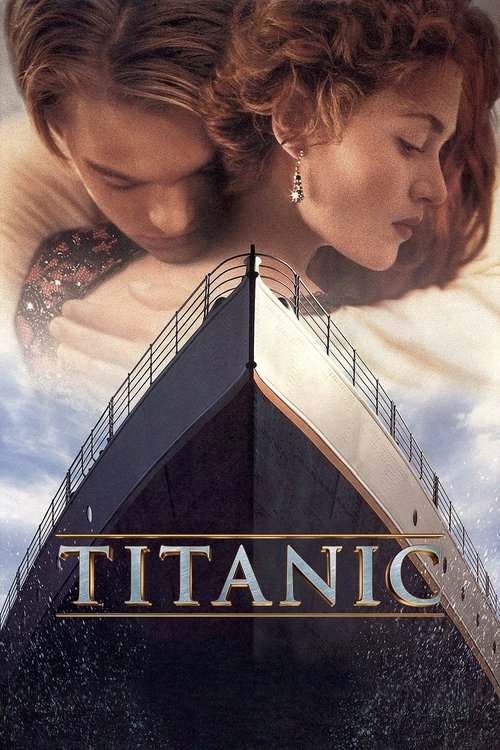
Titanic
1997 · James Cameron
Perpetually doubted, perpetually vindicated: Avatar: The Way of Water's $2.3B silenced "no cultural footprint" jokes without ever quite ending them. His pronouncements on AI, streaming, and running times are treated as oracle statements.
For when you want the big one — a grand, unashamedly emotional epic for a long night in, ideally with tissues and someone to watch it with. Pure comfort-epic, even with the heartbreak baked in.
What it's about
In 1912, a young society woman trapped by her engagement and her family's expectations boards the grandest ocean liner ever built. In steerage, a penniless artist has just won his ticket in a card game. Their collision — a forbidden romance across the ship's rigid class lines — unfolds while the Titanic steams toward the iceberg everyone watching already knows is coming, framed by the elderly Rose telling her story 84 years later.
The experience
A full three-hour surrender: swooning romance in the first half, white-knuckle disaster in the second, engineered to make you cry whether you want to or not. It earns its sweep — you feel the ship's scale, then feel it come apart.
Performances
Leonardo DiCaprio and Kate Winslet generate the kind of chemistry entire genres chase — his easy charm and her fierce restlessness make a simple love story feel like life or death; Kathy Bates brings warmth and wit as the unsinkable new-money passenger.
The craft
Cameron rebuilt the ship at near-full scale and married that practical enormity to then-groundbreaking digital effects, so the sinking plays as terrifyingly physical rather than cartoonish. The production detail — costumes, staterooms, the tilt of the decks — is obsessive, and the score is instantly recognizable. This is the definition of a film that demands the biggest screen and loudest speakers you can find.
Why it matters
It became the highest-grossing film ever made and held the crown for twelve years, won eleven Academy Awards, and turned repeat viewing by young audiences into a box-office phenomenon — the modern blockbuster-romance template starts here.
Snapshot
Titanic is James Cameron's epic disaster-romance, a film that fused a fictional cross-class love story with a meticulous reconstruction of the 1912 sinking of the RMS Titanic. Built on a then-unprecedented budget that made it the most expensive film yet produced, it became the highest-grossing film in history upon release and held that title for twelve years until Cameron's own Avatar (2009) surpassed it. It won eleven Academy Awards, tying the record held by Ben-Hur (1959). The film is significant less for narrative innovation than for the scale of its production logistics, its marriage of practical large-scale construction with emerging digital effects, and its galvanizing of a vast youth and repeat-viewing audience that reshaped late-1990s box-office economics. It is also a study in how a director's obsessive control over physical and technological resources can produce both spectacle and, for many critics, a sincere, unironic emotional register that divided sophisticated opinion even as audiences embraced it.
Industry & production
Titanic was co-financed by Paramount Pictures and Twentieth Century Fox, an arrangement Cameron and producer Jon Landau negotiated when costs ballooned beyond a single studio's appetite for risk. Fox took international rights and Paramount domestic, with Paramount's contribution capped — a structure that famously left Fox absorbing most of the overruns and, ultimately, the windfall. The production became notorious during 1996–97 for cost overruns and schedule slippage; trade-press accounts widely reported a budget that climbed past $200 million, an extraordinary figure for the period, and Cameron is reported to have forgone part of his own fee and back-end participation when the studios grew anxious. The shoot centered on a purpose-built facility at Playas de Rosarito in Baja California, Mexico, constructed by Fox as what became Fox Baja Studios, anchored by a roughly 17-million-gallon exterior tank holding a near-full-scale exterior of the ship's starboard side mounted on hydraulic gimbals.
The release was delayed from a planned summer 1997 date to December 1997, fueling industry predictions of disaster. Those predictions inverted spectacularly: the film opened solidly and then exhibited the rare quality of sustained, growing weekly grosses through the winter and spring, driven heavily by repeat attendance, particularly among young women — a demographic pattern that the industry studied closely thereafter. The film's commercial performance, alongside its modern frame-story device and its soundtrack single, became a template that studios spent years trying to reverse-engineer.
Technology
The production sat at a hinge point between practical and digital filmmaking, and Cameron exploited both. Cameron's own visual-effects house, Digital Domain (which he co-founded), executed the bulk of the effects work, blending a large physical model of the ship with computer-generated water, smoke, and crowds. Among the period's notable advances was the use of motion-captured and digitally animated human figures populating the decks in wide shots — synthetic extras composited into scenes where staging thousands of real performers was impractical. The CG ocean and the seamless integration of miniature, full-scale set, and digital elements were widely cited as state-of-the-art for 1997.
Equally important was the deep-sea component. To photograph the real wreck on the North Atlantic seabed, Cameron mounted expeditions using Russian Mir submersibles and commissioned a specialized titanium-housed camera system capable of operating at the wreck's crushing depth, with custom remotely operated vehicles deployed inside the hull. This documentary impulse — to film the actual artifact — would recur across Cameron's later career and feed directly into his deep-ocean exploration work. The film thus combined cutting-edge digital compositing with genuine technological feats of underwater cinematography.
Technique
Cinematography
Russell Carpenter shot the film and won the Academy Award for Cinematography. The visual approach balances two registers: the warm, gilded, painterly luminosity of the ship's first-class interiors and the launch — evoking the period through soft, glowing light — and the cold, blue-black chaos of the sinking, where Carpenter and Cameron orchestrate vast, legible action across a tilting, flooding set. The challenge was maintaining spatial clarity during the prolonged third-act catastrophe, where the camera must track characters across a geography that is itself rotating and breaking apart. Carpenter's work is notable for its scale management — keeping foreground emotional beats readable amid effects-heavy wide shots — rather than for stylistic flourish.
Editing
Cameron co-edited with Conrad Buff and Richard A. Harris; the team won the Academy Award for Film Editing. The film's structure is ambitious in duration — well over three hours — and the editing's principal achievement is pacing a long first half of character and class exposition so that the disaster, when it comes, arrives with accumulated stakes. The sinking sequence is a sustained exercise in cross-cutting between intimate peril and macro-catastrophe, intercutting Jack and Rose's flight with the ship's structural collapse and the social cross-section of passengers and crew. The frame story — the elderly Rose and the present-day salvage expedition — bookends and periodically interrupts the 1912 narrative, a device that lets the film foreground memory and testimony.
Mise-en-scène / staging
The film's mise-en-scène is its most lavish dimension. The near-full-scale set, period-accurate appointments, costumes by Deborah Lynn Scott (an Oscar winner for the film), and densely populated decks create an immersive material reconstruction. Cameron's staging during the sinking is governed by physical accuracy: the ship floods and tilts in stages consistent with the historical timeline, and the choreography of bodies — passengers sliding down the rising stern, the stratified access of classes to the lifeboats — converts spectacle into a moral diagram of the disaster. The class architecture of the ship is staged spatially, with the camera repeatedly crossing thresholds between gilded saloons and the steerage decks.
Sound
The sound design of the sinking — groaning metal, rushing water, the percussion of collapse — earned the film Academy Awards for both Sound and Sound Effects Editing. The soundscape modulates from the genteel ambiences of the early shipboard scenes (the string ensemble, the murmur of the dining saloon) to the overwhelming sonic violence of the wreck. The contrast between order and catastrophe is carried substantially through sound.
Performance
Leonardo DiCaprio and Kate Winslet anchor the film as Jack Dawson and Rose DeWitt Bukater, their chemistry central to the film's appeal and to DiCaprio's transformation into a global star. Winslet's Rose carries the film's emotional and thematic arc — a young woman choosing self-determination over a suffocating marriage — and her performance earned an Academy Award nomination. Gloria Stuart's framing performance as the centenarian Rose grounds the romance in retrospection and earned a Supporting Actress nomination, making her one of the oldest acting nominees in Academy history. Billy Zane plays the fiancé Cal Hockley as a hissable embodiment of patrician control, and Kathy Bates and Frances Fisher fill out the social field.
Narrative & dramatic mode
Titanic operates in the melodramatic mode in its richest sense: a drama of heightened emotion, clear moral polarities, and social obstruction, in which private feeling collides with rigid class structure. The dramatic engine is the doomed romance across class lines, framed as a story of liberation — Rose's escape from an arranged marriage and a stifling femininity into authenticity and agency. The historical catastrophe functions as both literal climax and metaphor: the unsinkable ship's hubris mirrors the rigidity of the Edwardian order it carries. The frame narrative converts the whole into an act of remembrance and testimony, with the elderly Rose as narrator authorizing the story's emotional truth and culminating in the casting of the "Heart of the Ocean" diamond into the sea — a gesture privileging memory and love over material value. Cameron's mode is unabashedly sincere, eschewing irony in favor of mythic emotional directness, a choice critics either admired as classical or faulted as sentimental.
Genre & cycle
The film sits at the intersection of the disaster film and the historical romance. It draws on the disaster-movie cycle — including prior Titanic films such as A Night to Remember (1958) and Titanic (1953), and the 1970s Hollywood disaster wave (The Poseidon Adventure, The Towering Inferno) — while grafting onto it the sweep of the romantic epic in the tradition of Gone with the Wind (1939) and Doctor Zhivago (1965). Its commercial success helped reinvigorate the large-scale historical romance and the effects-driven event film as vehicles for prestige rather than purely genre product. The "Titanic" itself constitutes a durable micro-genre of its own, and Cameron's film became its definitive popular entry.
Authorship & method
Titanic is a pure expression of Cameron's authorship: he wrote, directed, co-edited, and co-produced it, exercising the comprehensive technical and logistical control that defines his career. His method fuses documentary rigor — the dives to the real wreck, the obsessive period and engineering research, the insistence on a near-full-scale physical ship — with maximalist spectacle and a populist emotional core. The pattern recurs across his filmography (The Abyss, Avatar): a marriage of frontier technology, water and immersion as recurring motifs, and a sincere, often unfashionable emotional sincerity.
His key collaborators here include cinematographer Russell Carpenter; editors Conrad Buff and Richard A. Harris; composer James Horner, whose lush orchestral-and-vocal score and the Celine Dion end-credits song "My Heart Will Go On" (written with lyricist Will Jennings) became one of the most commercially dominant film-music phenomena of the era, winning the Academy Award for Best Original Song and Best Original Score; costume designer Deborah Lynn Scott; and producer Jon Landau, Cameron's long-term producing partner. Horner's score, with its distinctive vocal motifs, is inseparable from the film's mass emotional reach.
Movement / national cinema
The film belongs to mainstream American studio cinema at its most globalized — the late-1990s Hollywood blockbuster as international event. It is not affiliated with an art movement; rather, it exemplifies the New Hollywood-descended, technology-driven tentpole tradition that Cameron, alongside figures like Spielberg and Lucas, helped define. Its production in Mexico and its reliance on a multinational financing and effects apparatus also mark it as a product of an increasingly transnational film industry, even as its sensibility is thoroughly Hollywood.
Era / period
Released in December 1997, Titanic arrived at the close of a decade in which digital effects were maturing (Jurassic Park, 1993) and the event film was consolidating its dominance. It depicts April 1912 with archaeological care, making the Edwardian transatlantic world — its class hierarchies, dress, technology, and confidence — a central subject rather than mere backdrop. The film thus joins two eras: the turn-of-the-century moment it reconstructs and the turn-of-the-millennium moment of its making, when Hollywood's capacity to simulate the past digitally was reaching a new threshold.
Themes
The film's governing themes are class and social mobility (the rigid stratification of the ship made literal in its decks and lifeboat access); the liberation of the self, especially female agency, against the constraints of inherited social roles; hubris and the limits of technological confidence, with the "unsinkable" ship as the central irony; love as transcendence and the dignity of choosing authenticity over security; and memory, testimony, and mortality, carried by the frame story and Rose's century-long act of remembrance. Mortality and survival — who lives, who is sacrificed, and along what lines of wealth and gender — give the spectacle its moral seriousness.
Reception, canon & influence
Critical reception was strong but not unanimous: many reviewers praised the film's technical command, scale, and emotional sweep, while a vocal minority faulted the dialogue and the romance as clichéd, drawing a now-familiar distinction between Cameron the spectacle engineer and Cameron the screenwriter. The Academy's response was emphatic — eleven Oscars including Best Picture and Best Director — and the film's cultural saturation, from the score to DiCaprio's stardom to endlessly quoted images, was total.
Influences on the film (backward): the prior Titanic films, above all A Night to Remember (1958), supplied dramatic and factual templates; the 1970s disaster cycle supplied genre architecture; and the Hollywood romantic epic (Gone with the Wind, Doctor Zhivago) supplied the model of private love against historical cataclysm. Cameron's own The Abyss (1989) prefigured its water-and-technology obsessions.
Legacy (forward): Titanic reset expectations for blockbuster budgets, marketing, and the economics of repeat viewership, demonstrating the commercial power of a young female audience and of the romance-within-spectacle formula. It accelerated the integration of digital crowd and environment effects into prestige filmmaking, cemented Digital Domain's reputation, and made DiCaprio and Winslet enduring stars (later reunited in Revolutionary Road). It directly enabled Cameron's subsequent Avatar, both financially and methodologically, and its deep-sea expeditions seeded his ongoing oceanographic work. The film's soundtrack reshaped the film-song market for years. Its 3-D theatrical reissue in 2012, timed to the sinking's centenary, confirmed its durability as a recurring cultural event. More than a financial landmark, it stands as the defining case study in how spectacle, sincerity, and technological ambition can converge into a global phenomenon.
A Deleuzian reading
A remotely operated vehicle noses down what used to be a first-class corridor.
The full Deleuzian reading of Titanic →
Reception
Pre-release, the press had it pegged as the most expensive flop in history — over budget, delayed, doomed. It became the biggest hit ever made, then spent the 2000s as the cool-to-hate movie, and has since been fully reappraised as peak blockbuster craftsmanship.
How Titanic was received, from release to now →
Influences: the films it descends from and the films it influenced
- A Night to Remember (1958) — Supplied the procedural, multi-deck cross-cutting template for staging the sinking in near-real-time, tracking the disaster simultaneously across class strata and crew stations — the documentary-accuracy spine Cameron rebuilt at scale.
- The Abyss (1989) — Cameron's own proving ground for tank-based underwater cinematography, water-as-effect, and the marriage of frontier digital imagery (the CGI water tentacle) with sincere emotion that he scaled up here.
- The Poseidon Adventure (1972) — Established the disaster-genre architecture of a doomed ship as a vertical labyrinth, with survival staged through inverted/flooding shipboard sets and an ensemble navigating physical space against rising water.
- The Towering Inferno (1974) — Codified the 1970s disaster-cycle blueprint of intercut survivor strands within a single collapsing megastructure, the large physical destruction set, and star-laden ensemble peril Cameron inherited.
- Gone with the Wind (1939) — Model for the roadshow romantic epic in which a private, class-crossing love affair is staged against historical cataclysm, with melodramatic sweep and length justified by spectacle.
- Doctor Zhivago (1965) — Lean's template of a retrospective frame narration and a doomed romance dwarfed by historical upheaval, with lush leitmotif scoring (Lara's Theme) anticipating Horner's vocal-motif strategy.
- Lawrence of Arabia (1962) — Set the standard for scale-management cinematography — composing the human figure against an overwhelming built/natural environment — that Cameron's full-scale-ship coverage emulates.
- Jaws (1975) — Pioneered the logistics of shooting sustained drama on and in real water and the slow-build dread-to-catastrophe soundscape that the disaster's audio design extends.
- The Bridges of Madison County (1995) — Uses the same framing device of an elderly woman narrating a lost great love to her descendants, the affair surviving as memory-and-inheritance passed down.
- Avatar (2009) — Direct methodological and financial heir: Titanic's Digital Domain pipeline for digital crowds and environments funded and trained the performance-capture/virtual-camera apparatus Cameron built next.
- The Perfect Storm (2000) — Extended Titanic's CGI water and digital-ocean simulation into a film whose entire spectacle is photoreal computer-generated seas engulfing a real-scale vessel.
- Pearl Harbor (2001) — Transplants the romance-within-historical-catastrophe formula wholesale — a love triangle bisected by a meticulously digital-effects-rendered real disaster, marketed to the young-female audience Titanic proved.
- Poseidon (2006) — Remakes the capsizing-liner disaster using post-Titanic digital water and set-extension technology, treating the ship interior as a CGI-augmented physical labyrinth to traverse.
- 2012 (2009) — Cameron's fusion of CG water simulation, digital doubles tumbling down a foundering hull, and a small love story scaled against mass death set the blockbuster benchmark 2012 chases with its fluid-sim drowning of the world.
- The Notebook (2004) — The blueprint for the elderly-survivor framing device: an old woman in the present narrates a doomed, class-crossing youthful romance in flashback, the past bookended and finally released by the frame.
- Pirates of the Caribbean: At World's End (2007) — Establishes CG-ocean simulation fused with practical water and a cold desaturated maritime-disaster palette at tentpole scale, the technical and tonal precedent for the trilogy's sea spectacle.
- The Curious Case of Benjamin Button (2008) — Digital Domain's photoreal compositing pipeline and framed-flashback period-disaster melodrama are the direct institutional inheritance the Button effects team built upon.
- Avatar: The Way of Water (2022) — The choreography of a vast ship flooding as a legible three-dimensional volume in real scale is reused wholesale for the capsizing-SeaDragon finale's rising-water staging.
- Avatar: Fire and Ash (2025) — Begins the Russell Carpenter cinematography partnership that returns on Fire and Ash, and pioneers Cameron's digital crowd-replication and fluid simulation staged inside a catastrophe-melodrama structure.
- Life of Pi (2012) — Pioneered large-scale controllable water-tank filmmaking fused with CG ocean, the production model behind Pi's programmable Taichung wave tank.
- Gladiator (2000) — Shares the late-90s breakthrough of seamlessly compositing digital crowd extras into a prestige period production, normalizing CGI multitudes in serious Oscar filmmaking.
- Master and Commander: The Far Side of the World (2003) — Pursues the same near-full-scale period ship built on a gimbaled tank rig, prioritizing physical-set authenticity and on-deck immersion over green-screen for shipboard drama.
- Revolutionary Road (2008) — Reunites the DiCaprio–Winslet partnership Titanic forged, trading on the screen chemistry and audience memory the earlier film manufactured as a deliberate casting payload.
- Apollo 13 (1995) — Parallel exercise in re-engineering a known-outcome historical catastrophe for suspense through obsessive period/engineering reconstruction and built environments simulating extreme physical conditions.
- King Kong (2005) — A period romantic tragedy cross-cut against a doomed digital-spectacle set-piece, modeling the slow-build-then-catastrophe structure and maximalist period recreation Jackson adopts.
Similar films
- A Night to Remember (1958) — influence & lineage
- Avatar (2009) — influence & lineage
- Gone with the Wind (1939) — influence & lineage
- Pearl Harbor (2001) — influence & lineage
- The Abyss (1989) — influence & lineage
- The Aviator (2004) — shared sensibility
- The Curious Case of Benjamin Button (2008) — shared sensibility
- The Notebook (2004) — shared sensibility
All the films related to Titanic →