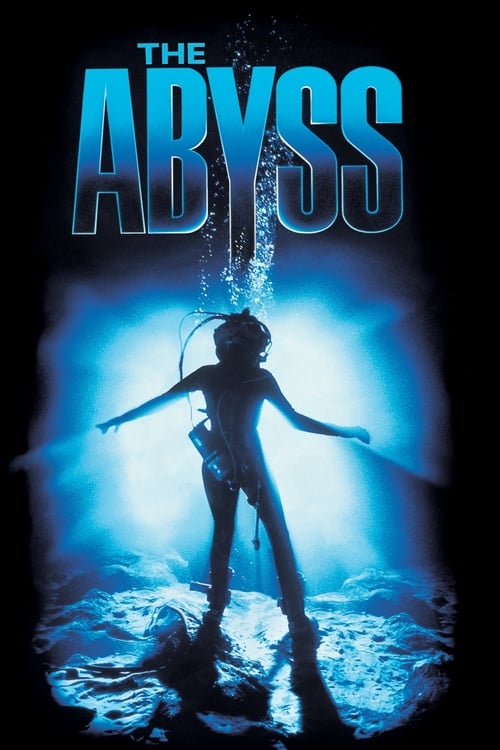
The Abyss
1989 · James Cameron
Perpetually doubted, perpetually vindicated: Avatar: The Way of Water's $2.3B silenced "no cultural footprint" jokes without ever quite ending them. His pronouncements on AI, streaming, and running times are treated as oracle statements.
For when you want a big, immersive adventure that puts you through the wringer and then moves you — a full-evening commitment film, not background viewing. Reach for it when you're craving spectacle with an actual heart.
What it's about
A civilian oil-rig crew working an experimental platform deep underwater gets commandeered by a Navy SEAL team after a nuclear submarine sinks mysteriously nearby. As the rescue mission goes wrong in the crushing dark of an ocean trench, the crew's estranged foreman and his engineer ex-wife are forced back together — and something intelligent and unearthly is waiting at the bottom, watching how humanity behaves with its fingers on the nuclear trigger.
The experience
Claustrophobic and physically gripping — you feel the pressure, the cold, the dwindling air — then it opens into moments of genuine awe. It swings between white-knuckle survival tension and a surprisingly raw love story, and the wonder lands harder because you've been holding your breath.
Performances
Ed Harris carries the film with a flinty, wounded decency that turns an action lead into something close to devastating, and Mary Elizabeth Mastrantonio matches him scene for scene — their scenes together give the spectacle its stakes. Michael Biehn is quietly terrifying as a SEAL commander coming apart under pressure.
The craft
Famously shot for real underwater in enormous flooded tanks, and it shows — the water isn't an effect, it's the world, and every dive feels dangerous. It also contains a landmark computer-generated image, a column of seawater that comes alive and mimics a human face, one of the moments that changed movie effects forever. Demands the biggest screen and best sound you can give it.
Why it matters
Its digital water creature was a proof of concept that opened the door to the CGI era, and its production became legend as one of the most punishing shoots ever mounted — a key chapter in James Cameron's reputation for pushing technology and crews to the edge.
Snapshot
James Cameron's The Abyss is a deep-ocean science fiction thriller in which a civilian diving crew aboard an experimental underwater platform is commandeered by a Navy SEAL unit to investigate a sunken nuclear submarine, only to encounter an intelligence of non-terrestrial origin at the floor of the Cayman Trough. Released in August 1989 by 20th Century Fox, the film is simultaneously a first-contact narrative, a Cold War parable, and a study in marital estrangement—a triangulation of ambitions that creates as much productive tension as it occasionally strains. It is remembered above all for the audacity of its production conditions and for a single computer-generated image—a shimmering water pseudopod that reshapes itself into a human face—that marks one of the decisive pivots in the history of photorealistic visual effects. The film received a theatrical director's cut in 1992 that restored approximately twenty-eight minutes and is widely considered the authoritative version.
Industry & production
The Abyss was produced through Pacific Western Productions, the company of producer Gale Anne Hurd, then still Cameron's wife; the couple separated during production and divorced shortly after, making the film's central story of a fractured marriage uncomfortably autobiographical. The shoot is one of the most documented production ordeals in Hollywood history. Cameron elected to film almost entirely underwater in two converted reactor-containment vessels at the unfinished Cherokee Nuclear Power Plant in Gaffney, South Carolina—the larger tank measuring roughly 55 feet deep and approximately 228 feet in diameter, at the time the largest underwater filming environment ever constructed. Cast and crew routinely worked twelve-to-seventeen-hour days largely submerged; the chronic fatigue, skin damage, and near-drowning incidents were extensively reported in behind-the-scenes accounts. Ed Harris has spoken in interviews of crying uncontrollably from exhaustion on the drive home. Mary Elizabeth Mastrantonio walked off set during the filming of a key emotional scene, delaying production. Cameron himself was reportedly equally grueling to himself, and the production crystallized his reputation for radical perfectionism at extraordinary personal and institutional cost.
The budget ran to a figure widely reported to be in the range of $45–70 million (primary sources differ), making it among the costliest productions of its era. Its domestic gross was a commercial disappointment relative to that investment, and the film was perceived at the time as a qualified failure; its long-term reputation has been substantially revised upward.
Technology
The Abyss is the film at which industrial digital imagery crossed from a novelty to a credible threat to practical effects. The pivotal sequence, designed at Industrial Light & Magic under technical director Jay Mack Smith, depicts a column of seawater that rises into the pressurized habitat, extends a tendril toward the divers, and molds itself into a reflective simulacrum of each of their faces before retreating. The roughly seventy-five seconds of CGI composited into that scene constitute the first convincing portrayal of a morphing, photorealistic organic surface in mainstream cinema. The challenge was not merely shape but material behavior—the team had to simulate the specular reflectivity and translucency of water while the form moved with biological intent. The lessons encoded in that sequence were carried directly forward by the same team into the liquid-metal T-1000 of Terminator 2: Judgment Day (1991), making The Abyss the critical laboratory experiment behind what is often cited as digital effects' first mature achievement.
On the practical side, the production developed or adapted a series of specialized tools for underwater filming: Panavision cameras in custom waterproof housings capable of operating at depth, novel lighting rigs designed not to blow out the refraction-heavy aquatic environment, and logistical systems for sustaining a full film crew through an unprecedented duration of in-water work. The film's closing sequence employed a real rat trained to breathe oxygenated perfluorocarbon liquid (a procedure that works physiologically, though it produced significant controversy with animal welfare organizations). This detail is illustrative of the production's methodology: wherever possible, Cameron insisted on doing the literal thing rather than the cinematic approximation of it.
Technique
Cinematography
Mikael Salomon, the Danish cinematographer who had recently shot Torch Song Trilogy (1988), was confronted with conditions that had no real precedent in studio cinematography. Underwater photography at the scale The Abyss demanded requires reconciling the inherent softness and color-absorption of water with the demands of high-contrast dramatic narrative; Salomon and Cameron solved this partly through the placement of practical light sources within the set itself—the rigs and vehicles of the underwater habitat glow with their own diegetic illumination, giving the deep sequences a cold, bluish-green industrial palette that reads as simultaneously scientific and alien. As the story descends into stranger territory, the lighting grows more expressionistic, the NTI craft bathing scenes in warm bioluminescent tones that stand in pointed contrast to the institutional harshness above. Salomon received an Academy Award nomination for his work. The film is presented in the anamorphic widescreen ratio of 2.39:1, which Cameron uses to emphasize both the horizontal claustrophobia of the rig's corridors and the vertiginous vertical scale of the abyss itself.
Editing
The theatrical cut runs approximately 140 minutes; the director's cut restores material that includes an explicit NTI warning sequence—enormous tidal waves held in suspension over world coastlines—that clarifies the thematic stakes Cameron had originally intended. The editing in both versions manages a difficult tonal negotiation: the first act functions as a sealed-environment procedural thriller whose rhythm is tight and spatial, while the second act opens into wonder in a way that requires the cutting to breathe. The transition between these modes—between the paranoid claustrophobia of Lt. Coffey's subplot and the oceanic-sublime register of Bud's solo descent—is the structural hinge the film balances on, and it holds.
Mise-en-scène / staging
Cameron's staging throughout privileges a functional, location-driven geometry: the cramped corridors and flooded modules of Deepcore impose a physical logic on blocking that keeps the action kinetically grounded even as the narrative turns fantastic. The production design (by Leslie Dilley) is rigorously plausible—this is a working oil-drilling platform adapted for deep-sea research, and every detail reads as functional rather than art-directed—which earns the film its authority when the imagery turns fully fantastic. The NTI sequences are staged with a restraint that is almost meditative; Cameron resists the impulse to provide too much spectacle, keeping the alien presence large but partially occluded, lit from within, never fully resolved into a conventional threat shape. The final image of Deepcore ascending on an alien platform belongs to the tradition of oceanic sublime rather than to the kinetic action grammar that dominates the film's middle sections.
Sound
Alan Silvestri's orchestral score moves between two registers: a percussive, militarized urgency for the SEAL and Cold War sections, and an expansive, choral-adjacent sweep for the NTI encounters that draws on the same vocabulary of awed spaciousness he would employ elsewhere in his career. The score has been less discussed than the film's visuals, but the transition from one mode to the other is a significant part of how The Abyss signals its generic pivots. The sound design more broadly is notable for its investment in the specific acoustic signature of deep-sea pressure—the creak of metal, the distortion of voices through radio and rebreather, the particular bubble-rush of ascent and descent—details that sell the environment's physical reality.
Performance
Ed Harris gives the film its emotional center through a performance of compressed physicality; Bud Brigman is a man who processes feeling through labor, and Harris conveys a great deal through what his body does in confined space and churning water. The genuinely grueling conditions of the shoot become an asset: the rawness in his face during the late sequences is not acting in the conventional sense. Mary Elizabeth Mastrantonio's Lindsey is one of the more anomalous female protagonists of late-1980s studio science fiction—a professional equal to every man on the platform, caustic, technically competent, and given a death and resurrection of her own before Bud's. Michael Biehn, recasting the unstable-soldier archetype he played differently in The Terminator, delivers Lt. Coffey's narcotic-induced decompression sickness and paranoia with a coiled menace that gives the film's second act its propulsive threat. The supporting ensemble of rig workers functions effectively as collective protagonist in the early sections.
Narrative & dramatic mode
The Abyss operates on three simultaneous dramatic tracks that it attempts to braid: the survival thriller (a hurricane on the surface, a clock on oxygen and structural integrity), the Cold War political thriller (a Navy SEAL team with a nuclear warhead and deteriorating judgment), and the first-contact narrative (a non-human intelligence observing from below). This tripartite structure is both the film's ambition and its formal risk; the Cold War plot, which functions as the film's most conventional action engine, effectively expires before the third act, leaving the NTI material to bear weight it is not entirely built to support in the theatrical cut. The director's cut substantially addresses this problem by completing the NTI's communication—their demonstration of global power, their explicit judgment of humanity's nuclear behavior—restoring the film's ethical argument from a suggestive postscript to a full dramatic statement.
The film's romantic subplot, in which an estranged couple's irreducible mutual attachment is tested by extreme conditions and eventually confirmed through an act of literal self-sacrifice and resurrection, is Cameron's most personal material and the emotional logic that holds the larger structure together. Bud's decision to descend alone knowing the dive is likely fatal is made credible only if the audience believes what is at stake between him and Lindsey—and the film invests enough in that relationship early to earn the weight of the ending.
Genre & cycle
The Abyss arrived as part of an extraordinary, overdetermined cluster of deep-sea horror and adventure pictures in 1989: Leviathan (George P. Cosmatos), DeepStar Six (Sean S. Cunningham), and Lords of the Deep all appeared in the same year, suggesting a shared cultural anxiety about oceanic depth that remains undertheorized. The cycle is partly explicable as a speculative response to ongoing deep-sea exploration coverage and to a late-1980s appetite for isolated-crew-in-hostile-environment narratives that drew on the commercial template of Alien (1979) and its sequels. Cameron's film was by far the most expensive and ambitious of the group and the only one to blend the horror-of-the-deep framework with an optimistic first-contact resolution. Its generic position is genuinely hybrid: it borrows the procedural gravity of submarine films, the wonder-and-threat vocabulary of Spielbergian close-encounter cinema, and the ecological-ethics register of 1970s science fiction in ways that are never entirely reconciled but remain productive.
Authorship & method
The Abyss consolidates the Cameron authorial signature in ways that would be legible for the next thirty years: the deep-water obsession (Cameron has made several subsequent real-world deep-sea dives and produced documentaries about them), the interest in military-industrial masculinity placed in contact with something that exceeds its categories, the romantic plot as ethical proving ground, the willingness to subordinate cast and crew welfare to a vision of physical authenticity. Cameron wrote the screenplay himself, and the script shows both his strengths (efficient genre mechanics, genuine interest in the science) and his tendencies (dialogue that sacrifices character texture for plot function, romantic reconciliation that can feel willed). Mikael Salomon's contribution to the film's visual grammar is substantial and was decisive in establishing what underwater dramatic photography could look like at scale. Alan Silvestri's score represents one of his more considered genre efforts.
Movement / national cinema
Squarely within the American studio system and the post-Jaws, post-Star Wars tradition of effects-driven prestige adventure, The Abyss is nonetheless an outlier within that tradition in its willingness to conclude with a register of contemplative wonder rather than kinetic resolution. Cameron's Canadian origin is occasionally cited in auteurist accounts as informing a certain outsider's ambition within Hollywood norms, though such arguments are difficult to substantiate rigorously. The film belongs more usefully to the lineage of American science fiction that treats the confrontation with the non-human as an occasion for ethical reckoning: a tradition running from the 1950s B-picture through Kubrick and into the ecological science fiction of the 1970s.
Era / period
1989 marks a specific inflection point in Cold War cinema: the Berlin Wall fell in November of that year, and The Abyss was released into a cultural moment when Cold War anxieties were both at their most reflexively familiar and—with hindsight—at their historical terminus. The film's paranoid military subplot reads differently post-1989 than it did at the moment of release. More broadly, the film belongs to the late Reagan/early Bush cultural period when large-scale American studio science fiction was testing how much metaphysical or political weight the spectacle-adventure format could bear—a question Cameron's subsequent career can be read as continuously answering.
Themes
The Abyss is organized around depth as both physical fact and metaphor: descent into the ocean is equated with descent into the unconscious, into marital truth, into political honesty about humanity's nuclear behavior. The NTIs serve as a Solaris-like mirror—they reproduce human faces from the seawater, manifesting back to the characters an image of themselves—and their ultimatum in the director's cut is explicitly ecological: an intelligence that has watched humanity's weapons proliferate and has decided to demonstrate that it could choose consequences. Water throughout the film functions as a medium of transformation: Bud must breathe it to descend to the limit, and Lindsey must pass through it to return to life. Cameron would return to oceanic depth and liquid transcendence in subsequent work, but The Abyss remains the most philosophically concentrated expression of those preoccupations. The marital estrangement plot is also a Cold War allegory in miniature—two people who cannot communicate except in extremity, whose mutual survival depends on the willingness to extend trust across a rupture.
Reception, canon & influence
Backward: influences on the film. The primary debts are to 2001: A Space Odyssey (1968)—both in the orchestration of awe and in the use of an inhuman presence as a catalyst for human self-examination—and to Andrei Tarkovsky's Solaris (1972), whose alien ocean generates illusions drawn from the observer's own psychology. The deep-sea adventure tradition reaches back through Jules Verne and the submarine-film genre; Cameron has cited Jacques Cousteau's underwater documentary work as formative. The first-contact optimism places the film in a lineage that includes Spielberg's Close Encounters of the Third Kind (1977), while the isolated-crew-under-threat structure inherits from Cameron's own Aliens (1986) and from Ridley Scott's Alien (1979).
Critical reception. Reviews at release were respectful but divided; the tonal shift in the third act and the perceived incompleteness of the theatrical ending were the most common points of criticism. The film won the Academy Award for Best Visual Effects, and that recognition correctly identified where its historical importance was lodged. Over subsequent decades, and in particular following the wider availability of the director's cut, critical assessment has risen considerably. It is now routinely discussed as a transitional object in the history of digital effects and as a characteristic example of Cameron's maximalist mode.
Forward: legacy and influence. The immediate and most consequential impact was industrial: the CGI pseudopod sequence provided the proof of concept and the trained personnel that enabled the T-1000 effects in Terminator 2 (1991), which in turn made photorealistic digital characters a viable proposition for mainstream cinema. The longer-term influence on Cameron's own work is also substantial—The Abyss is the first full articulation of the ecological and first-contact themes that reach their most elaborate expression in Avatar (2009), and the production's methodological extremity established the template for the similarly punishing shoots of Titanic (1997) and the Avatar sequels. The film's treatment of underwater space as a locus of the sublime—dangerous, transformative, ultimately redemptive—entered the vocabulary of subsequent science fiction and prestige adventure without generating direct descendants that match its ambition. Among films exploring deep-sea first contact, it remains without close equals.
A Deleuzian reading
Watch the water come down the corridor.
The full Deleuzian reading of The Abyss →
Reception
A grueling shoot and a soft box office (it opened in the shadow of Batman's summer) left it as the 'lesser Cameron' for years — but the 1992 Special Edition and the long-awaited 2023 4K restoration turned it into the beloved deep cut of his filmography, with many now calling it his most underrated film.
How The Abyss was received, from release to now →
Influences: the films it descends from and the films it influenced
- 2001: A Space Odyssey (1968) — Cameron's staging of the NTI's light-display climax inherits Kubrick's grammar of alien encounter as overwhelming sensory transcendence—the intelligence communicates through geometry and luminescence rather than language, and the protagonist emerges physically transformed, structuring the finale as an abandonment of rational cognition rather than a dramatic confrontation.
- Close Encounters of the Third Kind (1977) — Cameron's tripartite architecture—civilian discovery, military escalation, transcendent species-contact finale—directly replicates Spielberg's first-contact template; both films stage the climactic encounter as benevolent communication through mimicry, with the alien intelligence reproducing human features to signal intent before withdrawing.
- Alien (1979) — Cameron absorbed Scott's production design principle that futuristic installations must look inhabited and labored-in: Deepcore's tool-scattered corridors, worn wet suits, and diegetic-source lighting share Scott's logic that convincing science fiction requires the visual residue of work, a vocabulary Cameron had extended in Aliens and deepened here.
- Apocalypse Now (1979) — Cameron's decision to film almost entirely in real water over months of punishing production follows the paradigm Coppola established in the Philippines—using authentic extreme conditions to break down actors' composed performances into something rawer—a legitimizing strategy for directorial extremity that both productions converted into critical mythology.
- Das Boot (1981) — The Abyss's interior acoustic design—the pressure groans of the hull, differential registers between mechanical noise and human breath, sonar pings as psychological instrument—inherits directly from Petersen's deployment of underwater vessel acoustics to generate dread from the sounds the sea makes against metal.
- Aliens (1986) — Cameron's prior film established his compressed-physicality method: Colonial Marines move, sweat, and exhaust themselves within Hadley's Hope's physical constraints in ways Cameron then applied to the Deepcore crew, using actual fatigue from water-logged shooting days to generate authentic-looking desperation rather than performed distress.
- The Big Blue (1988) — Besson's film, released the year before, established a visual grammar for free-diving depth as spiritual rather than merely physical experience; Cameron and Mikael Salomon inherited this approach—treating descent as movement toward revelation—and industrialized it at a scale Besson's Mediterranean location work could not attempt.
- Terminator 2: Judgment Day (1991) — The ILM team that built the water pseudopod's specular-surface simulation—rendering a liquid material as it flows, reflects, and reshapes with biological intent—directly rebuilt and extended that pipeline to produce the T-1000's liquid-metal transformations, making The Abyss the technical laboratory experiment that T2's landmark digital effects required.
- Jurassic Park (1993) — The pseudopod's demonstration that CGI could simulate photorealistic organic surfaces with convincing material behavior—water translucency, specular reflection, volumetric movement—gave ILM and Spielberg the credibility to assign full-body dinosaur animation to the digital team rather than relying entirely on Stan Winston's practical creatures.
- Titanic (1997) — Cameron reprises The Abyss's extreme underwater production methodology—constructing the largest practical filming environment of its era and demanding months of physically grueling in-water work—while carrying forward the structural device of a romantic subplot staged as an ethical proving ground through which a grander historical catastrophe is morally adjudicated.
- Contact (1997) — Zemeckis borrows The Abyss's narrative architecture of a civilian scientist navigating military gatekeeping toward transcendent alien contact, staging the climactic encounter as a single protagonist's testimony that cannot be independently verified—the same structure Cameron used to center Bud Brigman's solo descent to the alien vessel.
- Sphere (1998) — Levinson's film deploys The Abyss's specific narrative premise—a deep-sea civilian-military team discovers an alien artifact that communicates by projecting transformative imagery—and stages its pressurized-habitat sequences in the same claustrophobic metal-corridor grammar, making it the most direct structural descendant of Cameron's first-contact design.
- Avatar (2009) — Cameron transposes the bioluminescent visual design and tripartite first-contact structure from The Abyss to Pandora—the NTI's warm organic glow becomes Na'vi bioluminescence, the ocean floor becomes an alien ecosystem—while applying the same extreme-production methodology, now to virtual camera systems and performance-capture stages rather than underwater tanks.
- Thirteen Lives (2022) — First large-scale practical underwater production built in purpose-flooded tanks, developing the breathing-apparatus choreography, water-column lighting rigs, and actor-in-mask performance techniques that Thirteen Lives's production team studied and extended for its narrow-passage sequences.
- Pirates of the Caribbean: At World's End (2007) — ILM's water-tentacle 'pseudopod' is the origin point of the CG fluid-simulation pipeline that produces the trilogy's photoreal ocean and the churning maelstrom vortex.
- Pirates of the Caribbean: Dead Man's Chest (2006) — ILM's CG water pseudopod pioneered photoreal fluid-surface simulation, the technical seed later scaled up for the Kraken and the Flying Dutchman's churning seas.
- The Mask (1994) — ILM's photoreal water pseudopod proved a soft CG element could convincingly interact with live actors in the same frame, the toolset that made the Mask's morphs possible.
- Death Becomes Her (1992) — ILM's morphing water-pseudopod was the R&D that established the photoreal, malleable digital-surface pipeline Zemeckis's team reused to render living flesh.
- Avatar: The Way of Water (2022) — Cameron's pressurized-tank underwater shoot and ILM's pseudopod — the first convincing CG water surface — are the direct technical seed of Weta's fluid-simulation and wet-capture pipeline here.
- DeepStar Six (1989) — Part of the same 1989 studio cycle of seabed-installation thrillers, sharing The Abyss's genre architecture of Navy personnel on a deep-sea platform threatened from below, though Cunningham routes the premise through creature-feature horror rather than first-contact transcendence, revealing the tonal range available within an identical production template.
- Leviathan (1989) — The third film of the 1989 underwater cycle deploys the same ensemble-in-metal-corridors production grammar as The Abyss while routing it through Alien-derived body horror rather than Cameron's first-contact wonder, making the contrast in genre deployment within identical spatial and institutional constraints explicit.
- The Hunt for Red October (1990) — McTiernan's film is the immediate Cold War successor in the deep-sea genre cycle, sharing The Abyss's dual-military-register acoustic design—competing sonar signatures as political metaphor—and its staging of geopolitical tension as procedural cat-and-mouse confined to enclosed metal corridors.
Similar films
- Alien (1979) — influence & lineage · same viewing thread
- Leviathan (1989) — influence & lineage
- Aliens (1986) — influence & lineage
- Avatar (2009) — influence & lineage
- Terminator 2: Judgment Day (1991) — influence & lineage
- Titanic (1997) — influence & lineage
- Jurassic Park (1993) — influence & lineage
- Das Boot (1981) — influence & lineage
All the films related to The Abyss →
Watch it with: curated runs of related films
- Crossing Into the Zone — A run of crews and expeditions that step across a threshold into a hostile unknown — a derelict, a shimmer, a forbidden Zone — that rewrites biology, sanity, and who comes back; watch them in sequence to feel the same dread deepen from pulp to the sublime.