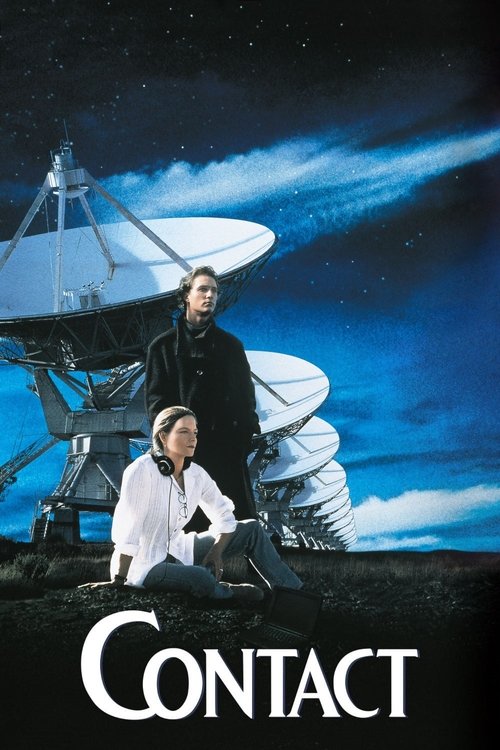
Contact
1997 · Robert Zemeckis
For when you want smart, hopeful science fiction that makes you feel small in a good way — a film to watch when you're in the mood to wonder rather than to be thrilled. Comfortable to watch, but it gives your brain plenty to chew on.
What it's about
Ellie Arroway, a radio astronomer who has spent her career listening for life beyond Earth, finally hears it: a signal from the star Vega, wrapped around instructions for building a machine. As governments, churches, and rivals scramble to control what happens next, she has to fight for her place in the discovery — and to defend an experience that science may never be able to verify. It's first contact told as a battle between evidence and belief.
The experience
Thoughtful, sweeping, and sincerely emotional — a rare blockbuster that builds its awe out of ideas and one woman's conviction rather than menace. It's paced like a drama, crests into genuine wonder, and leaves you turning over the faith-versus-proof question on the drive home.
Performances
Jodie Foster carries the film as Ellie — fierce, wounded, and utterly convincing as a scientist whose rigor and longing come from the same place; her conviction is what makes the film's big ideas land emotionally.
The craft
Zemeckis stages the science with unusual seriousness — real radio-telescope arrays, procedural detail, geopolitics — then pays it off with effects sequences built for scale, including a legendary opening shot that pulls back from Earth through the noise of the cosmos. The sound design of the signal itself is a character. Absolutely worth the biggest screen and best speakers you have.
Why it matters
Adapted from Carl Sagan's novel, it became the benchmark for intellectually serious studio science fiction — the film every 'cerebral first contact' movie since gets measured against.
Snapshot
Contact is a 150-minute first-contact drama from Warner Bros. that refuses the genre's default recourse to spectacle and menace. Dr. Eleanor "Ellie" Arroway (Jodie Foster), a SETI researcher driven by childhood grief and scientific conviction, decodes an extraterrestrial signal from the Vega system and is ultimately chosen to make the transit the aliens have blueprinted — an 18-second journey that produces no verifiable evidence, only her own testimony. The film uses the machinery of hard science fiction to stage a philosophical argument about evidence, faith, and the limits of empiricism, arriving at an ending that is, structurally, a mirror image of religious experience: an ineffable encounter that no instrument can confirm. Adapted from Carl Sagan's 1985 novel, the film was among the most intellectually serious studio science fiction films of its decade and stands as a touchstone in the ongoing negotiation between popular cinema and scientific culture.
Industry & production
Contact spent years in development before Robert Zemeckis attached himself as director. Carl Sagan and his partner Ann Druyan had been trying to bring the novel to the screen since before its publication, at various stages working with Lynda Obst as producer and navigating multiple studio configurations. Warner Bros. ultimately backed the production, and Zemeckis — arriving with enormous commercial authority after Forrest Gump (1994) swept the Academy Awards — gave the project the greenlight protection it needed to remain an adult, ideas-driven film rather than a summer-blockbuster reconfiguration. Sagan was involved in development and reportedly attended early production work, but he died of pneumonia in December 1996, seven months before the film's July 11, 1997 release; the film is dedicated to his memory. The screenplay went through credited drafts by James V. Hart and Michael Goldenberg. Jodie Foster, a producer on the film as well as its lead, had long championed the project; her commitment was a key factor in the production's coherence and in the sustained seriousness of its central performance. The film was shot primarily in New Mexico — at the actual Very Large Array (VLA), the National Radio Astronomy Observatory's landmark radio telescope facility near Socorro — and at Warner Bros. stages in Burbank. The VLA's concrete and steel geometry becomes a kind of architectural protagonist, its 27 dish antennae arranged in a Y-pattern across the high desert giving the film a visual grammar of patient, outward-facing attention.
Technology
Contact's most celebrated technical achievement is its opening sequence, a continuous pullback from Earth into deep space that simultaneously travels backward through time via the electromagnetic spectrum. As the camera recedes, we hear progressively older radio and television broadcasts — the signal fades from contemporary pop, through twentieth-century newscasts and mid-century jazz, through crackling early transmissions, to silence, at the moment we pass beyond the range of human electromagnetic emission. The sequence was accomplished through layered digital compositing and demonstrates a rigorous conceptual logic: radio waves travel at the speed of light, so the further out you go, the older the signal you'd receive. Industrial Light & Magic handled the sequence, and it set an early high-water mark for conceptually motivated CGI in mainstream cinema.
More controversial was the film's use of actual documentary footage of President Bill Clinton — drawn from a real 1996 press conference about the Pathfinder Mars mission — digitally re-cut to appear as though Clinton was commenting on events in the film's diegesis. The manipulation was technically seamless, and the White House objected to the use of the president's likeness in what was effectively a false context; Warner Bros. ultimately added a closing disclaimer. The episode became an early and widely discussed case study in digital fabrication of public figures, anticipating concerns that would become central to media literacy discourse in the following decades.
The film also contains a long-take illusion at its domestic opening: a shot of young Ellie running through her house that appears continuous but ultimately resolves as a mirror reflection — the camera pulling back to reveal adult Ellie's face. This practical effects technique, involving a half-silvered mirror and precise camera choreography, is one of Zemeckis's characteristic deployments of sleight-of-hand technology in the service of narrative rhyme.
Technique
Cinematography
Don Burgess, Zemeckis's collaborator since Forrest Gump, shoots the film in wide Panavision compositions that make landscape a register of Ellie's interiority. The Southwestern desert — its flat light, dust, and sky — conveys the loneliness of long-duration listening, while the VLA's angular geometry creates a visual rhyme with the alien Machine's later geometry. Burgess uses a notable extreme close-up during a key scene: Ellie's eye fills the frame, and within her pupil we see the reflected array — an image achieved by suspending a ten-foot dish above Foster and digitally erasing it, leaving only the sky. The effect collapses observer and instrument into a single image, literalizing the film's argument about the intimacy between scientist and her subject.
Editing
Arthur Schmidt edits the film with a patience unusual in summer-adjacent studio science fiction. Long stretches of near-silence accompany the listening sequences; the rhythm trusts the audience to dwell. The formal bookend of the opening pullback and the Machine transit sequence is handled through montage that parallels cosmic scale with personal interiority. Schmidt's most structurally ambitious move is the congressional hearing that closes the film: he cuts between Ellie's testimony and quiet reaction shots in a rhythm that recalls courtroom drama while accumulating the weight of philosophical irresolution.
Mise-en-scène / staging
Zemeckis stages the film's domestic and institutional spaces in ways that emphasize Ellie's relational isolation — she is most often shot either alone in wide frames or dwarfed by institutional architecture (Senate chambers, NASA facilities, the VLA). The Machine sequence stages the alien encounter as the inverse of this: an intimate beachscape, Pensacola from Ellie's childhood, where the alien takes the form of her dead father. The staging is deliberately anti-climactic in the spectacular sense — no vast alien civilization, no fleet of ships — and the choice to ground the cosmic in childhood memory is Sagan's, followed faithfully in the adaptation.
Sound
Alan Silvestri's score blends orchestral and ambient electronic textures, supporting the film's modulation between intimate drama and cosmic register. The opening sequence uses found sound — historical broadcasts — as the primary sonic element, and their deliberate degradation into static is among the more conceptually precise uses of diegetic sound in the film. The Machine transit scene uses near-silence and overwhelming ambient noise as structural tools, withholding conventional scoring at the moment of maximum dramatic intensity.
Performance
Foster's performance is the film's center of gravity. She plays Ellie's scientific conviction not as coldness but as a form of grief-driven need — the search for extraterrestrial life is also, the film insists, a search for her dead father. Foster modulates the character's affect across the film's tonal range without losing coherence: the blunt edges of the professional scientist, the vulnerabilities of the isolated true believer, the bewilderment of someone returned from an ineffable experience she cannot prove. Matthew McConaughey as Palmer Joss — a theological adviser and Ellie's romantic counterpart — is given less room by the script, but he grounds the faith side of the film's central debate in something warmer than abstraction. John Hurt's eccentric billionaire S.R. Hadden and James Woods's institutional antagonist Drumlin are both drawn from stock types, though Hurt in particular brings an idiosyncratic energy to a role that could have been purely functional.
Narrative & dramatic mode
Contact structures itself around an epistemological problem rather than a conventional action arc. The first two acts build to the activation of the Machine and Ellie's transit; the third act, however, is a sustained inquiry into the status of her experience. The film's ending — a congressional hearing in which Ellie must defend an encounter she cannot verify, while we in the audience have seen it — places the viewer in a position of asymmetric knowledge that is also the film's philosophical argument. We believe her; the institutional world does not; and the film suggests this is the condition of all foundational belief. The drama is powered by ideas, with romance and institutional conflict as supporting structures rather than primary motors.
Genre & cycle
Contact participates in a tradition of serious-minded science fiction — films more interested in the philosophical implications of contact with the unknown than in its action or horror possibilities. Its closest generic ancestor is Steven Spielberg's Close Encounters of the Third Kind (1977), with which it shares the lone-protagonist-as-receiver-of-alien-signal premise, the desert landscape, and the climactic encounter that is as much psychological as physical. Behind both lies Stanley Kubrick's 2001: A Space Odyssey (1968), whose influence is felt in Contact's willingness to subordinate plot resolution to experiential and philosophical ambiguity. Contact arrives in the mid-1990s cycle of science fiction that included Independence Day (1996) and Men in Black (1997), films far more comfortable with genre spectacle; Contact's relative austerity distinguishes it sharply within this cycle and connects it to a harder science fiction lineage.
Authorship & method
Robert Zemeckis is characteristically interested in the integration of technical innovation and emotional sincerity. His career — Back to the Future (1985), Who Framed Roger Rabbit (1988), Death Becomes Her (1992), Forrest Gump (1994) — consistently uses new or virtuosic technology in the service of human-scale stories. Contact extends this pattern: its most ambitious technical effects (the pullback, the mirror transition, the Clinton footage) are all conceptually motivated rather than decorative. Zemeckis's authorial signature here is the belief that technique and theme should illuminate one another. Don Burgess as cinematographer and Alan Silvestri as composer are both long-term collaborators whose contributions reflect established working patterns. Arthur Schmidt, also an editor on Back to the Future Part II and Forrest Gump, brings the patience and structural intelligence that the film's unusual third-act shape demands.
Movement / national cinema
Contact is a product of the Hollywood major-studio system in the mid-1990s, specifically the post-Gump prestige mode in which Zemeckis could command significant budgets for relatively adult material. It has no meaningful connection to national cinema movements outside this framework, though its engagement with American scientific culture — SETI, NASA, congressional oversight, Cold War signal-intelligence anxiety — is legible as a distinctly American film about distinctly American institutions and their relationship to transcendence.
Era / period
The film arrives in the late-Clinton-era optimism about American technological progress: the internet was becoming a mass phenomenon, Pathfinder had just landed on Mars, SETI was receiving renewed public attention. Contact channels this mood while also questioning it — its institutional figures are venal, its congressional process compromised, and its scientific heroine ultimately treated with the suspicion reserved for mystics. The film captures a particular late-1990s tension between scientific triumphalism and a cultural hunger for the numinous that lay beneath it.
Themes
The film's central opposition is between empiricism and faith, staged as a structural parallel: Ellie requires verifiable evidence for belief; Palmer Joss argues that some foundational commitments — love, meaning — exceed the evidentiary. The film does not resolve this symmetrically in favor of either position. Instead, it places Ellie in a situation where her experience is the kind of thing she would not believe if reported to her by someone else — and the 18 hours of static recorded by her instruments, which she cannot explain, are left quietly unexplored by the institutional investigators who have their own political reasons for suppressing the encounter. Alongside this epistemological theme runs a meditation on grief, solitude, and the relationship between scientific vocation and personal need. The search for extraterrestrial intelligence is explicitly connected to Ellie's childhood loss of her father; the alien encounter, in staging her father's image, fulfills both the scientific and the personal quest simultaneously — and makes it impossible to distinguish between them.
Reception, canon & influence
Backward — influences on the film: The primary source is Sagan's 1985 novel, which drew on his own SETI advocacy and on conversations with physicist Kip Thorne about the theoretical possibility of wormhole transit (Thorne provided scientific consultation for both the novel and the film). The cinema behind Contact is legible throughout: Kubrick's 2001 in the film's willingness to end in irresolution and its sense of cosmic scale; Spielberg's Close Encounters in its emotional architecture and desert landscapes; the post-war tradition of "first contact" science fiction in American cinema and literature that runs from The Day the Earth Stood Still (1951) onward. Sagan's own Cosmos television series (1980) is a direct formal ancestor of the film's opening pullback and its mode of using visual language to convey astronomical scale.
Critical reception: Reviews at release were respectful but divided. The film's refusal of a conventional climax and its philosophical ambition were praised by critics sympathetic to serious science fiction; others found the second half underpowered and the romance between Ellie and Joss schematic. Foster's performance was nearly universally celebrated. The film earned a Golden Globe nomination for Foster and was a moderate commercial success, though it did not approach the commercial scale of Forrest Gump or the year's dominant SF films.
Forward — legacy: Contact's most direct legacy is in the subsequent tradition of thoughtful, science-grounded first-contact films. Denis Villeneuve's Arrival (2016) is the clearest inheritor: it shares Contact's female-scientist protagonist, its interest in the phenomenology of alien communication rather than alien threat, and its willingness to locate the cosmic encounter within a framework of personal grief and loss. Christopher Nolan's Interstellar (2014) shares the parental-loss structure and the science-faith nexus, as well as the Kip Thorne gravitational physics that underlies both films' wormhole premises. More broadly, Contact is regularly taught in science communication contexts as a rare example of a mainstream film that represents scientific culture — the skeptical community, the institutional funding pressures, the SETI enterprise — with unusual fidelity. The film's digital manipulation of Clinton footage has become a standard reference point in discussions of synthetic media and is cited in academic and journalistic treatments of deepfakes as an early, publicly visible instance of the form.
A Deleuzian reading
Hold on the eye.
The full Deleuzian reading of Contact →
Reception
A solid hit with respectable reviews in summer 1997, it was still overshadowed by Men in Black and often dinged as 'talky' sci-fi; decades on it's been reappraised as one of the smartest studio science-fiction films of the 90s, the thinking-person's alien movie that Interstellar and Arrival get measured against.
How Contact was received, from release to now →
Influences: the films it descends from and the films it influenced
- 2001: A Space Odyssey (1968) — Kubrick's decision to score the Monolith and HAL sequences with near-silence rather than dramatic underscore — letting ambient sound carry uncanny weight — is Contact's direct model for the Machine transit, where Silvestri is withheld entirely and only the Vegan soundscape registers; the anti-climactic alien encounter that refuses a visible body is identical in structure.
- Solaris (1972) — Tarkovsky frames alien contact as an epistemological mirror — the station's phenomena are genuinely experienced but unverifiable to outside observers — which is the direct narrative precedent for Contact's ending, where Ellie's 18-second transit leaves zero objective evidence; the institutional review of Kris Kelvin's return and Ellie's congressional hearing are structurally identical scenes.
- Close Encounters of the Third Kind (1977) — Spielberg's finale — alien intelligence manifesting as light-and-tone rather than organism, government observers dwarfed in open-field Panavision, a single civilian scientist granted contact — is the compositional and tonal template for Contact's Machine transit, including the structural permission to withhold a visible alien body.
- The Right Stuff (1983) — Kaufman's strategy of staging scientist-pilots against NASA's bureaucratic apparatus in wide Panavision compositions that emphasize institutional scale over individual bodies — climaxing in Senate hearing sequences — is Contact's direct procedural template for Ellie Arroway's post-transit congressional testimony arc.
- Zelig (1983) — Allen's technique of inserting a fictional character into genuine newsreel and archival footage via composited optical printing — complete with period-appropriate grain and scratches — is the direct formal and ethical precursor to Contact's digital manipulation of the Clinton press-conference footage, establishing the grammar of seamlessly collapsing historical record with dramatic fiction.
- The Abyss (1989) — Cameron's NTI encounter — alien intelligence presented as luminous water-pseudopods rather than corporeal beings, first contact staged as personal emotional testimony rather than combat — is the immediate genre predecessor to Contact's Machine transit, sharing the structural choice to make anti-spectacular private encounter the climactic event of a large-budget science fiction film.
- The Silence of the Lambs (1991) — Demme's deployment of Foster in sustained extreme close-up — her face filling the Panavision frame, registering intellectual exposure while navigating male-dominated institutional corridors — is the precise performance grammar Burgess and Zemeckis reprise for Arroway, culminating in the shot of Foster's eye that resolves into her reflected radio dish.
- Woman in the Moon (1929) — The Machine's construction sequence — Ellie rendered tiny against the concentric rings of the enormous technological apparatus — directly inherits Woman in the Moon's staging of the protagonist dwarfed by the vehicle that will carry her beyond verifiable reality; the scientific-romance architecture of an empirical rationalist whose journey culminates in personal transcendence replicates the narrative structure Lang and Von Harbou established.
- The Day the Earth Stood Still (1951) — Extends the hopeful-first-contact ethos rendered in documentary-realist register, staging cosmic encounter against grounded institutional and domestic scale.
- Signs (2002) — Shyamalan borrows Contact's central dialectical architecture — empiricism vs. faith, the encounter readable as either — and systematically inverts its resolution: where Contact grants the rationalist an ineffable faith-like experience, Signs grants the bereaved priest rational evidence that his faith was justified, using the same asymmetric-knowledge structure to reach the opposite conclusion.
- The Tree of Life (2011) — Malick's structural bookend of a cosmological creation sequence against present-day human grief directly extends Contact's opening electromagnetic pullback strategy, and his use of near-silence and ambient natural sound against cosmological imagery — withholding conventional scoring for the dinosaur and creation sequences — is in formal dialogue with Contact's scored cosmic passages.
- Interstellar (2014) — Nolan appropriates Contact's structural bookend architecture — scientist-parent separated from child by cosmic transit, reunion serving as temporal ellipsis — and its epistemological frame (Cooper's testimony from the tesseract is, like Ellie's from Vega, unprovable by instrumentation), while Zimmer's organ-dominated score extends Contact's strategy of substituting solemn timbre for conventional dramatic underscore.
- Arrival (2016) — Villeneuve's female scientist protagonist undergoes an alien encounter that produces non-linear subjective knowledge no instrument can verify, culminating in an institutional debrief where her testimony is treated as epistemological liability — Jóhann Jóhannsson's withheld scoring and the heptapod encounter's anti-spectacular staging both extend Contact's formal precedents directly.
- Annihilation (2018) — Garland reprises Contact's anti-climactic encounter structure — a female scientist meets an alien presence that mimics her own form rather than presenting a conventional extraterrestrial body — and closes with a formal echo of the congressional hearing: Lena's debrief to the government interrogator is an unverifiable first-person account of an encounter only the witness can attest to, treated with identical institutional suspicion.
- Disclosure Day (2026) — Pioneers the intelligent first-contact film assembled from accumulating signal-evidence, with a scientist-versus-institution dual structure the seed converses with directly.
- Project Hail Mary (2026) — Stages the decoding of an alien transmission as a stepwise scientific procedural, making mathematics and signal the literal medium of communication-across-difference.
- My Sassy Girl (2001) — The Korean commercial romance's internet-native template — courtship mediated by online chat — anchored by a single curated Western pop record ('A Lover's Concerto') as connective leitmotif, both devices MSG inherits directly.
- I Origins (2014) — The empiricist's testimony scene as a set piece: a scientist made to defend an unrepeatable experience under procedural cross-examination with no data to offer — the closest American precedent for the debate Cahill stages, right down to opening on a child's eye in a mirror.
- Gattaca (1997) — Niccol's sibling hard-SF film deploys minimal spectacle and institutional-dwarfing wide compositions to stage a philosophical argument about determinism in the same release year as Contact, sharing its strategy of making architectural geometry — the glass-and-steel eugenics bureau echoing the VLA's Y-pattern — the visual register of institutional opposition to individual transcendence.
- Sphere (1998) — Levinson's adaptation of Crichton's 1987 novel is Contact's closest genre sibling: both adapt canonical hard-SF novels about scientists confronting alien artifacts that generate unverifiable subjective experience, and both culminate in institutional debriefings where the protagonist's testimony is structurally positioned as epistemological liability rather than evidence.
- The Arrival (1996) — Near-simultaneous signal-as-plot sibling: a scientist-protagonist decoding an intercepted extraterrestrial transmission drives a detection procedural, the same SETI-grammar engine Twohy uses, minus the paranoia inversion.
- Ad Astra (2019) — Frames the meaning of space travel as a terrestrial, familial question rooted in a lost father, arriving at the same anti-spectacle conclusion that the cosmos answers a human rather than a technological longing.
Similar films
- Arrival (2016) — influence & lineage · same viewing thread
- 2001: A Space Odyssey (1968) — influence & lineage · same viewing thread
- Interstellar (2014) — influence & lineage · same viewing thread
- Project Hail Mary (2026) — influence & lineage · same viewing thread
- Close Encounters of the Third Kind (1977) — influence & lineage
- Disclosure Day (2026) — influence & lineage
- Solaris (1972) — influence & lineage
- Annihilation (2018) — influence & lineage
All the films related to Contact →
Watch it with: curated runs of related films
- Alone in the Void — A run of films about a single mind pitted against the vastness — rationing air, doing the math, reaching across impossible distance — best watched together for how survival keeps tipping into awe.