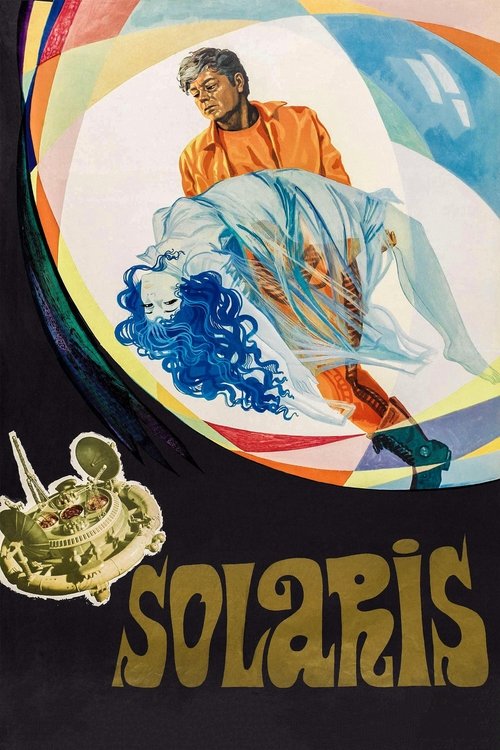
Solaris
1972 · Andrei Tarkovsky
For when you want a film to chew on for days — a patient, demanding evening that pays you back in haunting rather than excitement. Not one for a tired night; save it for when you can surrender to it completely.
What it's about
A psychologist is sent to a decaying space station orbiting Solaris, a planet covered by an ocean that seems to be a single vast mind, to find out why the crew is falling apart. What he finds is stranger than madness: the ocean reaches into the sleepers' memories and makes their most private griefs physically real. Soon he is confronted by an impossible visitor from his own past, and the mission becomes a reckoning with love, guilt, and what he owes the dead.
The experience
Slow, hushed, and hypnotic — it moves at the pace of grief rather than plot, and it gets under your skin gradually until certain images refuse to leave. Less a thriller than a long, sorrowful meditation that turns the vastness of space inward.
Performances
Donatas Banionis carries the film with a heavy, wounded stillness, and Natalya Bondarchuk is devastating as the visitor — tender, bewildered, and increasingly aware of what she is.
The craft
Tarkovsky shoots in long, unhurried takes that make you feel time passing — swaying reeds and rain on Earth against the humming, cluttered corridors of the station. The sound design and the film's textures of water, mist, and metal are extraordinary; it rewards a big screen, low lights, and no phone.
Why it matters
A landmark of philosophical science fiction, it proved the genre could be a vehicle for grief and conscience rather than spectacle, and it remains the touchstone for every slow, inward-looking space film since — remade in Hollywood and endlessly cited.
Snapshot
Solaris is a 166-minute Soviet science fiction film adapted from Stanisław Lem's 1961 novel of the same name. Directed by Andrei Tarkovsky, it follows psychologist Kris Kelvin (Donatas Banionis), dispatched to the orbital space station Prometheus above the oceanic planet Solaris, where three scientists have descended into apparent mental crisis. Once aboard, Kelvin discovers that the planet's sentient ocean materializes physical replicas drawn from its visitors' repressed memories — in his case, Hari (Natalya Bondarchuk), his wife who died by suicide years earlier. Rather than a film about humanity's encounter with alien intelligence, Tarkovsky frames the Solaris ocean as an externalization of conscience and grief, making the film a sustained meditation on memory, love, and what it means to be human. A landmark of art-cinema science fiction and of Soviet filmmaking at large, it remains one of the most philosophically dense and emotionally demanding films in the canon.
Industry & production
Solaris was produced at Mosfilm, the major Soviet state film studio. Tarkovsky and co-screenwriter Friedrich Gorenshteyn drafted a screenplay that departs substantially from Lem's source novel. Where Lem's book is a rigorous inquiry into the epistemological limits of contact — humanity cannot truly understand an alien consciousness, and cannot expect to be understood — Tarkovsky shifted the center of gravity inward, making Kelvin's guilt over Hari's death the film's emotional engine. This divergence generated significant conflict. Lem, who participated in early discussions, became an outspoken critic of the adaptation, arguing that Tarkovsky had domesticated a rigorously anti-humanist thought experiment into a melodrama about guilt and nostalgia. Their disagreement was sustained and documented in Lem's subsequent interviews and writings; the dispute is among the better-recorded authorial conflicts in science fiction cinema history.
Mosfilm's institutional apparatus created its own pressures. The studio required Tarkovsky to justify the film's length and its deliberately slow pace — the final cut runs over two and a half hours — and production moved at a difficult rhythm. Tarkovsky reportedly defended the length on the grounds that deliberate duration was not a stylistic indulgence but an ontological commitment, essential to cinema's capacity to record time's texture. The film received Soviet distribution and was submitted as the country's official entry to the 1972 Cannes Film Festival, where it won the Grand Prix Spécial du Jury.
Technology
The most significant technological element in Solaris is acoustic. Composer Eduard Artemyev created the film's electronic score using the ANS synthesizer, a Soviet optical-to-sound instrument invented by engineer Evgeny Murzin and named after the composer Alexander Nikolayevich Scriabin. The ANS generated sound by engraving patterns onto a light-sensitive glass disc, producing continuous spectral tonal masses unlike anything available from conventional instruments. Artemyev's use of it gave the space station sequences their unsettling, semi-organic drone — a texture that is simultaneously mechanical and biological, fitting for a technology whose ultimate origin is an alien mind.
Tarkovsky counterpoints Artemyev's electronics with Bach: the chorale prelude "Ich ruf zu dir, Herr Jesu Christ" (BWV 639) appears at pivotal emotional junctures, anchoring the film's otherworldly sonic environment in centuries-old devotional feeling. The juxtaposition of electronic texture and baroque counterpoint is characteristically Tarkovskian — the technological against the spiritual, the contemporary against the timeless.
The film was shot on Soviet film stock by cinematographer Vadim Yusov. The celebrated Tokyo expressway sequence was filmed on location and run through extended color processing to render contemporary urban infrastructure alien. Beyond this, the film's production relies on design over optical effects: the space station is built on set, its credibility achieved through accumulated physical detail rather than photochemical illusion.
Technique
Cinematography
Vadim Yusov had been Tarkovsky's principal cinematographer since Ivan's Childhood (1962), continuing through Andrei Rublev (1966). By Solaris their visual language was fully formed: a preference for long, still takes; restrained camera movement tending toward slow horizontal pans or barely perceptible zooms; a lighting vocabulary that draws on the Old Masters — warm pools of gold against near-total darkness in interiors, the diffuse silver-gray of Russian outdoor light in the opening dacha sequences.
The film opens on Kelvin's family property in what appears to be a northern Russian landscape: tall grasses shivering in wind, aquatic plants undulating in a clear shallow stream, a horse standing in rain. These images are extended far beyond narrative necessity and establish Tarkovsky's foundational concern — nature as duration, something to be inhabited rather than observed. Water recurs throughout as the film's governing material: the stream at the dacha, rain on a greenhouse roof, and later the Solaris ocean itself, glimpsed only through the station's portholes in swirling amber and brown, never rendered with the clarity that would permit scientific analysis.
The Tokyo expressway sequence positions the camera inside a moving vehicle traversing the Metropolitan Expressway system; filtered into amber-gold tones and run at a tempo that defies conventional establishing-shot logic, the footage abstracts modern urban infrastructure into something cold and estranging — a passage between worlds rather than a legible setting.
Editing
Editor Lyudmila Feyginova sustains the characteristically Tarkovskian rhythm: cuts are rare and the film's emotional pressure builds within shots rather than between them. The editing mode is cumulative rather than propulsive — the film refuses the accelerating cutting rhythms of science fiction convention and instead accretes meaning through duration. Scenes are not concluded but allowed to continue past the point of narrative information delivery, so that their affective residue accumulates in the viewer's body rather than their understanding.
The film's structure unfolds in three loose movements — the Earth prologue, the initial arrival at the station and its disorienting discoveries, and the long central section in which Kelvin's relationship with the Hari replica develops across her repeated materializations. These movements are not demarcated by any explicit visual or textual punctuation but flow together through Tarkovsky's insistence on time as continuous rather than episodic.
Mise-en-scène / staging
The space station's production design, credited to Mikhail Romadin, is among the most influential in science fiction cinema. Where the orbital environments of contemporaneous Western science fiction tended toward antiseptic whiteness and hardware precision, Prometheus is oppressively cluttered: bookshelves overflow with Earth artifacts, reproductions of Old Master paintings hang on corridor walls, papers and objects accumulate in every corner. The station has not maintained itself; it is eroding, made domestic by the human psychological weight its occupants have brought with them. When Hari materializes, she appears not in an alien environment but amid the familiar disorder of human habitation — which is precisely Tarkovsky's point.
Performance is staged with extreme patience. Actors are frequently positioned at the far margins of frame, partially obscured, or shown with backs to camera. Close-ups are withheld until they carry maximum weight. The celebrated zero-gravity sequence — in which Kelvin and Hari drift beneath a slow rotation of floating books and papers, lit only by the light turning past the porthole — stages the suspension of ordinary consciousness as literal levitation, one of the most precisely imagined images in the film.
Sound
Artemyev's ANS score operates in long, shifting tonal masses rather than conventional thematic development. The music does not score action or emotion in any standard dramatic sense; it saturates space, creating an ambient field that exists independently of narrative event. This approach — sustained texture rather than melodic statement — anticipates the formal strategies that Brian Eno and others would later theorize as ambient music.
Tarkovsky employs diegetic ambient sound with comparable care throughout: rain on glass, the creak and hum of the station's structure, birdsong and wind in the dacha garden. The specificity and density of this sound design grounds the film's more disorienting passages in tactile physical reality, ensuring that even its most oneiric sequences retain an immediate sensory weight.
Performance
Donatas Banionis, a Lithuanian actor from the Panevėžys Drama Theatre, brings a quality of guarded intellectual reserve to Kelvin that suits Tarkovsky's conception of the character as a man of science confronted by something his methods cannot process. His performance is deliberately internalized — grief surfaces through hesitation, physical stillness, and subtle displacement of gaze rather than melodramatic expression. The interiority is not coldness; it is the performance of a man managing feeling he has not fully allowed himself to have.
Natalya Bondarchuk plays Hari with luminous incomprehension exactly calibrated to a figure existing at the threshold of being and non-being. Her progressive awakening to the nature of her own existence — the growing sense of her own consciousness, the distress of discovering she is a replica — registers through small shifts in bearing and gaze rather than explicit declaration. Yuri Yarvet as Snaut brings wry, exhausted irony, a scientist who has passed beyond crisis into a kind of dark accommodation. Anatoly Solonitsyn as Sartorius — Tarkovsky's regular collaborator, appearing also in Andrei Rublev, The Mirror, and Stalker — represents cold scientific reason at its most brittle and defended.
Narrative & dramatic mode
Solaris is an interior drama that happens to be set in space. The genre furniture — orbital station, alien ocean, materialized ghosts — functions as a mechanism for staging a moral confrontation that is entirely personal. The Solaris ocean does not communicate, threaten, or enlighten in any traditional narrative sense; it materializes what its visitors most deeply repress, without apparent purpose or intelligibility. This withholding of explanation is the film's structural spine: the alien intelligence is permanently opaque, and the film refuses, absolutely, to resolve that opacity into meaning.
The dramatic mode is lyric rather than argumentative. Scenes accumulate significance through repetition and variation — Hari's multiple materializations, each slightly different; Kelvin's recurrent memories of the dacha — rather than through causal narrative development. The film's central question is not "what is Solaris?" but "what does Kelvin owe to a being that has his wife's memories and emotions but is not, in any technical sense, his wife?" This question is posed but not answered.
Genre & cycle
Solaris was made in the wake of Stanley Kubrick's 2001: A Space Odyssey (1968), and Soviet cultural authorities reportedly encouraged Tarkovsky to produce a Soviet artistic response to Kubrick's achievement. Tarkovsky accepted the commission but refused its terms: his film is less interested in the technological sublime and evolutionary transcendence than in the moral consequences of consciousness and the irreducibility of human guilt. Where Kubrick's film ends with transformation beyond the human, Tarkovsky's ends with something closer to penitential return — the final sequence imaging Kelvin kneeling before his father in a tableau that may itself be a projection of the ocean.
Within Soviet cinema the film belongs to a strand of work concerned with consciousness, spiritual crisis, and the weight of the past — films that used the formal latitude of art cinema to engage questions that socialist realism as a doctrine had no language for. Internationally, it belongs to a tradition of European philosophical science fiction running from Godard's Alphaville (1965) forward into later contemplative work, films that use extraterrestrial settings to stage epistemological and ethical problems that realist modes cannot easily accommodate.
Authorship & method
Tarkovsky's method on Solaris is consistent with the practice he later theorized in his book Sculpting in Time (first published in German in 1984, subsequently in Russian and English). For Tarkovsky, cinema's unique capacity was the capture and preservation of time itself — not the representation of events, but the reproduction of time's texture, its weight and grain. The long take was not a stylistic preference but an ontological commitment: extended duration reproduces, rather than simply depicts, the experience of time's passage. This is why the film's images of grass and water and fire are not merely decorative — they are time made visible, duration held still.
Cinematographer Vadim Yusov's collaboration with Tarkovsky ended effectively after Solaris; The Mirror (1975) would be shot by Georgy Rerberg. The precise grounds for the break are not fully documented in publicly available sources. Artemyev continued to work with Tarkovsky through The Mirror and Stalker (1979), consolidating a practice in which electronic texture and silence carry as much emotional freight as image or dialogue.
Co-screenwriter Friedrich Gorenshteyn brought structural discipline to the adaptation, though the fundamental philosophical reorientation — from Lem's epistemological skepticism to Tarkovsky's moral and spiritual humanism — was the director's own.
Movement / national cinema
Solaris is a central document of Soviet art cinema's high period — roughly 1958 to 1979 — during which Mosfilm produced a sequence of formally ambitious, philosophically serious films that circulated on the international festival circuit even as they navigated domestic ideological constraints. The relative cultural opening of the Khrushchev Thaw had created space for formal experimentation; by the Brezhnev era that space had narrowed, but Tarkovsky retained sufficient international prestige to complete his projects substantially on his own terms.
The film's relationship to Russian literary and spiritual culture is deep and explicit. The dacha sequences, the preoccupation with memory and longing, the natural world as spiritual correlative, the examination of moral conscience under the pressure of love — these draw on a tradition running from Chekhov and Tolstoy back through Russian Romantic literature and Orthodox devotional thought. The film's emotional register is that of what Russian literary culture names toska: a word encompassing longing, nostalgia, and the particular ache of desire for what has been irrevocably lost.
Era / period
Made in 1971–72 and released in the Soviet Union in 1972, Solaris belongs to the high period of international art cinema, when Bergman, Antonioni, Godard, and their contemporaries had established that cinema could sustain intellectual and philosophical ambition equivalent to that of serious literature. Tarkovsky was received on the festival circuit as a figure of comparable stature, though the conditions of Soviet distribution meant that his work reached Western audiences primarily through festivals and specialized screenings.
The period was also one of significant cultural anxiety about technological modernity, ecological loss, and the capacity of rationalist thought to account for human experience — anxieties legible throughout the film, from its careful attention to natural textures to its implicit critique of the technocratic rationalism Sartorius represents.
Themes
Memory and guilt are the film's primary thematic concerns. Kelvin's shame over his treatment of Hari before her death — his failure to take seriously her distress — drives the narrative; the ocean's materialization of her replica is simultaneously punishment and occasion for moral reckoning. The film asks whether redemption is possible in relation to a simulacrum — whether conscience can be satisfied by what is, technically, a facsimile of the person wronged — and refuses to answer definitively.
The limits of scientific knowledge — Lem's originating concern, retained despite the shift in dramatic emphasis — are structurally present in the film's absolute refusal to explain the Solaris ocean. The scientific community within the film has accumulated decades of observation and theorization; none of it produces understanding. What the situation demands is not empirical method but something more like conscience, humility, and love.
Nature versus technology is staged through the contrast between the dacha's organic richness — the water, grass, rain, and firelight that recur as talismanic images — and the station's decay and disorder. The film's deepest spiritual claim is that what Kelvin needs to recover is not scientific comprehension but the capacity to be fully present to the natural and human world he has spent his career studying from a safe empirical distance.
Reception, canon & influence
Influences on the film (backward): The direct literary source is Lem's novel, but Tarkovsky's cinematic antecedents include Bresson's formal austerity and commitment to non-psychological performance, Japanese cinema's patience with duration (Mizoguchi and Ozu are frequently cited in Tarkovsky's own writing), and the broader European modernist tradition of treating inner experience as the proper subject of serious art. The sustained presence of Bach signals an explicit claim on the European classical-spiritual inheritance as a counterweight to technological modernity.
Critical reception: The film won the Grand Prix Spécial du Jury at the 1972 Cannes Film Festival, where the Palme d'Or was shared by Elio Petri's The Working Class Goes to Heaven and Francesco Rosi's The Mattei Affair. Western critical reception in 1972 ranged from enthusiasm among art-cinema audiences and critics already oriented toward Soviet film to bewilderment at the film's pace and philosophical register. Its reputation grew steadily through the 1970s and 1980s as Tarkovsky's international stature increased; by the time of his death in 1986, he was regarded as one of the major filmmakers in the medium's history. Lem's sustained public dissatisfaction with the adaptation became itself a significant critical document — his argument that Tarkovsky humanized a rigorously anti-humanist problem illuminates the actual aesthetic and philosophical stakes of both works.
Legacy (forward): Solaris's most direct descendant is Steven Soderbergh's 2002 American remake, which follows the film's emotional architecture more closely than Lem's philosophical one — an implicit acknowledgment that Tarkovsky's interpretation had become the canonical form of the story in cinematic memory. Alex Garland's Annihilation (2018) draws explicitly on the Solaris template: an expedition confronting an intelligence that reflects and weaponizes human interiority, an alien presence that is never explained, only experienced. Denis Villeneuve's Arrival (2016) shares the film's willingness to use science fiction premises for investigations of grief, time, and the limits of comprehension.
More broadly, Solaris is a founding document of what has come to be called slow cinema — the international tradition encompassing the work of Béla Tarr, Apichatpong Weerasethakul, Carlos Reygadas, and others, in which duration is treated as a formal and philosophical instrument rather than an obstacle. Tarkovsky's theoretical insistence that cinema is fundamentally an art of time — and that therefore the sustained representation of time's texture, not narrative economy, is the medium's highest ambition — runs through this entire tradition. That the argument was made definitively in a science fiction film, a genre defined commercially by pace and spectacle, is one of the more instructive ironies in cinema history.
A Deleuzian reading
Start with the grass.
The full Deleuzian reading of Solaris →
Reception
It won the Grand Prix Spécial du Jury at Cannes in 1972 and was quickly marketed in the West as 'the Soviet answer to 2001' — a framing Tarkovsky hated. Once received as forbiddingly slow, it's now firmly canonized as one of the great works of philosophical science fiction.
How Solaris was received, from release to now →
Influences: the films it descends from and the films it influenced
- Ivan's Childhood (1962) — Vadim Yusov's cinematographic idiom — slow pans across water surfaces, protracted nature sequences functioning as duration rather than establishing shots, diffuse silvery-gray exterior light — was invented here with the same director-DP team and carried into Solaris unchanged.
- Andrei Rublev (1966) — Tarkovsky formalized his lyric episodic structure here — chapters that withhold psychological motivation and build emotional pressure within long takes rather than through cutting — establishing the duration-based editing logic and cluttered mise-en-scène of accumulated physical objects that Solaris inherits directly.
- 2001: A Space Odyssey (1968) — Solaris transplants Kubrick's space station setting and the formal contrast of silence against classical music, then systematically inverts his priorities: where Kubrick builds outward to cosmic spectacle through match-cut precision, Tarkovsky turns inward to psychological interiority, constructing the film as a deliberate counter-proposal in staging, pacing, and color temperature.
- L'Avventura (1960) — Antonioni established the modernist template for permanently unresolved narrative — questions not withheld but genuinely abandoned — and for building emotional accumulation within the shot rather than through editing; Tarkovsky applies this duration-based rhythm and structural opacity to the science fiction context.
- Hiroshima mon amour (1959) — Resnais's formal device of traumatic memory invading present-tense action — a dead beloved materializing through involuntary sensory triggers, past and present occupying simultaneous screen time — is the structural model for Hari's repeated materializations and Kelvin's inability to inhabit the station without grief re-appearing.
- Ugetsu Monogatari (1953) — Mizoguchi's phantom woman who materializes from a man's unresolved guilt and longing, conducted through long unbroken takes over water and fog, is the specific cinematographic-narrative precedent for the Hari plot: a physically present specter generated by the male protagonist's conscience rather than by external supernatural agency.
- Wild Strawberries (1957) — Bergman's structure — a guilt-ridden man traversing memory-visions that replay his failures, rendered through deeply internalized performance that suppresses rather than displays emotion — provides the psychological architecture Tarkovsky applies to Kelvin's confrontations with Hari on the station.
- La Jetée (1962) — Marker uses the science fiction temporal loop as a delivery mechanism for grief over a dead woman — the technological conceit exists entirely to stage the emotional return to loss — establishing the genre maneuver Tarkovsky executes at feature length: the alien's capacity to manifest memory serves the same narrative function as Marker's time travel apparatus.
- Woman in the Moon (1929) — Tarkovsky stages Kelvin as a small figure moving through the Solaris Station's geometrically rigid corridors — wide-angle lenses emphasizing architectural structure over the human body — extending Woman in the Moon's compositional principle of the protagonist rendered physically insignificant against the technology that houses them, while embedding intimate romantic transcendence (the returning dead beloved) within the hard-SF framework.
- Forbidden Planet (1956) — Rebuilds the central device — a vast alien intelligence that materializes the visitors' unconscious as physical fact, punishing them with their own buried content — and scores it on Eduard Artemiev's ANS photo-electronic synthesizer, electronic timbre again standing in for an unknowable mind.
- Portrait of Jennie (1948) — The returning woman is an image generated by the man's longing rather than a person, and Tarkovsky marks her ontological register by switching between monochrome, tinted, and color stock exactly as Selznick used tint and a Technicolor coda.
- Stalker (1979) — Eduard Artemyev's ANS-derived electronic score, the same lyric structure built around a psychologically charged forbidden zone, and the same duration-based editing rhythm developed in Solaris are all carried forward; the Zone's power to manifest desire mirrors the Solaris ocean's power to materialize guilt, extending the same formal-philosophical apparatus.
- Nostalghia (1983) — Tarkovsky extends Solaris's governing formal equation — memory as physical environment, the protagonist spatially unable to leave the past — through the same slow-pan-over-water cinematography and Artemyev's layered electronic-organic sound design, now applied to cultural displacement and exile rather than space travel.
- Solaris (2002) — Soderbergh's remake retains Tarkovsky's central substitution of Lem's epistemological SF into a grief film about a dead wife, and translates the ANS electronic texture into Cliff Martinez's synthetic-organic score, while compressing the long-take duration logic to test how much of the formal system survives at Hollywood running time.
- Under the Skin (2013) — Glazer transposes Tarkovsky's alien-as-mirror device — an alien body accumulating human psychological weight — into Mica Levi's pre-ambient score, whose organic-electronic timbres directly descend from the ANS's biological-synthetic fusion, while the film's affect-suppressed performance logic applies Solaris's internalized-affect mode to a female body.
- Annihilation (2018) — Garland adopts Tarkovsky's formal strategy of the alien phenomenon as psychological externalization of the protagonist's grief — the dead husband structuring perception just as Hari structures Kelvin's — using the same narrative opacity that refuses to resolve its central enigma and layering Ben Salisbury and Geoff Barrow's organic-electronic score in direct lineage from Artemyev's ANS texture.
- Contact (1997) — Tarkovsky frames alien contact as an epistemological mirror — the station's phenomena are genuinely experienced but unverifiable to outside observers — which is the direct narrative precedent for Contact's ending, where Ellie's 18-second transit leaves zero objective evidence; the institutional review of Kris Kelvin's return and Ellie's congressional hearing are structurally identical scenes.
- 2046 (2004) — Lyric science fiction in which a future technology literalizes unresolved grief — the dead lover returned as a projection the station cannot expel — is the direct generic precedent for 2046's train where androids embody the passengers' longing; slow contemplative pace against spectacular SF design establishes the genre convention 2046 inherits.
- Ghost in the Shell (1995) — Tarkovsky's use of choral orchestral scoring over extended meditative landscape shots to externalize an internal phenomenology of consciousness, and his treatment of memory as a constructed object more real than its original, feed directly into Kawai's score design and GitS's thematic architecture.
- Moon (2009) — Supplies the materialized double and the ethical question of whether a duplicate is owed the moral standing of the original.
- Inception (2010) — Tarkovsky's choice to materialize a dead wife from the protagonist's guilt-memory as a physically present, increasingly autonomous entity — tactile projection rather than hallucination — is the specific craft precursor to Mal's manifestation; Nolan borrows the decision to render psychological guilt as diegetically real.
- Gravity (2013) — Tarkovsky's technique of using the orbiting station as a material projection of the protagonist's grief — hallucinations literalized as present bodies — directly models Gravity's treatment of cosmic isolation as a theater for Ryan Stone's unresolved mourning; the Kowalski apparition is a direct structural echo.
- Interstellar (2014) — Tarkovsky's formal model of a space mission structured as confrontation with the limits of scientific rationality — where love and guilt materialize as literally present phenomena — is the direct precedent for Interstellar's fifth-dimensional love-as-physical-force resolution.
- Alphaville (1965) — Godard constructs science fiction without production design by reframing unmodified contemporary locations as futuristic space through camera angle and editing — the formal sibling strategy to Tarkovsky's space station built from accumulated physical detail rather than optical effects, both refusing spectacular SF illusion in favor of defamiliarized realism.
- Persona (1966) — Bergman's use of the extreme close-up face as the film's primary dramatic surface — where psychological doubling is read entirely through registered light on skin and micro-expressional suppression — is the performance-mode sibling to Tarkovsky's approach with Bondarchuk, whose internalized affect converts the face into the film's sole emotional screen.
- THX 1138 (1971) — Contemporary art-SF that likewise privileges atmosphere, silence and texture over expository plot, refusing the genre's action conventions.
- Ikarie XB 1 (1963) — Descendant through the shared Stanisław Lem source-tradition, foregrounding psychological endurance and moral crisis in the confined starship over external spectacle.
Similar films
- L'Avventura (1960) — influence & lineage · same viewing thread
- La Jetée (1962) — influence & lineage · same viewing thread
- Stalker (1979) — influence & lineage
- 2001: A Space Odyssey (1968) — influence & lineage
- Ivan's Childhood (1962) — influence & lineage
- Andrei Rublev (1966) — influence & lineage
- Hiroshima Mon Amour (1959) — influence & lineage · same viewing thread
- The Hourglass Sanatorium (1973) — same viewing thread
All the films related to Solaris →
Watch it with: curated runs of related films
- The Vanishing Self — A run of 1960s–70s modernist art cinema where identity comes undone — people simply vanish, faces are remade, memory bleeds into hostile landscape — that rewards being watched in a stretch, each film deepening the last's dread.