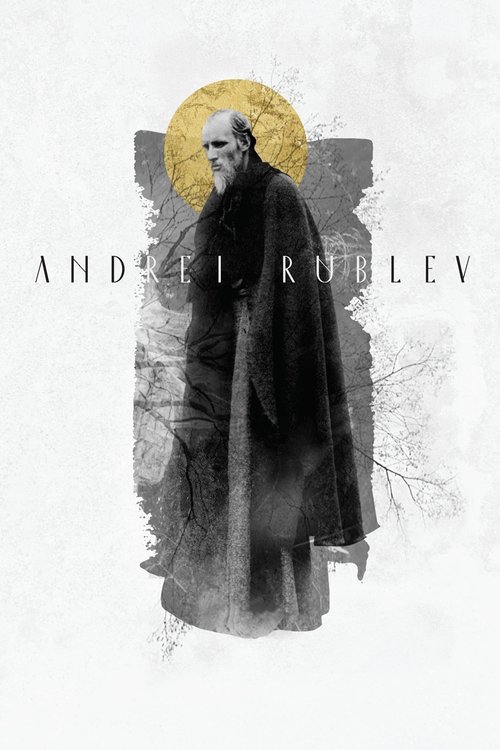
Andrei Rublev
1966 · Andrei Tarkovsky
For when you want to be swallowed by something monumental — a whole-evening commitment when you're craving depth, patience, and transcendence rather than entertainment. Definitely a challenge, and worth it.
What it's about
Medieval Russia, early 1400s: a monk and icon painter wanders a land of famine, pagan rituals, princely rivalries, and Tatar raids, trying to hold onto his faith in art while history burns around him. Told in loosely connected episodes across a quarter century, it follows Andrei Rublev from workshop apprenticeships through atrocity, silence, and the long road back to creation.
The experience
Slow, vast, and hypnotic — three and a half hours that feel less like watching a story than living through a century. It's demanding and sometimes brutal, but it builds to one of the most quietly overwhelming final stretches in cinema, and the awe is real.
Performances
Anatoly Solonitsyn, in his first major role, carries the film with a face that does the talking — Rublev spends long stretches silent, and Solonitsyn makes that silence eloquent.
The craft
Shot in stark, luminous black and white with roving long takes that make fifteenth-century Russia feel documentary-real — mud, snow, horses, cathedrals — before a final shift into color that lands like a thunderclap. The bell-casting episode near the end is one of the great sustained sequences ever filmed. See it as big as you possibly can.
Why it matters
Suppressed and recut by Soviet authorities for years before reaching the world, it's now a fixture on greatest-films-ever lists and the work that established Tarkovsky as a giant of spiritual cinema.
Snapshot
A three-and-a-half-hour meditation on artistic conscience, faith, and the cost of creation, Andrei Rublev follows the historical fifteenth-century Russian icon painter through a sequence of largely unconnected episodes spanning roughly 1400 to 1424. Tarkovsky's second feature is not a biography in any conventional sense: his Rublev witnesses atrocities, falls silent for years, and ultimately returns to painting without the film explaining why. That withholding is the argument. Shot almost entirely in stark, luminous black and white and concluding with an extended color epilogue of Rublev's surviving icons, the film refuses the heroic narrative arc of the Soviet historical epic it superficially resembles, instead proposing that the work of art outlasts — and perhaps redeems — the suffering that surrounds its making. Completed in 1966, suppressed by Soviet authorities, and not fully released in the USSR until 1971, it is widely regarded as one of the defining achievements of world cinema.
Industry & production
Andrei Rublev was produced at Mosfilm, the flagship Soviet state film studio, on a substantial budget commensurate with its historical scope, though exact figures have not been consistently reported in Western scholarship. Tarkovsky co-wrote the screenplay with Andrei Konchalovsky (then known as Andrei Mikhalkov-Konchalovsky), and the project gestated through multiple drafts before principal photography began in 1964. The pair had collaborated previously; Konchalovsky had worked on the script for Ivan's Childhood (1962), Tarkovsky's debut feature.
Upon completion, the film was immediately controversial within Mosfilm and the Soviet cultural bureaucracy. Authorities objected to its bleak portrayal of medieval Russian life — the violence, the pagan sexuality of the Midsummer Night episode, the general absence of socialist-realist uplift — and its implicit commentary on the relationship between the state and the artist was not lost on censors. The film was shelved. A heavily cut version circulated in very limited domestic screenings beginning around 1969, and a print — reportedly still not the full director's version — was screened at Cannes in 1969 outside of the main competition, where it attracted significant international critical attention. The complete film was not given a proper Soviet domestic release until 1971, five years after its completion, and even then under conditions that varied by region and venue. This protracted suppression became central to Tarkovsky's reputation in the West as an artist in defiance of Soviet cultural policy.
Technology
The film was shot on 35mm using Sovscope lenses and black-and-white stock for virtually its entire running length, with the crucial exception of the epilogue, which switches to color — reportedly using Sovcolor, the Soviet color film process — to reproduce Rublev's actual icons in something approaching their material reality. This structural use of monochrome-to-color is not a trick but an ontological shift: the black-and-white episodes are the record of history, suffering, and human time; the color sequences are the icons themselves, outside time. The film's original running time is approximately 205 minutes in its restored form, though various release prints have been shorter.
Lighting relied heavily on natural or naturalistic sources. Shooting on location — at historical sites in the Vladimir region and elsewhere in central Russia — imposed severe conditions, particularly for the winter sequences and the large-scale battle-and-raid episode. Tarkovsky and cinematographer Vadim Yusov pushed available-light techniques to extremes unusual for Soviet production of the period, and the resulting grain and tonal range are inseparable from the film's texture.
Technique
Cinematography
Vadim Yusov, who had shot Ivan's Childhood for Tarkovsky, is the film's cinematographer, and his collaboration with the director reaches its fullest expression here. The visual grammar is built on duration: extremely long takes that refuse to cut away from discomfort or to punctuate revelation with an edit. The camera moves — tracks, pans, slow cranes — but its movement tends to feel observational rather than expressive in the conventional sense, as if the frame is discovering rather than composing. Wide lenses are used to place figures within vast, hostile landscapes; close-ups are rare and, when they appear, intensely felt. The raid sequence deploys a more agitated, nearly handheld register that breaks sharply from the film's prevailing stillness, using visual chaos to convey the incoherence of mass violence without aestheticizing it. Throughout, fog, rain, mud, and snow are not atmospheric decoration but active pictorial elements that blur the boundary between figure and ground, between the human and the elemental.
Editing
The film was edited by Lyudmila Feiginova, and the editing philosophy is essentially anti-Eisenstein: where Soviet montage generates meaning through collision, Andrei Rublev generates meaning through duration and adjacency. The eight episodes (plus a prologue and epilogue) are separated by title cards giving dates, creating the structure of a chronicle, but the transitions within episodes resist psychological or causal continuity. Cuts to black are used to end episodes, creating genuine silences in the film's rhythm. The editing does not build toward climaxes so much as it accumulates weight.
Mise-en-scène / staging
Tarkovsky's staging across the film's extended sequences reveals a director for whom the physical world — mud, water, livestock, fire, bodies — carries metaphysical weight. Crowds are staged without the hierarchical clarity of conventional historical epics; figures at the edge of frame are as present as those at its center. The celebrated Midsummer Night sequence achieves an almost documentary texture in its depiction of pagan ritual, shot as if stumbled upon. The final Bell episode stages the casting of the great bell as a sustained crisis of faith and will, with the young Boriska (Nikolai Burlyaev) commanding vast numbers of workers across an outdoor landscape while Tarkovsky's camera observes from shifting distances, never reducing the event to spectacle.
Sound
Sound design is spare and often discomfiting. Silence functions as a structural element — Rublev's own vow of silence is literalized in the film's long stretches with minimal dialogue. Ambient sound (water, wind, the sounds of labor and animals) frequently dominates over musical score. Vyacheslav Ovchinnikov composed the music, which draws on Russian folk and ecclesiastical sources and is deployed very selectively, arriving at moments of heightened emotion or spiritual passage rather than as continuous accompaniment.
Performance
Anatoly Solonitsyn plays Rublev and delivers what may be the defining performance of his career — and, notably, a performance of nearly impossible restraint. For long stretches Rublev says almost nothing; Solonitsyn conveys inner life through posture, stillness, and the quality of attention he directs at the world around him. It was Solonitsyn's breakthrough role, and he would go on to appear in every subsequent Tarkovsky film made in the Soviet Union. Rolan Bykov's jester in the opening episode offers a counterpoint in kinetic, almost anarchic physicality. Nikolai Burlyaev, who had played the child soldier in Ivan's Childhood, returns here as Boriska — his performance of adolescent terror-masquerading-as-authority in the Bell episode is one of the most extraordinary in the film.
Narrative & dramatic mode
The film explicitly rejects conventional biographical narrative. Its episodes are deliberately chosen to exclude the events most obviously relevant to Rublev's artistic career; we see almost no painting until the very end. The drama unfolds through witnessing: Rublev watches a balloon flight end in catastrophe, observes the jester's humiliation, encounters Theophanes the Greek (a historical collaborator, played by Nikolai Sergeyev), survives the Tatar raid on Vladimir, and takes a silent vow that lasts for years. The Passion structure — the subtitle of Tarkovsky's original screenplay draft was reportedly The Passion According to Andrei — is legible but not schematic; Rublev is not Christ, but the film is interested in suffering, witness, and the possibility of grace. The narrative mode is closer to hagiography as a form than to the Western biopic, which makes the film's refusal of sanctimony all the more striking.
Genre & cycle
The film occupies an uncomfortable position relative to the Soviet historical epic, a prestige genre with a clear ideological function. Eisenstein's Alexander Nevsky (1938) and Ivan the Terrible (1944–46) are the canonical reference points — films that mobilized the past to glorify Russian collective identity. Andrei Rublev destabilizes this tradition at every point: its history is one of fratricidal violence, foreign invasion that is partly enabled by Russian princes, and the conspicuous absence of anything that could serve as national-mythological uplift. It belongs simultaneously to a mid-1960s international cycle of art cinema engagements with religious and metaphysical experience — Bresson's The Trial of Joan of Arc (1962), Bergman's faith trilogy — while remaining distinctively rooted in Russian Orthodox visual and spiritual culture.
Authorship & method
Tarkovsky was twenty-nine when he began the screenplay and thirty-four when the film was completed. Andrei Rublev is the work in which his mature aesthetic — long take, elemental imagery, the rejection of psychological causality as the engine of narrative — fully crystallizes. His method involved extensive pre-production research into medieval Russian history, iconography, and architecture, and a deliberate decision not to reconstruct history illustratively but to render it phenomenologically: as texture, labor, and physical presence rather than pageant. The collaboration with Konchalovsky on the screenplay was generative but also contested; accounts suggest the two diverged significantly in their conception of the material, with Tarkovsky pushing toward increasingly oblique and episodic structure. Yusov's contribution as cinematographer is difficult to overstate — his ability to work in natural light at the scale and duration Tarkovsky required was essential to the film's visual identity. After Andrei Rublev, Tarkovsky and Yusov parted ways; subsequent Tarkovsky films were shot by other collaborators.
Movement / national cinema
The film emerges from the conditions of the Khrushchev Thaw — a relative loosening of cultural controls that briefly permitted Soviet filmmakers to work with greater personal latitude — but arrives precisely as that thaw is ending and Brezhnev-era conservatism reasserts itself. Its suppression is partly explained by this political timing: the film was completed in a window that had already closed. It belongs to a generation of Soviet filmmakers — including Kira Muratova, Sergei Paradzhanov, and Elem Klimov — who pushed against socialist realism toward personal, visually experimental, and spiritually serious cinema. Paradzhanov's Shadows of Forgotten Ancestors (1965) shares with Andrei Rublev an interest in pre-modern folk and religious culture rendered in radical visual terms. The film's relationship to the Russian Orthodox tradition — its iconographic sensibility, its understanding of the icon as a window rather than a representation — gives it a specifically Russian cultural texture that resists easy assimilation into Western art cinema categories, even as it was received internationally through those categories.
Era / period
The film was made during what Tarkovsky scholars sometimes call the "long sixties" of Soviet art cinema — roughly 1958 to 1972 — a period bookended by the Thaw's opening and the accelerating cultural freeze of late Brezhnev. It is contemporary with a broad international wave of serious, formally ambitious cinema: the French New Wave, the Czech New Wave, the emergence of New German Cinema. Tarkovsky was aware of European art cinema — his admiration for Bergman and Bresson is well documented — but Andrei Rublev is not a provincial echo of those movements; it is a work with its own cultural and spiritual genealogy.
Themes
The film's central preoccupation is the relationship between art and suffering — specifically, whether art can be made in good conscience during times of historical catastrophe, and what it costs the artist to make it. Rublev's vow of silence is not a retreat but a response: having witnessed the Tatar sack of Vladimir and having killed a man to protect a woman, he cannot paint. The Bell episode answers this impasse obliquely: Boriska's act of creation — casting the bell through apparent faith in a knowledge he does not actually possess — dissolves Rublev's silence not through argument but through contagion. If a boy can create out of nothing (or out of bluff, or out of desperate faith), then perhaps art is possible again. Alongside this: Russian national identity and its violence, the fragility of sacred tradition, the relationship between individual conscience and collective history, and the problem of representing God in material form — the theological stakes of icon painting, which the film takes seriously as art-historical fact.
Reception, canon & influence
The film's critical reputation was built primarily through its international exposure before its domestic Soviet release. The 1969 Cannes screening generated substantial attention among European critics, and by the time of its full release in the early 1970s it had acquired the aura of a suppressed masterpiece. That aura has proved durable: the film regularly appears near the top of critical polls of the greatest films ever made, including the Sight & Sound decennial surveys, and it is the work most frequently cited when Tarkovsky's significance is being argued.
Influences on the film: Tarkovsky's engagement with Bergman's spiritual cinema (particularly the faith trilogy — Through a Glass Darkly, Winter Light, The Silence) is evident in the film's theological seriousness and its willingness to leave spiritual crisis unresolved. Bresson's model of sacred cinema — the reduced performance style, the use of non-professionals, the interest in grace — is a clear reference. The Soviet silent tradition, particularly Dovzhenko's lyric approach to landscape and collective life, informs the film's relationship to the natural world. Eisenstein's historical films are a conscious counter-model: Tarkovsky explicitly rejected Eisenstein's montage-based rhetoric in favor of what he called "sculpting in time."
Legacy and forward influence: The film's influence on subsequent cinema is extensive and largely indirect. Its conception of the long take as spiritual duration — the idea that real time onscreen is an ethical stance — anticipates and enables the work of Béla Tarr, whose extended takes carry a similar moral weight. Terrence Malick's use of natural imagery as a vehicle for metaphysical inquiry, visible across his entire filmography but particularly in The Tree of Life (2011), is inconceivable without Tarkovsky, and Andrei Rublev is the film where that mode is first fully achieved. The structure of the film — episodic, chronological but non-causal, organized around witnessing rather than acting — influenced a generation of directors interested in alternative models of historical narrative. Within Russian and post-Soviet cinema, the film effectively established the terms of a certain contemplative, iconographic cinema that younger filmmakers have had to reckon with. The Bell episode in particular — its portrait of creation as a wager on inherited knowledge that may not exist — has become something close to a reference myth about the artist's condition.
A Deleuzian reading
A man lashes himself to a crude balloon of stitched hide and rope, fights free of a mob and a church wall, and for one minute hangs above the silver bends of a river.
The full Deleuzian reading of Andrei Rublev →
Reception
Shelved by Soviet authorities for years after its 1966 completion, it screened at Cannes in 1969 only at a 4am slot after official pressure — and still won a prize; barely released at home until 1971, it's now a fixture near the top of Sight & Sound's greatest-films polls.
How Andrei Rublev was received, from release to now →
Influences: the films it descends from and the films it influenced
- La Passion de Jeanne d'Arc (1928) — Dreyer's hagiographic structure — a historical saint rendered entirely through what she endures and witnesses rather than through psychological motivation — establishes the biographical refusal and witnessing mode Tarkovsky applies to Rublev: both figures are characterized by what passes through them, not by resolved interiority.
- Earth (1930) — Dovzhenko's lyrical landscape cinema — wide-angle compositions placing figures within Ukrainian earth and sky, with contemplative duration replacing Eisenstein's collision-montage — gives Tarkovsky the model for treating elemental material (mud, water, fog) as metaphysical substance rather than atmospheric decoration.
- Ivan the Terrible, Part I (1944) — Eisenstein's expressionist staging of the historical great-man — montage-driven causality, operatic close-ups asserting psychological grandeur, ideological telos — is the exact Soviet historical-epic template Tarkovsky dismantles: where Eisenstein explains, Tarkovsky withholds; where Eisenstein accelerates, Tarkovsky accumulates.
- Ugetsu (1953) — Mizoguchi's long-take fluid tracking shots through historical Japanese settings — camera discovering space rather than composing it, allowing atmosphere to accumulate without montage assertion — give Tarkovsky the model for an observational camera that moves through the medieval world without punctuating or editorializing it.
- The Seventh Seal (1957) — Bergman's use of stark black-and-white photography to stage medieval encounters with mortality as non-causal allegorical episodes — with silence deployed as a spiritual register — provides the visual tone and episodic encounter structure Rublev inherits, where faith is dramatized through witnessing rather than through resolved argument.
- Pickpocket (1959) — Bresson's model system — directing actors toward affectless restraint by suppressing interpretive gesture — and his insistence on ambient sound as the film's acoustic architecture over non-diegetic score are the most direct technical precursors to Tarkovsky's direction of Solonitsyn and to Rublev's ambient-over-score sound design.
- Winter Light (1963) — Tarkovsky absorbs the Bergmanian chamber-drama approach — confined episodes, extended duration, silence as spiritual register — and scales it to medieval Russia; his theoretical writings directly cite Bergman's sculpting of time as the precedent for duration's role as a plastic, not merely temporal, material.
- Ivan's Childhood (1962) — Tarkovsky's next film extends the deep-focus ruin-landscape photography and Gothic framing into medieval Russia; the bell-casting sequence transplants Ivan's concentrated child performance — Boriska — into identical formal territory: a child under extreme historical pressure, rendered through physical intensity rather than psychological explanation.
- Europa '51 (1952) — Tarkovsky applies Rossellini's hagiographic mode — an artist-saint whose absolute moral position renders him socially unassimilable, staged through available-light cinematography and found-environment location work in medieval Russian spaces — inheriting the passive-presence performance logic and the drama-of-witness structure without direct acknowledged contact.
- The Human Condition I: No Greater Love (1959) — Long-take, long-form moral epic tracking an artist's conscience under historical brutality, sustaining the same dread-of-inevitability tempo across episodic chapters.
- Day of Wrath (1943) — Carries the contemplative duration and spiritual gravity of Dreyer's example into a medieval-religious slow cinema where time and the burdened face do the dramatic work.
- Diary of a Country Priest (1951) — Tarkovsky, who acknowledged Bresson, sustains spiritual desolation through contemplative duration and ambient naturalism, treating faith as endured rather than dramatized.
- The Color of Pomegranates (1969) — Parajanov's portrait of the Armenian poet Sayat-Nova organizes itself as tableaux rather than biographical episodes, using cultural objects — manuscripts, musical instruments, carpets — as primary visual language with complete refusal of psychological interiority, a direct descendant of Rublev's hagiographic structure developed within the same Soviet context and similarly suppressed by authorities.
- The Travelling Players (1975) — Angelopoulos extends Rublev's chronicle-episode structure and anti-Eisenstein duration into Greek political history: shots run to ten or more minutes, the camera pans through historical time within a single uncut take, and a theatrical troupe witnesses political upheaval without causal agency — a systematic formal inheritance of Tarkovsky's temporal grammar.
- Come and See (1985) — Klimov inherits Rublev's witnessing mode and available-light technique — pushed here to extreme grain and deliberate tonal distortion — for a Soviet war film in which the protagonist watches atrocity without heroic agency; the German raid sequences use the same controlled visual chaos as Rublev's Tatar attack, registering trauma through the body and face rather than through action.
- Wings of Desire (1987) — Wenders uses black-and-white for the angels' observational perspective and color for embodied human experience, the monochrome-to-color transition marking the moment of incarnation — a direct formal descendant of Rublev's epilogue structure, where black-and-white historical time gives way to color as the icons enter an ontological register outside human suffering.
- Sátántangó (1994) — Tarr's seven-hour episodic black-and-white chronicle, organized around rain and mud as constant active compositional elements, with extremely long takes refusing conventional editing rhythm and ambient sound suppressing non-diegetic score, represents the most systematic extension of Rublev's anti-Eisenstein durational grammar in post-Soviet cinema.
- Werckmeister Harmonies (2000) — Tarr's compressed available-light black-and-white long-take cinematography stages the witnessing mode in its purest form — János moves through collective violence without agency or comprehension — extending Rublev's formal proposition that duration and restraint, not montage or heroic action, are the appropriate cinematic registers for historical catastrophe.
- Silence (2016) — Scorsese deploys hagiographic episode structure for historical Jesuit missionaries, organizes the protagonist's extended silence as a spiritual crisis equivalent to Rublev's vow, and refuses biographical resolution — the film's final ambiguity inheriting Tarkovsky's core proposition that the surviving work (a hidden fumie kiss, a painted icon) outlasts the film's capacity to explain the suffering behind it.
- Magellan (2025) — Precedent for the black-and-white anti-epic of national history: treating a founding-era subject through long, contemplative tableaux and episodic restraint rather than the spectacle and forward drive of the costume epic.
- Solaris (1972) — Tarkovsky formalized his lyric episodic structure here — chapters that withhold psychological motivation and build emotional pressure within long takes rather than through cutting — establishing the duration-based editing logic and cluttered mise-en-scène of accumulated physical objects that Solaris inherits directly.
- Aguirre, the Wrath of God (1972) — Tarkovsky's refusal to subordinate image duration to narrative momentum — sustained takes and slow assembly cuts that accumulate weight over incident — is the direct predecessor of Beate Mainka-Jellinghaus's suspended editing rhythm, while Vyacheslav Ovchinnikov's ambient choral scoring precedes Popol Vuh's non-diegetic atmospheric function.
- Fitzcarraldo (1982) — Tarkovsky's episodic lateral structure — autonomous tableaux that accumulate rather than cause each other — and his staging of extreme physical conditions (mud, fire, ice) as spiritual metaphor rather than dramatic obstacle directly precede Herzog's narrative grammar and his insistence that the ship crossing be an act, not a symbol.
- Ran (1985) — Tarkovsky renders the Tatar raid sequence through long-take observation and formalized chaos — visually overwhelming but aesthetically positioned as spiritually catastrophic rather than thrilling — establishing for the prestige historical epic the method of locating moral meaning inside spectacular violence through durational formal rigor, a method Ran deepens in its castle-burning and battle sequences.
- Au hasard Balthazar (1966) — Released the same year, Balthazar extends Bresson's ambient-sound-over-score design and passive-witness episodic structure — a protagonist moving through human cruelty without causal agency — making it the closest formal sibling to Rublev's treatment of the icon painter as a figure through whom history passes rather than one who acts upon it.
- Persona (1966) — Also 1966, Bergman makes a character's refusal to speak the structural and narrative center of the film — silence generating meaning through surrounding pressure to fill it — which is precisely the formal move Tarkovsky makes with Rublev's years-long vow: withholding speech as the more powerful artistic act than explaining it.
- Chronicle of Anna Magdalena Bach (1968) — Straub-Huillet render Bach's life entirely through live recordings of his music and primary-source documents, refusing psychological dramatization and proposing that the surviving work is the artist's true record — the most formally exact sibling to Rublev's hagiographic refusal, where the color icon epilogue stands as the only evidence that matters.
- The Gospel According to St. Matthew (1965) — Renders sacred history through material roughness, weathered non-glamorous faces, and painterly black-and-white composition rather than epic gloss — the same anti-spectacular treatment of holy subject matter.
- Caravaggio (1986) — A painter's biography told in elliptical, non-chronological fragments that withhold the art until the end — the associative, anti-biopic structure Jarman's memory editing echoes.
- Mother Joan of the Angels (1961) — Monochrome meditation on faith and the body in extremis, with monastic figures set against austere fields and interiors, and bursts of collective pagan/ecstatic movement against the sacred order.
- Shadows of Forgotten Ancestors (1965) — Shares the chaptered, titled episodic architecture and the reconstruction of archaic ritual set-pieces (pagan rites, folk craft) as immersive ethnographic tableau within a Thaw-era poetic register.
- Edvard Munch (1974) — Films an artist's biography as episodic crises of creation and conscience — the life treated as a problem of consciousness and faith rather than a sequence of illustrated milestones.
- Marketa Lazarová (1967) — Near-contemporary medieval meditation on faith and violence built from long immersive takes and physical authenticity over dramatic exposition.
- War and Peace, Part II: Natasha Rostova (1966) — Yusov's wide-angle 'scope long takes drift through crowded, mud-real historical spaces with the camera behaving as an unattached observer among extras — the same Mosfilm-scale conviction that a period world must be built and then wandered through, not assembled in cutting.
Similar films
- The Color of Pomegranates (1969) — influence & lineage · same viewing thread · often watched together
- Au Hasard Balthazar (1966) — influence & lineage · same viewing thread
- The Passion of Joan of Arc (1928) — influence & lineage · often watched together
- The Seventh Seal (1957) — influence & lineage · often watched together
- The Turin Horse (2011) — same viewing thread · often watched together
- The Sacrifice (1986) — same viewing thread
- Mirror (1975) — same viewing thread
- Shadows of Forgotten Ancestors (1965) — same viewing thread
All the films related to Andrei Rublev →
Watch it with: curated runs of related films
- Transcendental Style — A run for when you want cinema as prayer — faith, ritual, and the turning of seasons rendered in long takes and painterly stillness, where time itself becomes the subject rather than the story.
Film essays and courses that include it
- What the Censor Invented: Forbidden Cinema from Stalin to Tehran
- Andrei Tarkovsky
- The Unbroken Take: From Camera Liberation to Single-Shot Cinema
- Dialectics of the Soul: Russian Cinema from Eisenstein to Zvyagintsev
- The Habit and the Void: Faith, Institution, and Doubt in World Cinema
- The Art of Duration: Slow Cinema from Dreyer to Tarr
- The Silence of God: Cinema's Argument with the Divine
- Sculpting in Time
- You Can Only Film the Doubt