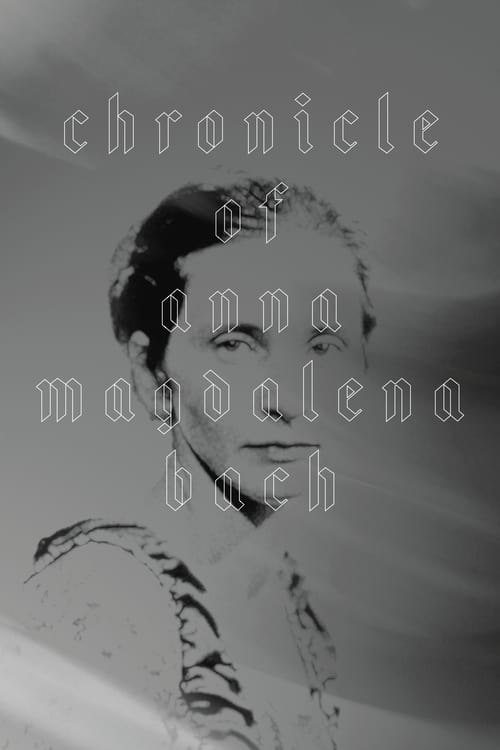
Chronicle of Anna Magdalena Bach
1968 · Jean-Marie Straub
For a quiet, unhurried evening when you want to sit inside great music rather than be told a story about it — a challenge for anyone expecting a biopic, a balm for anyone who loves Bach.
What it's about
The last decades of Johann Sebastian Bach's life, told through the calm voice of his second wife, Anna Magdalena — his jobs, his employers, his children, his money troubles, and above all his music. Instead of dramatized scenes, the film gives you musicians in period dress actually performing the works, at length, in the spaces where such music lived.
The experience
Serene, austere, and quietly hypnotic — long unbroken stretches of live Bach with almost no conventional drama between them. It asks for patience and rewards it; if you settle into its rhythm it becomes something close to meditation.
Performances
The harpsichordist Gustav Leonhardt, a giant of the early-music world, plays Bach himself — not acting so much as embodying the composer through the playing, which is the real performance here.
The craft
The music was recorded live as it was played, on period instruments, in long frontal takes — no miming, no studio sweetening — which was radical for its time and still sounds startlingly present. The narration is read flat and unadorned over documents, scores, and still frames, letting the performances carry all the feeling. Good speakers matter more than a big screen.
Why it matters
It became a touchstone for filmmakers interested in how cinema can present music honestly, and helped define its directors' reputation for rigorous, uncompromising work.
Snapshot
Chronik der Anna Magdalena Bach is a film about Johann Sebastian Bach that refuses almost everything the musical biopic had taught audiences to expect. Directed by Jean-Marie Straub in close partnership with Danièle Huillet — who, by the couple's own lifelong insistence, was a full co-author and is properly credited alongside him despite the era's single-name billing — the film narrates the last three decades of Bach's life through the invented voice of his second wife, Anna Magdalena. Over a soundtrack of her quiet, affectless reading, the screen gives us musicians in period dress performing Bach's works in long, frontally framed takes, the music recorded live as it was played. The keyboard parts are performed by the harpsichordist Gustav Leonhardt, who also embodies Bach; the early-music conductor Nikolaus Harnoncourt and his Concentus Musicus Wien appear among the players. The result is at once a documentary of performance and a rigorously austere historical reconstruction — a work that treats Bach's biography as a record of labor, contracts, grief, and obligation rather than of inspiration. It stands today as one of the foundational texts of materialist modernist cinema and the most uncompromising film ever made about a composer.
Industry & production
The film's defining production fact is its gestation: Straub and Huillet conceived it in the mid-1950s and spent more than a decade trying to finance it. Their refusal to compromise on the central principle — that the music be played, in full, by genuine performers on period instruments, recorded directly rather than dubbed or pre-recorded — made the project commercially illegible to producers who wanted a conventional costume drama with a star. The couple reportedly turned down funding offers that came with such conditions, and the long delay is part of the film's legend. It was finally realized as a West German–Italian co-production, mounted on a modest budget by figures sympathetic to the emerging European art cinema; the Italian producer Gian Vittorio Baldi was central to assembling the means, reflecting the Straubs' Rome base during these years. Precise budget and box-office figures are not part of the reliably documented record, and I will not invent them; what is clear is that the film was made cheaply, with a small crew, in authentic locations, and that its economy is inseparable from its aesthetic.
Shooting took place in 1967 in surviving Baroque interiors and churches in Germany associated with the period, lending the images a documentary weight that built sets could not. The casting of working musicians rather than actors was both an artistic and a practical decision: it guaranteed that the performances on screen were real, and it bound the production schedule to the rhythms of rehearsal and live music-making.
Technology
Chronicle is, at bottom, a film organized around a sound technology and a recording ethic. The decisive choice was direct sound — capturing the music in the moment of performance, on location, rather than constructing it in post-production. This was technically demanding in 1967: it required the camera and the recording apparatus to be subordinated to the musicians' tempo, and it foreclosed the conventional safety net of playback miming. The film thus belongs to the broader late-1960s movement toward synchronous location sound, but pushes it to a principle. The image is black-and-white 35mm, and the visual technology is deliberately unspectacular — no elaborate optical effects, no color, no process work. The instruments themselves are the period technology the film foregrounds: harpsichords, the chamber organ, Baroque strings and winds, tuned and played in a manner that anticipated the historically-informed performance movement Leonhardt and Harnoncourt were then pioneering. In a real sense the film is a document of that musicological technology as much as of cinema's.
Technique
Cinematography
The photography — credited to a small camera team that worked closely under Straub and Huillet's exacting direction — is defined by stillness, frontality, and a refusal of expressive lighting. Compositions are typically square-on to the performers, framing the act of playing: hands on a keyboard, an ensemble ranged across a hall, a choir loft. The black-and-white is clean and even rather than dramatically chiaroscuro'd. Camera movement, when it occurs, is slow and motivated — a measured pan or a reframing — never used to "interpret" the music or to inject false dynamism. The camera observes; it does not editorialize. This austerity is a positive aesthetic, not a limitation: by holding on the performers without cutting away, the cinematography insists that what matters is the labor of making the music, visible in real time.
Editing
Huillet was the principal architect of the film's editing, and the cut follows the music's logic rather than a dramatic one. Performances are presented in long, often unbroken takes that respect the integrity of a movement or section; the film resists the standard montage of a piece broken into reaction shots and cutaways. Between the musical "tableaux," the editing is elliptical, advancing across years via the spoken chronicle and intertitle-like markers rather than dramatized transitions. The effect is a paratactic structure — performance, narration, performance — that accumulates rather than builds in the manner of a plot. The cut's discipline is one of the most influential features of the film.
Mise-en-scène / staging
Everything in the frame is governed by an ethic of authenticity and restraint. Period costume, real Baroque rooms, genuine instruments, and the absence of anachronistic decoration give the staging a documentary plausibility. The performers are arranged as they would have been to play, not as a director would block actors for emotional legibility. There is no "business," no invented incident to humanize the figures. When Bach sits at the keyboard, the staging is simply that of a man at work. This frontal, presentational mise-en-scène is closely related to Brechtian theater: it shows rather than illusionistically absorbs, keeping the spectator aware that they are watching a reconstruction.
Sound
Sound is the film's center of gravity. Because the music was recorded live and direct, it carries the grain and presence of real performance — the room, the instruments, the human effort. Anna Magdalena's voice-over is delivered flatly, without dramatic color, so that it functions as document rather than emotional commentary. The relation between her spoken text and the played music is one of counterpoint: the narration supplies the dates, the moves, the bereavements and disputes, while the music supplies what cannot be said. The deliberate avoidance of a non-diegetic "score" — there is no music in this film that is not someone playing — is total and exemplary.
Performance
The film's most radical wager is to cast a great musician, Gustav Leonhardt, as Bach, and to let his musicianship rather than his acting carry the role. Leonhardt does not "perform" emotion; he performs Bach's keyboard works, and his bearing is grave, contained, professional. Christiane Lang plays Anna Magdalena, and Nikolaus Harnoncourt appears as Prince Leopold of Anhalt-Köthen. The acting throughout is anti-expressive — figures speak and move with a flatness that denies the audience the catharsis of conventional biography. This is performance as presentation, aligned with Straub-Huillet's lifelong commitment to non-professional or specially-chosen performers who bring their real competence (here, musical) to the frame.
Narrative & dramatic mode
The film advances chronologically from roughly the time of Bach's marriage to Anna Magdalena in 1721 through the Köthen years and the long Leipzig period as Thomaskantor, to his death in 1750. Its dramatic mode, however, is anti-dramatic. The narrating chronicle is a Straub-Huillet invention — no such memoir by Anna Magdalena exists — but its content is assembled from authentic documents: Bach's letters and petitions, contracts and complaints, the records of his disputes with the Leipzig town council over duties and remuneration, and the obituary notice written after his death. The film thus dramatizes a life largely through its paperwork and its losses: the deaths of children and of Bach's first wife, the friction between an employed musician and his institutional masters, the daily grind of producing cantatas to schedule. There is no rising action, no climax, no redemptive arc. The "drama," such as it is, lies in the tension between the transcendent music we hear and the mundane, often grinding material conditions under which it was produced.
Genre & cycle
Chronicle belongs nominally to the composer biopic and the music film, but it exists as a deliberate negation of both. Against the Hollywood and European tradition of the lushly scored, emotionally heightened composer biography — films that treat music as the soundtrack to a great man's passions — Straub and Huillet built an anti-biopic: documentary in its respect for performance, materialist in its attention to economics and labor. It can equally be placed in a cycle of modernist films of the late 1960s that interrogated cinematic representation itself, and in the lineage of "films about art" that refuse to reduce the artwork to illustration. Within Straub-Huillet's own filmography it inaugurates a recurring method — the long-gestated adaptation, the direct-sound performance of a text or score, the frontal tableau — that they would pursue across decades.
Authorship & method
The film is the work of Jean-Marie Straub and Danièle Huillet, whose collaboration was so complete that separating their contributions is largely artificial; Huillet's role in scripting, editing, and the rigorous production discipline was decisive, and the standard later correction to the historical record is to credit the film to both. Their method is the film's true subject: the refusal to fake anything. The screenplay was constructed over years from primary documents; the casting privileged real musicians; the sound was recorded live; the locations were authentic. The musicological collaborators are inseparable from the authorship — Gustav Leonhardt as both performer-actor and keyboardist, and Nikolaus Harnoncourt and the Concentus Musicus Wien as the ensemble whose historically-informed practice gave the film its sonic identity. The camera team and the editing (Huillet) served a single governing principle of subordination to the music and the document. It is one of the purest expressions in cinema of an ethics of authorship in which form is wholly determined by a refusal to lie about the material.
Movement / national cinema
The film arrived at the threshold of the New German Cinema, and is often invoked in that context, but Straub and Huillet always sat athwart any national category. Germans working substantially out of Italy, financed across borders, steeped in French cinephile and Brechtian-modernist culture, they belong to a transnational modernist European cinema as much as to any one tradition. Chronicle is nonetheless a landmark of what would soon be called the materialist or modernist current — the wing of late-1960s filmmaking that, alongside figures elsewhere in Europe, treated film as a means of analysis rather than illusion. Its insistence on the labor behind art, and its Brechtian distance, mark it as a political film without a single overt political statement.
Era / period
Released in 1968, Chronicle is a creature of its moment even as it looks back two centuries. The late 1960s saw a Europe-wide turn toward films that questioned representation, narrative, and the spectator's passive absorption; it also saw, in music, the rise of the historically-informed performance movement that Leonhardt and Harnoncourt led. The film sits precisely at the intersection of these two renewals — cinematic and musicological — and could only have been made when both were cresting. Its long pre-history through the 1950s and early 1960s also makes it a bridge from the post-war cinephile culture that formed the Straubs to the explicitly modernist cinema of 1968.
Themes
The film's deepest theme is work — art as labor performed under conditions of constraint, dependency, and grief. Bach appears not as a genius transported by inspiration but as a salaried craftsman negotiating with employers, mourning his dead, and producing, week after week, music of staggering quality under unglamorous pressure. A second theme is the relation between the material and the transcendent: the film holds the documentary fact of performance — bodies, instruments, rooms, contracts — in tension with the spiritual reach of the music, and refuses to collapse one into the other. Mortality runs throughout, voiced in Anna Magdalena's catalog of deaths. And underlying all of it is an ethic of fidelity: a refusal to sentimentalize, to dramatize falsely, or to let representation betray the truth of how the music actually came to be.
Reception, canon & influence
On release the film was recognized by serious critics as a singular achievement and by general audiences as forbidding; its austerity guaranteed that it would never be a popular success, and detailed contemporary box-office records are not part of the reliable account. Over the following decades, however, Chronicle of Anna Magdalena Bach became a touchstone of modernist film culture, regularly cited as among the greatest films about music and about the relation between cinema and the other arts, and championed by critics associated with rigorous, theory-informed criticism.
Its influences run backward to Brecht's theater of distanciation, to a documentary impulse toward unfaked reality, and to the post-war European cinephilia that formed its makers. Forward, its legacy is large out of all proportion to its viewership. It established direct-sound performance and the frontal long take as serious aesthetic options, and it became a model for filmmakers seeking to film art, text, or music without illusionism — a lineage of austere, materialist cinema that treats the camera as a witness rather than an interpreter. For the Straub-Huillet partnership it was the breakthrough that defined a fifty-year method. Among films that ask what it means to represent a great artist without lying, it remains the unsurpassed example, and its quiet refusals continue to instruct filmmakers and scholars far more than its modest first audiences would have predicted.
A Deleuzian reading
Hands on a keyboard, square to the camera, and the music is real — recorded in the room, in the moment, by a man who is actually playing it.
The full Deleuzian reading of Chronicle of Anna Magdalena Bach →
Reception
In 1968 it split audiences down the middle — many found its long, static takes of musicians simply playing Bach unwatchably austere, while a devoted critical camp hailed it as radical. Today it's securely canonized as a landmark of modernist cinema and the most-cited entry point into Straub-Huillet.
How Chronicle of Anna Magdalena Bach was received, from release to now →
Influences: the films it descends from and the films it influenced
- Diary of a Country Priest (1951) — Bresson's affectless first-person voiceover reading directly from a written diary, paired with cast 'models' drained of theatrical expression, is the template for the film's flat document-recitation and anti-expressive performance.
- Pickpocket (1959) — The paratactic assembly of discrete gestural fragments and the treatment of hands and objects as documentary fact, rather than dramatically motivated action, anticipates Straub-Huillet's refusal of dramatic causality.
- The Taking of Power by Louis XIV (1966) — Rossellini's didactic, unemphatic reconstruction of court ritual — authentic costume and protocol filmed as pedagogical record with no dramatic underscoring — is the immediate precedent for an anti-biopic that reconstructs the past without faking it.
- Rome, Open City (1945) — The neorealist principle of shooting in authentic locations with a camera that witnesses rather than interprets is the documentary impulse Straub-Huillet carry into a 1968 reconstruction of Bach's milieu.
- Man with a Movie Camera (1929) — Vertov's materialist foregrounding of the recording apparatus and of work as the film's true subject underwrites the 'art-as-labor' ethic and the camera-as-instrument stance of the Bach film.
- Ordet (1955) — Dreyer's austere frontal staging and slow, near-static long takes that withhold psychological emphasis prefigure the frontal tableau used to film performance as ritual.
- The Trial of Joan of Arc (1963) — Radicalizes Bresson's documentary-transcript method: non-professional performers frontally recite historical documents in static long takes with direct-sound primacy, treating the archive as the film's spine.
- Jeanne Dielman, 23 quai du Commerce, 1080 Bruxelles (1975) — Akerman's fixed frontal frames and real-time long takes recording domestic labor without dramatic emphasis transpose the 'art/work-as-labor' tableau and anti-expressive performance onto everyday duration.
- Colossal Youth (2006) — Costa films non-actors playing versions of themselves in fixed frontal compositions with direct location sound and no score, explicitly extending the Straubian camera-as-witness to a contemporary milieu.
- The Death of Louis XIV (2016) — Serra's durational, anti-dramatic historical reconstruction — period detail filmed as patient observation rather than spectacle — inherits the anti-biopic ethic of reconstructing the past without theatrical lying.
- Sátántangó (1994) — Tarr's extended unbroken takes make duration itself the subject, descending from the frontal long take's insistence that the camera bear continuous witness to real time.
- Ten Skies (2004) — Benning's fixed-frame structural cinema with ambient direct sound and no non-diegetic score radicalizes the materialist principle of the camera as a neutral recording witness.
- 'Til Madness Do Us Part (2013) — Wang's observational long takes with direct sound and no score, refusing dramatic shaping of the recorded reality, carry forward the documentary impulse toward unfaked actuality.
- Stray Dogs (2013) — Tsai's extreme static long takes, near-motionless anti-expressive performers, and absence of non-diegetic score extend the frontal tableau into a contemplative durational form.
- Woyzeck (1979) — Straub-Huillet structure their film around pre-existing Bach performances used non-illustratively against frontal theatrical staging and zero intercutting within musical sequences — the precise model for Herzog's deployment of pre-existing Bavarian folk songs over Woyzeck's scenes rather than a commissioned or operatic score.
- The Enigma of Kaspar Hauser (1974) — Straub-Huillet's static camera observing non-professional performers in front of period architecture in rigorously composed tableaux — lens as uninvolved ceremonial witness — establishes the distanced presentational mode that Schmidt-Reitwein employs for the film's institutional and courtroom set-pieces.
- Even Dwarfs Started Small (1971) — Straub-Huillet enforce diegetic-only sound as a strict formal rule with extended takes that refuse editorial intervention — duration itself becomes the expressive instrument — establishing the New German Cinema discipline that Even Dwarfs applies to its own material as an act of anti-spectacular rigor.
- Dear Comrades! (2020) — Straub-Huillet's Academy ratio monochrome and rigorously non-dramatized observational staging of historical period—refusing both costume-drama theatrics and documentary commentary—anticipates Dear Comrades!'s formal austerity.
- Thirty Two Short Films About Glenn Gould (1993) — Tells a musician's life through complete performances shot in long takes with direct sound and through documents read aloud, refusing interiority entirely — the precedent for using Gould's own recordings as the film's structural substance instead of dramatic underscore laid beneath invented emotion.
- Not Reconciled (1965) — The directors' immediately prior feature established the paratactic editing, direct location sound, and non-actors-reciting-text method that the Bach film consolidates into a fifty-year practice.
- History Lessons (1972) — Extends the same direct-sound recitation of primary documents in authentic locations, with anti-dramatic long takes treating text as material to be heard, not performed.
- Moses und Aron (1975) — Applies the Bach film's principle — music recorded live and filmed frontally without illusionist coverage — directly to Schoenberg's opera, refusing playback and decorative staging.
- India Song (1975) — Duras splits an affectless, detached voiceover from the image track, sharing the Bach film's anti-illusionist separation of sound and picture and its refusal of dramatic identification.
- Andrei Rublev (1966) — Straub-Huillet render Bach's life entirely through live recordings of his music and primary-source documents, refusing psychological dramatization and proposing that the surviving work is the artist's true record — the most formally exact sibling to Rublev's hagiographic refusal, where the color icon epilogue stands as the only evidence that matters.
- La Chinoise (1967) — Straub-Huillet's frontal staging of Bach harpsichord performance—musicians filmed head-on in non-naturalistic stasis, musical labor exposed rather than aestheticized—develops the same Brechtian anti-illusionist blocking in parallel with La Chinoise, both films making theatrical apparatus visible as the political substance of the image.
- Land of Silence and Darkness (1971) — Straub-Huillet's radical austerity within New German Cinema — no narration, no historical explanation, sustained observation of craft labor and face — establishes the ascetic formal discipline that shapes Herzog's documentary restraint; the shared refusal of interpretive voiceover as a mode of respecting the observed subject is the direct link.
- L'Amour fou (1969) — The other 1968 argument for direct sound as an ethic — performances recorded live and whole within a single set-up, refusing post-synchronisation and refusing added score, the position Eloy's unconsoling music and Rivette's Nagra takes stake out from the fiction side.
Similar films
- Gertrud (1964) — shared sensibility
- Vivre Sa Vie (1962) — shared sensibility
- The Trial of Joan of Arc (1963) — shared sensibility
- Autumn Sonata (1978) — shared sensibility
- Last Tango in Paris (1972) — shared sensibility
- Scenes from a Marriage (1974) — shared sensibility
- The Gospel According to St. Matthew (1965) — shared sensibility
- Hitler: A Film from Germany (1978) — shared sensibility
All the films related to Chronicle of Anna Magdalena Bach →