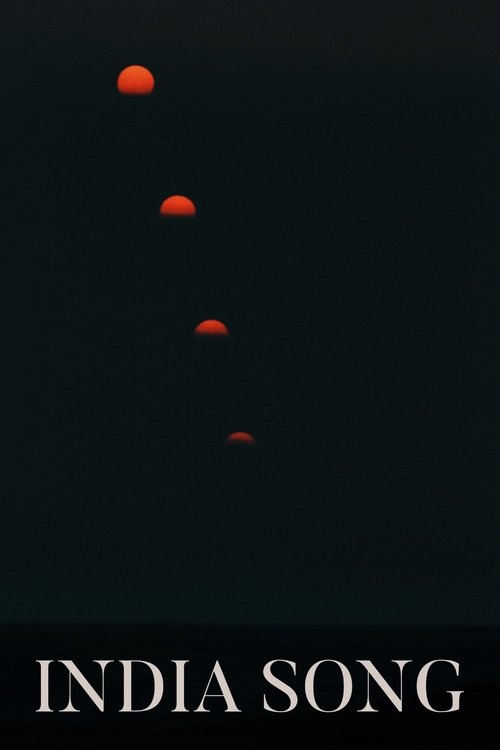
India Song
1975 · Marguerite Duras
For a late night when you want to surrender to something slow, strange, and haunted rather than be told a plot. This is challenge viewing — a mood to sink into, not a film to half-watch.
What it's about
In the swelter of 1930s colonial India, Anne-Marie Stretter — wife of the French ambassador — drifts through embassy receptions and takes lovers to stave off an unnameable boredom. Circling her is the disgraced Vice-Consul of Lahore, whose desperate, unanswerable desire keeps breaking the diplomatic calm. The whole affair reaches us secondhand: told, remembered, and mourned by voices we never see speaking.
The experience
Hypnotic and deliberately slow — less a story unfolding than a rumor of one, overheard through gossip, music, and murmured recollection. It puts you in a trance if you let it, and an ache settles in that's hard to shake.
Performances
Delphine Seyrig holds the screen without ever speaking in sync — everything is carriage, glance, and languor — while Michael Lonsdale's offscreen anguish as the Vice-Consul is genuinely harrowing to hear.
The craft
The radical move is on the soundtrack: no one on screen is ever heard speaking, and the entire film arrives through disembodied voices, ambient murmur, and a recurring, mournful tune, while the camera barely moves. It's a film you listen to as much as watch — good speakers and total quiet transform it.
Why it matters
A landmark of experimental narrative cinema and the peak of Marguerite Duras's work as a filmmaker, proving a novelist could reinvent film form rather than just adapt to it.
Snapshot
India Song is the most fully realized film of Marguerite Duras's "Indian cycle," a hypnotic, near-static chamber piece in which a colonial love story is told entirely in the past tense — recalled, mourned, and reconstructed by disembodied voices that never belong to the bodies we see. Anne-Marie Stretter (Delphine Seyrig), wife of the French ambassador to Calcutta in the 1930s, moves through the torpid heat of the embassy and its receptions, surrounded by lovers and by the unanswerable desire of the Vice-Consul of Lahore (Michael Lonsdale), a disgraced functionary whose cries shatter the diplomatic calm. What makes the film radical is not its melodrama but its method: Duras severs sound from image absolutely. No character on screen is ever heard to speak in synchronized dialogue; the entire soundtrack — narration, gossip, recollection, the scandal of the Vice-Consul, the off-screen song of a mad beggar woman — floats free of the silent, ghostly figures arranged before the camera. The result is one of the defining works of European art cinema's most austere wing: a film about colonialism, ennui, and death conceived as an act of remembering, where the image is already a ruin and the voice is all that survives.
Industry & production
India Song was a low-budget, artisanal production in the tradition of French auteur cinema operating well outside the commercial mainstream. By 1975 Duras was an established novelist and playwright who had moved decisively into directing; she had already made several films, including Détruire, dit-elle (1969), Nathalie Granger (1972), and La Femme du Gange (1973), the last of which began her experiments with the autonomous voice-track.
The film was shot in France, not India — a deliberate refusal of location realism. Its principal setting was a derelict mansion outside Paris, the abandoned Château Rothschild at Boulogne-Billancourt, whose faded grandeur, peeling surfaces, and overgrown grounds Duras used to stand in for the French embassy at Calcutta and the colonial "Indes." The decay of the real building becomes the decay of empire and of memory itself. The production was modest in scale and short in schedule, relying on a small ensemble, a single principal location, and the economy that Duras's method imposed: because there was no live sound recording of dialogue, the shoot could proceed in near-silence, with performers moving as directed figures rather than speaking actors.
A striking economy of means defined the project even after the fact. In 1976 Duras made a companion film, Son nom de Venise dans Calcutta désert, by laying the entire, unchanged soundtrack of India Song over wholly new footage — long, depopulated shots of the same ruined château, now empty of actors. That a complete second feature could be generated from a single soundtrack underlines how thoroughly Duras conceived of the voice, not the image, as the load-bearing element of her cinema.
Technology
Technologically India Song is unassuming on the surface and revolutionary in its application. It was shot on 35mm color film with conventional equipment; there is no optical trickery, no elaborate apparatus. The innovation is conceptual and lies in the post-synchronization workflow. Rather than treating sound as a record of the filmed event, Duras built the soundtrack as an independent composition — voices recorded separately, music, ambient texture, silence — and married it to images that were never meant to illustrate it. The post-production sound mix, not the camera, is where the film is authored.
This exploitation of the basic affordance of magnetic sound — that it can be fully detached from the photographed moment — places India Song within the lineage of materialist filmmaking that foregrounds the constructedness of the medium. Duras essentially treats cinema as radio with pictures, or as theater whose actors have been struck dumb, using ordinary technology to expose the normally invisible seam between what we see and what we hear.
Technique
Cinematography
The photography is by Bruno Nuytten, who would become one of the major French cinematographers of his generation. His work here is built on long, slow takes, a largely static or very gradually moving camera, and a warm, smoky, amber-gold palette that suggests both tropical heat and the patina of recollection. Light pools and fades; figures are often held at a distance, composed within doorways and against the worn surfaces of the château.
Nuytten's most celebrated device is the recurrent use of a large mirror, in which much of the action is staged and observed. The camera frequently shows us the reflected space alongside or instead of the "real" space, so that characters appear doubled, and the viewer cannot always be certain whether a figure is present or merely an image of itself. This mirror-work literalizes the film's governing condition: everything we watch is a reflection, a thing already past, seen at one remove.
Editing
The cutting is sparse and unhurried, consonant with the film's funereal tempo. Shots are held far beyond conventional duration, and transitions are slow. The decisive "editing," however, happens between the image-track and the sound-track rather than between shots: the friction generated by aligning autonomous voices against silent tableaux is the film's true montage. Meaning accrues in the gap — when a voice speaks of a death we do not see, or names a desire the impassive faces refuse to enact.
Mise-en-scène / staging
Duras stages India Song as a series of pictorial tableaux closer to theater and painting than to naturalist drama. Bodies are arranged, posed, and held; they recline, drift, and embrace with a slowed, ceremonial languor. The reception sequences, with their dressed figures and the swell of off-screen party chatter, have the quality of a tableau vivant of the colonial class caught in its own decadence. The derelict mansion is itself the dominant element of the staging — its empty rooms and ruined park supply the film's atmosphere of suspended, dying time. Nothing is hurried; the mise-en-scène asks the viewer to dwell, to wait, to feel duration as the film's true subject.
Sound
Sound is the heart of India Song and its most consequential formal achievement. Duras constructs a layered, polyphonic soundtrack of voices that are wholly off-screen and unattributed to visible bodies. Among them are two young female voices who recall the story of Anne-Marie Stretter with palpable longing and even love — narrators who seem themselves enchanted by, and grieving for, the events they describe; the murmured social talk of the embassy reception; and the cry of the Vice-Consul. Threading through it is the off-screen singing of the beggar woman, the mad wanderer who has come on foot from Savannakhet. The voices do not so much narrate as conjure, hesitate, question one another, forget. Carlos D'Alessio's recurring title theme — a langorous, melancholy melody with the lilt of a tango or slow blues — binds the whole and became the film's most memorable sensory signature. By refusing synchronized speech entirely, Duras makes absence audible: the people are gone, only their voices and their music remain.
Performance
Performance in India Song is reconceived as silent presence. The actors never speak in sync; they enact the drama through posture, movement, gaze, and stillness, like figures in a dream or apparitions summoned by the voices. Delphine Seyrig, already an icon of the European art film, gives a performance of extraordinary restraint and physical eloquence as Anne-Marie Stretter — her slow gestures, her recumbent passivity, her air of beautiful exhaustion carry the film's themes of desire and death without a single spoken line. Michael Lonsdale's Vice-Consul is the disruptive force, his anguish registered above all through the off-screen cry that breaks the embassy's decorum. The supporting ensemble — including performers such as Mathieu Carrière, Claude Mann, and Vernon Dobtcheff among Anne-Marie Stretter's circle — function as a frieze of colonial society, present and yet spectral.
Narrative & dramatic mode
The film's dramatic mode is elegiac, retrospective, and anti-dramatic in the conventional sense. There is a story — a married woman's affairs, the obsessive love of a ruined diplomat, a suicide, the scandal of the Vice-Consul who fired on lepers and on the gardens of Lahore — but it is never enacted as present-tense drama. Instead it is remembered, pieced together and circled by voices that are uncertain of their own recollections. Events are spoken of rather than shown; climaxes occur off-screen or have already happened. Time is dislocated: the voices speak of the characters in the past tense even as we watch them, so that the figures on screen seem to be ghosts of a story that is already finished. This is narration as séance — the recovery of a buried memory rather than the unfolding of a plot.
Genre & cycle
Nominally a drama and a tragic romance set against the backdrop of colonial India, India Song belongs far more meaningfully to the genre of the literary-modernist art film. It is the central panel of Duras's "Indian cycle," a constellation of works sharing characters, settings, and obsessions: the novel Le Vice-consul (1966), the film La Femme du Gange (1973), the play/text India Song (published 1973), and the 1976 film Son nom de Venise dans Calcutta désert, which recycles the India Song soundtrack. Across these works the figures of Anne-Marie Stretter, the Vice-Consul, and the mad beggar woman recur and mutate. As cinema, the film sits within the experimental, structural-materialist current of 1970s European filmmaking rather than within any popular generic tradition.
Authorship & method
India Song is among the purest of auteur films: Duras wrote it, directed it, and conceived its sound. The project grew out of a commissioned text — written in the early 1970s for the theater — and Duras carried into the cinema her lifelong preoccupations as a novelist and dramatist: voice, memory, desire, and absence. Her method here is the systematic separation of voice from body, an approach refined from La Femme du Gange and pushed to its limit. She treats film not as a recording of reality but as a space in which a text can be made to haunt a set of images.
Her key collaborators were essential to realizing this vision. Bruno Nuytten's cinematography supplied the film's seductive, decaying visual surface and its mirror-haunted compositions. Carlos D'Alessio's score — above all the title theme — gave the film its emotional through-line and its most enduring popular trace. Delphine Seyrig and Michael Lonsdale, both major figures of European art cinema, lent their charisma to a mode of performance stripped of speech. The film's collaborative signature, though, remains unmistakably Duras's: every element is bent toward the primacy of the spoken, remembering voice.
Movement / national cinema
The film is a landmark of French post–New Wave art cinema and is associated with the "Left Bank" sensibility and the cinema of the Nouveau Roman, the milieu in which writers turned filmmakers — Alain Robbe-Grillet, Alain Resnais (with whom Duras had collaborated as screenwriter on Hiroshima mon amour, 1959), and Duras herself — interrogated narrative, time, and memory. Seyrig's presence directly recalls that lineage; she had been the enigmatic woman of Resnais and Robbe-Grillet's Last Year at Marienbad (1961), and India Song shares that film's dreamlike suspension of time. India Song also belongs to the broader European tradition of structural and materialist filmmaking that foregrounds the apparatus of cinema, and to a feminist avant-garde then redefining what a film could be.
Era / period
Made in 1975, India Song arrives at a high point of European art-cinema experimentation, the same year as Chantal Akerman's Jeanne Dielman, 23 quai du Commerce, 1080 Bruxelles — two films that, in very different registers, used radical duration and formal rigor to reframe questions of women, time, and interiority. The mid-1970s saw the post-1968 generation pushing cinematic form toward minimalism, reflexivity, and political critique, and Duras's film is a touchstone of that moment. Its diegetic setting, by contrast, is the colonial 1930s — the world of Duras's own Indochinese childhood — so the film is doubly historical: a 1970s avant-garde work looking back on the dying decades of European empire.
Themes
The film's themes are colonialism and its boredom, decay, and guilt; female desire and the social position of a woman who lives through her lovers; the inseparability of love and death; and, above all, memory and absence. Anne-Marie Stretter embodies a beautiful, terminal languor — a woman who relieves the unbearable tedium of colonial life through affairs and who drifts toward death. Set against the privileged ennui of the embassy is the suffering of the colonized world: the leprosy, the beggar woman from Savannakhet who has lost her children, the heat and misery beyond the embassy walls, and the Vice-Consul's violent breakdown, which can be read as the return of the repressed horror that colonial decorum cannot contain. Underlying everything is Duras's conviction that the present is already past, that to film is to mourn, and that the voice is the last residue of what has been lost.
Reception, canon & influence
India Song was presented in 1975 at the Cannes Film Festival and received serious critical attention, dividing audiences between those who found it mesmerizing and those who found its slowness and abstraction forbidding. It was embraced by France's intellectual film culture as a major work of literary modernist cinema and quickly became the film by which Duras's cinema is best known. (The fine detail of its festival prizes is not something I can confirm with certainty, and I would rather flag that than misstate the record.)
In terms of influences on the film (backward), India Song draws on Duras's own novels and plays — especially Le Vice-consul — and on the Nouveau Roman aesthetic of fractured time and memory she had explored with Resnais; the figure of Anne-Marie Stretter reaches back to memories of Duras's colonial childhood in Indochina. Its formal sense of suspended, recollected time is kin to Last Year at Marienbad.
Its legacy forward is considerable within art and experimental cinema. India Song is a foundational reference point for "slow cinema" and for any filmmaking that explores the autonomy of the soundtrack and the dissociation of voice and image. Duras's example — cinema as voice, as text, as a haunting of images by language — informed later generations of avant-garde and contemplative filmmakers and remains a key case study in academic film theory, particularly in discussions of sound, narration, feminist film practice, and the relation between literature and the moving image. While it never reached a wide popular audience, its standing in the canon of European art cinema is secure, and it is routinely cited as Marguerite Duras's cinematic masterwork.
A Deleuzian reading
Start with the mirror.
The full Deleuzian reading of India Song →
Reception
Divisive from the start — many at its 1975 Cannes screening found it inert, others called it a revelation — it has steadily hardened into a modernist landmark, now a fixture of slow-cinema and sound-design syllabi and a rite of passage for Duras converts.
How India Song was received, from release to now →
Influences: the films it descends from and the films it influenced
- Hiroshima mon amour (1959) — Duras's own screenplay invented her core method here — a literary voice-over running asynchronously against images, where the remembering voice carries what the frame cannot show, the word/image dissociation India Song radicalizes.
- Last Year at Marienbad (1961) — Hieratic statue-still figures in opulent décor traversed by an incantatory off-screen voice, plus Delphine Seyrig's identical mask-like, frozen presence and the suspension of narrative time, are carried over almost wholesale.
- La Femme du Gange (1974) — Duras's immediately prior film where she first detached the commenting 'voices' (voix off) from the on-screen bodies — the exact technique India Song systematizes into two pairs of disembodied narrators.
- Nathalie Granger (1972) — Established her anti-dramatic register of silent durations, near-motionless performers, and domestic space held as a charged tableau, with Lonsdale already supplying the stripped, speechless presence.
- Pickpocket (1959) — The flattened, affect-less 'model' performance and the expressive autonomy of off-screen sound — bodies drained of theatrical expression while the soundtrack carries the drama — prefigure Seyrig and Lonsdale's mute charisma.
- The Silence (1963) — Duras's radical dissociation of voice from image — characters speak offscreen of events not shown, making the film's language permanently untranslatable as image — extends The Silence's device of unintelligible invented speech into a poetics of systematic sound-image separation.
- Muriel, or the Time of Return (1963) — Reunites Seyrig and Vierny and radicalizes Muriel's disjunctive mix, fully severing off-screen voices from on-screen bodies so sound and image narrate in parallel.
- Gertrud (1964) — Builds an entire film from averted gazes, figures who never quite meet eyes, slow lateral tracks, and detached voices in Gertrud's anti-naturalistic stillness.
- News from Home (1977) — Voice-off reading letters laid over city images that never depict the speaker — a direct extension of India Song's principle that the soundtrack is autonomous from, and haunts, the image.
- Son nom de Venise dans Calcutta désert (1976) — The literal limit-case: Duras lays India Song's entire unchanged soundtrack over new footage of empty, ruined rooms, proving the voices were never bound to those bodies at all.
- Le Camion (1977) — Pushes voice-primacy to its endpoint — Duras and Depardieu read aloud a film that is never shown, cinema reduced to the conditional tense of a spoken, remembered text.
- Flowers of Shanghai (1998) — Amber lamplit colonial-brothel interiors, languid long takes, a recurring musical motif, and systematic off-screen elision of the dramatic event — India Song's decaying-interior tableau and slow tempo in another register.
- In the Mood for Love (2000) — A recurring musical theme (Umebayashi's waltz, like D'Alessio's) structures memory and unconsummated desire across a slow, amber-lit palette of mirrored, fragmentary compositions.
- Sátántangó (1994) — The slow-cinema long take and hypnotic durational tempo that India Song helped found, with a voice-over narration that floats free of and comments upon the images it accompanies.
- Goodbye, Dragon Inn (2003) — A near-wordless film built from long static takes of a decaying movie-palace as architecture of absence, where sound and the ghosts of the past haunt near-empty, motionless frames.
- Colossal Youth (2006) — Postcolonial decay staged as statuesque held figures in fixed, painterly compositions, with characters reciting letters and memory in a voice that floats above the anti-dramatic image.
- Cemetery of Splendor (2015) — Tropical languor and sleeping, silent bodies haunted by off-screen voices and colonial history — the soundtrack carrying spectral memory over slow, near-still images, India Song's sound-as-haunting transposed to Thailand.
- Dreams (2024) — Treats voiceover as an autonomous literary text floating free of the image, so that narration — not action — carries desire and memory, the device behind Dreams' voiceover-driven structure.
- Three Colors: Blue (1993) — Duras structures the film's emotional logic around a waltz that erupts without diegetic source and recedes without resolution, functioning as symptom rather than accompaniment — the direct formal ancestor of Preisner's intrusion motif in Blue.
- Indochine (1992) — Establishes the languid, mournful aestheticization of French-Indochina torpor — the nostalgic beautifying of empire's decay that Indochine adopts wholesale as mood.
- L'Immortelle (1963) — Nouveau Roman cinema rendered as exotic colonial reverie: hieratic figures, looping memory and absence, and a soundtrack disjoined from a half-remembered narrative, the same Left Bank literary-modernist DNA.
- Jeanne Dielman, 23 quai du Commerce (1975) — Feminist durational cinema sharing India Song's year: fixed frontal tableau framing, real-time slowness, and a refusal of conventional dramatic event in favor of attention to gesture and stillness.
- Chronicle of Anna Magdalena Bach (1968) — Duras splits an affectless, detached voiceover from the image track, sharing the Bach film's anti-illusionist separation of sound and picture and its refusal of dramatic identification.
Similar films
- Hiroshima Mon Amour (1959) — influence & lineage
- In the Mood for Love (2000) — influence & lineage
- Memoria (2021) — shared sensibility
- Gertrud (1964) — shared sensibility
- Charulata (1964) — shared sensibility
- La Notte (1961) — shared sensibility
- West Indies: The Fugitive Slaves of Liberty (1979) — shared sensibility
- All We Imagine as Light (2024) — shared sensibility
All the films related to India Song →