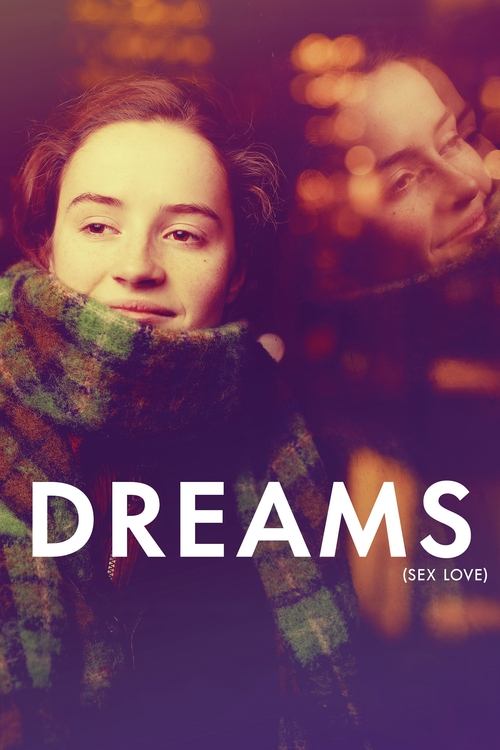
Dreams
2024 · Dag Johan Haugerud
For an evening when you want something tender and intelligent that sneaks up on you — a film about falling in love and about putting feelings into words. Comfort with substance; bring someone you like talking to afterward.
What it's about
In contemporary Oslo, a teenage girl falls hopelessly in love with her young teacher and pours the whole consuming experience into a written manuscript. When her mother and her grandmother — a published poet — read it, the household stops asking what happened and starts asking whether it's literature: is the text true, is it good, and should it be published? Three generations of women end up debating desire, honesty, and who owns a story.
The experience
Warm, talky, and quietly funny, with a current of real ache underneath — it captures first love's total weather while gently noticing how absurd and precious it looks from outside. It's the rare film about a teenager that takes her inner life completely seriously.
The craft
Dag Johan Haugerud builds the film out of voiceover and conversation — the manuscript's language versus the family's arguments about it — so that writing itself becomes the drama. It's dialogue-driven Scandinavian filmmaking at its most graceful: modest on the surface, precise underneath, and it plays beautifully at any size.
Why it matters
The crowning entry in Haugerud's 'Sex Love Dreams' trilogy of Oslo films, it took the top prize at the Berlin film festival and turned an international spotlight on his quietly radical, talk-centered cinema.
Snapshot
Dreams (Norwegian: Drømmer; the film also circulates under the festival title Dreams (Sex Love)) is a Norwegian drama written and directed by Dag Johan Haugerud and released in 2024. It forms the third and most celebrated entry in Haugerud's loosely linked "Sex Love Dreams" trilogy, a triptych of standalone, dialogue-driven films set in contemporary Oslo and concerned with desire, intimacy, and the language people use to make sense of feeling. The film follows Johanne, a teenager who develops an intense infatuation with her young teacher, Johanna, and pours the experience into a written manuscript; when her mother and her grandmother — herself a published poet — read the text, the household's attention shifts from the romance itself to its literary worth, its truthfulness, and the question of whether such private material should be published. Dreams won the Golden Bear, the top prize at the 75th Berlin International Film Festival, in February 2025, an unusually high honor for a small-scale, talk-centered Norwegian film and the event that established it as Haugerud's international breakthrough. Its reputation rests on a deceptively plain surface — voiceover, conversation, ordinary interiors — beneath which it conducts a sustained inquiry into how raw experience becomes art.
Industry & production
Dreams is a product of the Norwegian arthouse-production ecosystem, made through Motlys, the Oslo company long associated with Haugerud's work and with producer Yngve Sæther, and supported within the framework of Norwegian Film Institute public funding that underwrites most domestic auteur cinema. The defining industrial fact about the film is that it was conceived not as a single project but as one panel of a trilogy shot and developed in close succession, an economy of scale that let Haugerud reuse a creative team, a city, and a thematic preoccupation across three features. Sex premiered at the Berlinale's Panorama section in early 2024 and Love (Kjærlighet) screened in competition at the Venice Film Festival later that year, so that by the time Dreams reached Berlin's main competition in 2025 it arrived as the capstone of an already-visible body of work — a sequencing that almost certainly amplified its critical reception. The Golden Bear converted a regionally respected filmmaker into a festival-circuit name and triggered the international distribution and subtitled releases through which most viewers outside Scandinavia have encountered the film. Precise budget and box-office figures are not reliably documented in English-language sources, and I will not estimate them; the relevant point is that this is modestly budgeted, subsidy-supported cinema whose ambitions are artistic rather than commercial.
Technology
Dreams was made with contemporary digital cinematography, consistent with the naturalistic, available-light register of Norwegian narrative film of the 2020s, though the specific camera and lens packages are not widely published and I will not invent them. What matters technologically is restraint: the film makes no display of spectacle, visual effects, or formal apparatus. Its most important "technology," in a sense, is the recorded human voice — the film leans heavily on voiceover narration, so that sound capture and the post-production handling of narration carry as much expressive weight as any image-making tool. This is filmmaking that treats the camera and microphone as transcription instruments for language and behavior rather than as engines of illusion.
Technique
Cinematography
The cinematography is patient, composed, and unshowy, favoring stable framings of domestic and urban interiors — kitchens, living rooms, classrooms, stairwells — and the muted northern light of Oslo. The visual approach across the trilogy has been credited to Cecilie Semec, a cinematographer associated with Haugerud's recent work; readers should note that detailed below-the-line attributions for the film are thinly documented in English, and I flag that uncertainty rather than overstate it. The look subordinates image to talk: compositions tend to hold characters in conversation, often in two-shots or loose ensemble groupings, allowing dialogue and performance to organize the frame. The camera observes more than it dramatizes, and its very plainness is a rhetorical choice — it asks the viewer to listen.
Editing
Dreams is cut for rhythm of speech and thought rather than for action. Scenes are allowed to run at the length conversation requires, and the film's signature structural device is the interplay between Johanne's retrospective voiceover and the images it accompanies, so that editing must continually negotiate the gap between what is narrated and what is shown. The result is a montage of remembering: the cut becomes a way of testing narrated experience against depicted reality, sometimes confirming it, sometimes quietly undercutting it. The specific editor's credit is not something I can attribute with confidence, and I decline to guess.
Mise-en-scène / staging
The staging is domestic and theatrical in the best sense — built around bodies in rooms, talking. Haugerud's mise-en-scène foregrounds the textures of ordinary middle-class Oslo life and the intergenerational household: the apartment shared or traversed by Johanne, her mother, and her grandmother becomes a chamber for debate. Blocking emphasizes proximity and withdrawal, the small choreographies of a teenager moving toward and away from adults. The teacher's spaces — the classroom, glimpsed everyday settings — are staged with a deliberate ordinariness that makes Johanne's transfiguring infatuation feel like an act of imagination imposed on the mundane.
Sound
Sound is central, because the film is, in large part, narrated. Johanne's voiceover — the spoken form of her written manuscript — is the connective tissue of Dreams, and the film's emotional and intellectual life unfolds in the tension between that interior literary voice and the comparatively flat surfaces of recorded reality. Diegetic sound is naturalistic and unobtrusive. Scored music, if present, is used sparingly; I am not able to confirm a composer credit and will not fabricate one. The dominant aural fact of the film is language itself.
Performance
Performances are the film's engine. Ella Øverbye anchors Dreams as Johanne, carrying both the on-screen behavior of an adolescent and the more articulate, retrospective consciousness of the voiceover — a doubled performance of feeling and of writing-about-feeling. The adult roles are taken by major figures of Norwegian stage and screen: Ane Dahl Torp as the mother and Anne Marit Jacobsen as the grandmother give the household debate its weight and wit, while Selome Emnetu plays the teacher, Johanna, the object of an infatuation the film keeps deliberately opaque. The acting register is naturalistic and conversational, calibrated to a script in which what people say — and how they hedge, argue, and reframe — is the principal drama.
Narrative & dramatic mode
Dreams operates in a reflexive, literary mode rather than a conventional dramatic one. Its ostensible plot — a teenage crush — is largely complete before the film's true subject begins, because the central action is interpretive: the reading, evaluation, and contestation of Johanne's written account by the women of her family. The film thus stages the act of criticism as drama. Its mode is essayistic and autofictional, organized around voiceover narration that frames the visible events as already-written, already-remembered. This produces a productive instability: the viewer is never quite sure whether to take Johanne's narration as transparent truth, adolescent embellishment, or conscious literary construction — and the film's most sophisticated move is to make that uncertainty its theme rather than a problem to be resolved. The dramatic stakes are epistemological and ethical: What did happen? Whose story is it? Can it be published without betraying its subject?
Genre & cycle
Nominally a romance and drama, Dreams sits at the intersection of several cycles: the queer coming-of-age film, the literary or "writerly" drama, and the talk-driven European art film. As queer cinema it treats a young woman's same-sex awakening with a marked absence of melodrama or crisis, declining the trauma plots that long dominated the genre. As a literary drama it belongs to a 2020s wave of films preoccupied with autofiction and the ethics of writing about real people — a cinematic counterpart to the Scandinavian literary culture of Karl Ove Knausgård and Vigdis Hjorth. Within Haugerud's own output it is one movement of the "Sex Love Dreams" cycle, films that share a city and a sensibility but not characters, each isolating a different facet of intimacy. Its festival-circuit success places it squarely within the contemporary arthouse cycle of intimate, conversation-led European features.
Authorship & method
Dreams is a thoroughgoing auteur work: Dag Johan Haugerud wrote and directed it, and his authorship is inseparable from his sensibility as a novelist and short-story writer. Haugerud, who has combined filmmaking with a career connected to libraries and literature, makes films that are unusually verbal, structured like prose, and interested in the moral and intellectual texture of conversation — qualities visible in earlier features such as I Belong and Beware of Children (Barn). His method is to build films from talk, to trust dialogue to carry meaning, and to use the trilogy structure as a way of examining a single human domain from multiple angles. Among his collaborators, producer Yngve Sæther and the Motlys company provide the institutional continuity, and the cinematography across the recent films has been associated with Cecilie Semec; as noted above, certain craft credits for Dreams are not robustly documented in the English-language record, and I have flagged those gaps rather than fill them with invention. The authorial signature is nonetheless unmistakable: a calm, intelligent, literary cinema in which ideas are dramatized through speech.
Movement / national cinema
The film belongs to a strand of contemporary Norwegian cinema that prizes the literary and the conversational. It is natural to place Haugerud in dialogue with Joachim Trier, whose The Worst Person in the World gave Oslo's articulate, self-examining milieu international visibility; but where Trier is romantic and kinetic, Haugerud is more austere, theatrical, and essayistic. The deeper lineage is European: the moral-tale tradition of Éric Rohmer, whose talky, ethically curious cinema of young people reasoning about love is the clearest ancestor, and the patient, reflexive registers associated with directors like Hong Sang-soo. Dreams extends a recognizably Nordic art cinema — restrained, interior, socially observant — while pushing it toward a reflexive interest in writing and authorship.
Era / period
Dreams is emphatically a film of the 2020s, set in a contemporary, secular, middle-class Oslo. Its concerns are legible against several period currents: the post-#MeToo sensitivity to power and consent that hovers, unspoken but present, around a student's feelings for a teacher; the autofiction boom in Scandinavian letters and its attendant anxieties about the right to use real lives as material; and a broader cultural normalization of queer adolescence that lets the film treat same-sex first love as a matter of literary and emotional interest rather than social scandal. The film's intergenerational structure — teenager, mother, poet-grandmother — also makes it a portrait of changing attitudes across three cohorts of Norwegian women.
Themes
The film's governing theme is the relationship between experience and writing — the way feeling is transformed, possibly falsified, certainly shaped, when it becomes text. Around this it gathers several others: first love and queer awakening, rendered without crisis; the unreliability of memory and desire; the ethics of autofiction and the question of who owns a shared experience once one party writes it down; and the intergenerational transmission of women's emotional and intellectual life. The debate over whether to publish Johanne's manuscript opens onto questions of artistic value versus private truth, and onto the discomfiting possibility that the literary quality of an account and its factual honesty may be at odds. Language itself — its power to elevate, distort, and lay claim — is the film's deepest subject.
Reception, canon & influence
Critically, Dreams was received as the standout of Haugerud's trilogy and as a surprising, widely approved Golden Bear winner at the 2025 Berlinale, praised for its intelligence, its tonal control, and its unfashionable faith in talk and voiceover; reviewers frequently singled out the literary sophistication of its script and the strength of its ensemble, particularly the central performance and the grandmother–mother–daughter dynamic. The award conferred immediate canonical standing within recent Norwegian cinema and secured the film international distribution. Looking backward, its influences are clear: the Rohmerian moral tale, the reflexive literary cinema of conversation, and the contemporary Scandinavian autofiction that supplies its central anxiety; the Trier-era Oslo film is its closest domestic context. Looking forward, the film's legacy is still forming — it is too recent for a settled influence to be claimed honestly, and I will not overstate it — but its Golden Bear has plausibly strengthened the case, within festival culture, for quiet, dialogue-led, literary filmmaking, and it stands as a high-water mark for the Norwegian art film's international standing in the mid-2020s. Its most lasting contribution may prove to be its demonstration that a film about reading and writing — about criticism as drama — can hold an audience without raising its voice.
A Deleuzian reading
A teenage girl sits in an ordinary Oslo apartment and reads aloud the thing she wrote about being in love.
The full Deleuzian reading of Dreams →
Reception
It arrived as the quiet closing chapter of a modest Norwegian trilogy and left the 2025 Berlinale with the Golden Bear — an overnight promotion from festival curio to art-house event, with the whole Sex/Love/Dreams triptych getting re-released and repackaged in its wake.
How Dreams was received, from release to now →
How to watch Dreams: what to notice on a first viewing
- Watch Johanne mostly look and listen, not act. Ella Overbye plays a teenager who watches, remembers, and writes far more than she does anything to change her situation with her teacher. The infatuation has nowhere to go but onto the page, because acting on it was never really an option.
- Listen for the voiceover say more than the image shows. Johanne's written account is spoken over plain, ordinary images, and the two tracks do not always confirm each other the way narration usually does. You start to wonder whether you're watching what happened or what she decided to make of it.
- Watch the camera hold on two people mid-conversation. Compositions favor stable two-shots and loose ensemble groupings, letting dialogue and performance organize the frame rather than camera movement. The plainness of the shots is itself an instruction: stop looking for images and start listening.
- Watch the apartment turn into a courtroom for a manuscript. The household Johanne shares with her mother and grandmother becomes a chamber where the written account gets read, argued over, and judged. An ordinary living room becomes the actual site of the film's drama, not the crush itself.
- Watch three generations of women argue about the same page. Ane Dahl Torp and Anne Marit Jacobsen give the household debate its weight, arguing with Johanne over what her own writing means. Three different generations of women get to weigh in on what one girl's feelings are actually worth in print.
The whole guide to watching Dreams, with the keys for a rewatch →
Influences: the films it descends from and the films it influenced
- Claire's Knee (1970) — Frames erotic infatuation as a first-person moral case study, using literary voiceover and seated talk to convert desire into ethical self-examination — the exact Moral-Tale grammar Dreams adopts.
- Pauline at the Beach (1983) — Observes a young woman's romantic awakening through layered, ironic conversation in which characters narrate their own feelings, the talk itself supplying both plot and moral scrutiny.
- Autumn Sonata (1978) — Stages a mother–daughter reckoning as sustained confessional dialogue in chamber two-shots, the model for Dreams' grandmother–mother–daughter dynamic built from talk rather than incident.
- India Song (1975) — Treats voiceover as an autonomous literary text floating free of the image, so that narration — not action — carries desire and memory, the device behind Dreams' voiceover-driven structure.
- News from Home (1977) — Reads first-person written prose aloud over static, available-light shots, fusing autobiographical text and unembellished image exactly as Dreams stages 'experience into writing.'
- Manhattan (1979) — Uses confessional literary voiceover by a writer narrating his own romantic entanglements, foregrounding the ethics of turning lovers into material.
- Metropolitan (1990) — Builds an entire drama from dense, literate conversation about books, morals and feeling, proving talk alone can sustain a film — the talk-driven art-film lineage Dreams extends.
- Reprise (2006) — A reflexive Norwegian film about writing whose omniscient literary voiceover shapes and reorders events, establishing the Oslo literary-cinema idiom that is Dreams' closest domestic precedent.
- Beware of Children (Barn) (2019) — Haugerud's own method of building a moral-ethical drama from extended, multi-viewpoint talk, directly seeding Dreams' conversation-as-drama construction.
- The Worst Person in the World (2021) — Chaptered Oslo art film narrating a young woman's romantic and creative self-examination through voiceover, sharing Dreams' prose-structured, literary approach to a female interior life.
- The Novelist's Film (2022) — Autofiction about a writer assembled from long, near-static conversational takes in available light, mirroring Dreams' trust in deadpan talk and reflexivity about authorship.
- 20th Century Women (2016) — Uses intergenerational women and a literary chapter/voiceover structure to dramatize how people narrate and 'write up' one another, the same authorship-ethics engine as Dreams.
- Before Sunset (2004) — Makes near-real-time conversation the sole narrative engine, sustaining naturalistic two-shots of two people talking — the formal wager Dreams makes on dialogue.
- Columbus (2017) — Composes quiet intellectual exchanges in carefully framed static two-shots under available light, the precise cinematographic register of Dreams' talk scenes.
- Water Lilies (2007) — Renders adolescent queer awakening through restrained, naturalistic ensemble observation rather than melodrama, sharing Dreams' cool handling of a teenage girl's first desire.
- Love (2024) — Companion film in the Oslo trilogy applying the same talk-driven, prose-structured examination of intimacy and desire across a single human domain.
- Sex (2024) — Trilogy companion that dramatizes ideas through calm, sustained dialogue and naturalistic ensemble performance, the shared authorial signature Dreams perfects.
Similar films
- The Worst Person in the World (2021) — influence & lineage
- House of Hummingbird (2019) — same viewing thread
- Past Lives (2023) — same viewing thread
- Sentimental Value (2025) — shared sensibility
- Falling in Love Like in Movies (2023) — shared sensibility
- Young Hearts (2024) — shared sensibility
- The Girl with the Needle (2024) — shared sensibility
- Sound of Falling (2025) — shared sensibility
All the films related to Dreams →
Watch it with: curated runs of related films
- The Ache of Almost — Watch these together for the way each circles a love that time, distance, or duty keeps just out of reach — long looks, feelings left unsent, and the life that gets lived instead.