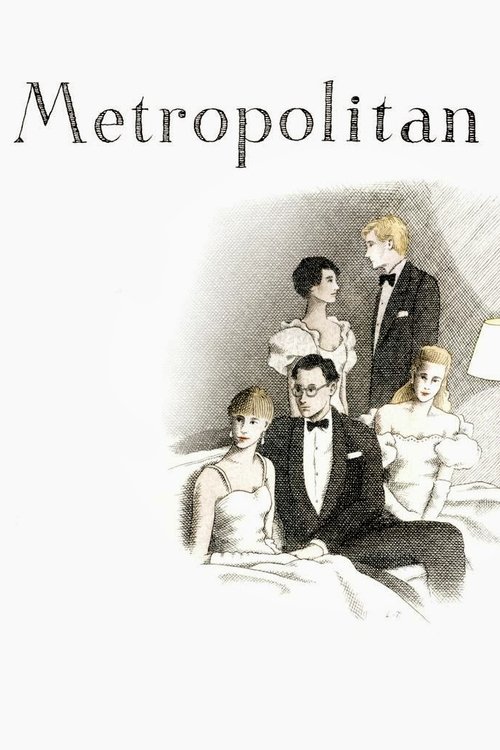
Metropolitan
1990 · Whit Stillman
For a cozy, civilized night in when you want great conversation instead of plot — the cinematic equivalent of staying too late at a party with people smarter than they are wise. Comfort viewing for anyone who loves talk.
What it's about
During debutante season in Manhattan, a middle-class student with vaguely radical convictions falls in with a clique of young Upper East Side preppies who gather after parties to play bridge, dissect each other's love lives, and debate socialism, God, and their own likely decline. He's their critic and their guest at once — and the longer he stays inside the cocoon, the more entangled he gets, especially with a bookish girl who takes a shine to him.
The experience
Warm, wordy, and very funny in a dry, literate way — the pleasure is watching articulate young people talk circles around feelings they can't actually handle. Underneath the wit runs a surprising melancholy about youth ending and a world quietly going extinct.
Performances
Chris Eigeman is the breakout as the clique's resident cynic, delivering outrageous pronouncements with total conviction, and Taylor Nichols makes neurotic earnestness genuinely endearing; the largely unknown cast feels like a real, closed little world.
The craft
Shot on 16mm over winter nights in Manhattan on a shoestring, it turns poverty into elegance — a few apartments, some evening clothes, and a screenplay so precisely written it earned an Oscar nomination. The direction is unshowy on purpose: everything is in the rhythm of the dialogue.
Why it matters
A landmark of American independent film that proved indie cinema could be about manners and conversation rather than grit, launching Whit Stillman's career and a whole strain of literate, talk-driven comedy.
Snapshot
Metropolitan is a first feature made almost entirely on borrowed conditions: shot on 16mm over a series of nights in Manhattan during the winter, financed largely by its writer-director's own resources, cast overwhelmingly with unknowns, and edited into a comedy of manners about a social class that the American independent cinema of its moment had almost no interest in. Whit Stillman was in his late thirties when he made it, having worked in publishing and in the marketing of Spanish films rather than through the usual apprenticeships of film school or the studio system. The result is a film with no visible debt to the aesthetics that dominated 1980s American independent production — no ironic genre pastiche, no punk affect, no regional grit. It is instead a talk picture, and its talk is the point.
The premise is deliberately slight. Tom Townsend, a young man of reduced means and Fourierist convictions, is absorbed by accident into a group of Upper East Side debutante-season regulars who call themselves the Sally Fowler Rat Pack. Over the course of a Christmas-through-New Year's stretch of parties, after-parties, and bridge games in a rented apartment, Tom's presence and his skepticism act on the group, and the group acts on him. Very little happens in the sense that a plot summary would recognize as event: a romantic misdirection, a rescue mission to Long Island, a duel that is not quite a duel. What the film has instead of plot is an unusually precise account of how a small social world talks about itself while it is dissolving.
The dominant critical framing at the time was that Stillman had made an American Jane Austen picture, or a Woody Allen picture about the wrong borough sensibility, or a piece of anthropology conducted by a native informant. All three are partly right and each misses the film's structural oddity: it is a comedy whose central subject is downward mobility, narrated by characters who possess the vocabulary to describe their own decline and no means to arrest it. That combination — social observation delivered as verbal comedy, with elegy underneath — is what the film transmitted forward.
Industry & production
The production circumstances are among the better-documented aspects of the film, largely because Stillman has discussed them consistently and because they became a template invoked by later low-budget filmmakers. The film was made for a very small sum by feature standards; Stillman has described funding it substantially himself, including through the sale of an apartment, supplemented by contributions from friends and acquaintances. Precise figures have circulated in interviews and press coverage, but they vary in the retelling and I will not assert one as authoritative — the reliable claim is that the budget was in the low hundreds of thousands and that Stillman bore much of the personal financial exposure.
Practically, this meant shooting on 16mm rather than 35mm, working with a small crew, and scheduling around the availability of locations and of a cast who were not professional actors in the main. Interiors were assembled from apartments and spaces that could be obtained cheaply or through personal connections; the film's evening-and-night structure both suited the material (the debutante season is nocturnal) and reduced the burden of lighting exteriors. The shoot was reportedly discontinuous, with production halting and resuming as funds allowed. Continuity in the finished film — the same clothes, the same rooms, the same faces across what reads as a single compressed holiday season — is therefore a considerable achievement of planning rather than a byproduct of a comfortable schedule.
The distribution history matters as much as the production. Metropolitan premiered at the Sundance Film Festival in 1990, at a moment when that festival was in the process of becoming the primary discovery mechanism for American independent cinema. New Line Cinema, through its specialty arm, took the film on, and it went out as a platform release in art houses. It performed well against its cost and, more consequentially, it received an Academy Award nomination for Best Original Screenplay — an unusual outcome for a self-financed 16mm debut and one that materially altered Stillman's ability to make his subsequent films. The nomination also had a canonizing effect: it placed the film in a category of legitimacy that most Sundance discoveries of the period did not reach.
The film's afterlife was secured by home video and then by the Criterion Collection, which released it on laserdisc and later on DVD and Blu-ray. Criterion's early adoption is worth noting as an industrial fact rather than a matter of taste — it kept the film continuously in circulation and in critical conversation during the decades when Stillman himself worked only intermittently.
Technology
The technological profile is straightforward and consequential. The film was originated on 16mm and blown up to 35mm for theatrical release. Everything about the image follows from that decision: the visible grain structure, the relatively shallow tonal range in the darker interiors, the softness in the blown-up prints. Stillman did not attempt to disguise the format. There is no effort to make the film look more expensive than it was through wide-angle showmanship or heavy diffusion.
What the 16mm origin permitted was the thing the film most needed: long takes with a small package, in real rooms, with a crew that could fit inside those rooms. A 35mm production of the same script would have required larger lighting units, more grip equipment, and a schedule the financing could not support. The available-light-adjacent approach to the party interiors — practicals doing much of the work, supplemented rather than replaced — is a technological constraint converted into a consistent look.
Sound was recorded on location with the ordinary equipment of low-budget production, and the film relies on it heavily, since dialogue is nearly the entire content. Post-production was conventional for 1990: photochemical finishing, analog optical soundtrack. There is no visual effects work of any kind, no motion control, no optical trickery beyond simple opticals for titles and fades. The film's technological interest lies entirely in what a 16mm package made possible for a director with no money and a script consisting almost wholly of people talking in rooms.
Technique
Cinematography
John Thomas shot the film, beginning a working relationship that continued into Stillman's later work. The strategy is one of restraint bordering on self-effacement. Compositions are largely static or gently reframing; the camera is placed at seated-eye height in the party scenes and holds. Coverage tends toward the classical — establishing the room, then working in medium and medium-close shots that keep two or three speakers in frame — but the cutting rate is far slower than the coverage would permit, which means the two-shots and group shots carry long stretches of dialogue.
The lighting is the most distinctive element. Interiors are warm and pooled, dominated by lamplight and by the golden cast of the rented apartments and ballrooms; the exteriors are cold, blue, and often deep, with figures small against Manhattan streets and the snow. This warm-interior / cold-exterior binary is not subtle, and it does not need to be: it is the film's thesis rendered optically. Inside is the cocoon; outside is the city and the economic weather that will eventually get in. The taxi rides and doorway farewells that punctuate the film are the visual hinge between the two states.
The 16mm grain is legible throughout and reads as period-appropriate rather than distressed. There is very little camera movement of the flourishing kind — no crane, minimal dolly, no handheld urgency. The film's few moves are functional: following a character into a room, reframing as someone stands. This is a cinematography of attention rather than of statement, which is the correct posture for material whose meanings are carried in the language.
Editing
Christopher Tellefsen edited the film, early in a career that later took him through work for a range of major American directors. The editing problem in Metropolitan is unusual: the material is verbally dense, the shooting was discontinuous, and the film must generate momentum without conventional narrative escalation. The solution is a structure of discrete social occasions — party, after-party, party, after-party — separated by taxi transits and title-card-like moments of arrival, so that the film's rhythm is the rhythm of an evening repeated across a season.
Within scenes, the cutting resists the modern impulse to cut on every line. Exchanges are frequently held in a single frame containing both speakers, which allows the comedy of reaction — a raised eyebrow, a decision not to answer — to play without being underlined. When the film does cut, it cuts late, letting a line land and the room absorb it. The effect is that the dialogue sounds like conversation rather than like a series of setups and punchlines, even though it is heavily written.
The elliptical handling of time is the other editorial signature. Nights end and begin without transition; characters disappear from the group for stretches and return; the season's progress is registered through accumulated exhaustion rather than through dated markers. The final movement, which takes the characters out of Manhattan and toward the beach houses of Long Island, shifts the rhythm — the transit is longer, the cutting looser — and this formal loosening is how the film signals that the cocoon has been left behind.
Mise-en-scène / staging
The staging is the film's most consistently underrated element. Stillman's characters are almost always arranged in configurations that encode social relation: the semicircle of the drawing room, the four-sided closure of the bridge table, the line of people along a wall at a dance. Bridge is not decorative. It is a game of partnerships, bidding, and concealed information, and the film uses the table as a literal diagram of who is allied with whom and who is being deceived.
The apartment interiors are dressed to suggest inherited rather than purchased taste — worn upholstery, crowded bookshelves, furniture that is good but not new. This matters because the film's subject is a class in decline; the rooms must look like money that arrived a generation or two ago and has not been replenished. The formalwear does similar work. Dinner jackets and long dresses are worn with a familiarity that reads as habit rather than costume, and the small failures of maintenance — the dishevelment as the nights wear on, Tom's conspicuously inadequate raincoat over his rented formal clothes — carry the economic information the dialogue is too polite to state directly.
Blocking is minimal by design. Characters sit and talk; when they move, the movement is motivated by social business — refilling a drink, answering a door, escaping a conversation. The result is a stage-adjacent style that never quite becomes filmed theater, because the camera's placement and the editing's patience make the rooms feel observed rather than presented.
Sound
Mark Suozzo composed the score, initiating a collaboration that persisted across Stillman's subsequent films. The music works in registers that are deliberately at odds with the material's low budget: chamber-scaled, faintly antique, drawing on light-classical and ballroom idioms and on the mid-century American dance-band vocabulary. It is neither ironic nor sentimental. It treats the debutante season as though it were a legitimate subject for elegant music, which is precisely the film's attitude toward its characters — taking them seriously enough to allow the comedy to be affectionate rather than contemptuous.
Source music is used extensively: the bands and recordings at the parties, the dance music the characters actually move to. The distinction between score and source is sometimes intentionally blurred, so that the film's own musical voice seems to emanate from the world it is describing.
The dialogue recording is the sound design. Voices are the film's texture, and the mix keeps them forward and clear even in crowded rooms, with party ambience held low enough that overlapping conversation never obscures the line that matters. This is a choice with an aesthetic consequence: real cocktail parties are acoustically hostile, and the film's rooms are legible in a way real rooms are not. The slight artificiality is essential — we are meant to hear every clause of these sentences.
Performance
The casting of largely unknown and in many cases non-professional performers is the film's riskiest decision and its most successful one. Chris Eigeman as Nick Smith, Edward Clements as Tom, Carolyn Farina as Audrey, Taylor Nichols as Charlie, and Allison Rutledge-Parisi, Dylan Hundley, Isabel Gillies and the rest of the group deliver Stillman's highly written dialogue in a register that is unusual in American film: precise, unhurried, slightly formal, and entirely unaffected by the naturalist mumbling that was the period's default marker of authenticity.
The performances work because they do not attempt to naturalize the language. The actors speak Stillman's periodic sentences and subordinate clauses as though people really do talk that way — which, in the specific milieu depicted, is closer to true than the naturalist objection allows. Eigeman's Nick is the standout and became the model for a recurring type in Stillman's work and beyond: the fluent, defensive, self-aware talker whose certainties are a screen for something more fragile. Farina's Audrey supplies the film's emotional weight almost entirely through stillness and reticence, holding a reserve that the surrounding volubility keeps failing to breach. Nichols's Charlie carries the film's anxieties about class demise in an earnest register that the film treats gently rather than mocking.
Non-professional casting on a low budget usually produces flatness. Here it produces a collective quality — a group that seems genuinely to have known one another, with the shared shorthand and unstated hierarchies of an actual social set.
Narrative & dramatic mode
The dramatic mode is the comedy of manners, executed with a fidelity to the form that is rare in cinema and more familiar from the novel and the stage. The mechanics are the classical ones: an outsider enters a closed society; the society's rules are made visible by his failure to know them; the outsider's own convictions are tested by contact; romantic misalignment supplies the plot; the season ends and the group disperses.
What distinguishes Stillman's handling is the near-absence of conventional dramatic pressure. There is no antagonist in any meaningful sense — Rick Von Sloneker functions less as a villain than as a rumored threat whose reality the film keeps at arm's length. There is no deadline, no material stake beyond the emotional, and the climactic action is a rescue that turns out not to require rescuing and a confrontation that resolves into something closer to embarrassment than to victory. The film's structural courage lies in trusting that conversation, arranged in the right order, generates enough forward motion.
The narration is largely objective, but the film periodically grants Tom a limited privilege — we track his misapprehensions and his slow correction. His Fourierism is treated as genuinely held and genuinely inadequate, a set of borrowed positions that dissolve on contact with people rather than being refuted argumentatively. Charlie's coinage for the group, the "urban haute bourgeoisie," and his conviction that the class is doomed, function as the film's explicit thematic statement — but the film is careful to place that statement in the mouth of a character who is both right and slightly ridiculous.
The register is comic throughout, but the comedy is of a specific kind: it arises from the gap between the elaborateness of the characters' self-understanding and the modesty of their circumstances. Nobody in the film is stupid; everybody is somewhat deluded. That is a novelistic rather than a cinematic comic engine, and its successful transfer to film is the achievement.
Genre & cycle
Generically the film sits at the intersection of romantic comedy, the ensemble talk picture, and the youth film — while belonging comfortably to none. It has the marriage-plot architecture of romantic comedy without the genre's momentum or its guarantee of resolution. It has the ensemble structure of the hangout film without that mode's looseness, since every scene is doing structural work. It concerns young people at a threshold, which nominally places it in the coming-of-age tradition, but it declines that genre's usual apparatus of rebellion, sexual initiation, and generational conflict.
In terms of cycle, Metropolitan is a founding text of what became the 1990s American independent boom, arriving at Sundance in the same general window as the films that established the festival as a market. But it is a strange member of that cohort. Where the dominant independent strains of the period were regional, transgressive, or genre-inflected, Stillman's film was mannered, verbal, and set among the people American independent cinema had defined itself against. It is the beginning of a small counter-cycle — the literate, dialogue-driven, socially observant American independent film — that runs through Stillman's own Barcelona and The Last Days of Disco, and finds relatives in Noah Baumbach's early work and in the talk-centered comedies of the following decades.
There is also a lineage worth naming that the film joins from outside cinema: the American social novel of manners, from Edith Wharton and F. Scott Fitzgerald through Louis Auchincloss. The film's genre logic is at least as much literary as cinematic.
Authorship & method
Stillman's authorship is unusually legible because his corpus is small, consistent, and concerned with a narrow band of material. He wrote, directed, and produced Metropolitan, and the film's method reflects a writer's priorities: the script came first and was not substantially rewritten to accommodate production limitations; the visual approach was designed to serve the dialogue rather than to compete with it.
The method has a documented autobiographical component. Stillman moved in a version of the milieu he depicts, and the film's texture of specific knowledge — the etiquette of the season, the escort system, the vocabulary of self-deprecation — comes from observation rather than research. He has been candid that the film is not literally autobiographical but that its social intelligence is first-hand. This is the source of the film's characteristic tone: it neither sends up its subjects from outside nor defends them from inside, but describes them with the affectionate accuracy of someone who has been in the room.
The key collaborators established here recur across his work. John Thomas (cinematography) and Mark Suozzo (music) both continued with Stillman on subsequent films, and the continuity of their contributions is a substantial part of what makes his corpus feel unified — the warm interiors and the chamber score are as much authorial signatures as the dialogue. Christopher Tellefsen's editing established the patient rhythm that later Stillman films retain. Chris Eigeman's performances across Metropolitan, Barcelona, and The Last Days of Disco function almost as a recurring authorial voice, a single type refracted through three characters.
Stillman's directorial method with actors, as reflected in the results, prioritizes fidelity to the written line over improvisation. The dialogue is not paraphrasable, and the performances do not attempt to paraphrase it. This is closer to the practice of a theater director working on a stylized text than to the American independent norm of the period.
Movement / national cinema
Metropolitan is an American film, and specifically a New York film, but its affiliations run substantially toward Europe. The most frequently cited comparison is to Éric Rohmer, and the comparison is sound: both filmmakers build features from conversation, treat moral and intellectual positions as genuine dramatic material, organize films around seasons and social occasions, and hold shots long enough for talk to become the event. Rohmer's Comedies and Proverbs are the closest formal relatives, and Stillman has acknowledged the French tradition's importance to him.
The film also carries a debt to the tradition of the literary adaptation and the drawing-room comedy — a British and French inheritance more than an American one — and to the classical Hollywood comedy of manners, particularly the mode associated with Preston Sturges's verbal density and with the high-society comedies of the 1930s and 1940s.
Within American cinema, the film belongs to the New York film in a specific sense: it is a picture about a Manhattan that is understood as a set of social spaces rather than as a location. Woody Allen is the obvious antecedent for a New York cinema built from talk, and the comparison was made constantly on release, though Stillman's characters occupy a different Manhattan — uptown, WASP, and, crucially, in economic retreat rather than cultural ascendancy.
Nationally, it sits inside the American independent movement of 1989–1996 while being formally the least "independent-looking" film of that group. Its independence is economic, not stylistic.
Era / period
The film's temporal setting is elusive by design. An opening title places the action "not so long ago," and the film is deliberately vague about its exact year — the manners, the clothes, and the social machinery evoke a period somewhat earlier than the film's 1990 release, closer to the late 1960s or the 1970s in feel while remaining unfixed. This vagueness is doing thematic work: the debutante season the film depicts is presented as an institution already in its late phase, and refusing to date it precisely allows the film to be about a general condition of decline rather than a specific historical moment.
The production era, by contrast, is very precise. 1990 is the hinge year for American independent cinema: Sundance was consolidating as the discovery apparatus, specialty distribution arms were being built inside larger companies, and the economics of a 16mm feature reaching art-house screens had briefly become viable. Metropolitan is a product of that specific window, and it is difficult to imagine it being financed or released under the conditions of five years earlier or fifteen years later.
The film also lands at a moment of shifting American attitudes toward class. Made at the end of the 1980s, it addresses inherited privilege at exactly the point when that privilege was being culturally displaced by newer money — a subject the film handles obliquely but persistently.
Themes
The central theme is downward mobility, treated as a social condition rather than a personal failure. Charlie's "doomed bourgeoisie" thesis states it outright: this class is finished, and its members know it. The film's power comes from placing that recognition inside characters who have no framework for responding to it other than good manners and continued attendance at parties.
Closely bound to this is the theme of ideology as costume. Tom's Fourierism is sincerely held and completely inert — he can cite Fourier's critique of the social order while being unable to afford a proper overcoat and unwilling to relinquish access to the world he critiques. The film treats his socialism neither as hypocrisy to be exposed nor as wisdom to be vindicated, but as a set of ideas that has not yet made contact with experience. That contact is the film's arc.
A third theme is the social utility of manners. The film takes seriously the proposition that etiquette, formality, and even snobbery perform work — they organize a group, protect the vulnerable, and provide a language for feelings that cannot be stated. The film is genuinely ambivalent about whether this is admirable or merely elaborate, and it declines to resolve the ambivalence.
Reading and the misreading of texts recur throughout. The Austen argument — Tom's criticism of a novel he has not read, countered by Audrey's defense — is the film's clearest statement of method: it is a film about people who understand themselves through literature and who therefore get themselves and each other wrong in specifically literary ways.
Finally, there is loneliness. Beneath the group's constant company is a set of characters who are conspicuously unaccompanied — Audrey's reserve, Charlie's anxiety, Nick's compulsive performance. The film's affection for its subjects rests on this: the parties are a defense against being alone in a city, and the season's end is a return to that condition.
Reception, canon & influence
Critical reception on release was strong and, in the main, surprised. Reviewers responded to the anomaly of an accomplished, verbally sophisticated comedy of manners arriving from nowhere on a self-financed 16mm budget. The Rohmer comparison was near-universal, as was the Austen comparison; the more perceptive notices identified the film's melancholy under the wit rather than treating it as pure social comedy. The Academy Award nomination for Best Original Screenplay confirmed the reception at an institutional level. Some dissent existed and was predictable in shape — that the film was mannered, that its concerns were narrow, that sympathy for declining WASP privilege was a strange thing to ask of an audience. The film has largely outlived those objections.
Influences on the film run backward along two tracks. Cinematically: Rohmer above all, for the conversational feature and the seasonal structure; the classical Hollywood comedy of manners for the verbal rhythm; and, in a more oppositional relation, Woody Allen's New York talk pictures, which established the possibility of the form in American cinema even as Stillman turned it toward a different social territory. Literarily: Austen, explicitly and thematically, with the marriage plot and the moral education of a misjudging protagonist; Fitzgerald, for the elegiac treatment of a moneyed class observed by someone slightly outside it; and the American novel-of-manners tradition more broadly.
Forward, the film's influence has been substantial and diffuse. It established a template for the low-budget, dialogue-driven American independent feature that persists — the demonstration that a talk picture with no action, made cheaply and cast with unknowns, could reach theaters and awards. It is regularly cited by filmmakers as a permission structure in this sense. Stylistically, the specific Stillman register — hyper-articulate young people, deadpan comedy delivered without winking, affectionate satire of a social set — became a recognizable strain. Noah Baumbach's Kicking and Screaming is the most direct descendant, sharing Chris Eigeman and a great deal of tonal DNA; Wes Anderson's early work shares the taste for mannered speech and formal composition applied to the eccentric bourgeoisie, though the visual approaches diverge sharply. The broader lineage of literate American independent comedy — the films that trust dialogue to carry a feature — runs back through this one.
The film's canonization was secured by the Criterion Collection's early and sustained support, which kept it available and framed it as a serious work rather than a period curiosity. It is now routinely included in accounts of the American independent breakthrough of the early 1990s, where its persistent oddity — the least fashionable subject in the most unfashionable style — is precisely what has preserved it. Stillman completed the informal trilogy with Barcelona (1994) and The Last Days of Disco (1998), then did not release another feature for over a decade; that gap has, if anything, increased Metropolitan's stature as a self-contained achievement.
A Deleuzian reading
A young man stands in a doorway in a rented dinner jacket with a raincoat over it.
The full Deleuzian reading of Metropolitan →
Reception
A no-budget Sundance surprise in 1990 that snagged an Oscar nomination for its screenplay, it's since settled into Criterion-approved cult status — rediscovered every December as the talkiest Christmas movie in the canon.
How Metropolitan was received, from release to now →
How to watch Metropolitan: what to notice on a first viewing
- Compare the warm lamplight indoors to the cold blue streets. John Thomas lights every party interior warm and golden with lamplight, then shoots the Manhattan exteriors cold, blue, and deep, with figures small against the snow. Inside is the cocoon, and outside is the world about to get in.
- Notice how rarely the camera cuts during a conversation. Christopher Tellefsen holds two people in a single frame through long exchanges, cutting only after a line has fully landed and the room absorbs it. A raised eyebrow gets to register instead of being cut away from.
- Watch who sits across from whom at the bridge table. The four-sided bridge table is staged as a literal diagram of partnership, bidding, and concealed information, showing who is allied with whom. The seating arrangement is quietly telling you the group's real alliances.
- Notice how thin Tom's raincoat looks over his rented tuxedo. The apartments are dressed with worn upholstery and crowded bookshelves, and Tom's inadequate coat carries the economic information the dialogue is too polite to state. The costumes and the furniture are arguing about money nobody will mention out loud.
- Watch Audrey stay quiet while everyone else keeps talking. Carolyn Farina plays Audrey almost entirely through reserve and stillness, holding back while the volubility around her keeps failing to draw her out. Her silence carries as much weight as any of the group's clever lines.
The whole guide to watching Metropolitan, with the keys for a rewatch →
Influences: the films it descends from and the films it influenced
- My Night at Maud's (1969) — The template Stillman copies wholesale: a single overnight conversation held in unbroken medium two-shots with a locked-off camera, where the drama is entirely a matter of one character revising a moral position under verbal pressure — Tom Townsend's Fourierism debate is Jean-Louis's Pascal wager rewritten for a Park Avenue sitting room.
- Claire's Knee (1970) — Supplies the seasonal-bracket structure (a discrete social interval that opens, runs, and closes, after which the group disperses) and Néstor Almendros's practice of shooting interiors on available and practical light, which John Thomas reproduces on 16mm using the apartments' own lamps rather than film units.
- The Philadelphia Story (1940) — The drawing-room verbal rhythm Stillman writes to — epigram, riposte, and self-indicting aside traded between a class insider and a watchful outsider — plus the staging convention of arranging six people around furniture so that the seating chart itself carries the social hierarchy.
- Holiday (1938) — The exact spatial figure Stillman borrows for the after-parties: the grand Fifth Avenue house whose real life happens in a secondary room where the young retreat from the ballroom, with the outsider protagonist (Tom, like Johnny Case) admitted on sufferance and audited by the family's money.
- The Magnificent Ambersons (1942) — The method of dramatizing a class's extinction through its rituals rather than its finances — a chronicle built from successive party scenes, with elliptical cuts across weeks and a valedictory register that Stillman's 'we're doomed' UHB speech and the film's abrupt Long Island ending both inherit.
- Manhattan (1979) — Established the American dialogue-forward mix — talk recorded and balanced as the primary sonic event, scored with chamber/standards rather than orchestral underlining — and the convention of hyper-articulate New Yorkers walking and talking through named real locations, which Stillman adopts formally while relocating the milieu from the West Side intelligentsia to the debutante season.
- The Mother and the Whore (1973) — Proof that a feature could be built from nothing but people talking in small rooms on a 16mm budget with a nearly immobile camera, treating monologue and cross-talk as the sole editorial material — the economic and formal permission structure Stillman worked from.
- Boyfriends and Girlfriends (1987) — An openly Rohmerian comedy of manners among literate young bourgeois, driven entirely by talk in which social self-presentation is the subject and the source of gentle judgment.
- The Last Days of Disco (1998) — Completes the trilogy's signature blocking device — the group argument staged around a fixed social apparatus (bridge table becomes banquette and club floor) with long two-shots and Christopher Tellefsen-style elliptical cuts that drop the arrivals and departures, keeping only the talk.
- Kicking and Screaming (1995) — The most direct descendant: Chris Eigeman transplanted with his cadence intact, the same over-articulate young men using literary reference as social armor, and the same structure of a group in a fixed location talking through a transitional interval they refuse to admit is ending.
- Bottle Rocket (1996) — Takes the deadpan register — characters who speak in complete, formal sentences and are never played for irony by the camera — and pairs it with composed, frontal staging; the visual approach diverges toward symmetry, but the writing discipline of unwinking mannered speech is Stillman's.
- The Royal Tenenbaums (2001) — Inherits the inherited-taste decor principle: a family's declining status conveyed through the accumulated objects, wallpaper, and costume uniforms of a Manhattan townhouse, with each character's dress functioning as a fixed class-and-role marker exactly as Nick's dinner jacket and Audrey's gowns do.
- Archipelago (2010) — Pushes the static-wide dinner-table two-shot to its severest form — a locked camera at conversational distance, no coverage, class rendered purely through diction, hesitation, and who is permitted to speak — the British answer to Stillman's Sally Fowler Rat Pack sequences.
- Tiny Furniture (2010) — Replays the Metropolitan production model — self-financed, cast largely with non-professionals from the filmmaker's own milieu, shot in the family apartment in static wides — to observe a privileged New York set from the inside with the same mix of affection and unflattering specificity.
- Margaret (2011) — Carries forward the hyper-articulate Manhattan private-school adolescent as a dramatic instrument: argument scenes written at full intellectual velocity and let run at length, with a protagonist whose moral education proceeds through catastrophic misjudgment of other people — Austen's engine, via Stillman's Tom.
- Igby Goes Down (2002) — Pioneers the dialogue-forward comedy of manners rendered from inside old-money Manhattan, using verbal precision and class-specific argot to give privileged caricatures genuine flesh — Steers's exact insider method.
- The Squid and the Whale (2005) — Establishes the literate American indie of young people performing erudition (name-dropping authors they haven't read), the exact intellectual-class affectation Walt parrots from his father.
- Dreams (2024) — Builds an entire drama from dense, literate conversation about books, morals and feeling, proving talk alone can sustain a film — the talk-driven art-film lineage Dreams extends.
- Materialists (2025) — Stillman builds an entire film from drawing-room dialogue in which young Manhattanites appraise each other's class, prospects, and market value, the talky courtship-as-social-economics register Materialists shares.
- Her Story (2024) — A witty drawing-room ensemble in which dialogue about class, sex and manners IS the plot, structuring the film as a chain of verbal set-pieces rather than incident.
- Barcelona (1994) — Sibling by production method: Chris Eigeman again as the ideologically fluent provocateur, Mark Suozzo's small-ensemble chamber score, and the same John Thomas scheme of warm practical-lit interiors cut against cold, underexposed exteriors to mark the shift from social shelter to exposure.
- Damsels in Distress (2011) — Extends the deadpan-without-winking delivery to its limit: dialogue written in a diction no one speaks, performed straight by young actors in static, symmetrical compositions, with source music and a dance number treated as diegetic social ritual rather than musical number.
- The Unbelievable Truth (1989) — Contemporaneous solution to the same problem — non-naturalistic, aphoristic dialogue delivered flat by unknowns in front of a static camera on a shoestring — arriving at the same anti-improvisational discipline from a Long Island working-class register instead of a WASP one.
- Before Sunrise (1995) — The conversational feature carried to its purest form: a bounded time-frame, no plot beyond whether two people keep talking, and takes long enough that the actors must sustain an argument's real duration — Rohmer's discipline routed through the American indie that Metropolitan made commercially thinkable.
- Trust (1990) — A contemporaneous comedy of manners whose entire texture is over-articulate, literary, self-aware dialogue — sharing Trust's conviction that mannered talk, not incident, is the drama.
- A Summer's Tale (1996) — An avowedly Rohmerian comedy of manners driven entirely by articulate young people talking themselves into and out of desire, wit and self-justification substituting for incident.
Similar films
- The Last Days of Disco (1998) — influence & lineage
- Manhattan (1979) — influence & lineage
- The Royal Tenenbaums (2001) — influence & lineage
- Kicking and Screaming (1995) — influence & lineage
- Before Sunrise (1995) — influence & lineage
- Synecdoche, New York (2008) — shared sensibility
- My Dinner with Andre (1981) — shared sensibility
- American Beauty (1999) — shared sensibility