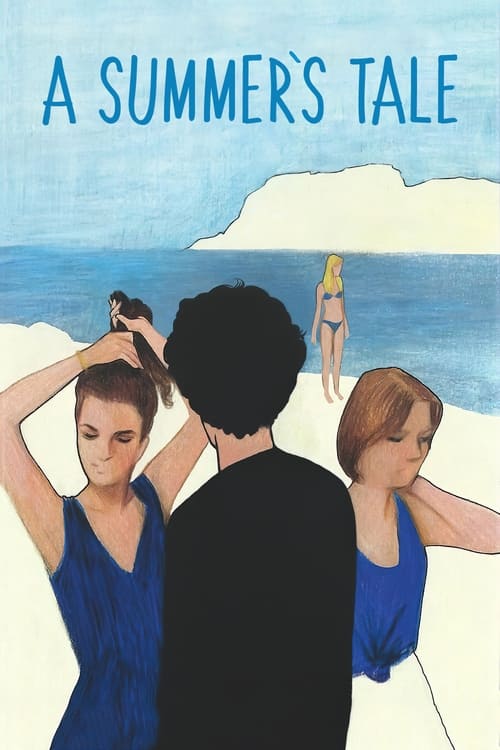
A Summer's Tale
1996 · Éric Rohmer
For when you want a warm, intelligent summer film — something breezy on the surface with real feeling underneath, perfect for an unhurried evening or when you're nostalgic for the summers when everything felt undecided. Pure comfort, with a wry sting.
What it's about
Gaspard, a shy young math graduate with a guitar, arrives at the Breton seaside resort of Dinard to wait for a girlfriend who may never show up. In the meantime he falls into an easy friendship with Margot, a sharp-eyed ethnology student waitressing for the summer, and a charged flirtation with the confident local Solène — so when Léna finally appears, he's juggling three women and can't commit to any of them.
The experience
Sunlit, talky, and quietly hilarious in the way real romantic dithering is hilarious — nothing explodes, but every beach walk and café conversation hums with the comedy of a young man who can't make up his mind. It's the cinematic equivalent of a long vacation afternoon.
Performances
Melvil Poupaud makes Gaspard's passivity funny and touching rather than annoying, and Amanda Langlet is quietly wonderful as Margot — the friend whose clear-sightedness makes her the film's true center of gravity.
The craft
Rohmer, in his mid-seventies, shoots with disarming simplicity: natural light, real beaches and tides, and conversation so precisely written it feels overheard. The drama lives entirely in talk and deferral — what's said, what's dodged — and the Breton coast gives it a constant, breathing beauty.
Why it matters
Part of Rohmer's celebrated Tales of the Four Seasons cycle, it's beloved as one of the great late works of a French New Wave founder and a touchstone for every filmmaker drawn to low-key, dialogue-driven romance.
Snapshot
A Summer's Tale (Conte d'été) is the third of Éric Rohmer's four-part cycle Contes des quatre saisons (Tales of the Four Seasons), made when the director was in his mid-seventies and near the end of a career that began as a critic and editor at Cahiers du Cinéma and helped define the French New Wave. It is a slight, exacting comedy of romantic indecision: Gaspard (Melvil Poupaud), a reticent young math graduate and amateur musician, waits at the Breton resort of Dinard for a girlfriend, Léna (Aurélia Nolin), who may not come, and in the interval drifts into ambiguous attachments with two other women — the level-headed ethnology student Margot (Amanda Langlet) and the sensual local Solène (Gwenaëlle Simon). Nothing is consummated and almost nothing is decided; the drama is entirely a matter of talk, deferral, and self-justification. Widely regarded as the most personal and autobiographically tinged of Rohmer's films, it distills, in the plainest possible register, the moral and conversational preoccupations that had run through his work for forty years.
Industry & production
The film was produced within the artisanal framework Rohmer had built for himself over decades, centered on his production company (the Compagnie Éric Rohmer) working in concert with Les Films du Losange, the company Rohmer had co-founded with Barbet Schroeder in the early 1960s and which, under Margaret Menegoz, remained his production and distribution home. Rohmer's economic model was famously frugal: tiny crews, real locations rather than sets, existing daylight rather than heavy lighting packages, and shooting schedules organized around the availability of place and, in this case, the actual Breton summer. This economy was not merely a budget constraint but an aesthetic principle — it allowed Rohmer complete authorial control and freedom from the pressures that shape more capitalized productions. The Tales of the Four Seasons cycle as a whole was conceived across the decade (beginning with A Tale of Springtime, 1990, and A Tale of Winter, 1992, and concluding with Autumn Tale, 1998), giving Rohmer a structural container for four self-contained films unified by seasonal mood rather than plot. Precise budget and box-office figures for A Summer's Tale are not something I can state reliably, and I will not invent them; what the record makes clear is that these were low-cost productions designed to recoup modestly and to serve their author's aims rather than a market.
Technology
A Summer's Tale was shot on 35mm film with the deliberately lightweight, low-impact apparatus that characterized late Rohmer. He resisted technological display of every kind — no elaborate camera rigs, no conspicuous artificial lighting, no optical trickery. The camera favors a fixed or gently repositioned viewpoint on a tripod; the palette is that of unmanipulated Breton coastal daylight, bright and slightly cool. Rohmer's technical conservatism was a considered position rather than indifference: he believed the cinema's proper business was the recording of real people in real places and light, and he treated the medium's basic resources — a camera, direct sound, and the natural world — as sufficient. The result is images that read as documentary transcriptions of a specific coastline in a specific season, a fidelity to place that is itself the film's chief "special effect."
Technique
Cinematography
The cinematography is by Diane Baratier, Rohmer's regular director of photography through this period and across the Four Seasons films. Her work here is self-effacing in the best sense: compositions are clean and frontal, often framing figures against sea, sky, harbor, or the geometry of the resort town, and the lighting is predominantly available daylight, which lends the film its transparent, almost weightless surface. Baratier's camera tends to hold a stable frame while the actors move and talk within it, following them on their walks along the coast paths and beaches with unobtrusive pans and reframings rather than dramatic movement. The visual grammar refuses emphasis — there are few close-ups deployed for pointed effect, and the coverage keeps bodies legible in their environment. This restraint throws all the weight onto behavior and speech, which is precisely Rohmer's intent.
Editing
Editing is by Mary Stephen, Rohmer's longtime collaborator, and it follows the director's principle of preserving the integrity of the recorded scene. Cutting is functional and rhythmically calm, built to sustain long conversational exchanges without breaking their real-time flow. Scenes are allowed to run to their natural conversational length; the montage does not compress or accelerate the drama but lets it unfold at the pace of talk and walking. The seams are nearly invisible, and the film's sense of duration — of a summer stretching out in idleness and hesitation — is itself a product of this unhurried assembly.
Mise-en-scène / staging
Rohmer's staging is organized around the walk-and-talk and the seated conversation. The mise-en-scène is documentary in its use of actual streets, cafés, harbors, cliff paths, and beaches of Dinard and the surrounding Breton coast; the geography is real and consistent, so that the audience comes to know the terrain across which Gaspard shuttles between his three women. Blocking is naturalistic — two figures side by side on a coastal path, a trio at a café table — and the environment is never merely a backdrop but the medium through which relationships are conducted. The staging quietly encodes the film's romantic geometry: Gaspard is repeatedly shown in transit, moving between people and places, never settled, and the spatial pattern of his comings and goings dramatizes his temperamental incapacity to choose.
Sound
Sound is recorded direct, in keeping with Rohmer's lifelong rejection of post-synchronization and, generally, of non-diegetic scoring. The soundtrack is the ambient reality of the coast — wind, sea, gulls, footsteps, the murmur of the town — under the near-continuous dialogue. Music enters the film almost exclusively from within the story: Gaspard is a guitar-playing would-be musician, and the film's most memorable musical motif is a sea shanty (a sailor's song) associated with his character, performed diegetically. By withholding an orchestral score, Rohmer keeps the emotional register cool and denies the audience any external cue as to how to feel about Gaspard's maneuverings — we are left, as with the characters, to judge for ourselves.
Performance
Performance is the film's true medium. Melvil Poupaud gives Gaspard a mumbling, evasive, faintly sullen charm — a young man forever explaining himself and forever failing to act — that anchors the comedy. Amanda Langlet, as Margot, supplies the film's clear-eyed intelligence and its most engaging presence; her casting carries a particular resonance for Rohmer's admirers, as she had played the title role in his Pauline at the Beach (1983), so that her reappearance here as a perceptive young woman at the seaside reads almost as a reprise across thirteen years. Gwenaëlle Simon (Solène) and Aurélia Nolin (Léna) complete the quartet. Rohmer's direction of actors, honed over decades, produces a naturalism that can seem like non-acting: the performers appear to be simply conversing, yet every hesitation and evasion is precisely calibrated to expose character.
Narrative & dramatic mode
The dramatic mode is Rohmer's signature: a "conte" — a tale or moral fable — built almost entirely from conversation, in which the ostensible plot (will Gaspard end up with Léna, Solène, or Margot?) is a pretext for the anatomy of a temperament. The narrative is comic in structure, turning on the classic device of the vacillating suitor and the collision of commitments, and it is resolved by a characteristically Rohmerian deus ex machina — an external contingency that spares Gaspard the necessity of choosing. The mode is ironic and observational rather than psychological in the dramatized-interior sense: we learn everything about Gaspard from what he says and how he behaves, and the gap between his self-image and his conduct is the engine of both the comedy and the moral scrutiny. There is no voice-over confession here as in some of Rohmer's earlier work, but the same interrogation of self-deception governs the film.
Genre & cycle
Generically, A Summer's Tale sits at the intersection of romantic comedy and chamber drama, but it belongs most precisely to a genre Rohmer more or less invented for himself: the talkative moral comedy of manners among young, articulate, self-deceiving people at leisure. Within his oeuvre it is the "summer" panel of the Four Seasons cycle, and it converses with two earlier Rohmer cycles — the Six Moral Tales (Contes moraux) of the 1960s–70s and the Comedies and Proverbs (Comédies et proverbes) of the 1980s. It is, specifically, a summer-holiday-by-the-sea film, a mode Rohmer returned to repeatedly (La Collectionneuse, 1967; Pauline at the Beach, 1983; The Green Ray, 1986), so that A Summer's Tale reads as a late, distilled entry in his personal genre of the seaside idyll and its erotic small print.
Authorship & method
A Summer's Tale is a thoroughly authored film. Éric Rohmer (born Maurice Schérer, 1920–2010) wrote and directed it, as he did all his mature work, and his method is unmistakable: dialogue-driven scripts realized with minimal crews, direct sound, natural light, real locations, and long conversational takes, all in service of a moral inquiry into how people rationalize their desires. Rohmer is widely understood to have invested more of himself in Gaspard than in most of his protagonists — the character's combination of intellectual seriousness (mathematics) and musical avocation, and the Breton coastal setting, have led critics and Rohmer himself to treat the film as his most autobiographically inflected. His key collaborators are the constants of his late period: cinematographer Diane Baratier, whose limpid natural-light images define the film's look; editor Mary Stephen, whose unhurried assembly preserves the real-time flow of the scenes; and producer Margaret Menegoz at Les Films du Losange, who sustained the economic conditions of Rohmer's independence. There is no credited composer of a film score in the conventional sense; music enters diegetically, through Gaspard's own songs. The unity of vision across writing, direction, image, and cutting is total, and it is Rohmer's — his collaborators serve a fully realized authorial program.
Movement / national cinema
Rohmer is one of the founding figures of the French New Wave (Nouvelle Vague), a critic-turned-filmmaker who edited Cahiers du Cinéma and made his first features in the movement's first wave. But by 1996 his relationship to that history is one of remarkable continuity rather than rupture: where colleagues like Godard and Truffaut evolved radically, Rohmer refined a single, consistent practice — location shooting, natural light, non-professional or lightly professional ensembles, dialogue over spectacle — that preserved the New Wave's original ethos of low-budget, personal, reality-anchored cinema into the 1990s. A Summer's Tale is thus a late flowering of the Nouvelle Vague's founding principles, made by one of its authors decades after the movement's historical moment had passed, and it stands as an emblem of French auteur cinema's artisanal tradition.
Era / period
The film is a product of 1990s French auteur cinema, an era in which the commercial landscape was increasingly dominated by larger productions, yet in which a durable culture of state support, cinephile audiences, and specialized distribution allowed veteran auteurs like Rohmer to continue working on their own terms. Its texture is contemporary to its making — the fashions, cars, and cassette-and-Walkman-era details of mid-1990s coastal France — but its sensibility is deliberately timeless, the ageless comedy of youthful romantic dithering. Within Rohmer's own career it belongs to a serene, valedictory late period, in which a filmmaker in his seventies turned repeatedly to the loves and hesitations of the very young.
Themes
The governing theme is indecision as a moral condition: Gaspard's inability to choose among the three women is presented less as bad luck than as a symptom of passivity, vanity, and a preference for keeping options open over committing to any reality. Around this cluster the film arranges its abiding Rohmerian concerns — the gap between what people say about themselves and what they do; the self-flattering stories we tell to excuse desire; the tension between freedom and fidelity; and the particular temporality of summer, that suspended, consequence-light interval in which idleness breeds both possibility and paralysis. Margot functions as the film's ethical intelligence, a confidante whose ethnographic vocation (she studies people) mirrors the film's own observational stance, and whose clear sight exposes Gaspard's evasions. Chance and contingency — the external accident that resolves the plot — carry a quiet philosophical weight, suggesting that character is destiny only up to the point where luck intervenes to let the irresolute off the hook.
Reception, canon & influence
Critically, Rohmer's late films, and A Summer's Tale among them, were received with the affectionate respect due a master working in a mode he had perfected; the film is generally esteemed as one of the strongest of the Four Seasons cycle and, in the view of many admirers, one of the most purely charming and personal works of his career. A significant fact of its reception history is its belated arrival before English-language audiences: A Summer's Tale went for many years without a U.S. theatrical release and was finally distributed in the United States only in 2014, in a restored form, long after its French premiere and well after Rohmer's death in 2010 — an unusually delayed canonization that introduced the film to a new generation of American cinephiles and prompted a fresh wave of appreciative criticism.
The influences on the film run backward through Rohmer's own oeuvre more than through any external source: it is the culmination of his lifelong seaside-comedy strain (La Collectionneuse, Pauline at the Beach, The Green Ray) and of the moral-tale form he had been refining since the 1960s, itself descended from a literary tradition of French moralistes and the conte as a genre. The reappearance of Amanda Langlet ties it explicitly to Pauline at the Beach, making the film partly a dialogue with Rohmer's own past.
Its forward influence lies chiefly in the model it offers to subsequent talk-driven, low-budget romantic cinema — the walking-and-talking, real-time, morally observant chamber film about young people and their evasions. Rohmer's method is a widely acknowledged touchstone for later filmmakers working in the register of the conversational romance and the eventless-yet-charged encounter; his fingerprints are frequently cited on the international art-house tradition of dialogue-centered relationship films. I would be overstating the record to attribute specific later works directly to A Summer's Tale in particular rather than to Rohmer's practice as a whole, and I will not do so; but the film stands as one of the purest late demonstrations of an approach whose descendants are legion in contemporary independent cinema.
A Deleuzian reading
A young man sits on the sand at Dinard with a guitar he plays well enough, waiting for a girl who may not come.
The full Deleuzian reading of A Summer's Tale →
Reception
A modest arthouse release in 1996, it famously didn't get a US theatrical run until 2014 — eighteen years late — and that belated release turned it into a full-blown rediscovery, with critics and a new generation crowning it the jewel of Rohmer's Four Seasons.
How A Summer's Tale was received, from release to now →
How to watch A Summer's Tale: what to notice on a first viewing
- Watch how often Gaspard is walking between two places. Rohmer stages most conversations as walks along real coastal paths and harbor streets, and Gaspard is almost always shown in transit rather than settled in one spot. His constant movement between people is doing the psychology a monologue would normally have to spell out.
- Listen for wind and sea noise picked up right on the microphone. Rohmer records sound live and never adds a score, so you hear the actual gulls, wind, and footsteps of the day instead of any music cueing your reaction. With no orchestra telling you how to feel about him, the judgment is left entirely up to you.
- Watch the frame hold still while the actors keep moving. Baratier keeps the camera stable and mostly avoids close-ups, letting figures stay legible against the sea, sky, and streets rather than isolating a face for emphasis. Without close-ups pushing you toward one reading, you're left to weigh his behavior for yourself, the way you would with a real person.
- Watch how often Gaspard explains himself instead of deciding anything. Poupaud plays him mumbling and faintly sullen, always ready with a new account of his own intentions to whichever woman is in front of him at the time. Each explanation sounds sincere in the moment, which is exactly what makes him so hard to pin down.
The whole guide to watching A Summer's Tale, with the keys for a rewatch →
Influences: the films it descends from and the films it influenced
- Pauline at the Beach (1983) — Directly quoted: Amanda Langlet reappears as essentially the grown Pauline, and the seaside-chamber architecture of overlapping, self-deceiving flirtations observed in direct sound and available daylight is the same structural machine.
- La Collectionneuse (1967) — Establishes the sun-idle vacation film shot with a skeleton crew, direct sound and natural light, where erotic strategy is conducted almost entirely through casual coastal conversation.
- My Night at Maud's (1969) — Codifies the extended real-time dialogue take as the primary dramatic unit — talk as a moral testing ground where a man rationalizes his desire in long, near-uncut conversational scenes.
- Claire's Knee (1970) — The summer-holiday moral tale in which a man's want is dissected verbally rather than acted upon, staged in real lakeside locations with static framing and daylight exteriors.
- The Green Ray (1986) — Its improvised, semi-documentary dialogue method and its protagonist paralyzed by indecision — drifting through seaside settings awaiting a sign — are the direct rehearsal for Gaspard's dithering.
- A Day in the Country (1936) — Renoir's open-air staging of romantic ambivalence in real riverside locations under natural light is the tradition Rohmer explicitly revered and transposes to the Breton coast.
- Journey to Italy (1954) — Rossellini's real-location moral drama shot with minimal apparatus, which Rohmer championed as a critic, models the idea that unforced settings and behavior can carry an entire ethical inquiry.
- Before Sunset (2004) — Pushes the Rohmer method to a near-real-time, roughly continuous walking conversation whose entire drama is what two people evade and confess in dialogue.
- Right Now, Wrong Then (2015) — Hong's explicitly Rohmerian practice — direct sound, natural light, tiny crew, and awkward talky romance anatomizing male self-deception through repetition and variation.
- Funny Ha Ha (2002) — Founds mumblecore on Rohmer's low-budget, improv-inflected dialogue realism: nonprofessional-feeling naturalism, ambient direct sound, and drama built from hesitant romantic conversation.
- In the City of Sylvia (2007) — Extends Rohmer's daylight observation of looking and strolling — a near-plotless film of a young man watching and walking, carried by ambient sound and available light rather than event.
- The Worst Person in the World (2021) — Adopts the chaptered conte structure to anatomize a young protagonist's romantic indecision and self-deception, treating vacillation itself as the moral subject in Rohmer's manner.
- Call Me by Your Name (2017) — Rohmer's real-time, talk-driven seaside coming-of-age rhythm — natural light, deferred desire, and moral hesitation dramatized through unhurried conversation rather than plot.
- A Tale of Springtime (1990) — Opens the same Four Seasons cycle using the identical conte form: a chance encounter, a mild romantic entanglement, and self-deception resolved through talk rather than plot.
- A Tale of Winter (1992) — Same cycle, same structure of a protagonist's romantic indecision suspended until chance or faith resolves it, sustained by unhurried long-take scenes.
- Autumn Tale (1998) — Closes the cycle with the same late-Rohmer craft team's signature — Diane Baratier's limpid natural-light images and Mary Stephen's real-time-preserving cutting.
- Metropolitan (1990) — An avowedly Rohmerian comedy of manners driven entirely by articulate young people talking themselves into and out of desire, wit and self-justification substituting for incident.
- Before Sunrise (1995) — Builds the eventless-yet-charged encounter out of continuous walk-and-talk in real locations, near real-time, a method Linklater has credited to Rohmer's conversational cinema.
Similar films
- The Green Ray (1986) — influence & lineage
- My Night at Maud's (1969) — influence & lineage
- The Worst Person in the World (2021) — influence & lineage
- Boyfriends and Girlfriends (1987) — shared sensibility
- Summer Hours (2008) — shared sensibility
- Summer of 85 (2020) — shared sensibility
- Call Me by Your Name (2017) — shared sensibility
- The Swimming Pool (1969) — shared sensibility