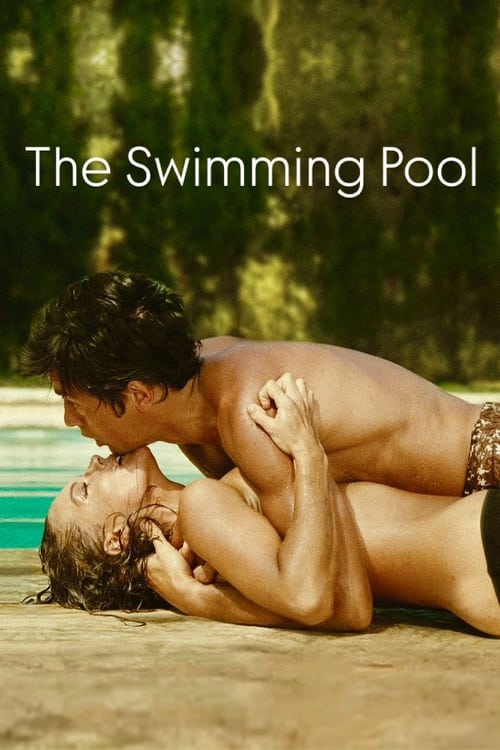
The Swimming Pool
1969 · Jacques Deray
For a hot summer night when you want glamour with teeth — a languid, gorgeous slow burn to sip like a cold drink that turns out to be stronger than it looks. Seductive first, unsettling after.
What it's about
Jean-Paul and Marianne are lovers idling away a summer at a villa above Saint-Tropez, sunbathing, swimming, and wanting nothing but each other. Then Marianne invites her ex — a charismatic record producer — to stay, and he arrives with his beautiful teenage daughter in tow. Four people, one house, one pool, and a rising current of jealousy, rivalry, and old history that the holiday can't contain.
The experience
Slow-burning and sensual, all glittering water and tanned skin with something poisonous underneath — the menace builds by degrees while everyone keeps smiling. It's a thriller that works through atmosphere and long silences rather than shocks, and it tightens beautifully.
Performances
Alain Delon and Romy Schneider — former real-life lovers reunited on screen — generate a charge no script could fake, and Delon's cool surface barely covers the resentment underneath. Maurice Ronet is perfect as the guest who charms a room while quietly claiming it.
The craft
Jacques Deray shoots the villa and its pool as a sealed, sun-drenched arena, letting bodies, glances, and the placement of deck chairs do the storytelling. The film's power is in its patience — lingering takes, ambient summer sound, tension distributed across silences. It's ravishing on a good screen; the Riviera light is practically a character.
Why it matters
A huge popular success in France in 1969, powered by the Delon–Schneider reunion, it became the touchstone for the sun-soaked psychological thriller and has been directly remade and imitated ever since.
Snapshot
La Piscine is a sun-scalded erotic thriller set entirely within the sealed world of a Saint-Tropez villa, where the swimming pool functions simultaneously as pleasure ground, arena, and murder site. Directed by Jacques Deray and starring Alain Delon, Romy Schneider, Maurice Ronet, and Jane Birkin, the film arrived in French cinemas in late January 1969 and became an immediate popular phenomenon, driven as much by its casting — Delon and Schneider were former real-life lovers reunited on screen for the first time since the early 1960s — as by its taut, Highsmith-adjacent psychology. Beneath the shimmering surface of Riviera leisure lies a film about sexual possession, masculine rivalry, and the violence that accumulates when desire is forced into too small a space. Deray, working at the height of his commercial powers, shapes material that might have been a mere fait divers into something genuinely unsettling: a meditation on how beauty and murder share the same light.
Industry & production
La Piscine was produced by Gérard Beytout for Société Nouvelle de Cinématographie (SNC) in association with Marianne Productions. It was conceived explicitly as a prestige commercial property built around star power. The pairing of Delon and Schneider was the project's engine: the two had been romantically involved from roughly 1958 to 1964, a liaison so publicly documented that their separation remained a subject of French tabloid interest. Reuniting them on screen — as lovers whose relationship has calcified into something possessive and uneasy — gave the film a quasi-documentary charge that no script revision could have manufactured. Audiences understood they were watching real history refracted through fiction.
The addition of Maurice Ronet as Harry, the intruding ex-lover, carried its own intertextual weight. Ronet had played Philippe Greenleaf in René Clément's Plein Soleil (1960), the Highsmith adaptation in which Delon's Tom Ripley murders him. Nine years later, casting Ronet again opposite Delon — with Delon again, eventually, killing him — was a choice that cannot have been accidental. The echo is structural: Deray and his collaborators were building a hall of mirrors between two films, inviting audiences who knew Plein Soleil to feel a grim inevitability in every scene Harry and Jean-Paul share. Jane Birkin, cast as Harry's teenage daughter Pénélope, was then largely unknown in France; the role made her a significant presence in European cinema.
Shooting took place primarily on location on the Côte d'Azur, near Saint-Tropez, using a private villa whose pool became the film's central stage. The decision to remain almost entirely within this single location for the duration of the narrative concentrates pressure elegantly, ensuring that no character can escape the atmosphere of mutual surveillance and desire.
Technology
The film was shot on 35mm in the Eastmancolor process, with the technical pipeline standard for high-end French commercial production of the late 1960s. The choice to shoot on location in direct Mediterranean sunlight rather than on controlled studio sets was both an aesthetic and a practical decision: it gave cinematographer Jean-Jacques Tarbès access to the quality of light that gives the film its particular beauty and menace. No unusual technical innovations are documented for this production; the film achieves its effects through the skilled deployment of conventional tools rather than technical experimentation.
Technique
Cinematography
Jean-Jacques Tarbès's camera work is one of the film's defining achievements. He treats the Riviera landscape not as backdrop but as a system of surveillance: the camera watches characters watching each other, registering glances, the tracking of eyes across bodies, the slow accumulation of looks that precede violence. The pool itself is photographed with an almost erotic attention — its surface fractured by light, its depths obscured, its blue a constant reminder of both desire and danger. Tarbès uses wide shots of the villa and its grounds to establish the characters' containment: they are beautiful figures in a beautiful cage. Close-ups of faces — particularly of Delon and Ronet in confrontation — are staged in strong direct light that leaves no shadow for ambiguity. The film's visual grammar associates clarity of light with moral exposure.
Editing
The editing maintains a measured, pressurized rhythm that is less concerned with pace than with the steady tightening of a screw. Sequences of leisure — meals, poolside lounging, drives — are cut so that the idleness itself becomes oppressive. The murder sequence is handled with comparative abruptness, refusing the slow-motion aestheticization common to genre contemporaries; the violence arrives quickly and leaves the camera to contemplate its aftermath in near-silence.
Mise-en-scène / staging
Deray's staging is fundamentally about geometry and proximity. The villa's pool and terrace create a spatial vocabulary in which characters are perpetually too close, forced into each other's orbit. He returns repeatedly to configurations in which three of the four principals are visible simultaneously, allowing audiences to read triangulations of desire — who is watching whom, who is being excluded from whose gaze — without dialogue. The blocking of Delon and Ronet in their confrontational scenes emphasizes physical equality: both men are lean, tanned, equally at ease in the space, so that their rivalry reads as a contest between two versions of the same type rather than between a protagonist and an antagonist.
Sound
Michel Legrand's score is used with notable restraint. Legrand was at the peak of his international reputation in 1969 — he had recently scored The Thomas Crown Affair (1968) and his collaboration with the Nouvelle Vague (particularly Agnès Varda) was well established — but Deray deploys him sparingly, allowing ambient sound (water, cicadas, the clatter of a meal) to carry much of the film's emotional weight. When the score does enter, it registers mood rather than directing emotion. Extended passages of the film run without non-diegetic music at all, a restraint that heightens the atmosphere of unease.
Performance
The performances are the film's center. Delon plays Jean-Paul with a controlled, almost reptilian stillness; the character's jealousy manifests not as explosive temperament but as a barely perceptible tightening — a quality Delon had developed across his career and which here feels genuinely dangerous. Schneider brings enormous intelligence to Marianne: her character knows exactly what her inviting Harry has set in motion, and Schneider plays her awareness against her desires with remarkable precision, giving the film its moral complexity. Ronet's Harry is the finest element: charming, casually cruel, unwilling to cede ground, he is the kind of man who mistakes appetite for vitality, and Ronet plays him with a lightness that makes his death genuinely ambivalent. Birkin's Pénélope is partly constructed as a catalyst — young, openly desirous of Jean-Paul — but Birkin locates something real in the character's mixture of provocation and loneliness.
Narrative & dramatic mode
The film operates as a classical five-act compression. The first act establishes equilibrium — Jean-Paul and Marianne's contented isolation. Harry's arrival breaks it, introducing rivalry and suppressed violence. The middle section is a prolonged, slow-burning middle act in which nothing and everything happens: pleasures continue, but every pleasure is contaminated by surveillance and jealousy. The murder is structurally the film's fourth-act pivot rather than its climax; the fifth act involves the investigation, during which Jean-Paul's guilt accumulates circumstantially while his culpability is simultaneously morally complicated. Deray is interested in the aftermath of violence as much as in its commission — in how the beautiful world of the villa persists, slightly altered, after someone has drowned in it.
The dramatic mode draws on the roman policier tradition but is inflected by a European art-film interest in psychology over plot mechanics. Unlike a genre thriller, La Piscine refuses to frame Jean-Paul as straightforwardly guilty or innocent: the murder is presented as something that emerged from a structure of feeling rather than a plan, which gives the film its lingering moral discomfort.
Genre & cycle
La Piscine belongs to a recognizable cycle of Mediterranean erotic crime films that runs from Plein Soleil (1960) through the 1960s and finds renewed form in the 1990s and early 2000s. The cycle's essential ingredients — beautiful people in a sun-saturated location, a closed social world, desire that crosses into violence — draw on both Patricia Highsmith's moral universe (wealth as corruption, the unexamined life as dangerous) and on the traditions of the roman noir and the classical unities of French tragedy. By setting the entire action within a single property, Deray aligns the film formally with the theatrical tradition of the contained catastrophe: the villa is simultaneously locus amoenus and trap.
The film also participates in a late-1960s French commercial cinema that was consciously engaging with Hitchcock — with psychological suspense as a legitimate framework for serious character study. It is not a thriller that happens to have intellectual ambitions; it is a film in which genre and psychology are continuous.
Authorship & method
Jacques Deray (born Jacques Desrayaud, 1929–2003) was a director of precise and underestimated craft, consistently working in the commercial mainstream while maintaining a consistent set of interests: masculinity under pressure, the ethics of violence, male friendship and rivalry. His long association with Alain Delon — La Piscine initiated a collaboration that extended through Borsalino (1970), Flic ou Voyou (1979), Le Marginal (1983), and others — gave him a singular instrument: Delon's screen persona, which Deray understood as deeply as any director who worked with the actor. La Piscine is arguably the most concentrated expression of what that collaboration could produce at its finest.
The screenplay is credited to Jean-Emmanuel Conil and Deray, based on an original story. The structure shows a filmmaker interested in economy: everything narrative is achieved through the closed world of the villa rather than through incident or subplot.
Michel Legrand's presence as composer connects the film to the wider French and international prestige cinema of the period; his work here is deliberately less lush than his concurrent international scores, calibrated to the film's cool surface.
Movement / national cinema
La Piscine sits at an interesting position within French national cinema of 1969. It is not a Nouvelle Vague film — Deray's commitment is to craft and commercial storytelling, not to the formal ruptures of Godard or Truffaut — but it is a film that has absorbed certain lessons of the New Wave without fully adopting its methods. The location shooting, the attention to performance over plot mechanics, the willingness to leave moral questions unresolved: these are practices that the New Wave normalized within French cinema, even for directors who were not part of the movement. Deray works in the space the New Wave opened up without working in its mode.
The film also reflects the specific cultural moment of French commercial cinema immediately post-1968: it has the surface glamour of the earlier 1960s but a harder, more ambivalent undertone, as though the social ruptures of May '68 had permeated even the hermetically sealed world of Saint-Tropez villadom.
Era / period
The late 1960s on the Côte d'Azur is not merely setting but period atmosphere: Saint-Tropez in 1969 still carried the associations of Bardot and the nouvelle vague of sexuality that the resort had acquired in the mid-1950s, while also being legible to audiences as a site of a specific bourgeois leisure culture under pressure. The film's year of release corresponds to a moment in European cinema when the explicit treatment of sexuality and violence on screen was rapidly expanding, and La Piscine tests the new thresholds with considerable confidence.
Themes
Sexual jealousy and the desire for exclusive possession drive the film's action, but Deray frames these as symptoms of a deeper problem: the arrested development of a certain type of male identity that equates love with ownership. Jean-Paul's capacity for violence is not presented as aberrant — it is presented as the logical terminus of the way he understands Marianne. Harry's intrusion is threatening not merely because he is a rival but because his presence reveals how little Jean-Paul trusts the bond he believes he has with her.
The film thinks carefully about complicity. Marianne invites Harry; she is not a passive figure but an active participant in the drama's construction. Whether she anticipates the violence, desires it at some level, or is simply catastrophically miscalculating her ability to control what she has set in motion is never resolved, and the film is richer for it.
Privilege and the violence it enables is a background concern: the villa, the leisure, the unscheduled days — all create the conditions under which this catastrophe becomes possible. There is no working world intruding on these characters, no external reality that might interrupt the feedback loop of desire and rivalry. The pool is both the film's central object and its moral symbol: beautiful, artificially maintained, capable of holding a body.
Reception, canon & influence
La Piscine was a major commercial success on its French release in January 1969 and performed well internationally. Critical reception at the time acknowledged the film's craft and the quality of the performances, though Deray's commercial reputation meant the film was not immediately received as a significant artistic statement. It was understood primarily as a prestigious genre entertainment — which, in retrospect, undersells it.
Influences on the film: The Highsmith inheritance is significant even without a direct adaptation: the moral universe of Ripley — in which beautiful people in beautiful places commit violence for psychologically comprehensible reasons — permeates the film's atmosphere. Plein Soleil is the film's most important precursor, and the casting of Delon and Ronet together functions as a direct citation of it. Classical French tragedy's interest in the unities and in the catastrophic consequences of closed systems of passion is also operative. Hitchcock's model of suspense — the slow accumulation of dread through environment and performance rather than through incident — is a technical influence.
Legacy and forward influence: The film's most traceable direct descendant is François Ozon's Swimming Pool (2003), which shares its title, its basic spatial premise (a villa with a pool as a closed world of desire and violence), and its interest in the psychology of female desire, though Ozon's film is formally quite different. More broadly, La Piscine helped establish the template of the Mediterranean crime-of-passion film that would be reprised in The Talented Mr. Ripley (Anthony Minghella, 1999), Plein soleil (re-evaluated in its wake), and numerous European thrillers of subsequent decades. The film's insistence on the pool as a morally loaded space — leisure as preparation for violence — has become a kind of shorthand in subsequent cinema.
The career trajectories of its cast give the film additional retrospective significance. Jane Birkin's emergence here as a major screen presence, within months of her partnership with Serge Gainsbourg (which began around the same period), means the film captures something historically particular: a specific moment in European popular culture in which youth, sexuality, and a certain transgressive freedom were briefly coincident. For Delon and Schneider, La Piscine is the definitive document of their screen chemistry — more fully realized, arguably, than either of their earlier collaborations — and it has grown in critical estimation as both stars' careers have been reassessed. The film repays serious attention as a work about what happens when the world is too beautiful and no one has anywhere else to be.
A Deleuzian reading
Noon at the villa, and the pool holds the whole film in its surface — blue, lacquered, broken into scales by the light, then going dark a few feet down.
The full Deleuzian reading of The Swimming Pool →
Reception
A hit in France in 1969 but long dismissed abroad as glossy Eurotrash, it was spectacularly reappraised when a 2021 restoration ran for months at New York's Film Forum and turned it into a certified summer classic.
How The Swimming Pool was received, from release to now →
Influences: the films it descends from and the films it influenced
- Plein Soleil (1960) — Deray's deliberate recasting of Ronet as the man Delon murders nine years later — same Mediterranean setting, same Highsmith-adjacent closed-world psychology — transforms the killing into a structural echo that the audience's memory of the earlier film has already made feel inevitable, and Tarbès's cinematography is explicitly calibrated against Decaë's original surveillance of bodies in direct Riviera light.
- Les Diaboliques (1955) — The pool as the specific site of murder concealment and waterlogged-corpse revelation — a structural device Deray directly inherits — embedded in a closed-world villa thriller whose triangulated desire between two men and one woman is the genre template La Piscine refines.
- L'Avventura (1960) — Mediterranean bourgeois leisure as a moral vacuum where characters surveil each other's bodies across empty landscape is the formal principle La Piscine domesticates into genre — Antonioni's structural refusal of moral resolution becomes Deray's ambiguity about who is ultimately guilty of what.
- Knife in the Water (1962) — Three-person triangulation of desire and violence within a single sealed leisure space — a boat substituting for a pool — building through enforced proximity and pressurized-restraint editing to sudden violence is the nautical template La Piscine transposes precisely to the Riviera villa.
- The Servant (1963) — Losey encodes class and sexual rivalry entirely through the spatial choreography of a single domestic space — who occupies which room, how bodies approach and retreat through architecture — and Deray transplants this grammar of proximity-as-threat directly from the London townhouse to the Riviera villa.
- Blow-Up (1966) — Antonioni codifies the surveillance gaze as a formal device in which watching generates rather than resolves ambiguity — photography as an act of capture that yields no knowledge — and situates this epistemology in the same world of fashionable European leisure whose beautiful, morally emptied surfaces La Piscine simultaneously inhabits.
- Le Samouraï (1967) — Delon's reptilian-stillness performance grammar — held gaze, minimal gesture, physical menace expressed through economy of movement — is codified here as a system that Deray deploys directly eighteen months later: Jean-Paul's threat in La Piscine operates on precisely the same register Melville established.
- Dead Calm (1989) — Noyce transposes La Piscine's sealed-arena geometry from pool to open ocean — a yacht as the three-person spatial trap where surveillance, enforced proximity, and pressurized restraint give way to abrupt violence — inheriting the erotic-thriller closed-world logic directly.
- Beau Travail (1999) — Denis extends La Piscine's formal logic of male rivalry in spatial containment to the Foreign Legion: Agnès Godard's camera surveils sun-damaged bodies with the same homoerotic surveillance gaze Tarbès applied to Delon and Ronet, while ambient-diegetic sound over a near-absent score becomes the film's primary emotional register.
- The Talented Mr. Ripley (1999) — Minghella extends the Plein Soleil/La Piscine Highsmith-adjacent Mediterranean-murder lineage — surveillance of desire between men, murder by a figure who cannot possess what he covets, bodies in leisure landscapes — with Dryburgh's cinematography treating Italian light the way Tarbès treated Riviera light.
- Swimming Pool (2003) — Ozon explicitly restages La Piscine's architecture — a writer, a villa in the south of France, a sexually threatening young woman, an ambiguous poolside murder — while destabilizing the 1969 film's genre certainties by relocating the violence inside an unreliable narrator's possibly imagined fiction.
- Laurel Canyon (2003) — The swimming pool as the literal stage of languid erotic transgression — bodies, heat, and idleness choreographed around water as the site where coupledom comes undone.
- Teorema (1968) — A sexually magnetic stranger arrives at a bourgeois family's leisure space and destabilizes every relationship through unresolved desire — the same closed-world intrusion geometry as Harry arriving at Jean-Paul and Marianne's villa — though Pasolini extends it to allegory where Deray contains it as erotic thriller.
- Deep End (1970) — Skolimowski uses a pool — here a London municipal bathhouse rather than a Riviera villa — as the stage for sexual surveillance, obsessive desire, and abrupt fatal violence, arriving independently and simultaneously at the same spatial-erotic logic and shock-cut death that defines La Piscine's formal strategy.
- Le Boucher (1970) — Chabrol's contemporaneous thriller shares the formal strategy of making a sealed provincial space generate psychological pressure through spatial containment, restrained score, and the triangulation of desire, with violence arriving abruptly after long surface calm — a Hitchcockian formal precision running parallel to Deray's.
- The Conformist (1970) — Storaro's surveillance cinematography treats European architectural space and Mediterranean light as a system of moral exposure, while Trintignant's reptilian physical self-containment is a direct parallel to Delon's performance mode, with moral ambiguity around sexual violence and murder as the structural common ground.
- Eyes Full of Sun (1970) — The definitive late-60s languid-leisure film — tanned bodies, Côte d'Azur heat, idle desire rendered through slow sunlit compositions — a direct stylistic peer.
- The Swimmer (1968) — Deray sustains an entire drama on a pool's surface in high-key summer light, treating water and sunlit skin as the arena where class and sexual power get settled — the pool as social instrument rather than setting.
Similar films
- Purple Noon (1960) — influence & lineage · same viewing thread
- L'Avventura (1960) — influence & lineage · often watched together
- Diabolique (1955) — influence & lineage
- The Talented Mr. Ripley (1999) — influence & lineage · same viewing thread
- The Servant (1963) — influence & lineage · often watched together
- Last Year at Marienbad (1961) — often watched together
- The Swimmer (1968) — often watched together
- Charade (1963) — often watched together
All the films related to The Swimming Pool →
Watch it with: curated runs of related films
- Elegant Betrayals — Watch these back-to-back for couples and beautiful people whose polished surfaces — a London flat, a Riviera villa, a spies' dinner party — hide a betrayal, a surveillance, and a body, each turning intimacy into a crime scene.