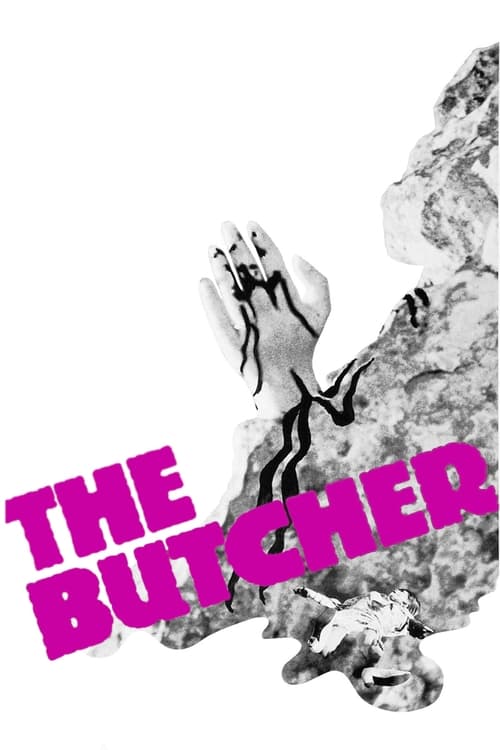
The Butcher
1970 · Claude Chabrol
For when you want tension that simmers rather than jolts — a slow-burn evening film to sit with quietly and turn over afterward. Challenge over comfort, but of the hushed, absorbing kind.
What it's about
In a quiet village in rural France, the local butcher — a lonely veteran of colonial wars — strikes up a halting, tender friendship with the town's reserved schoolteacher. As they circle each other, a series of knife murders begins terrorizing the district, and the question of who is responsible hangs over every gentle conversation they share.
The experience
A thriller that runs on stillness: almost no violence on screen, yet the dread is constant, seeping out of pauses, glances, and everyday routines. It's melancholy as much as menacing — a suspense film that doubles as a study in loneliness.
Performances
Jean Yanne makes the butcher heartbreaking — coarse, eager, wounded — while Stéphane Audran's cool, contained schoolteacher lets you read whole histories of repression in the smallest reactions. The film lives in the charged space between them.
The craft
Claude Chabrol's direction is a masterclass in restraint: he practically tells you where the danger lies early on, then reroutes all the suspense into the relationship itself. Every framing of the village — the school, the shop, the caves in the hills — tightens the atmosphere without a single cheap shock.
Why it matters
Widely regarded, including by Chabrol himself, as among his finest films, and a benchmark for how psychological suspense can be built from character rather than plot mechanics.
Snapshot
Le Boucher is Claude Chabrol's quietest and most concentrated masterwork: a murder story with almost no on-screen murder, a thriller that withholds nearly all of its suspense in favor of a study in loneliness. In a Périgord village, Popaul (Jean Yanne), the local butcher, forms a tender, halting friendship with Hélène (Stéphane Audran), the headmistress of the school, while a series of knife killings terrorizes the district. The film's genius is that it treats the identity of the killer almost as a formality — the audience intuits Popaul's guilt early — and reroutes all its tension into the human bond between two damaged people who cannot quite reach one another. Made at the height of Chabrol's most fertile period and widely regarded, including by the director himself in interviews, as among his finest achievements, it fuses Hitchcockian moral inquiry with a Balzacian sociology of provincial France and a nearly Langian sense of fate. At roughly ninety minutes, it is a model of compression: every scene carries weight, and the film's horror is inseparable from its compassion.
Industry & production
Le Boucher belongs to the remarkable run of films Chabrol produced with André Génovès between roughly 1968 and 1972 — Les Biches (1968), La Femme infidèle (1969), Que la bête meure (1969), Le Boucher (1970), La Rupture (1970), and Juste avant la nuit (1971) — the cycle that restored Chabrol's critical standing after a run of commercial assignments and genre pictures in the mid-1960s. This was a Franco-Italian co-production (the era's standard financing structure), shot on location in and around Trémolat in the Dordogne. Working with a stable, trusted crew and a modest budget, Chabrol operated with the efficiency of a filmmaker who had learned to shoot fast and cleanly; he was known for tight schedules and a preference for working with the same collaborators film after film. Reliable, verified figures for the production budget and box-office returns are not something I can state with confidence, and I will not invent them; what the record does establish is that these Génovès-era films were made economically and returned Chabrol to the front rank of French auteurs both critically and commercially. The casting reflects the domestic logic of the period: Stéphane Audran was Chabrol's wife and his central muse of these years, cast repeatedly as a woman named Hélène, while Jean Yanne — a comedian, singer, and provocateur — had just worked with Chabrol on Que la bête meure.
Technology
Technologically, Le Boucher is unassuming by design. It was shot on 35mm in color (Eastmancolor-era stock) by Jean Rabier, and the film's technical choices run counter to spectacle. There is no elaborate optical work, no showy process photography, and the violence is almost entirely elided rather than staged with effects. The most conspicuous "technology" in the film is diegetic and thematic rather than a matter of production apparatus: the cigarette lighter Hélène gives Popaul, which becomes the story's fatal piece of evidence, and — at the level of the film's imagination — the prehistoric technology of the flint and the blade, invoked through the Cro-Magnon caves the characters visit. Chabrol's method treated the camera as an instrument of observation rather than manipulation; the sophistication lies in framing, staging, and duration rather than in any novel apparatus. In that sense the film is a demonstration that the New Wave's technical modesty had matured into a refined classical craft.
Technique
Cinematography
Jean Rabier's photography is central to the film's authority. Rabier, who had been Henri Decaë's operator and shot much of Chabrol's work as well as Agnès Varda's Le Bonheur, gives Le Boucher a lucid, sunlit calm that makes its undercurrent of dread all the more disquieting. The celebrated opening is a long, fluid moving shot that follows a wedding procession through the village and into the reception — an unhurried establishing gesture that maps the community, introduces the two protagonists, and sets the film's tempo of watchful patience. Rabier favors clean, level compositions and controlled camera movement over montage; the countryside of the Dordogne is rendered as a serene, ancient landscape, and that serenity is precisely what the killings profane. The film's single most famous image is an exercise in composition and revelation: on a school outing atop the cliffs, a drop of blood falls onto a child's bread, and the camera tilts up to disclose a body above — horror introduced not through a cut but through the discovery within a continuous frame.
Editing
Cut by Jacques Gaillard, the editing is unobtrusive and classical, prioritizing the integrity of the scene over rhythmic assertion. Chabrol builds tension through duration and withholding rather than through accelerated cutting; the film lets conversations and glances play out, so that meaning accrues in the spaces between lines. Where a conventional thriller would fragment its violent set-pieces, Le Boucher keeps them off-screen or brief, and reserves its editorial patience for the intimate two-handers between Hélène and Popaul. The result is a film whose suspense is dramatic and moral rather than mechanical.
Mise-en-scène / staging
Chabrol's staging is his signature strength, and here it is exemplary. The film is organized around a small set of charged locations — the school, the butcher's shop, Hélène's apartment, the village square, the caves, the cliffs, the river — and Chabrol choreographs his actors within them with unshowy precision. The recurring juxtaposition of Hélène's ordered, book-lined, self-contained interior with the raw physicality of the butcher's shop encodes the film's central opposition of civilization and appetite. Meals, gifts, and small courtesies structure the relationship; the exchange of the lighter and the cherries, the shared cigarette, the offered flowers all function as staged objects that carry the emotional and eventually forensic weight of the plot.
Sound
Pierre Jansen, Chabrol's regular composer of this era, supplies a spare, modernist score that deploys dissonance and silence rather than continuous underscoring — music used as punctuation and unease rather than reassurance. Chabrol was notably attentive to ambient sound: the quiet of the provincial town, birdsong, the noise of the schoolyard, and the everyday hum of village life form a naturalistic bed against which the score's intrusions register sharply. The restraint of the sound design mirrors the film's larger strategy of withholding.
Performance
The film rests on two performances of great subtlety. Stéphane Audran's Hélène is a study in composed self-suppression — poised, cultured, and warm, yet defended by a wariness rooted in a past disappointment she alludes to but never fully opens. Audran conveys a woman who has chosen safety over passion, and whose dawning knowledge of Popaul's nature becomes a moral trap. Jean Yanne's Popaul is the film's astonishment: gruff, funny, wounded, and disarmingly gentle, a man brutalized by years of colonial warfare who reaches toward Hélène with genuine tenderness even as he kills. Yanne makes the murderer sympathetic without ever excusing him, and it is the co-existence of monstrousness and vulnerability in his playing that gives the film its tragic force.
Narrative & dramatic mode
Le Boucher deliberately inverts the whodunit. Chabrol dispenses with mystery early, letting the audience — and, more slowly, Hélène — recognize Popaul's guilt, so that the dramatic mode becomes that of tragedy rather than detection. The engine of the film is not "who did it?" but "what will she do, and what does her knowing cost her?" This is domestic, psychological, and ironic drama in the Chabrolian key: a chamber piece about intimacy and denial in which the suspense is ethical. The narrative is patient and elliptical, advancing through everyday encounters rather than plot machinery, and its climax is not a confrontation of hunter and hunted but a confession of love and a self-inflicted death, followed by a coda of desolate solitude.
Genre & cycle
The film sits at the intersection of the crime thriller and the psychological chamber drama, and within Chabrol's oeuvre it belongs to the great Génovès–Audran cycle of bourgeois and provincial studies of the late 1960s and early 1970s. Chabrol repeatedly returned to the murder story as a vehicle for social and moral dissection, and Le Boucher is his most refined instance of the form — a serial-killer premise stripped of sensationalism and turned toward character. It also participates in the long tradition of French provincial realism, the anatomizing of small-town life that runs from Balzac and Flaubert through French cinema, and which Chabrol openly claimed as an inheritance.
Authorship & method
Le Boucher is a near-textbook demonstration of Chabrol's authorship and of his method of working through a company of trusted collaborators. Chabrol wrote the screenplay himself, and the film reflects his lifelong Hitchcockian preoccupations — guilt, complicity, the eruption of violence beneath bourgeois calm — filtered through a colder, more clinical eye than Hitchcock's. A co-author (with Éric Rohmer) of the pioneering 1957 critical study of Hitchcock, Chabrol here practices what that book theorized: the transfer of guilt, the moral implication of the observer, the ordinary surface that conceals catastrophe. His key collaborators are essential to the achievement: cinematographer Jean Rabier, whose limpid images define the film's tone; composer Pierre Jansen, whose austere modernism supplies its unease; editor Jacques Gaillard; and above all Stéphane Audran, whose recurring "Hélène" persona across these films gives the cycle its through-line. The consistency of this team allowed Chabrol a relaxed, precise control that reads on screen as effortless classicism.
Movement / national cinema
Chabrol was a founding figure of the French Nouvelle Vague — a critic at Cahiers du cinéma and the maker of Le Beau Serge (1958), frequently cited as one of the first New Wave features — and Le Boucher represents the movement's maturation into a personal classicism. By 1970 the youthful stylistic rebellions of the New Wave had, in Chabrol's hands, settled into a controlled, Hitchcock- and Lang-inflected craft applied to the analysis of French society. The film is deeply a work of French national cinema in its attention to the manners, class textures, and landscapes of provincial France, and in its literary lineage; it demonstrates how the New Wave's auteurist convictions could be reconciled with genre and with an almost nineteenth-century sociological realism.
Era / period
Released in 1970, the film is inseparable from its moment without being topical. Its most historically specific charge is Popaul's biography: a man who spent years as a soldier in France's colonial wars — the film invokes his long, brutalizing military service — and returned to civilian life carrying an appetite for violence he cannot govern. In the wake of the Indochina and Algerian conflicts, and against the backdrop of the era's broader reckoning with organized violence, Popaul functions as an image of the wars' human residue deposited back into the placid heart of rural France. At the same time, the film reaches past its present toward deep time, using the region's prehistoric caves to frame contemporary murder as the persistence of something ancient — situating 1970 within a continuum stretching back to Cro-Magnon man.
Themes
The film's governing theme is the thin membrane between civilization and savagery — the schoolteacher and the butcher as the two faces of the human animal, culture and appetite, restraint and instinct. The prehistoric caves make this explicit: modern refinement is a recent veneer over an atavistic capacity for killing. A second, intertwined theme is repression and loneliness. Hélène's cultivated self-sufficiency is a wound as real as Popaul's, and the tragedy is that two isolated people find in each other exactly what might have saved them, yet cannot cross the distance — her fear of intimacy meeting his inability to master his nature. The film also probes complicity and moral responsibility: how much Hélène knows, when she knows it, and what her silence makes her. Finally, it meditates on the legacy of war, the way institutionalized violence deforms the individual and follows him home. These themes are never stated as theses; they are dramatized through gesture, object, and place.
Reception, canon & influence
Le Boucher was received as a major work on release and has only grown in stature, routinely named among Chabrol's greatest films and among the finest French films of its era; it has been championed by critics across generations and has retained a durable place in the canon through revival and home-video restoration. (Specific contemporary review quotations and citations I will not reconstruct from memory, to avoid misattribution — but the broad critical consensus of the film's high standing is well established.) Its influences run backward to Alfred Hitchcock above all — the moral architecture of guilt and complicity that Chabrol had studied as a critic — and to Fritz Lang's fatalism and the French literary realism of Balzac and Flaubert; the sympathetic, socially situated murderer also echoes the tradition of Lang's M. Forward, its influence lies less in direct imitation than in its demonstration that the serial-killer story could be a vehicle for tenderness, tragedy, and social analysis rather than shock — an approach that reverberates through subsequent art-house treatments of violence and through the wider critical revaluation of Chabrol as a master psychologist of the everyday. Within his own body of work it stands as the keystone of the Audran cycle and the film against which his later variations on murder and the bourgeoisie are measured.
Reception
Praised on release as the peak of Chabrol's late-'60s hot streak, it has only climbed since — now routinely called his masterpiece and a fixture on best-French-thriller lists, exhibit A in the case that Chabrol was the most underrated of the New Wave.
How The Butcher was received, from release to now →
Influences: the films it descends from and the films it influenced
- M (1931) — Lang builds his child-murderer as a compulsion-driven, pitiable man pleading for understanding rather than a monster — the sympathetic, socially situated killer whose tragic humanity Chabrol transposes onto Popaul.
- Shadow of a Doubt (1943) — The exact 'transfer of guilt' and observer-killer doubling Chabrol theorized in his 1957 Hitchcock study — a charming murderer nested inside a placid provincial community, morally implicating the woman who half-knows him.
- Strangers on a Train (1951) — The criss-cross of complicity in which an innocent becomes morally bound to a killer supplies the Hélène/Popaul dynamic — guilt shared between watcher and murderer rather than confined to the guilty party.
- Psycho (1960) — Hitchcock's boyish, tender, wounded murderer engineers audience sympathy toward the killer himself — the affective machinery Chabrol reuses to make Popaul's monstrousness heartbreaking.
- La Bête humaine (1938) — Renoir's Zola adaptation gives the French literary-realist template of a decent man driven to kill by an inherited, uncontrollable compulsion — the Balzac/Flaubert naturalism (murder as pathology of milieu and heredity) that grounds Le Boucher.
- Le Corbeau (1943) — Clouzot's closed provincial French town as a moral petri dish — malignancy festering beneath bourgeois calm, anonymous menace among ordinary neighbors — is the social laboratory Chabrol inherits for Trémolat.
- La Règle du jeu (1939) — Renoir's deep-focus ensemble mise-en-scène, staging social order and its violent underside within a single controlled frame, models the 'effortless classicism' of Chabrol's staged long takes.
- The Wages of Fear (1953) — Chabrol — who named Clouzot as primary influence — inherits the temporal-extension suspense method and the spatial-legibility staging: individual threat sequences in Le Boucher are stretched past thriller convention and always spatially anchored before danger arrives, with Jean Yanne's laconic physicality a direct echo of Montand's masculine-performance mode.
- The Skeleton of Mrs. Morales (1960) — Descends the killer-amid-normalcy craft into provincial realism, letting a murderer coexist with placid bourgeois domesticity under a deceptively calm surface.
- A Short Film About Killing (1988) — Extends Chabrol's proof that murder can be filmed as tragedy and social indictment, not shock — a cold, jaundiced cinematographic tone treating the killer as a socially produced, still-human figure.
- Henry: Portrait of a Serial Killer (1986) — Deglamorizes the serial killer through flat, observational realism and everyday banality — the art-house route of tenderness-and-tragedy over spectacle that Le Boucher opened.
- Memories of Murder (2003) — Turns the serial-killer story into an analysis of a whole rural community and its historical moment rather than a shock machine — Chabrol's social-diagnostic use of murder scaled to a nation.
- Caché (2005) — Haneke's glacial, clinical eye on bourgeois guilt and buried violence — with the legacy-of-war (Algeria) surfacing beneath calm domesticity — is the direct heir to Chabrol's colder-than-Hitchcock transfer of guilt onto the comfortable observer.
- Anatomy of a Fall (2023) — Chabrol's middle-distance neutral camera withholds moral assignment from a potentially lethal provincial protagonist by refusing subjective alignment — the same distancing mechanism Triet deploys to suspend the viewer's adjudication of Sandra throughout.
- The Chaser (2008) — Pioneers banal-menace staging in which the killer is an ordinary, unremarkable presence in a known community, withholding suspense from 'who' to dwell on quotidian dread.
- La Cérémonie (1995) — The acknowledged late-masterpiece companion: restrained, clinically observed menace in provincial everyday life, trusting performance and economy over stylistic display.
- Misericordia (2024) — Establishes the template of the murderer woven seamlessly into a precisely observed provincial community, where killing erupts from — and is absorbed back into — the placid bourgeois rhythms of village life.
- Story of Women (1988) — Establishes Chabrol's frontal, observational provincial framing and his refusal to condemn a killer, the exact evenness of gaze later trained on Marie.
- Que la bête meure (1969) — Made a year earlier with the identical team — Rabier's limpid images, Jansen's austere score, Gaillard's cutting — driving a fatalistic vengeance plot toward the same tragic inevitability.
- La Femme infidèle (1969) — The core of the Audran 'Hélène' cycle: the same actress-persona, the same clinical long-take observation of a placid bourgeois surface split open by a single act of murder.
- Les Biches (1968) — Opens the Audran cycle and the trusted-company method — Rabier, Jansen, the recurring Hélène figure — establishing the cold, precise mise-en-scène against which Le Boucher is measured.
- Juste avant la nuit (1971) — The immediately following bourgeois-guilt variation: confession and complicity handled with the same detached clinical eye and the Audran persona, extending the cycle's study of murder beneath respectability.
- Peeping Tom (1960) — Powell ties his killer's compulsion to childhood trauma and forces the viewer into the murderer's watching eye — the same implication-of-the-observer and pathologized, pitiable killer working the sympathetic-killer strand in parallel.
- The Swimming Pool (1969) — Chabrol's contemporaneous thriller shares the formal strategy of making a sealed provincial space generate psychological pressure through spatial containment, restrained score, and the triangulation of desire, with violence arriving abruptly after long surface calm — a Hitchcockian formal precision running parallel to Deray's.
- Monsieur Verdoux (1947) — Chabrol's other return to the killer-among-us, extending the tradition of the tender, courtly murderer whose crimes are staged against placid provincial normalcy rather than sensational thriller mechanics.
Similar films
- Caché (2005) — influence & lineage
- Le Corbeau (1943) — influence & lineage
- La Cérémonie (1995) — shared sensibility
- The White Ribbon (2009) — shared sensibility
- Revanche (2008) — shared sensibility
- Diary of a Country Priest (1951) — shared sensibility
- A Man Escaped (1956) — shared sensibility
- Diabolique (1955) — shared sensibility