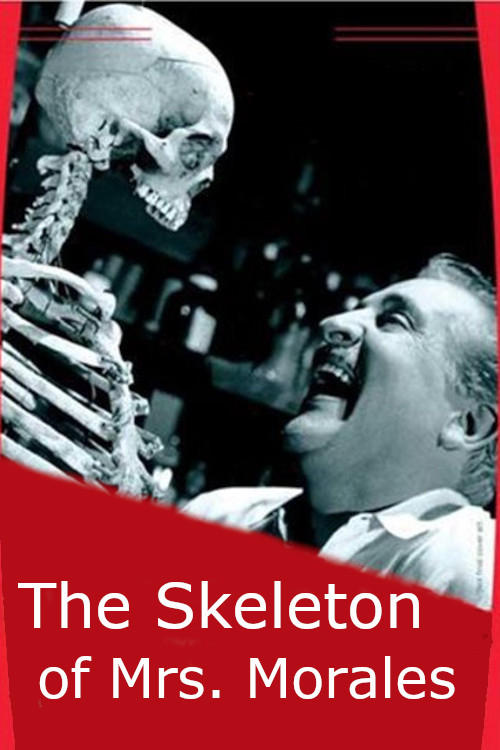
The Skeleton of Mrs. Morales
1960 · Rogelio A. González
For when you want your comedy black as tar — a sly, grown-up night in for viewers who like laughing at things they probably shouldn't. More bracing than cozy.
What it's about
Pablo Morales is a taxidermist who has endured twenty years of marriage to a pious, hypochondriac wife who wields religion, illness, and neighborhood gossip like weapons. When he finally decides he's had enough, his solution draws on his professional skills — and the investigation, the neighbors, and the courts all get their say. A pitch-black comedy of murder and respectability from Mexican cinema's Golden Age.
The experience
Wickedly funny and morally queasy — it keeps daring you to root for a murderer, then making you squirm for it. The tone is dry, savage, and precise, closer to a raised eyebrow than a punchline.
Performances
Arturo de Córdova, normally the suave leading man of melodramas, is superbly cast against type — his weary, courtly Pablo makes the film's moral vertigo work, because you can't help liking him.
The craft
The script comes from Luis Alcoriza, Buñuel's great Mexican collaborator, adapting an Arthur Machen story, and the fingerprints show: anticlerical needling, a savage portrait of bourgeois respectability, and the sense that sainthood and cruelty can share a face. Rogelio A. González directs it with clean, classical control that makes the nastiness land harder.
Why it matters
One of the blackest comedies Mexican cinema ever produced and a late jewel of its Golden Age — a cult touchstone that keeps getting rediscovered by new generations of dark-comedy lovers.
One of the blackest comedies Mexican cinema ever produced, and a late jewel of its Golden Age. Arturo de Córdova — normally the suave leading man of melodramas — plays Pablo Morales, a taxidermist trapped in twenty years of marriage to a pious, hypochondriac wife who weaponizes religion, illness and neighborhood gossip against him. His solution involves his professional skills. Rogelio A. González directs from a script by Luis Alcoriza, Buñuel's great Mexican collaborator, adapting Arthur Machen's story 'The Islington Mystery,' and the Buñuelian fingerprints are everywhere: the anticlerical needling, the savage portrait of bourgeois respectability, the sense that sainthood and cruelty can share a face. What elevates it is its moral vertigo — the film keeps daring you to sympathize with a murderer, then punishing you for it, right up to a final twist of the knife that Mexican audiences have been quoting for six decades. Long a word-of-mouth cult item, it now regularly tops polls of the greatest Mexican films, a skeleton the national cinema is proud to keep in its closet.
A Deleuzian reading
The title tells you how the marriage ends before anyone has spoken a line.
The full Deleuzian reading of The Skeleton of Mrs. Morales →
Reception
A hit and a scandal in 1960 Mexico — its gleeful anticlerical jabs somehow sailed past a conservative era's sensibilities — it has since been fully canonized, landing at #19 on Somos magazine's 1994 list of the 100 greatest Mexican films.
How The Skeleton of Mrs. Morales was received, from release to now →
Influences: the films it descends from and the films it influenced
- Monsieur Verdoux (1947) — Establishes the respectable bourgeois husband as methodical wife-killer, weaponizing domestic propriety as both alibi and the true satirical target — the template González and Alcoriza refit to a Mexican household.
- Kind Hearts and Coronets (1949) — Renders murder as a drawing-room comedy of manners where impeccable etiquette and cool narration make the killing funnier and more damning, the tonal register Mrs. Morales inherits.
- Él (1953) — Casts Arturo de Córdova as the outwardly devout, inwardly monstrous bourgeois Catholic husband — the exact persona and matinee-idol-against-type deployment the taxidermist reprises.
- The Criminal Life of Archibaldo de la Cruz (1955) — Alcoriza's own script model: a Mexican black comedy about a genteel would-be murderer, its droll tone, fetishized objects, and matter-of-fact cruelty are the direct writing precedent.
- Los olvidados (1950) — Forged the Alcoriza–Buñuel method of observing cruelty without moralizing and centering unsympathetic protagonists, the amoral gaze Mrs. Morales turns on its own killer-hero.
- Shadow of a Doubt (1943) — Nests the charming killer inside respectable domesticity and builds toward the twist that murder hides behind the family table — the structural irony behind the film's final reveal.
- Arsenic and Old Lace (1944) — Perfects the domestic-space murder farce, concealing corpses within the genteel household as the primary comic engine, prefiguring the taxidermist's skeleton gambit.
- The Suspect (1944) — Frames a sympathetic husband driven to kill a shrewish, sanctimonious wife in period-melodrama register, the marital-entrapment-as-murder-motive Mrs. Morales darkens into comedy.
- The Exterminating Angel (1962) — Alcoriza co-scripts again to trap the respectable bourgeoisie and strip their manners to reveal savagery beneath, advancing the same anatomy of bourgeois respectability.
- The Discreet Charm of the Bourgeoisie (1972) — Carries the Buñuelian dissection of bourgeois respectability as ritualized hypocrisy to its fullest formal expression, extending the seed's satirical target.
- Le Boucher (1970) — Descends the killer-amid-normalcy craft into provincial realism, letting a murderer coexist with placid bourgeois domesticity under a deceptively calm surface.
- The Trouble with Harry (1955) — Shares the deadpan control that treats a corpse as a mere domestic inconvenience, sustaining comedy over macabre material without tipping into horror.
- Macario (1960) — Same-year Mexican Golden Age literary adaptation fusing death, folk-Catholic morality, and moral irony, a parallel high-craft prestige treatment of mortality and piety.
- Viridiana (1961) — Mounts the same anticlerical assault on ostentatious piety and the theme of sainthood-as-cruelty, exposing sanctity's violence within a Hispanic production.
- Divorce Italian Style (1961) — Extends the black comedy of marital entrapment in which a respectable spouse plots murder to escape a suffocating marriage, mocking bourgeois honor via ironic narration.
- Landru (1963) — Stages Bluebeard as a fastidious bourgeois whose killings are choreographed with ironic domestic elegance, the same politesse-over-slaughter craft.
Similar films
- The Criminal Life of Archibaldo de la Cruz (1955) — influence & lineage
- Macario (1960) — influence & lineage
- The Exterminating Angel (1962) — influence & lineage
- Él (1953) — influence & lineage
- Divorce Italian Style (1961) — influence & lineage
- Arsenic and Old Lace (1944) — influence & lineage
- Monsieur Verdoux (1947) — influence & lineage
- Waiting for the Hearse (1985) — shared sensibility
All the films related to The Skeleton of Mrs. Morales →