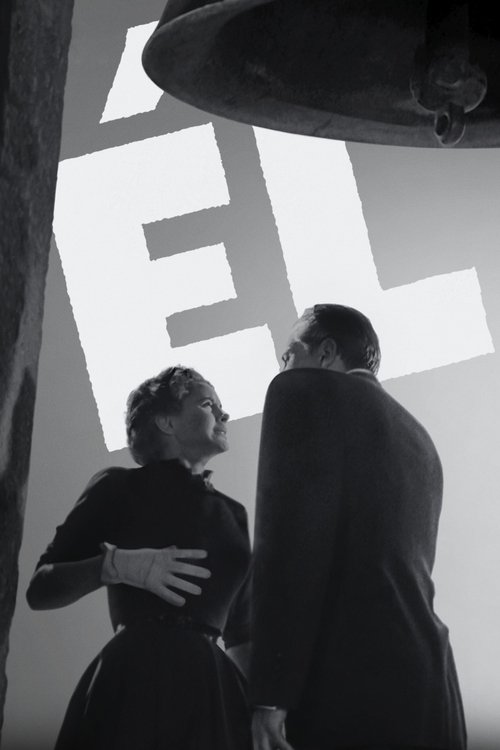
Él
1953 · Luis Buñuel
For when you want a film to chew on for days — a dark, sardonic psychological study for viewers who like their classics with a disturbing edge. Challenge, not comfort.
What it's about
Francisco is wealthy, devout, and impeccably mannered — a pillar of respectable society. When he fixes his attention on Gloria during a church ceremony, he courts her with old-world charm and marries her. Behind closed doors, the charm curdles: what looked like devotion reveals itself as jealousy and control, and Gloria finds herself trapped inside a marriage no one outside will believe is a prison.
The experience
Unnerving in a slow-tightening way — it plays like an elegant melodrama that keeps sliding toward horror, and Buñuel's dry, needling wit makes the dread stranger. You watch respectability itself become the menace.
Performances
Arturo de Córdova is chilling as Francisco precisely because he never plays a villain — the public gallantry and the private mania are the same performance, one face rotated a few degrees.
The craft
Buñuel smuggles obsession into the polished grammar of a 1950s studio melodrama: elegant interiors, a famously vertiginous staircase, and set pieces of paranoid imagination that erupt from apparently normal scenes. The precision is the point — madness filmed with perfect table manners.
Why it matters
Now regarded as one of the peaks of Buñuel's Mexican period, it became a touchstone portrait of pathological jealousy — studied by filmmakers and psychoanalysts alike — and its anatomy of the controlling husband still feels decades ahead of its time.
Snapshot
Él (English titles: This Strange Passion / Torments) is Luis Buñuel's clinical anatomy of male paranoia, made at the midpoint of his long Mexican exile. Francisco Galván de Montemayor (Arturo de Córdova), a wealthy, devout, middle-aged bachelor of impeccable manners, glimpses a woman's foot during a Maundy Thursday foot-washing ceremony, fixes his desire on its owner, Gloria (Delia Garcés), courts and marries her — and then, in the privacy of marriage, curdles into a jealous, delusional tyrant. What reads on its surface as a domestic melodrama Buñuel turns into a case study: a portrait of the pathology dressed in the costume of respectable Catholic bourgeois virtue. Compact (roughly 90 minutes) and outwardly conventional, the film smuggles surrealist obsession into the grammar of the commercial Mexican picture, and Buñuel repeatedly named it among the works closest to him. It is now widely regarded as one of the essential films of his Mexican period.
Industry & production
Él was produced within the Mexican studio system during the tail end of its "Golden Age" (Época de Oro), the industrial and cultural high-water mark of Mexican cinema in the 1940s–50s. It was produced by Óscar Dancigers, the émigré producer who had brought Buñuel back to feature filmmaking with Gran Casino (1947) and who backed the breakthrough Los Olvidados (1950). Dancigers's operation gave Buñuel a paradoxical freedom: tight budgets and short shooting schedules — typically a matter of weeks — in exchange for genre-legible product that could recoup in the Spanish-language market. Buñuel worked fast and cheap by temperament as much as by constraint, and Él bears the marks of that discipline: economical coverage, studio interiors, and a small principal cast.
The film's source is the autobiographical novel Él by Mercedes Pinto, a Spanish writer whose account drew on her own marriage to a paranoiac. Buñuel adapted it with Luis Alcoriza, his frequent screenwriting collaborator of the period. Casting Arturo de Córdova, a genuine star of Mexican and even Hollywood cinema, in the lead lent the production marquee value and, crucially, respectability — the audience's investment in a handsome, sympathetic leading man is precisely what Buñuel exploits and betrays. The picture screened at the Cannes Film Festival in 1953. Contemporary commercial reception in Mexico was, by most accounts, muted to poor, with reports of audiences laughing at the very sequences Buñuel intended most seriously; its critical elevation came later and largely from Europe.
Technology
Technically, Él is a standard product of its moment: 35mm black-and-white photography, the Academy (roughly 1.37:1) aspect ratio, and post-synchronized optical sound, shot largely on studio sets with location work in Guanajuato. There is nothing technologically innovative in the apparatus — no widescreen, no color, no novel process — and Buñuel had no interest in technical showmanship for its own sake. The interest lies entirely in how conventional means are bent to expressive ends. Where the resources of the Mexican industry do register is in production values above the film's modest budget: the deep, sculptural black-and-white rendering associated with the country's studios, and the ability to stage the Guanajuato honeymoon and bell-tower sequences on real, vertiginous architecture. The technology is transparent by design; the disturbance is placed in front of the lens and in the cut, not in the machinery.
Technique
Cinematography
The photography is by Gabriel Figueroa, the towering Mexican cinematographer best known for the baroque, cloud-heavy monumentalism of his work with Emilio Fernández. In Él, Buñuel largely reins in Figueroa's romantic grandeur in favour of a cooler, more analytic surface — appropriate to a film that observes its protagonist as a specimen. Figueroa's control of deep, glossy blacks and hard architectural light nonetheless surfaces in the film's most charged passages, above all the church-tower sequence, where the geometry of stairs, ironwork, and bells becomes an externalization of Francisco's spiraling mind, and the Guanajuato locations, whose stacked verticality Figueroa exploits for a sense of dizziness and threat. The camera also periodically adopts Francisco's paranoid vantage — the sightline through a keyhole, the surveying gaze down a staircase — so that composition itself implicates the viewer in his suspicion.
Editing
The editing (cut by Carlos Savage, a mainstay of Buñuel's Mexican productions) is, on the whole, invisible in the classical manner — clean, continuity-driven, unshowy — which is exactly what makes its ruptures land. Buñuel builds Francisco's respectable public self through smooth, legible cutting, then lets the delusional interior break through in isolated, uncanny beats. The rhythm tightens as the marriage deteriorates, and the film's most famous images — the abortive attempt to bind and sew his sleeping wife, the final zig-zag walk — derive their force less from montage pyrotechnics than from Buñuel's willingness to hold and cut on gestures that a conventional melodrama would suppress.
Mise-en-scène / staging
Mise-en-scène is where the film does its deepest work. Francisco's world is a curated museum of bourgeois-Catholic propriety: ornate staircases, ecclesiastical décor, an ordered household — a set dressing of virtue that Buñuel treats as pathology's natural habitat. The staircase recurs as the film's signature space, a site of ascent, descent, and the crawling menace of Francisco's approach. Objects carry obsessive weight in the surrealist manner — a foot, a hairpin, a length of rope, needle and thread, a revolver — props that migrate from the domestic into the delusional. Buñuel stages the couple's home so that its very orderliness becomes claustrophobic, the architecture of control tightening around Gloria until respectability and imprisonment are indistinguishable.
Sound
The score is credited to Luis Hernández Bretón and functions in the conventional idiom of Mexican melodrama, underscoring emotion in ways that Buñuel — always suspicious of music's manipulations — deploys with a certain irony against Francisco's self-justifying pathos. More characteristic of Buñuel is the expressive use of concrete sound and, above all, of the church setting's aural signature — bells, footsteps, liturgy — and the reported detail of an inner monologue and unstable acoustics in the climactic church scene, where the murmuring congregation seems to Francisco to be laughing at him. Sound here is subjectivized: what we hear is warped by the protagonist's persecution.
Performance
Arturo de Córdova's performance is the film's engine and its most quietly radical element. He plays Francisco not as a raving lunatic but as a composed, courteous, wounded gentleman utterly convinced of his own reasonableness — a portrait of paranoia from the inside, in which every act of surveillance and cruelty is experienced by the character as justified love. The refusal to signal madness broadly is what makes the film unsettling. Delia Garcés, as Gloria, carries the film's shifting point of view and the dawning terror of a woman who realizes too late what her husband is; her role is structured partly as testimony, the story reaching us in retrospect through her account. The supporting playing sustains the veneer of normalcy against which Francisco's disintegration registers.
Narrative & dramatic mode
The dramatic mode is melodrama turned inside out into psychological case study. Él borrows the shape of the romance-and-marriage picture — courtship, wedding, honeymoon, domestic crisis — and empties it of romance, so that each familiar beat becomes evidence in a diagnosis. The narration leans on retrospection and Gloria's perspective, framing events as the reconstruction of how a marriage became a trap, and it grants privileged access to Francisco's distorted interiority through subjective sound and sightline. The result is a doubled address: the audience is invited both to inhabit Francisco's delusion and to observe it clinically from without. The film's structural irony is that its "resolution" — Francisco's retreat into monastic life, apparently at peace — is undercut by the closing image of his crooked, zig-zagging walk, which tells us the pathology has not been cured but merely rehoused.
Genre & cycle
Nominally a drama and psychological thriller, Él sits athwart several cycles. It belongs to the Mexican melodrama of its era while systematically subverting that genre's moral economy. It is also a keystone in a Buñuel cycle of studies in obsessive, sexually pathological men — most directly anticipating Ensayo de un crimen (The Criminal Life of Archibaldo de la Cruz, 1955), and resonating forward toward the fetishism and erotic fixation of later works such as Belle de jour (1967) and That Obscure Object of Desire (1977). Within the broader field, it is frequently discussed alongside the mid-century cinema of jealousy and paranoia, though Buñuel's clinical detachment and surrealist inheritance set it apart from the more romantic treatments of obsession found elsewhere in the period.
Authorship & method
Él is one of Buñuel's most personal films, and he said as much in later life; the character of Francisco is often read as carrying a measure of the director's own confessed jealousy and his lifelong fascination with fetishism, particularly the foot fetish that opens the film. Buñuel's method here is characteristically deadpan: he presents outrageous psychological material with a straight, unemphatic face, trusting the incongruity between polite surface and delusional content to generate disquiet. Key collaborators shaped the result decisively — screenwriter Luis Alcoriza, Buñuel's essential co-author of the Mexican years, in adapting Mercedes Pinto's novel; cinematographer Gabriel Figueroa, whose disciplined black-and-white lends the film its sober authority and occasional expressionist charge; editor Carlos Savage, whose classical continuity makes the eruptions of the uncanny possible; and composer Luis Hernández Bretón, whose melodramatic scoring Buñuel turns to ironic ends. Producer Óscar Dancigers provided the industrial frame that let Buñuel work at all. The authorship is unmistakably Buñuel's, but it is achieved through, not against, the craft of the Mexican studio.
Movement / national cinema
The film is a product of two lineages at once. It belongs to Mexican national cinema at its most industrially confident — the Golden Age, with its star system, its studios, and in Figueroa its signature visual style. And it is a work of surrealism in exile: Buñuel, veteran of Un Chien andalou (1929) and L'Âge d'or (1930) and of the Paris avant-garde, importing surrealist preoccupations — desire, fetish, the irrational beneath bourgeois order, anticlericalism — into a popular commercial form. The productive friction between these two identities is the essence of Buñuel's Mexican period generally and of Él in particular: a subversive, dreamlike sensibility operating inside, and quietly detonating, the conventions of mainstream melodrama.
Era / period
Made in 1953, Él stands at the crest of Mexican cinema's commercial dominance in the Spanish-speaking world and near the midpoint of Buñuel's Mexican exile (1946 into the early 1960s), the phase that rescued and rebuilt his directorial career after nearly two decades of interruption. It arrives after the international shock of Los Olvidados (1950) had re-established him as a major artist and just before the run of increasingly assured Mexican features that carried him back toward European and international production. The film's preoccupations — Catholic guilt, sexual repression, the persecutory imagination — are legible against a mid-century moment saturated with popularized Freudian and psychoanalytic ideas, which the film engages without ever announcing itself as a "message" picture.
Themes
The governing theme is paranoid jealousy as a socially sanctioned pathology: Francisco's possessiveness is not an aberration from bourgeois-Catholic patriarchy but its logical extremity, love and ownership collapsed into one. Around this cluster Buñuel's lifelong obsessions: fetishism and the mechanics of desire, announced by the foot-washing ceremony that ignites the plot; the hypocrisy of respectability, the way piety, wealth, and manners furnish cover for cruelty; and anticlericalism, the church at once Francisco's sanctuary and the theater of his final breakdown. The film is also a study of male control and female entrapment, dramatizing marriage as a mechanism of surveillance and confinement. And it is, finally, about the untrustworthiness of the reasonable surface — the terror that the most composed and courteous of men may be the most dangerous, and that his madness will be legitimized rather than checked by the institutions around him.
Reception, canon & influence
Commercially and in its immediate Mexican reception, Él was not a success, and the reports of audiences laughing at its most serious sequences wounded Buñuel; he discussed the film's mixed early fortunes in his later reflections. Its critical fortunes reversed decisively over subsequent decades, particularly in Europe, where it came to be counted among the finest works of his Mexican years and a key text in understanding the continuity between the surrealist provocateur of the 1920s and the mature master of the 1960s–70s.
The most celebrated strand of its afterlife is psychoanalytic. It is widely reported that Jacques Lacan screened Él for students and colleagues as an unusually accurate depiction of paranoid delusion — an anecdote frequently cited in Buñuel scholarship as testimony to the film's clinical acuity, though the reader should treat the precise circumstances as received tradition rather than closely documented fact.
Looking backward, the film draws on Mercedes Pinto's autobiographical novel; on Buñuel's own surrealist formation and personal obsessions, foot fetishism among them; and on the popular currency of Freudian ideas about repression and persecution. Looking forward, its most direct descendant within Buñuel's own work is Ensayo de un crimen (1955), and its concerns thread through his later meditations on desire and obsession culminating in That Obscure Object of Desire (1977). More broadly, Él stands as a canonical portrait of the pathology of male jealousy and a model of how genre respectability can be used to disguise, and thereby to expose, monstrosity — an influence felt less through direct citation than through its enduring status as the reference point for the cinema of paranoid love. Where the historical record on specific downstream borrowings is thin, its significance is best stated as one of reputation and recurring critical invocation rather than traceable lineage.
A Deleuzian reading
A priest is washing feet.
The full Deleuzian reading of Él →
Reception
Dismissed and even laughed at when it premiered — its Cannes 1953 screening was a notorious flop — Él is now ranked among the crown jewels of Buñuel's Mexican period, the film devotees push on anyone who thinks his career only got serious back in Europe.
How Él was received, from release to now →
How to watch Él: what to notice on a first viewing
- Watch Francisco's eyes during the foot-washing ceremony at the start. He is well-dressed among the devout, and his attention runs along the row of bare feet rather than to the priest performing the ritual. His desire fixes on a single detail before he has even seen the woman's face.
- Watch for shots that put you at a keyhole. The camera periodically adopts Francisco's own vantage, a sightline through a door or down a staircase, so you're seeing through his eyes before you notice you've been placed there. For a few seconds you're looking with him, and only afterward do you notice whose eyes you borrowed.
- Notice how often the staircase appears as Francisco moves through his house. Buñuel returns repeatedly to the same ornate stairs for ascent, descent, and the sound of someone approaching. The architecture of the marriage keeps announcing itself as a trap before anyone says so out loud.
- Watch how calm and courteous Francisco stays in every scene. Arturo de Córdova plays him as a composed, reasonable gentleman who never raises his voice or signals that anything is wrong. The film's unease comes from watching control and cruelty delivered with perfect manners.
The whole guide to watching Él, with the keys for a rewatch →
Influences: the films it descends from and the films it influenced
- Un Chien Andalou (1929) — Él's opening foot-fetish sequence descends directly from Buñuel's surrealist grammar of the fragmenting close-up that isolates a body part into an autonomous erotic object.
- L'Âge d'Or (1930) — Establishes Buñuel's deadpan method of presenting amour fou and anticlerical outrage with an unemphatic straight face, the tonal restraint Él uses to expose Francisco's delirium.
- Los Olvidados (1950) — First pairs Buñuel with Figueroa and works out the technique of embedding a surrealist subjective interlude inside otherwise invisible naturalist continuity, the exact seam Él exploits.
- María Candelaria (1944) — Codified Gabriel Figueroa's Mexican Golden Age idiom — deep-focus blacks, sculptural low-angle chiaroscuro — that Él borrows to lend melodrama a sober, expressionist authority.
- Suspicion (1941) — Models the retrospective subjective-female-POV structure in which a wife's mounting perception reconstructs a respectable husband as a potential killer.
- Gaslight (1944) — Turns the respectable domestic interior and its staircase into the theater of a husband's methodical psychological persecution of his wife, the staging Él inherits.
- Secret Beyond the Door (1947) — Uses a wife's psychoanalytic voice-over to narrate her dawning knowledge of a husband's pathology, the Freudian case-study framing Él adopts as retrospective female POV.
- The Cabinet of Dr. Caligari (1920) — Pioneers the externalization of deluded subjectivity through distorted architecture and stairs, the expressionist charge Figueroa lends Francisco's paranoid perception.
- Ensayo de un crimen (1955) — Buñuel's direct successor: the same deadpan clinical anatomy of a fetishist's obsession, again co-written with Alcoriza, treating monstrous desire as respectable case study.
- That Obscure Object of Desire (1977) — Extends Él's retrospective confessional structure — obsessive male desire narrated to bystanders — into Buñuel's final meditation on the paranoia of possessive love.
- Repulsion (1965) — Builds a paranoid interior world through subjectivized audio and apartment-as-psyche distortion, extending Él's method of locating us inside the deluded perceiver.
- The Tenant (1976) — Mounts first-person persecutory paranoia through domestic architecture and staircases, treating the delusion from wholly inside the sufferer as Él does with Francisco.
- Raging Bull (1980) — Renders male sexual jealousy as a clinical case study observed from behind the jealous eye, extending Él's dispassionate anatomy of paranoid love into the boxing melodrama.
- The Skeleton of Mrs. Morales (1960) — Casts Arturo de Córdova as the outwardly devout, inwardly monstrous bourgeois Catholic husband — the exact persona and matinee-idol-against-type deployment the taxidermist reprises.
- Simon of the Desert (1965) — Anatomizes Catholic obsession and religious paranoia through deadpan clinical observation, the interrogation of faith-as-neurosis Simon extends to the ascetic ideal.
- Castle of Purity (1973) — The paranoid patriarch who imprisons his wife inside the bourgeois home out of a jealous mania for purity — the template for a tyrant framed through, and defined by, his own domestic architecture.
- The Place Without Limits (1978) — Its clinical dissection of pathological machismo and paranoid possessiveness confined within claustrophobic domestic architecture is the template for Pancho and Don Alejo's coercive, jealousy-driven gaze.
- Deep Crimson (1996) — Buñuel's model of erotic obsession as a bourgeois household pathology staged through props — the needle-and-thread, the belfry, the locked bedroom — gives Ripstein his method of letting an object carry the argument a character will not speak.
- Tristana (1970) — Gives Tristana its architecture of paranoid ownership: the proprietor-patriarch whose psychology is diagrammed by vertical space — staircases, balconies, the bell-tower ascent — so that a man's position in the frame's height literally states his claim over a woman below.
- Belle de Jour (1967) — Continues Él's technique of rendering fetishism and fantasy with an unemphatic, polite surface so that pathology erupts without any change in register.
- Vertigo (1958) — Shares the subjectivized POV of male obsession and the fetishistic remaking of the love object, with the spiral staircase literalizing the vertigo of possessive delusion.
- Peeping Tom (1960) — Uses subjective-camera identification with a pathological fetishist and the respectable-genre surface to disguise and thereby expose monstrosity, Él's central strategy.
Similar films
- The Criminal Life of Archibaldo de la Cruz (1955) — influence & lineage · same viewing thread
- L'Âge d'or (1930) — influence & lineage · same viewing thread
- Belle de Jour (1967) — influence & lineage · same viewing thread
- That Obscure Object of Desire (1977) — influence & lineage · same viewing thread
- Vertigo (1958) — influence & lineage
- Un Chien Andalou (1929) — influence & lineage
- The Exterminating Angel (1962) — same viewing thread
- Viridiana (1962) — same viewing thread
Watch it with: curated runs of related films
- Buñuel and the Bourgeoisie — A run of surrealist provocations where every dinner, prayer, and marriage bed hides an appetite polite society can't admit — watch them together for the way Buñuel (and Pasolini's Theorem) keep pulling the tablecloth out from under the well-heeled.