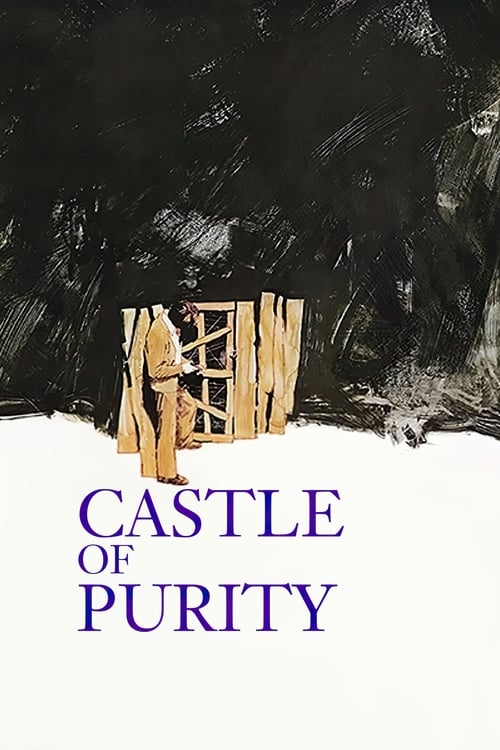
Castle of Purity
1973 · Arturo Ripstein
For when you want a film to chew on for days — a dark, disciplined psychological drama rather than a thriller. Reach for it when you're up for something claustrophobic and morally unsettling, not when you need comfort.
What it's about
A father who believes the outside world is irredeemably corrupt has kept his wife and children locked inside their crumbling house for years, schooling them in his private doctrine of purity. The family survives by making rat poison that he sells door to door — the only member allowed out. Drawn from a notorious real Mexican criminal case, it's a study of a household run as a private kingdom, and of what festers when one man's virtue becomes everyone else's prison.
The experience
Slow-burning, airless, and quietly horrifying — the film builds its dread not from events but from routine, watching hypocrisy and control curdle day by day. You feel the walls of the house the whole time, and the tension of waiting for something inside it to give.
Performances
Claudio Brook is chilling as the patriarch Gabriel — a tyrant who genuinely believes he is a saint, played with a calm, self-righteous conviction that's far scarier than shouting.
The craft
Ripstein turns a single house into an entire world, using the enclosed space, dripping courtyards, and long takes to make confinement something you experience rather than observe. The irony is built into the film's bones — sermons about purity delivered over vats of poison — and the control of tone for a director in his late twenties is remarkable.
Why it matters
Widely considered Ripstein's first fully realized film and a landmark of the renewed Mexican cinema of the early 1970s, it established the enclosed-space, dysfunctional-family territory he would mine for the rest of his career.
Snapshot
El castillo de la pureza is Arturo Ripstein's chamber drama of domestic tyranny, drawn from a notorious real Mexican criminal case: a man who imprisoned his wife and children inside their own house for years in the name of shielding them from a corrupt world. Ripstein, then in his late twenties, converts the sensational premise into a controlled study of patriarchal authority, self-deception, and moral rot. The father, Gabriel Lima, preaches purity while the family survives by manufacturing rat poison — an irony the film never lets the viewer forget. Widely regarded as Ripstein's first fully realized work and a landmark of the renovated Mexican cinema of the early 1970s, it announced the enclosed-space, dysfunctional-family poetics that would define his entire career. It is essential viewing for understanding both Ripstein and the auteurist current of Mexican film in the Echeverría years.
Industry & production
The film was produced within Mexico's state-supported studio system at the moment that system was reorienting itself toward more ambitious auteur cinema. Following the 1970 inauguration of President Luis Echeverría, whose administration (with Rodolfo Echeverría directing the state film bank, the Banco Nacional Cinematográfico) actively channeled resources toward artistically serious projects, a space opened for younger directors to make work that departed from the commercial genres — comedies, melodramas, lucha libre pictures — that dominated the industry. Castle of Purity is a product of that opening, made through the established Churubusco-linked studio infrastructure rather than as marginal independent work.
Ripstein came to the project as an industry insider: his father, Alfredo Ripstein, was a prominent producer, which gave the young director access to professional resources uncommon for a director early in his career. That said, the precise financing and production-company particulars of this specific film are not something I can state with confidence, and I will not invent a producer of record or budget figures. What is secure is that the film was a mainstream studio-scale Mexican production of 1973, shot largely on a single principal location — the family house — which suited both its modest scale and its thematic confinement.
Technology
The film was shot on 35mm color stock, standard for a Mexican studio feature of the period, and framed for conventional theatrical projection. There is nothing technologically experimental about the production: no unusual gauge, no novel lab process, no early video or optical intervention that the record attests to. Its interest lies entirely in how conventional tools are marshaled. The single most important "technological" fact is environmental rather than mechanical — the production's commitment to a perpetually wet, dripping, decaying interior, which required practical water effects, controlled leaks, and a set dressed for constant dampness. This is a film whose technical achievement is atmospheric control within a fixed space rather than any hardware innovation.
Technique
Cinematography
The cinematography is credited to Alex Phillips Jr. (Alejandro Phillips), one of the significant Mexican cinematographers of the era; I hold this attribution with reasonable but not absolute confidence and flag it as such. Whoever the credited operator, the visual strategy is unmistakable and consistent. The camera treats the house as a labyrinth of thresholds, bars, grilles, and interior windows, repeatedly composing family members behind or between vertical elements so that the architecture itself reads as a cage. The palette is desaturated and cold — greens, grays, browns, the colors of damp and mildew — reinforcing the film's governing image of a home that is rotting from within even as its patriarch insists on its moral cleanliness. Light tends to fall in narrow, weak shafts, consistent with an interior sealed off from the outside world.
Editing
The cutting is patient and observational, favoring duration over acceleration. The film builds tension through accumulation — the daily routines of poison-making, feeding, discipline, and surveillance — rather than through montage. I do not have a securely verified editor credit to cite, and rather than guess at a name I will simply note that the editorial rhythm is deliberately slow-burning, giving scenes room to develop the claustrophobia and letting the eventual eruptions land harder against the established stillness.
Mise-en-scène / staging
This is the film's richest register. The house is the film's total world, and Ripstein stages it as a self-contained cosmos with its own economy (the rat-poison workshop), its own theology (Gabriel's sermons on purity), and its own architecture of control. The pervasive water — leaks, puddles, the sound and sight of constant dripping and rain — is the central staging motif: an image of seepage and corruption that contradicts every claim of "purity" the father makes. Cluttered, functional spaces (the workshop, the courtyard, cramped bedrooms) are arranged so that privacy is impossible and the father's gaze is inescapable. Ripstein choreographs bodies within confinement, using doorways and interior barriers to divide and reunite the family, and staging the father's movements as those of a warden making rounds.
Sound
Sound design is dominated by the diegetic environment: dripping water, rain, the domestic and industrial noises of the household's poison manufacture. This ambient soundscape does enormous thematic work, keeping the sense of damp decay continuous even in quiet scenes. Regarding the musical score, I do not have a composer credit I can verify, and I will not fabricate one; the film's aural identity is in any case carried more by its worked environmental sound than by any prominent scoring.
Performance
Performance is where the film's ideas become flesh. Claudio Brook, as Gabriel Lima, gives a performance of controlled fanaticism — a man persuasive and even tender in his own logic, which makes his tyranny more disturbing than open monstrousness would. The role of the wife/mother is taken by Rita Macedo, who registers the complicity, exhaustion, and buried resistance of a woman who has internalized and half-sustains the regime that imprisons her. The film is also notable as the screen debut of Diana Bracho, who plays the adolescent daughter and whose awakening sexuality becomes one of the pressures the sealed household cannot contain; her performance was singled out at the time and launched a major career. The children — named with the father's utopian abstractions (names evoking ideals such as Future, Will, and Utopia) — are directed to embody both the success and the fragility of Gabriel's project of raising "pure" beings.
Narrative & dramatic mode
The dramatic mode is realist tragedy with a strong allegorical undertow. The narrative is nearly unified in place and situation: it observes the daily functioning of the imprisoned household, the father's departures to sell poison in the outside world, and the mounting internal pressures — sexual, generational, and psychological — that make the system unsustainable. Rather than a plot of twists, the film advances through the steady tightening of an intolerable status quo toward rupture. Its power comes from the audience's dual awareness: we understand Gabriel's project from inside (his sincerity, his terror of the world's "evil") and judge it from outside (as abuse and madness). This tension between empathy and condemnation is the film's central dramatic engine, and it refuses easy melodramatic release.
Genre & cycle
Formally the film is a domestic drama, but it operates at the intersection of family melodrama, psychological horror, and social allegory. It belongs to a small but potent cycle of "house of confinement" films — works in which a single household becomes a sealed microcosm of authority and repression. Within Mexican cinema it can be read against the grain of the classic family melodrama tradition: it takes the genre's obsession with the family unit and inverts its sentimentality, exposing the patriarchal family as a prison. The rat-poison trade grafts a grotesque, near-Buñuelian material irony onto the melodramatic frame.
Authorship & method
Castle of Purity is a foundational auteur statement. The screenplay was written by Ripstein together with the poet and novelist José Emilio Pacheco, one of the major Mexican literary figures of the twentieth century — a collaboration that gives the film its literary density and its allegorical seriousness. The source is a real Mexican case of a man who confined his family within their home for many years, material that also resonated across Mexican letters. Working from that documentary kernel, Ripstein and Pacheco distilled it into a parable.
Ripstein's method here established what would become his signature: enclosed physical spaces standing for moral and psychological entrapment; families as sites of tyranny and mutual destruction; a refusal of sentimental resolution; and a fascination with figures whose self-justifying logic makes their cruelty comprehensible. Ripstein had apprenticed in the orbit of Luis Buñuel (he is often noted as having observed Buñuel's work in the early 1960s), and his debut feature Tiempo de morir (1966) was scripted by Gabriel García Márquez — a lineage that placed him among Mexico's most literarily connected young directors. On the technical side, the cinematography (attributed to Alex Phillips Jr., held with caution) and the ensemble of Brook, Macedo, and Bracho are the key collaborative contributions; I have deliberately not asserted editor or composer credits I cannot verify.
Movement / national cinema
The film is a central document of the early-1970s renewal of Mexican cinema — sometimes discussed under the banner of a "nuevo cine mexicano" — enabled by the Echeverría government's turn toward state-backed auteur production. This moment produced a generation of directors (Ripstein foremost among them, alongside figures such as Felipe Cazals, Jaime Humberto Hermosillo, and others) making socially and psychologically serious films that broke from the industry's commercial formulas. Castle of Purity exemplifies the movement's ambition: a national cinema turning a critical, allegorical eye on Mexican society — on authority, family, and repression — using the resources of the established studio system for non-commercial ends.
Era / period
Produced in 1973, the film sits squarely in the Echeverría-era window (1970–1976) when the Mexican state most actively subsidized ambitious filmmaking. Read historically, its allegory of a benevolent-seeming patriarch who imprisons his dependents "for their own protection," insisting on purity while the house rots, invites interpretation as a commentary on authoritarian paternalism — a resonance that would not have been lost in a country governed by the long single-party rule of the PRI, in the aftermath of the 1968 Tlatelolco massacre. The film never states such an allegory explicitly, and the record is genuinely open on how far Ripstein intended it; but the political undertone is one of the standard and defensible readings.
Themes
The core themes are tightly interwoven: patriarchal authority and its violence; purity versus corruption (the central irony of a "pure" household sustained by manufacturing poison, and of a father whose own sexual drive contradicts his asceticism); confinement and the house as prison; isolation and fear of the outside world as engines of tyranny; complicity, especially the mother's, in sustaining an abusive order; and the eruption of sexuality, particularly among the maturing children, as the force the sealed system cannot regulate. Undertones of incestuous tension and generational revolt run throughout. Above all the film dramatizes self-deception — the tyrant who believes himself a protector — and the way idealism can become indistinguishable from cruelty.
Reception, canon & influence
Critically, Castle of Purity was recognized as a major work and is generally treated as Ripstein's breakthrough — the film in which his mature themes and control first cohered. It was honored at Mexico's Ariel Awards; the film and its performers were among the recipients, and Diana Bracho's debut in particular was singled out. I want to be candid that I cannot reconstruct the exact slate of Ariel categories won without risk of error, so I state the recognition in general rather than itemized terms. Over subsequent decades the film's standing has only grown, and it is routinely cited in surveys of Mexican and Latin American cinema as a key title of the 1970s.
Influences on the film (backward): The dominant lineage is Buñuel — the confined group in The Exterminating Angel (1962) is the obvious antecedent for a household that cannot leave its own space, and Buñuel's corrosive treatment of the bourgeois family, Catholic notions of purity and guilt, and cruelty-as-comedy all inform Ripstein's sensibility. The literary hand of José Emilio Pacheco and the grounding in a documented Mexican case give it a second, realist-literary lineage distinct from pure Buñuelian surrealism.
Legacy (forward): Castle of Purity is the seedbed of Ripstein's entire subsequent oeuvre — the enclosed spaces, doomed families, and morally trapped protagonists that recur through El lugar sin límites (1978) and, in his long later partnership with screenwriter Paz Alicia Garciadiego, Profundo carmesí (Deep Crimson, 1996) and beyond. More broadly, it stands as an influential model for a strain of Latin American cinema built on domestic claustrophobia and the family-as-microcosm-of-power, and it helped establish Ripstein internationally as one of the foremost Mexican auteurs of the post-Buñuel generation. Its reputation as one of the essential Mexican films of its decade is now firmly settled.
Reception
A landmark on arrival — it announced Ripstein as a major voice in early-70s Mexican cinema — and it has only climbed since, now routinely ranked among the greatest Mexican films ever made and rediscovered abroad through restorations and streaming.
How Castle of Purity was received, from release to now →
How to watch Castle of Purity: what to notice on a first viewing
- Notice bars and grilles between you and every family member. The camera treats the house as a labyrinth of thresholds and grilles, repeatedly composing the family behind or between vertical elements so the architecture itself reads as a cage. You see the family imprisoned in the frame before the plot has to explain their situation.
- Notice the damp greens and grays running through every room. The palette stays desaturated and cold, greens, grays, browns, the colors of damp and mildew, so the home looks like it is rotting even as its patriarch calls it pure. The color scheme argues against the father's sermons before he even finishes speaking one.
- Listen and look for water leaking, dripping, or pooling somewhere. Water keeps leaking, pooling, and dripping through the house, a constant image of seepage and corruption that contradicts every claim of purity the father makes. The wet house argues against him in its own material long before anyone in the family does.
- Watch how tender and persuasive Brook makes the father's logic. Brook plays Gabriel as controlled and even gentle within his own worldview, never an obvious monster, which is exactly what makes his tyranny so unsettling to watch. A persuasive tyrant is more disturbing than an obvious one, and the film asks you to feel why.
The whole guide to watching Castle of Purity, with the keys for a rewatch →
Influences: the films it descends from and the films it influenced
- Los olvidados (1950) — Establishes the Mexican model Ripstein works in — a documented social case distilled into a cruel, unsentimental parable, cruelty observed without moralizing rescue.
- Él (1953) — The paranoid patriarch who imprisons his wife inside the bourgeois home out of a jealous mania for purity — the template for a tyrant framed through, and defined by, his own domestic architecture.
- Nazarín (1959) — Supplies the self-justifying protagonist whose rigid doctrine of purity makes his cruelty internally coherent rather than cartoonish villainy.
- Viridiana (1961) — Catholic notions of purity corrupted from within an enclosed estate — the purity-versus-corruption dialectic Ripstein transplants into the sealed household.
- The Exterminating Angel (1962) — The direct staging antecedent for house-as-prison: a single-location narrative of people inexplicably unable to cross their own threshold, the group confined and slowly decaying.
- Una familia de tantas (1948) — The Golden Age Mexican patriarchal-household melodrama whose authoritarian father Ripstein inverts — same domestic-melodrama grammar turned into monstrous tragedy rather than reconciliation.
- Tiempo de morir (1966) — Ripstein's own debut, scripted by García Márquez, establishing the director-plus-major-writer collaboration method he repeats here with the poet José Emilio Pacheco to gain literary density.
- El santo oficio (1974) — Carries the enclosed-space moral-entrapment logic forward into the Inquisition, families destroyed by an all-controlling doctrinal authority.
- El lugar sin límites (1978) — A doomed 'family' confined to a single decaying brothel, self-destruction played as realist tragedy — the direct continuation of the single-house microcosm.
- Principio y fin (1993) — Extends the family-as-microcosm-of-tyranny into a long slow-burn saga of one household consuming itself under a controlling will.
- Profundo carmesí (1996) — With screenwriter Paz Alicia Garciadiego, returns to Ripstein's method of building a folie-à-deux tragedy from a real Mexican crime case, just as Castle drew on a documented confinement.
- Fanny and Alexander (1982) — Children imprisoned inside a bishop's austere household, patriarchal authoritarianism enforced through cold domestic architecture and interiors composed as cells.
- La ciénaga (2001) — Latin American family-as-microcosm of decay built on a dense diegetic soundscape and a pervasive water motif, the house rendered as an inescapable trap.
- Dogtooth (2009) — A father seals his grown children inside the family compound behind an invented ideology of purity — the house-of-confinement premise pushed to its logical extreme.
- The White Ribbon (2009) — Patriarchal purity, discipline and punishment within a hermetic community, rendered in an austere desaturated (monochrome) palette that mirrors Castle's drained, controlled surface.
- Silent Light (2007) — Continues the post-Buñuel Mexican austere-realist tragedy — slow-burn duration, spare diegetic ambience, a patriarchal enclosed community — descended from the same national art-cinema line.
Similar films
- La Ciénaga (2001) — influence & lineage
- Deep Crimson (1996) — influence & lineage
- Dogtooth (2009) — influence & lineage
- The Exterminating Angel (1962) — influence & lineage
- Nazarín (1959) — influence & lineage
- The Place Without Limits (1978) — influence & lineage
- The Wolf House (2018) — shared sensibility
- The Power of the Dog (2021) — shared sensibility