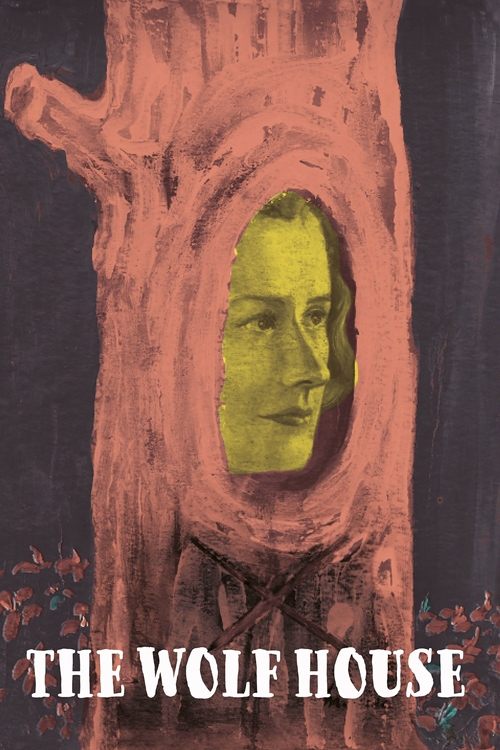
The Wolf House
2018 · Cristóbal León
For when you're craving a real scare of the slow, skin-crawling kind — art-house nightmare fuel, not jump scares. Challenge viewing, and best faced when you're up for it.
What it's about
Framed, with poisonous irony, as a restored propaganda film made by a German-speaking colony in southern Chile, it follows Maria, a girl who flees the community and shelters in an isolated house with two pigs for company. The house responds to her fear — walls repaint themselves, bodies assemble and slump apart — and the refuge slowly becomes a trap. Behind the fairy tale stands a real horror: the cult enclave that tortured prisoners for Pinochet's regime.
The experience
Genuinely unsettling in a way conventional horror rarely manages — the animation itself feels alive and wrong, everything perpetually decomposing and reforming. It's short, dreamlike and hard to shake; expect to sit in silence afterward.
The craft
Cristóbal León and Joaquín Cociña spent five years animating inside working galleries, painting directly onto full-scale walls and sculpting papier-mâché figures that melt and rebuild in a single unbroken nightmare of a space. There is nothing else in cinema that moves like this; the bigger the screen, the more it gets under your skin.
Why it matters
It became an instant landmark of experimental animation and announced Chilean animation to the world, influencing how horror filmmakers think about texture and transformation — Ari Aster was among its vocal admirers.
Presented, with poisonous irony, as a restored propaganda film made by a German-speaking agricultural colony in southern Chile, this animated nightmare follows Maria, a girl who flees the community and shelters in an isolated house with two pigs for company — a house that warps and remakes itself around her fear. The colony evokes a real horror: Colonia Dignidad, the cult enclave that tortured prisoners for Pinochet's regime, and the film reads as a fairy tale the perpetrators might tell about themselves. Chilean artists Cristóbal León and Joaquín Cociña spent five years making it inside working galleries and museums, animating in public as a kind of endless performance. Their technique is like nothing else in cinema: paint crawls across full-scale walls, papier-mâché bodies assemble and slump apart, furniture melts and reforms, all staged as one continuous, prowling camera move through rooms that never stop mutating. Ari Aster became an early champion, later producing the pair's follow-up short.
A Deleuzian reading
Watch any wall in this film for thirty seconds and it will start to move.
The full Deleuzian reading of The Wolf House →
Reception
It premiered quietly at the 2018 Berlinale (winning the Caligari Prize) and lived on the festival circuit until its 2020 US release — championed loudly by Ari Aster — turned it into a word-of-mouth cult sensation among animation and horror fans.
How The Wolf House was received, from release to now →
Influences: the films it descends from and the films it influenced
- Alice (1988) — Establishes the tactile stop-motion fairy tale as horror, animating taxidermy, wood and found domestic objects inside a claustrophobic house that the child cannot escape — the exact object-animation-plus-flight-and-confinement grammar Wolf House inherits.
- Dimensions of Dialogue (1982) — Its clay heads that endlessly devour, fuse and re-extrude one another are the direct precedent for Wolf House's continuously mutating figures and set morphing in-frame rather than by cut.
- Street of Crocodiles (1986) — A prowling, restless camera glides through a decaying diorama where matter self-assembles and dust reconfigures — the model for Wolf House's single roaming lens through a rotting interior.
- Tale of Tales (1979) — Layered translucent cut-outs dissolve one painted memory into the next without hard cuts, pioneering the seamless metamorphic image-flow Wolf House stages as an unbroken take.
- The Street (1976) — Paint-on-glass technique smears each frame directly into the following image so the picture never cuts but perpetually becomes — the metamorphic 'no edit' logic Wolf House scales to a whole house.
- Felix in Exile (Drawings for Projection) (1994) — Charcoal drawn, erased and redrawn on the same sheet leaves ghost palimpsests of prior states, the gallery-born painted-animation-as-guilt method Wolf House translates onto its mutating painted walls confronting a fascist past.
- Faust (1994) — A lone protagonist wanders a theatrical set that transforms around him between live actor, puppet and clay, prefiguring Wolf House's single body drifting through a space that reshapes itself as she moves.
- Asparagus (1979) — Hand-painted surreal animation conceived for and exhibited in art spaces, an early instance of the gallery-animation-performance lineage Wolf House was born from as an installation piece.
- Belladonna of Sadness (1973) — Paint and papier-mâché mutate on camera across continuous surfaces, so the material itself performs the violence of the allegory — the contemporary inheritance of Belladonna's technique of letting the medium visibly deform in step with what happens to the body.
- Mad God (2021) — A decades-hand-built practical stop-motion hellscape presented as immersive, dialogue-light horror, extending Wolf House's proof that stop-motion can sustain feature-length dread as an art object.
- Los Huesos (2021) — Their own follow-up short exhumes and re-animates Chilean dictatorship figures using the identical stop-motion, painted-surface and single-take techniques refined on Wolf House.
- Beau Is Afraid (2023) — Its central animated interlude was directed by León & Cociña themselves in the same handmade mutating style, a literal transplant of Wolf House's craft into a champion's feature.
- Turn Into Me (2008) — Gallery-exhibited claymation staging grotesque dark fairy tales as art-world installation — the same contemporary-art-animation context and exhibition-first authorship as León & Cociña's practice.
- Russian Ark (2002) — An unbroken prowling camera glides continuously through rooms of a space where history mutates around it, the live-action analog of Wolf House's single-continuous-camera conceit.
- The Act of Killing (2012) — Perpetrators re-stage and mythologize their own atrocities inside a self-produced propaganda framing — the identical false-propaganda-frame and perpetrator-mythology device Wolf House adopts by posing as a colony's promotional film.
- This Magnificent Cake! (2018) — Handcrafted needle-felt stop-motion confronting colonial guilt (Belgian Congo) through slow, tactile puppet tableaux — the same material-handmade approach to reckoning with a colony's violence.
- Oh Willy... (2012) — Foregrounds the visible texture of felted, imperfect handmade puppetry as an emotional register, the same insistence on the artisanal seam that Wolf House uses with paint and papier-mâché.
Similar films
- Alice (1988) — influence & lineage · often watched together
- Pan's Labyrinth (2006) — same viewing thread · often watched together
- Guillermo del Toro's Pinocchio (2022) — same viewing thread
- The Devil's Backbone (2001) — same viewing thread
- Tótem (2023) — same viewing thread
- Coraline (2009) — shared sensibility
- The Mysterious Gaze of the Flamingo (2025) — shared sensibility
- Isle of Dogs (2018) — shared sensibility
All the films related to The Wolf House →
Watch it with: curated runs of related films
- Where Children Meet the Dead — Watch these together and Coco's candlelit sweetness darkens by degrees into a run of folk fables where the dead won't stay buried and children bargain with mortality under the shadow of war and fascism.