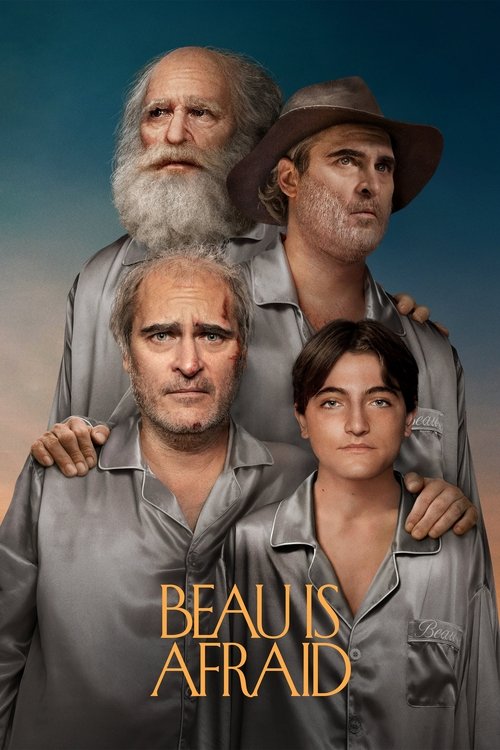
Beau Is Afraid
2023 · Ari Aster
Went from horror wunderkind (Hereditary, Midsommar) to deliberate audience-divider: Beau Is Afraid was a notorious A24 money-loser people still argue about, and Eddington, his COVID-era conspiracy western, split Cannes down the middle. The director people cite when debating whether "divisive" means brave or self-indulgent.
When you want to be challenged, baffled, and a little bruised — an ordeal movie for adventurous nights, absolutely not a comfort watch. Reach for it when 'what did I just see' is the feeling you're after.
What it's about
Beau is a middle-aged man so consumed by anxiety that leaving his apartment is an act of courage, and he's supposed to fly home to visit his mother. When she dies suddenly and grotesquely, his simple trip home becomes a sprawling, ever-mutating odyssey — through a hostile city, a suburban household with problems of its own, and stranger territories still — as everything he fears about the world, and about his mother, keeps coming true. It's a three-hour nightmare comedy about guilt, and about a son who can never quite get home.
The experience
Watching it feels like being inside a panic attack that keeps finding punchlines — hilarious and suffocating in the same breath, and it only gets stranger as it goes. It's exhausting by design, and it lingers for days whether you want it to or not.
Performances
Joaquin Phoenix commits totally as Beau, playing a lifetime of terror and guilt in a shrinking, apologetic body — a performance that's somehow both childlike and ancient.
The craft
Ari Aster builds each chapter of the journey as its own world with its own visual logic, including one astonishing extended animated passage, and stages anxiety with the precision he once brought to horror. Every frame is dense with jokes and dread hidden in the background. It's a maximalist production — reportedly A24's most expensive to that point — and it looks it.
Why it matters
It marked Aster's deliberate break from the elevated-horror brand that made him famous and became one of the most divisive big-swing releases of its decade — a film people argue about rather than agree on.
Snapshot
Beau Is Afraid is Ari Aster's third feature and his decisive swerve away from the elevated-horror brand that Hereditary (2018) and Midsommar (2019) had built for him and for A24. A three-hour picaresque odyssey — roughly 179 minutes — it follows Beau Wassermann (Joaquin Phoenix), a paralytically anxious middle-aged man, as he attempts to travel home for the anniversary of his father's death and, after his mother's sudden and grotesque demise, is instead flung through a sequence of escalating nightmares. The film is at once a Kafkaesque anxiety comedy, a surrealist quest narrative, and a psychoanalytic case study of maternal guilt rendered as literal geography. It expands the premise of Aster's 2011 short film Beau, and it was, by reported figures, the most expensive production A24 had financed to that point — a scale that its divisive reception and modest commercial performance would make a recurring point of discussion. It stands as the purest available statement of Aster's sensibility once the genre scaffolding is removed: a comedy of dread whose engine is shame rather than fear.
Industry & production
The film is a product of the A24 auteur pipeline at its most indulgent and most exposed. Having delivered two profitable horror pictures, Aster was extended the creative latitude — and the budget — to make something with no clear commercial lane. Reported budgets place the production around $35 million, a substantial sum for A24 and for a film with no genre hook, movie-star ensemble comedy structure, or franchise potential to anchor it. Aster co-produced through his own Square Peg banner (co-founded with Lars Knudsen), which had also shepherded Midsommar and adjacent projects such as Lamb and Disappointment Blvd. — the latter being this film's working title during production, a detail worth noting because it signals how personal and deliberately un-marketable the project was conceived to be.
Principal photography took place largely in and around Montreal, Quebec, where extensive practical sets — most famously the hellish urban block outside Beau's apartment — were constructed rather than found or composited wholesale. The commercial outcome is the film's most-cited industrial fact: it opened to a limited platform release before expanding, and by broad critical consensus underperformed relative to its cost, becoming shorthand in trade coverage for the risk of the blank-check auteur bet. What the record supports without exaggeration is that the film was expensive, that it did not recoup theatrically at anything like Midsommar's level, and that it did not dent Aster's standing enough to prevent his next feature — Eddington (2025) — from being financed. Precise grosses vary by source and I will not assign a specific number here.
Technology
Beau Is Afraid is a maximalist film made through the convergence of large-scale practical construction and digital finishing, and its most distinctive technological feature is arguably its most analog: a fully animated interlude. In the film's forest act, Beau watches a traveling theatrical troupe perform, and the staged story blooms into an extended hand-crafted animated sequence — an imagined life Beau might have lived — created by the Chilean animation duo Cristóbal León and Joaquín Cociña, known for the stop-motion feature The Wolf House. Their tactile, unsettling technique is deployed as a discrete formal register inside the live-action whole, and it is the film's clearest demonstration that Aster treats "technology" as a menu of media to be switched among for psychological effect rather than a single capture pipeline.
The live-action body of the film relies on constructed environments and integrated visual effects to sustain a reality that is heightened but never signposted as fantasy — the opening urban dystopia, the surgical-suburban household, the courtroom-arena climax. The film was captured digitally and finished with substantial but largely invisible effects work in service of a world that is warped rather than obviously CGI-laden. I will not specify a camera or lens package without confirmation.
Technique
Cinematography
Pawel Pogorzelski, Aster's cinematographer on both prior features, shoots Beau Is Afraid with the controlled symmetry and slow, insinuating camera moves that have become the pair's signature, here bent toward comic paranoia rather than horror. The film's four principal movements are each given a distinct palette and lighting logic: the sickly, overexposed chaos of the city; the antiseptic, too-bright pastels of the suburban home; the dappled, storybook greens of the forest; and the vast, shadowed theatricality of the finale. Pogorzelski favors clean, frontal compositions and precise camera placement that turn Beau into a small figure trapped inside oppressively legible frames — the visual grammar of surveillance and exposure. The camera's calm is a joke played against the content's hysteria; the more unhinged the events, the more composed the image, which is the mechanism by which the film's dread curdles into laughter.
Editing
Cut by Lucian Johnston — who edited Midsommar — the film's editing is defined by its willingness to sustain discomfort past the point of conventional rhythm. Scenes are held long, escalations are allowed to compound, and the three-hour runtime is itself an editorial thesis: the picture refuses the mercy of a tighter cut, immersing the viewer in Beau's inability to escape. Within that macro-structure the editing is agile, orchestrating slapstick escalation, sudden violence, and dream-logic transitions between the film's discrete worlds. The cutting has to manage tonal whiplash — terror to farce and back within a single sequence — and its control of that oscillation is central to whether a given viewer finds the film exhilarating or exhausting.
Mise-en-scène / staging
This is a production-design film to an unusual degree; its meaning lives in its environments. Each act is a self-contained designed world with its own rules, and the density of background detail — signage, graffiti, product labels, the litter of a decayed civic order — rewards and overwhelms the eye. The opening cityscape is a comprehensive dystopia staged as ambient assault; the suburban home weaponizes bright normalcy; the finale stages Beau's psyche as a literal amphitheater of judgment. Aster's staging repeatedly places Beau as the passive object around which aggressive worlds arrange themselves, and the choreography of extras, props, and architecture does much of the film's characterization. (The production design is credited to a single lead designer whose exact name I will not state here without confirmation, but the discipline's centrality is not in doubt.)
Sound
Sound design is one of the film's primary instruments of anxiety, layering off-screen menace, domestic hum, and sudden intrusion to keep Beau — and the audience — in a state of hypervigilance. The score is by Bobby Krlic, the electronic composer known as The Haxan Cloak, who also scored Midsommar. Where his Midsommar work built dread through drone and folk-adjacent dissonance, here the music must also accommodate comedy and picaresque motion, shading Beau's terror without ever letting it settle into pure horror. The interplay of designed sound and score sustains the film's governing sensation: that the world is always a half-second from turning on its protagonist.
Performance
Joaquin Phoenix anchors nearly every frame as Beau, a role built almost entirely from reaction — flinching, apologizing, absorbing. It is a performance of near-total passivity, a difficult register to sustain across three hours, and Phoenix modulates it through gradations of fear, guilt, and brief, doomed hope. Around him the ensemble delivers sharply calibrated grotesques: Patti LuPone as the domineering mother Mona (with Zoe Lister-Jones as her younger self and Armen Nahapetian as young Beau); Nathan Lane and Amy Ryan as the disturbingly cheerful suburban couple; Parker Posey as the figure of Beau's fixated longing; Stephen McKinley Henderson; Denis Ménochet; and others deployed as embodiments of the anxieties pressing on Beau. The performances lean into caricature by design — they are the shapes Beau's terror gives to the people around him.
Narrative & dramatic mode
The film's dramatic mode is the picaresque quest turned inward — an odyssey in which the hero is defined by his incapacity to act and the episodes are staged as external manifestations of internal states. Structurally it moves through four discrete worlds, each a self-contained short film with its own tone, before converging on a climactic reckoning staged as a trial. The mode is deliberately anti-realist: the film never commits to whether events are literal, dreamed, delusional, or symbolic, and this suspension is the point. It operates as an anxiety dream given narrative form, where cause and effect obey the logic of guilt rather than physics. The dramatic tension is not "will Beau reach home?" but "how completely will the world confirm his worst beliefs about himself?" — a comedy whose punchline is foregone catastrophe.
Genre & cycle
Officially tagged comedy, adventure, and fantasy, the film sits athwart its own categories, which is its comic strategy. It belongs to a lineage of surrealist tragicomedies about hapless men crushed by systems and mothers, and it participates in the "anxiety comedy" and Jewish-American neurotic-son tradition even as it inflates that tradition to mythic, Homeric scale. It is not horror, though it borrows horror's tools, and its release marked a conscious cycle-break: Aster explicitly moving from the horror label he had helped make bankable toward a more idiosyncratic art-cinema register. Within the broader 2020s A24 cycle of auteur-driven, formally ambitious features, Beau Is Afraid represents the maximalist, budget-stretching extreme — the moment the model was tested against a film with almost no genre safety net.
Authorship & method
Beau Is Afraid is the most nakedly authorial of Aster's features, written and directed by him and grown from a seed he had planted over a decade earlier in the short Beau (2011). Aster's method here is the elaboration of a private psychology into a fully built external world; his stated preoccupations — inherited trauma, guilt, the family as a site of dread — are transposed from the horror grammar of his first two films into comedy without losing their intensity. His authorship is legible in the recurrence of his core collaborators, which makes Beau readable as the third panel of a triptych: cinematographer Pawel Pogorzelski, composer Bobby Krlic, and editor Lucian Johnston all carry over from Midsommar, lending continuity of eye, ear, and rhythm across a radical shift in genre. The screenplay is Aster's alone, and the film's structure — episodic, digressive, unwilling to discipline itself — is the clearest evidence that this was a project made to satisfy its author's design rather than an audience's expectations. The animated interlude by León and Cociña is the one place where Aster hands his sensibility to outside artists, and it functions as a curated guest passage within an otherwise total authorial control.
Movement / national cinema
The film is an American independent production in the A24 auteur tradition, but its aesthetic passport is emphatically European and international. Its lineage runs through European surrealism and absurdism far more than through American realism, and its production draws on Canadian (Montreal) infrastructure and Chilean animation, making it a nominally American film assembled from transnational parts. It does not belong to a coherent national "movement" so much as to a loose contemporary current of maximalist, festival-oriented auteur cinema that circulates internationally and answers to individual directors rather than to schools.
Era / period
Beau Is Afraid is a distinctly post-2020 film in temperament. Though not literally about the pandemic, its ambient dread, agoraphobic protagonist, hostile public space, and preoccupation with a body under threat resonate with the anxieties of the early 2020s. Industrially it belongs to the moment when specialty distributors, flush from prior successes, were willing to underwrite large-budget auteur experiments — and to the swift correction that followed when several such bets did not pay off. The film is thus a period marker twice over: of a cultural mood and of a brief, expensive high point in the auteur-financing cycle.
Themes
The film's governing theme is guilt as inheritance — specifically the son's inextinguishable debt to the mother, staged as a world that exists to accuse him. Around this core cluster its other preoccupations: anxiety as a total condition rather than a symptom; the impossibility of separation and individuation from a controlling parent; the way shame distorts perception until self-punishment feels like fate. Sexuality appears as terror, coded in Beau as a literal, inherited threat. The film is also, obliquely, about narrative itself — Beau is a man trapped inside a story authored by someone with power over him, and the finale's arena literalizes the fantasy that one's whole life is evidence assembled for prosecution. Underneath the surrealist apparatus is a plainly psychoanalytic, even Oedipal, structure that the film both dramatizes and satirizes.
Reception, canon & influence
Critical reception was sharply divided, and that division is itself the film's reception story. Beau Is Afraid premiered to responses that split between admiration for its ambition, formal control, and Phoenix's endurance-test performance, and frustration with its length, self-indulgence, and relentlessness — many critics acknowledged both in the same review. Its commercial disappointment relative to its reported budget became inseparable from its critical framing, positioning the film as a case study in the limits of the auteur blank check. It did not become an awards presence, and its canonization, if it comes, is likely to be as a cult object and a purist's touchstone rather than a consensus classic.
Its backward influences are worn openly: the bureaucratic nightmares and guilt-logic of Kafka; the odyssey structure of Homer refracted through anxiety; the psyche-as-world of Charlie Kaufman's Synecdoche, New York; the deadpan tableaux of Roy Andersson; the dream-cinema of Fellini and Buñuel; the retro-dystopian sprawl of Terry Gilliam; and the specifically Jewish-American comedy of the guilt-ridden son, with Philip Roth's Portnoy's Complaint an unavoidable literary antecedent. Aster's own short Beau (2011) is the most direct source.
Its forward influence is still forming and honestly better described as open than settled. Within Aster's career, the film functions as the pivot that freed him from the horror label and licensed the different register of Eddington (2025). More broadly it is likely to be cited as a boundary case — the reference point for both the artistic possibilities and the financial hazards of maximalist auteur cinema in the 2020s — and as a durable cult film championed by a devoted minority. Claims that it has already reshaped a body of subsequent work would be premature, and I flag that the record here is genuinely thin; its legacy is a question the next decade will answer.
A Deleuzian reading
Beau stands inside his door and looks at the street he has to cross.
The full Deleuzian reading of Beau Is Afraid →
Reception
Landed in April 2023 as A24's biggest-ever gamble and promptly divided everyone — walkouts, rapturous defenses, a soft box office. Three years on it's settled into 'misunderstood magnum opus' territory, the Aster film his diehards insist will be vindicated.
How Beau Is Afraid was received, from release to now →
How to watch Beau Is Afraid: what to notice on a first viewing
- Notice how centered and calm the frame stays. Pawel Pogorzelski composes frontally, places the camera precisely, and moves it slowly or not at all while the events inside the frame come apart. The composition is not panicking. Everything in it is. The gap between a calm image and hysterical content is exactly where the laughter comes from.
- Watch what the street does while Beau stands still. He rarely crosses anything. The city arrives at him. Extras, traffic, signage and architecture do the moving, and Aster stages Beau as the object that aggressive worlds arrange themselves around. His passivity is not a hole in the writing. It is the wall holding the film up.
- Read the signs, graffiti and product labels in the background. Each act is a built world packed with information: the decayed city, the too-bright suburb, the storybook forest. You could take an inventory of any frame. Beau never reads a word of it. Every frame is legible to you and illegible to him. He is the only thing in the shot that cannot read the shot.
- Listen for threats you can hear but never locate. Bobby Krlic's score shades the fear without letting it settle into horror. The design keeps menace off screen: a bang down a hallway, a voice through a wall, a hum under the house. A danger with no address keeps you scanning the room. That is Beau's ordinary condition, handed to your ears.
- Watch Joaquin Phoenix apologize. Count how often he does it. Phoenix builds Beau almost entirely out of reaction: flinching, saying sorry, absorbing. Around him Patti LuPone, Nathan Lane, Amy Ryan and Parker Posey play broad grotesques, pitched well past ordinary behavior. The caricatures are not loose acting. They are the shapes a frightened man's fear gives to everyone he meets.
The whole guide to watching Beau Is Afraid, with the keys for a rewatch →
Influences: the films it descends from and the films it influenced
- Beau (2011) — Aster's own short is the literal seed — its anxious man crossing a lethal urban street is expanded into Beau's opening apartment-district gauntlet, staged with the same symmetrical-frontal framing of a passive body under siege.
- Synecdoche, New York (2008) — Externalizes a protagonist's interior guilt as an ever-expanding built environment, the model Aster uses to turn Beau's psyche into a literal picaresque geography of set-pieces.
- The Trial (1962) — Kafkaesque guilt-logic staged inside oppressive, disorienting expressionist architecture where a passive man is prosecuted for an unnamed crime — Beau's bureaucratic dread grammar.
- Brazil (1985) — Retro-dystopian, cluttered maximalist production design that drives the world-building, where paranoia is expressed through sprawling set architecture rather than plot.
- 8½ (1963) — Dream-cinema that folds memory, fantasy, and anxiety into a procession through the author's own mind, licensing Beau's anti-realist ambiguity and surreal interludes.
- Songs from the Second Floor (2000) — Deadpan, deep-staged static tableaux in pallid palettes populated by grotesque human caricature — the direct model for Beau's frontal, production-design-driven compositions.
- The Swimmer (1968) — Episodic picaresque homeward journey in which each vignette strips away the hero's denial and exposes psychological collapse — Beau's quest structure precisely.
- After Hours (1985) — Escalating nightmare-odyssey comedy where a passive man is punished by an increasingly hostile night, the anxiety-comedy engine of tonal whiplash Aster inherits.
- The Discreet Charm of the Bourgeoisie (1972) — Surrealist nesting of dreams-within-dreams that refuses to resolve into a single stable reality, the antecedent for Beau's unfixable narrative ontology.
- A Serious Man (2009) — Jewish-American guilt comedy built as Job-like escalating cosmic persecution of a passive protagonist, sharing Beau's theology of the harassed, blameless son.
- The Wolf House (2018) — The Chilean duo whose hand-built, continuously-mutating stop-motion Aster commissioned for Beau's play-within interlude, a curated guest passage in their papier-mâché surrealist idiom.
- Joker (2019) — Aster's unreliable narrator integration — the camera fully inhabiting a paranoid male protagonist's deteriorating grasp on reality, with urban space rendered as hostile surveillance apparatus — extends the formal license Joker opened; Pogorzelski's surveillance-proximity staging for Beau's street-level horror borrows the same logic of camera-as-social-pressure that Sher developed.
- Eddington (2025) — The film Beau's blank-check freedom licensed, extending Aster's post-horror register into paranoid Americana anxiety and hypervigilant sound design without the genre scaffolding.
- Hereditary (2018) — First panel of Aster's inherited-trauma triptych; maternal guilt and family-as-site-of-dread constructed through miniature/dollhouse framing that treats characters as fixed figurines.
- Midsommar (2019) — Shares Beau's exact craft team — DP Pawel Pogorzelski, composer Bobby Krlic, editor Lucian Johnston — carrying over symmetrical daylight dread and grief metabolized as ordeal.
- mother! (2017) — Subjective-claustrophobic anxiety escalation locking a passive protagonist inside an allegorical house that mutates around maternal/creation guilt — Beau's sustained-discomfort editing rhythm.
- I'm Thinking of Ending Things (2020) — Anti-realist ambiguity in which memory, age, and identity destabilize and the physical world bends to a single mind's projections — the same unreliable psyche-as-world logic.
- Poor Things (2023) — Aster's picaresque nightmare, structured as a sequence of elaborately designed tableau chapters in alternate-reality spaces with deliberately dissonant orchestral scoring, shares the non-cathartic episodic rhythm, production-design surrealism, and inverted-bildungsroman logic that place it as a direct generic sibling.
- Dream Scenario (2023) — Shares producer Aster's Square Peg house style — escalating-anxiety vignette structure and deadpan dread surrounding a passive, humiliated everyman.
- Gozu (2003) — Descendant deadpan-surreal picaresque quest where a passive protagonist is propelled through escalating grotesque set-pieces governed by dream-logic, with bodily/maternal horror as the engine — Gozu's structure at feature scale.
- Tony (2026) — Bauman's other register with the same glass: wide lenses held at close range so a room's geometry warps around a protagonist who misreads it, and long handheld-adjacent moves that stay composed rather than jittery — the technique Tony deploys for comic kitchen space.
Similar films
- Hereditary (2018) — influence & lineage
- Eddington (2025) — influence & lineage
- Midsommar (2019) — influence & lineage
- mother! (2017) — influence & lineage
- Synecdoche, New York (2008) — influence & lineage
- The Father (2020) — same viewing thread
- Joker (2019) — shared sensibility
- Asteroid City (2023) — shared sensibility
All the films related to Beau Is Afraid →
Watch it with: curated runs of related films
- When the Family Comes Undone — Watch these when you want intimate, one-household dramas where love and grief are the same thing — a parent fading, a marriage on trial, a child at the center of the wreckage.