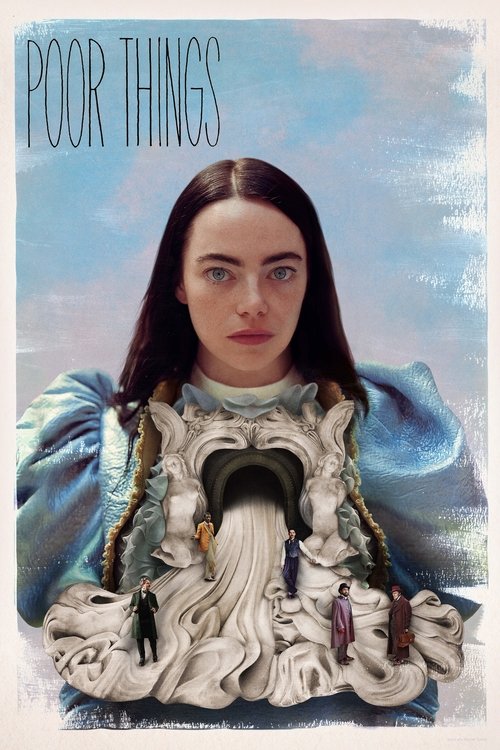
Poor Things
2023 · Yorgos Lanthimos
The sex-and-liberation argument of its season — feminist odyssey or male-gaze fantasia — conducted at full volume all the way to Emma Stone's second Oscar.
For when you want a big, wild, beautiful night of a movie that's still smart — best for adventurous viewers, since it's frank about sex and cheerfully grotesque.
What it's about
Bella Baxter is brought back to life by an eccentric surgeon in a fantastical Victorian London — a grown woman starting from zero, learning the world at ferocious speed. She bolts across the continent with a preening rake of a lawyer, devouring experience — sex, oysters, philosophy, injustice — and outgrowing every man who tries to contain her. Part fairy tale, part comedy of liberation.
The experience
Bawdy, gorgeous and gleefully strange — laugh-out-loud funny one minute, unexpectedly moving the next, with the momentum of an adventure and the bite of a satire.
Performances
Emma Stone won the Oscar for a fearless, full-body performance that ages a mind from infancy to brilliance before your eyes; Mark Ruffalo is hilariously pathetic as her vain seducer; Willem Dafoe finds gruff tenderness under heavy prosthetics.
The craft
Shot with fisheye lenses and swinging from velvety black-and-white into candy-saturated color, it unfolds on handmade soundstage cities while Jerskin Fendrix's woozy score bends and matures along with Bella's mind. The production and costume design are a feast — see it as big as you can.
Why it matters
It took the Golden Lion at Venice and four Academy Awards, proving a defiantly weird art film could be a mainstream event and marking Lanthimos's arrival at full studio scale with his strangeness intact.
Snapshot
A sui generis Victorian-fantasia, Poor Things adapts Alasdair Gray's 1992 Scottish novel into a baroque, picaresque Bildungsroman about a woman re-animated with an infant's brain who proceeds to educate herself sexually, philosophically, and politically at a speed that embarrasses every man around her. The film won the Golden Lion at the 2023 Venice Film Festival and collected four Academy Awards — including Best Actress for Emma Stone — from eleven nominations. It represents Lanthimos's fullest embrace of mainstream production scale while preserving the disorienting formal intelligence of his earlier work, and stands as one of the more audacious studio-adjacent art films of the decade.
Industry & production
The film is an Irish-British co-production between Element Pictures (Ed Guiney and Andrew Lowe, based in Dublin, the same outfit behind The Favourite and the bulk of Lanthimos's English-language work) and Film4, distributed internationally by Searchlight Pictures. The production was mounted largely in Budapest, using the expansive studio infrastructure at Origo Film Studios, which allowed the construction of the film's elaborate interior environments — Dr. Baxter's labyrinthine London townhouse, the Lisbon hotel and street sets, the Parisian brothel — on controlled soundstages. Location work was supplemented in Lisbon and Malta.
Alasdair Gray's novel presented a specific adaptation challenge: its frame device — a Victorian medical text assembled by unreliable narrators — is substantially stripped back in Tony McNamara's screenplay, which instead transposes the novel's feminist revisionism into a more linear, though still episodic, picaresque structure. Lanthimos had long expressed interest in the Gray source; he and McNamara had established their collaboration on The Favourite (2018), and Poor Things deepens that partnership, with McNamara again supplying anachronistic, abrasive dialogue that functions as Brechtian puncture of period decorum.
The casting of Emma Stone, who had worked with Lanthimos on The Favourite, anchored the production. Willem Dafoe, whose grotesque physiognomy (surgically enhanced for the role via prosthetics) grounds Dr. Godwin Baxter in a lineage of Frankenstein-adjacent patriarchs, and Mark Ruffalo, playing the preening libertine Duncan Wedderburn with a controlled comic grotesquerie, complete the central triangle.
Technology
Cinematographer Robbie Ryan shot the film using anamorphic lenses, with wide-angle and fisheye optics deployed to produce the film's characteristic distorted perspectives — views that approximate the freshness and spatial disorientation of an infant consciousness discovering the world anew. A significant structural conceit governs the image: the film opens in monochrome, restricting the visual world to the confined, Dickensian atmosphere of Baxter's household, and progressively introduces color as Bella's experience widens through travel. The Lisbon sequences bloom into vivid, oversaturated pastels; Alexandria and Paris are rendered in increasingly warm, dense palette. This chromatic arc is not mere decoration; it functions as an externalized map of cognitive and emotional expansion.
The production design, conceived by Shona Heath and James Price (who won the Academy Award for Best Production Design for their work here), is assembled from deliberate anachronism — gaslit Victorian interiors coexist with impossible architecture, airships, and mechanistic flourishes drawn less from historical accuracy than from a tradition of European fantasy illustration. The costumes by Holly Waddington (Academy Award for Best Costume Design) similarly treat the period as raw material to be warped: Bella's clothing tracks her agency, shifting from white-smocked infantilism to increasingly assertive, self-selected extravagance.
Technique
Cinematography
Ryan's lens choices give Poor Things its most immediately distinctive feature. Wide-angle and fisheye shots, sometimes framed within circular irises or vignettes, recur particularly when the camera inhabits Bella's point of view, encoding her perceptual rawness in optical form. As she matures, the compositions normalize — the fisheye gives way to more conventional framings — without abandoning the film's overall theatricality. Lighting design leans toward the theatrical, with deep shadows and highly controlled pools of warm light in interior scenes, while the exterior sequences in sun-drenched Lisbon represent a deliberate rupture: flat, bright, almost uncanny in their artificial vividness.
Editing
Yorgos Mavropsaridis, Lanthimos's long-standing editor, maintains the elliptical, abrupt rhythms that have defined the director's work since Dogtooth. The film's episodic structure — organized around Bella's successive cities and men — is cut to deny conventional dramatic payoff. Scenes end not at resolution but at an angle, often on Bella's expression of impatience or curiosity, foregrounding her interiority over the mechanics of plot. Extended sequences aboard the cruise ship serve as a structural pause, slowing rhythm to allow philosophical conversation to surface, before the film accelerates again into Parisian episodes.
Mise-en-scène / staging
Lanthimos's staging in Poor Things is more overtly theatrical than in his earlier Greek-language films, though the logic is consistent: characters occupy composed frames that emphasize their positions relative to power and knowledge rather than naturalistic geography. Dr. Baxter's house is staged as a series of threshold spaces — corridors, doorways, staircases — that Bella progressively crosses as she advances cognitively. The recurring motif of Bella viewed through glass, or from high angles that reduce her to object status, gives way across the film to eye-level framings that assert her subjectivity.
Sound
Jerskin Fendrix composed the score, his first feature film assignment, and it is among the most unusual soundtracks of recent prestige cinema. Fendrix employs a deliberately destabilized orchestration — conventional string writing interrupted by dissonance, unexpected timbres, and passages that hover between diegetic and non-diegetic space. The music neither flatters nor soothes; it underscores the film's tonal instability, sliding between grotesquerie and tenderness without resolution. The effect is closer to the scoring sensibility of certain European art films of the 1960s and 1970s than to conventional Hollywood period-picture music.
Performance
Emma Stone's performance as Bella Baxter is architecturally demanding: she must credibly inhabit several distinct developmental stages across a single continuous character — infant locomotion and diction, adolescent curiosity and impulsiveness, adult philosophical conviction — while maintaining a continuous identity. Stone achieves this through rigorous calibration of physical performance, adjusting gait, gesture, and vocal register incrementally. The performance belongs to a tradition of performers embodying radical naivety (Chaplin, Tati's Hulot, Isabelle Huppert in La Cérémonie) without condescending to the character's ignorance.
Willem Dafoe performs Baxter from behind substantial facial prosthetics suggesting surgical experiment, and navigates between paternal tenderness, intellectual pride, and a horror at the implications of what he has created. Ruffalo commits entirely to Wedderburn's comic disintegration — a man who fetishizes female inexperience and is destroyed when the inexperience evaporates.
Narrative & dramatic mode
The film is structured as a picaresque — Bella's journey across Lisbon, Alexandria, and Paris is the framework, and each city delivers a new set of instructors, exploiters, and companions who cumulatively produce her political education. The picaresque logic is satirical: Bella's encounters expose the ideological furniture of the world (bourgeois propriety, sexual double standards, colonial indifference) precisely because she arrives without it. She can see the furniture because she was not trained to regard it as natural.
The inverted Bildungsroman is the film's controlling dramatic irony. Conventionally, the genre traces a protagonist's gradual accommodation to society's norms; Bella's arc runs precisely opposite — her growth is a progressive refusal of accommodation, a hardening of individuality against every social institution (marriage, propriety, philanthropy organized by guilt, brothel economics) that attempts to contain her. The film's ending — Bella practicing medicine at Baxter's house, having incorporated her patriarchal creator into a domestic arrangement organized on her terms — is wry and utopian in equal measure.
Genre & cycle
Poor Things sits at the intersection of several genre traditions without settling into any. From Gothic science fiction (particularly the Frankenstein lineage — the creature animated by transgressive science, then outgrowing its creator), it inherits the body-horror register of Bella's origin and Dr. Baxter's own visibly sutured anatomy. From Victorian literary satire (Swift, Voltaire's Candide), it inherits the picaresque naïf whose observations defamiliarize the social world. From feminist surrealism, it draws the project of inhabiting a female body and consciousness as the site of philosophical experiment rather than erotic spectacle.
The film belongs to a recognizable early-2020s cycle of prestige films with feminist bodies-as-territory concerns (Titane, Crimes of the Future, Men, Beau Is Afraid), though Lanthimos's tone is more legible as dark comedy than as pure horror. It also occupies the space of the literary adaptation with significant auteurist transformation, alongside films like Spencer (2021) or The Power of the Dog (2021) that use genre conventions as aesthetic scaffolding for arthouse concerns.
Authorship & method
Yorgos Lanthimos emerged from the Greek Weird Wave — a loose grouping of filmmakers (including Athina Rachel Tsangari) working in Athens in the 2000s whose films shared a commitment to formal estrangement, flat affect, and the defamiliarization of domestic violence and social power. His Greek-language films — Dogtooth (2009), Alps (2011) — established international visibility; the move to English-language productions with The Lobster (2015) and The Killing of a Sacred Deer (2017) preserved much of that sensibility while expanding his reach.
The Favourite (2018) introduced Tony McNamara as a screenwriter and expanded the production scale considerably; Poor Things extends that collaboration into its most baroque and formally adventurous expression. McNamara's contribution is structural: his screenplay maps Bella's journey into legible episodes while his dialogue's deliberate anachronism — characters deploy contemporary frankness in Victorian settings — functions as a Brechtian alienation device, preventing the viewer from retreating into comfortable period nostalgia.
Robbie Ryan, who had shot The Favourite and multiple Andrea Arnold features (Fish Tank, American Honey, Wuthering Heights), has developed a distinctive grammar of hand-held intimacy alongside formal compositional rigor. His collaboration with Lanthimos channels this into something more controlled and tableau-oriented than his work with Arnold, though the instinct for optical disruption — the fisheye, the canted angle — persists.
Yorgos Mavropsaridis's editing and Jerskin Fendrix's score are the other primary collaborative axes: Mavropsaridis has edited all of Lanthimos's features, providing the distinctive rhythm of abrupt, non-cathartic cutting; Fendrix, a newcomer to features, brought an outsider's disregard for conventional scoring function.
Movement / national cinema
Lanthimos remains productively uncontainable within national cinema frameworks. Greek by formation, he has worked primarily with British and Irish production infrastructure since The Lobster, employing international casts and shooting across multiple European countries. Poor Things is set in a fantastical version of Victorian Britain and continental Europe, adapted from a novel by a Scottish author, produced by an Irish company with British public funding, shot in Hungary with a largely American star. This pan-European character is thematically apt — Bella's liberation is figured precisely as the refusal of fixed national and social identity — and structurally consistent with Lanthimos's position as a director who circulates within but is not captured by any single national film culture.
The film can be situated within the broader tradition of British literary adaptation with Continental aesthetics — a tradition running from Nicolas Roeg through Peter Greenaway and Sally Potter — insofar as it uses English literary source material as occasion for formally experimental cinema that would be unusual within mainstream British film culture.
Era / period
Poor Things was made in an era defined by intersecting pressures: the post-Me Too reorientation of feminist representation in prestige cinema; the continuing expansion of streaming-adjacent arthouse (Searchlight Pictures operating as a distributor for sophisticated, awards-seeking work); and a renewed appetite, following the pandemic years, for large-scale production design as a form of cinematic spectacle. The film's baroque visual excess is partly a function of this moment — a demonstration of what physical production can do that digital de-realization cannot replicate.
It also arrives in the wake of a cycle of formally ambitious prestige films — Roma (2018), The Favourite (2018), Parasite (2019), Titane (2021) — that established a space for formally experimental work within major awards competition, making the Venice Golden Lion to Oscar pipeline more visible and reliable than it had been in previous decades.
Themes
Education and epistemology. Bella's cognitive development is the film's central action, and Lanthimos treats learning not as accumulation of approved knowledge but as the progressive destruction of received wisdom. Every authority Bella encounters — paternal, romantic, institutional, philanthropic — is exposed as interested and partial. Her education is in the unreliability of what she has been told.
The body as site of female sovereignty. Bella's sexuality is presented without shame or titillation-framing — it is one of several domains of experience she investigates with the same methodical curiosity she applies to books, food, and travel. The film's insistence on Bella's non-pruriently depicted sexual agency is a deliberate inversion of the male-created-woman tradition, in which the created female body has historically been positioned as erotic property.
Paternal creation and its limits. Dr. Baxter is simultaneously sympathetic and monstrous — his attachment to Bella is genuine, but he created her, named her, and housed her in conditions designed to limit her exposure to the world. The film treats the Frankenstein myth as an allegory of patriarchal education: the father who makes the daughter, then cannot cope with her independent will.
Capitalism, charity, and false liberation. The Alexandrian sequence — Bella distributing Wedderburn's stolen money to impoverished dockworkers, then discovering that her companion Harry Astley considers this naive sentimentalism — introduces a sharp political edge: genuine solidarity cannot be performed as bourgeois gesture. The brothel episodes in Paris extend this into labor economics, with Bella arriving at a structural rather than merely personal understanding of her situation.
Reception, canon & influence
Poor Things premiered at the Venice Film Festival in September 2023, winning the Golden Lion — the festival's top prize — and generating immediate and enthusiastic critical recognition. Critics broadly praised the production design, Stone's performance, and Lanthimos's formal ambition, while debate persisted over whether the film's feminist framework was fully realized or remained, despite its intentions, framed through a male directorial gaze. This debate — genuine, unresolved — is part of the film's reception history.
At the 96th Academy Awards (2024), the film received eleven nominations and won four: Best Actress (Emma Stone), Best Production Design, Best Costume Design, and Best Makeup and Hairstyling. Best Picture went to Oppenheimer.
Influences on the film (backward): The most direct antecedents are literary — Mary Shelley's Frankenstein (the created being who exceeds its creator's expectations) and Voltaire's Candide (the naïf whose innocence constitutes critique). Within cinema, the most productive reference points are the surrealism of Luis Buñuel (the satirical demolition of bourgeois propriety from within its own settings), the Czech New Wave's taste for absurdist domestic estrangement (Miloš Forman's early films, Jan Švankmajer's stop-motion grotesquerie), and Fellini's picaresque female-centric odysseys. Terry Gilliam's Brazil (1985) is a relevant precedent for elaborately designed, politically satirical alternate-history world-building. Within feminist cinema, Agnès Varda's sustained interest in female consciousness and the female body as subject rather than object is a consistent background presence in films of this type; Godard's Vivre sa vie (1962), in which a woman's agency is traced through successive social encounters, offers a structural analog.
Legacy and influence (forward): It is too early for Poor Things to have a fully documented influence on subsequent filmmaking, and any account of its legacy at this distance would be speculative. What can be said is that it consolidates and validates a contemporary genre space — feminist body surrealism in prestige production — and that Emma Stone's performance, and the film's commercial and critical success, will likely encourage further projects in this register. Its demonstration that formally aggressive, sexually frank, and politically discomfiting material can be produced at significant scale and compete seriously in major awards competition is itself a fact about the film industry's current tolerances that subsequent filmmakers and producers will read.
A Deleuzian reading
Start with a face seen through a fishbowl.
The full Deleuzian reading of Poor Things →
Reception
Premiered at Venice 2023 and took the Golden Lion, then rode an awards wave to 11 Oscar nominations and 4 wins — but audiences were split from day one, and it's settled in as Lanthimos's mainstream breakthrough that people still argue about rather than a consensus classic.
How Poor Things was received, from release to now →
Influences: the films it descends from and the films it influenced
- The Discreet Charm of the Bourgeoisie (1972) — Lanthimos inherits Buñuel's structural device of bourgeois ceremony that ritually fails to complete itself — social ritual as the engine of satirical defamiliarization — so that Bella's encounters with Victorian propriety are staged as ceremonies that expose rather than reinforce social norms.
- Brazil (1985) — Gilliam's method of constructing an internally coherent alternate-history production design — where anachronistic technology and architecture make political satire legible as world-system rather than joke — is the direct template for the film's Victorian-fantasia sets and McNamara's anachronistic dialogue register.
- Vivre sa vie (1962) — Godard's episodic chapter structure, in which a woman's trajectory is subdivided into discrete social encounters that accumulate without psychological resolution, provides the architectural model for Bella's picaresque stages of education across European milieus.
- Alice (1988) — Švankmajer's stop-motion grotesquerie — objects with uncanny autonomy, bodies in states of partial construction, spaces that share their animacy with furniture and creatures equally — shapes the film's staging of Bella's developmental physicality in constructed uncanny interiors.
- Nights of Cabiria (1957) — Fellini's picaresque grammar — a female protagonist moves through a succession of social environments that each promise integration and deliver exploitation, while her irreducible vitality resists narrative defeat — is the structural template for Bella's episodic odyssey that refuses tragic resolution.
- Bride of Frankenstein (1935) — Whale's foundational staging of the created being's physical education — the creature's awakening to sensation, its threshold straddling of the monstrous and the domestic, the horror-comedy of the created exceeding the creator's moral intentions — is directly legible in Bella's developmental arc and its genre register.
- The Wizard of Oz (1939) — Robbie Ryan and Lanthimos's monochrome-to-color cinematographic arc — using desaturation that yields progressively to full color saturation as Bella's consciousness expands — is a direct formal quotation of Fleming's sepia-to-Technicolor transition as grammar for a protagonist's entry into a larger world.
- Cléo de 5 à 7 (1962) — Varda's method of holding the female body as cinematic subject from within rather than surveilling it from without — the camera attending to a woman's interiority as she moves through social space — is the foundational formal commitment *Poor Things* inherits for its approach to Bella's developing selfhood.
- Dogtooth (2009) — Lanthimos's own wide-angle anamorphic distortion that flattens spatial depth while expanding peripheral vision, his behavioral flatness as alienation device, and domestic architecture as total ideological apparatus are all directly transposed and amplified from this Greek-language source.
- The Favourite (2018) — The immediate predecessor establishing the three-way collaboration of Lanthimos, McNamara, and Ryan — in which fisheye wide-angle distortion, anachronistic verbal register in period settings, and female power struggle are already fully operative — making it the direct formal and structural scaffold on which *Poor Things* builds.
- Fish Tank (2009) — Robbie Ryan's handheld anamorphic grammar developed across his Andrea Arnold collaborations — intimate close-body tracking, frames that crowd the protagonist's body against environmental edges — establishes the physical syntax of proximity and enclosure that he brings to *Poor Things*' staging of Bella's embodied discovery.
- The Shape of Water (2017) — Occupies the prestige-genre lane the film opened: a reanimated woman's fabulist coming-of-age in a hyper-saturated, artificial period-fantasy design, love-across-difference staged as an Oscar-honored adult fairy tale.
- The Substance (2024) — Fargeat's feminist body-horror film — in which female bodily transformation is literalized as political horror using production design excess, a formally aggressive female gaze, and prestige festival framing (Cannes Best Screenplay) — is the clearest immediate descendant extending the genre space *Poor Things* consolidates and validates.
- Bugonia (2025) — Mavropsaridis editing and Robbie Ryan cinematography at maximum production scale; demonstrates that the anti-naturalistic performance system achieves mainstream traction — the platform from which Bugonia's more commercially legible genre-coded premise operates.
- The Lobster (2015) — Lanthimos's first English-language feature deploys the same wide-angle anamorphic grammar, behavioral deadpan, and invented social system whose arbitrary rules defamiliarize normative institutions, making it a direct formal sibling that exercises the same defamiliarization toolkit at a different target.
- The Killing of a Sacred Deer (2017) — Lanthimos and his collaborators' Kubrick-derived method of displacing canonical sacred or classical music (Handel, Schubert) into scenes where its formal authority creates tonal rupture rather than emotional correspondence — a strategy carried forward into the commissioning of Jerskin Fendrix's deliberately unsettled orchestration.
- Titane (2021) — Ducournau's Palme d'Or-winning feminist body-horror surrealism — featuring a female protagonist whose bodily transformation operates simultaneously as horror and liberation within prestige production — establishes the festival/awards viability of formally aggressive, sexually frank female-body surrealism that *Poor Things* enters and consolidates.
- Beau Is Afraid (2023) — Aster's picaresque nightmare, structured as a sequence of elaborately designed tableau chapters in alternate-reality spaces with deliberately dissonant orchestral scoring, shares the non-cathartic episodic rhythm, production-design surrealism, and inverted-bildungsroman logic that place it as a direct generic sibling.
- Frankenstein (2025) — A parallel Frankenstein riff centering the reanimated creation's articulate becoming — foregrounding the made being's language and interiority rather than its menace, the same recovery del Toro performs.
- The French Dispatch of the Liberty, Kansas Evening Sun (2021) — A chaptered narrative that moves from black-and-white into saturated color using fisheye and aspect distortions plus deadpan-presentational performance, a contemporary variant of the same tableau-and-transition toolkit.
- Beetlejuice Beetlejuice (2024) — Practical storybook-gothic sets shot with forced perspective and fisheye lensing that make artifice legibly handmade, sharing the sequel's commitment to visible, tactile fabrication over seamless digital worlds.
- "Wuthering Heights" (2026) — Sibling as the auteur-driven, deliberately provocative literary reimagining in operatic register and large-format — using canonical/period source material as a stage for stylized transgression and heightened performance.
- The Ugly Stepsister (2025) — Shares the pairing of lavish painterly period production design with a surgically reconstructed woman reclaiming bodily autonomy, and the same deadpan oscillation between grotesque and comic.
- I Want Your Sex (2026) — A chapter-carded education plot in which sexual apprenticeship is the literal narrative spine, staged in deliberately artificial hyper-saturated design — the closest contemporary match to the film's card-and-episode pedagogy structure.
- The Bride! (2026) — Robbie Ryan's rehoused vintage and fisheye glass on digital capture, plus the monochrome-to-saturated-color switch keyed to a reanimated woman's growing autonomy — the same lens-and-mode logic the seed runs through aspect ratio instead of color.
- Queer (2024) — Contemporaneous case for the same wager: chaptered picaresque staged entirely on built sets with painted skies and matte cities, the falseness declared as a moral position on the protagonist rather than concealed as production limitation.
Similar films
- The Favourite (2018) — influence & lineage · same viewing thread
- The Lobster (2015) — influence & lineage
- The Substance (2024) — influence & lineage
- Beau Is Afraid (2023) — influence & lineage
- Dogtooth (2009) — influence & lineage
- "Wuthering Heights" (2026) — same viewing thread
- Orlando (1992) — same viewing thread
- Cruella (2021) — same viewing thread
All the films related to Poor Things →
Watch it with: curated runs of related films
- Drunk on Design — Watch these together for the rush of maximalist, color-drenched cinema where a woman is made, remade, or consumed by an art form — ballet, fashion, gothic desire — and the production design does half the storytelling.
Film essays and courses that include it
- Eros Unrepressed: Cinema's Century of Desire
- The Body Will Not Behave: Appetite, Transformation and Excess in Recent Cinema
- The Camera That Would Not Flinch: A Field Guide to the New Vanguard
- Hold Everything: The Art of the Maximalist Genre-Collapse Comedy
- Worlds with Rules: The Deadpan Grotesque Fable
- Skin and Obsession: The Erotic Film from Provocation to Revival
- The Architect of Cruel Systems