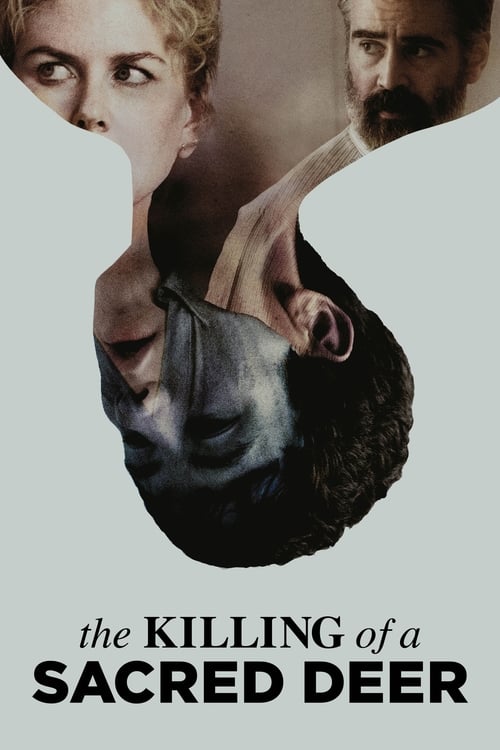
The Killing of a Sacred Deer
2017 · Yorgos Lanthimos
The Greek Weird Wave export who became an awards-season fixture; Poor Things ignited a genuine culture-war argument about whether its sex-positive fable was feminist or a male fantasy. His Emma Stone partnership is treated as the defining actor-director pairing of the decade.
For when you're craving something genuinely disturbing and strange — a challenge, not a comfort — the kind of film you watch through your fingers and can't stop thinking about for days.
What it's about
A celebrated heart surgeon has the immaculate life — the house, the practice, the wife and two kids — and an odd habit of meeting a fatherless teenager named Martin for gifts and diner lunches. As Martin works his way closer to the family, the reason for the doctor's attention surfaces, and the boy calmly presents him with a debt that must be paid. What follows is a domestic nightmare that runs on the merciless logic of an old myth.
The experience
Cold, precise, and deeply unnerving — the deadpan line deliveries are funny until they're terrifying, and the dread ratchets up with almost surgical patience. It gets under your skin and stays there.
Performances
Barry Keoghan is unforgettable as Martin, radiating soft-spoken menace in a breakout turn, with Colin Farrell and Nicole Kidman perfectly pitched as a couple whose control curdles into panic.
The craft
Lanthimos shoots hospital corridors and suburban interiors with slow, looming camera moves and wide lenses that make ordinary spaces feel wrong, while a shrieking, dissonant score keeps your nerves on edge. Its Cannes-winning screenplay commits totally to its flat, ritualistic dialogue — the film's strangest and boldest choice.
Why it matters
It cemented Lanthimos as one of the most distinctive and divisive directors of his generation and became a touchstone of the arthouse-horror wave of the 2010s.
Snapshot
Yorgos Lanthimos's fifth feature transplants the mechanics of Greek tragedy into the sterile corridors of an American hospital and the manicured avenues of suburban Cincinnati. Cardiovascular surgeon Steven Murphy befriends Martin, the teenage son of a patient who died on his operating table, only to find himself subjected to a remorseless logic of substitution: a life must be given for a life. The film operates with the cold inevitability of myth, folding the Euripidean Iphigenia cycle into contemporary domestic space. Shot with wide-angle distortion and spoken in the flat, affectless register that had become Lanthimos's signature, it won the Best Screenplay prize at Cannes 2017 and confirmed him as one of contemporary cinema's most distinctive and polarizing voices.
Industry & Production
The Killing of a Sacred Deer was produced by Element Pictures, the Dublin-based production company led by Ed Guiney and Andrew Lowe, which has been Lanthimos's primary production partner since Dogtooth (2009). Co-financing came from Film4 and the British Film Institute, reflecting the model of UK public arts funding that had supported Lanthimos's English-language transition. A24 acquired North American distribution, continuing their association begun with The Lobster (2015).
The film reunites Lanthimos with Colin Farrell, who starred in The Lobster, and pairs him with Nicole Kidman, then at the peak of a late-career resurgence that included Big Little Lies and Lion. The casting of Barry Keoghan as Martin — a then-relatively-unknown Irish actor who had appeared in Christopher Nolan's Dunkirk the same summer — proved a defining creative decision whose ramifications would extend well beyond this film. Production took place in Cincinnati, Ohio, a city whose unremarkable suburban geography and imposing hospital architecture supplied what the film required: a setting simultaneously quotidian and uncanny, American enough to feel universal while remaining free of specific metropolitan associations.
Technology
The film was shot digitally by cinematographer Thimios Bakatakis. No proprietary or experimental technology was deployed; the film's visual power derives from lens choice, staging, and spatial control rather than technological novelty. Wide-angle and ultra-wide-angle lenses — some reportedly as short as 14mm — were used extensively, producing the characteristic spatial distortion: stretched corridors, slightly convex surfaces, a world that looks recognizable while being measurably wrong. The aspect ratio of 1.85:1 keeps compositions contained and slightly airless rather than widescreen-expansive. The medium is the message: the digital image's hyper-legibility renders its clinical subjects with an unsparing clarity.
Technique
Cinematography
Bakatakis and Lanthimos employ a visual strategy best described as institutional alienation. The camera moves through spaces — hospital corridors, underground car parks, suburban dining rooms — with a deliberate, unhurried tracking motion that refuses subjective alignment with any character. Low-angle setups recur, looking up at figures in ways that make the familiar subtly wrong. Symmetrical framings recall Kubrick — the corridor tracking shots specifically echo The Shining and Eyes Wide Shut — but are deployed more sparingly, erupting at moments of maximum dread. Lighting is clinical and largely shadowless in medical spaces; in the Murphy home it is slightly warmer but equally immaculate. There is almost no handheld photography. The camera's implacable steadiness is the film's first formal argument: what is coming cannot be shaken loose.
Editing
Yorgos Mavropsaridis, Lanthimos's regular editor, cuts in a rhythm that mirrors the script's own quality of metronomic forward motion. Scenes end where conventional drama would extend them — the lingering shot, the extended aftermath, the beat of processing: all are denied. The pacing is neither fast nor slow but relentless, building dread not through montage acceleration but through the cumulative sense that each scene advances an equation that will be solved regardless of the characters' wishes or the viewer's endurance.
Mise-en-scène / Staging
The Murphy household is immaculate to the point of unreality: every surface clean, every room proportioned as if for an architectural shoot. Lanthimos stages interactions within this space with formal severity. Characters sit opposite one another across tables, occupy opposing ends of rooms, deliver speech in straight lines. Physical contact is perfunctory or strangely performative. This staging discipline extends to the hospital, which operates under an identical regime of arranged tableaux. When the domestic order begins to fracture — when the children lose the use of their legs — the formal staging cannot and does not relent. The compositions maintain their propriety. This is the source of horror: the form refuses to register the catastrophe it presents.
Sound
Rather than commissioning an original score, Lanthimos compiled a soundtrack from existing classical works. Franz Schubert's String Quintet in C major (D. 956) appears at pivotal moments; written in the year of Schubert's death, its searching, elegiac quality lends the proceedings a quality of predestined grief. Bach features throughout, and choral sacred music is deployed at moments where ironic religious resonance is sought. Otherwise the sound design is minimal and precise: footsteps on linoleum, the particular silence of sealed suburban interiors. The absence of conventional underscore in many scenes forces attendance to silence and to the peculiar cadences of the dialogue, which are themselves a form of sonic uncanniness.
Performance
The Lanthimos performance style has been extensively documented since Dogtooth: actors deliver lines in a carefully constrained flat affect, avoiding the naturalistic peaks and valleys of conventional screen performance. Speech is deliberate and evenly cadenced, responses slightly delayed, humor flat and untethered from social context. In Sacred Deer this approach does specific and differentiated work across the cast.
Colin Farrell — a performer associated with expressive emotional intensity — is here deliberately contained, his Steven Murphy inhabiting his skin with a quality of moral blankness that the film invites the audience to read as guilt compressed beneath professional competence. Nicole Kidman's Anna Murphy brings controlled unease to her complicity; the quietness of her final capitulation is more disturbing than visible anguish would be. Barry Keoghan's Martin is the film's dominant performance and its strangest achievement. His unblinking, patient delivery — the sense of a person who possesses the advantage of knowing the story's end — makes him terrifying in a register that owes nothing to conventional horror acting. He does not threaten; he explains. Alicia Silverstone appears briefly as Martin's mother, deployed for tonal counterpoint: a flash of ordinary maternal warmth that makes the surrounding affect all the more alien. The unified performance world means that the absence of naturalistic emotion reads not as stylization but as revelation — as the way people actually inhabit themselves when concealment has become reflexive.
Narrative & Dramatic Mode
The film's mythic underpinning is transparent and deliberate. In Euripides' Iphigenia at Aulis and its sources, Agamemnon kills a deer sacred to Artemis and is subsequently required to sacrifice his daughter so the Greek fleet may sail to Troy. Lanthimos and Filippou map this structure onto a contemporary moral scenario: a surgeon's operative failure results in a patient's death, and the dead man's son arrives to collect the debt. The logic is arithmetical — one death requires one death — and cannot be negotiated or deferred.
The film operates in a mode of tragic determinism: the audience understands the endpoint before the characters fully do, and the drama consists not of suspense about outcome but of the agonizing delay before the inevitable arrives. Martin does not dissemble about his powers; he describes them precisely and in advance. The film takes his claims seriously, which means it takes the structure of myth seriously — not as supernatural anomaly but as formal necessity. The final scene, in which Steven selects his sacrifice while blindfolded and spinning with a gun, is horrifying precisely because it is logical. The family has understood and accepted the myth's demand.
Genre & Cycle
The Killing of a Sacred Deer occupies several overlapping categories. As psychological horror it participates in what critics and distributors had begun calling "elevated horror" — art-film productions deploying genre mechanics in the service of formally and thematically ambitious filmmaking. A24's promotional apparatus was central to constructing this category; the film appeared in the same release window as the broader cycle that included It Comes at Night (2017), Hereditary (2018), and Midsommar (2019). It also belongs to the domestic horror tradition, in which home — typically the site of safety — becomes the staging ground for catastrophe. The suburban-medical thriller, reaching back through Coma (1978), provides surface generic scaffolding.
More fundamentally, the film extends a line of Greek myth adaptation that runs from Carl Dreyer through Pasolini (Medea, 1969; Oedipus Rex, 1967) into contemporary European art cinema. It also participates in a cycle of bourgeois-household disruption films, most explicitly recalling Pasolini's Theorem (1968), in which a mysterious visitor systematically dismantles a comfortable family by fulfilling what each member most desires — or, in this case, what justice most demands.
Authorship & Method
Yorgos Lanthimos (born Athens, 1973) developed his practice within the Greek experimental and avant-garde theater scene before his features began receiving sustained international attention with Dogtooth. His method is rigorously auteurist in the sense that thematic and formal concerns — the arbitrariness of social contract, the horror of rule-bound systems, the violence latent within family structure, the flatness of behavioral performance — persist and intensify across his filmography. He is known for giving actors extensive preparation in the delivery style while withholding conventional motivational explanation.
Efthymis Filippou co-wrote Dogtooth, Alps (2011), The Lobster, and The Killing of a Sacred Deer, constituting the most formally distinctive screenwriting partnership in contemporary European art cinema. Filippou's contribution to the schematic dialogue and structural severity of the narratives is widely acknowledged, though the precise internal division of authorship is not documented in the public record. Sacred Deer was the final collaboration between them; Lanthimos subsequently worked with Australian writer Tony McNamara on The Favourite (2018) and Poor Things (2023), producing films that retained formal control while modulating toward a darker-comic register.
Thimios Bakatakis (cinematographer) brings to the film the same unnerving spatial intelligence displayed in Dogtooth and The Lobster: a camera that expresses no subjective distress yet renders everything measurably wrong.
Yorgos Mavropsaridis (editor) is Lanthimos's long-term editorial collaborator. His contribution to the film's implacable rhythm — the refusal of extension, the denial of relief — is structural rather than decorative.
Movement / National Cinema
Although The Killing of a Sacred Deer is a British-Irish co-production set and filmed in the United States, Lanthimos's work is invariably situated within the Greek Weird Wave, the loose international grouping of filmmakers who emerged around 2009–2015 and who share a concern with defamiliarized domestic space, arbitrary social codes, and non-naturalistic performance. Core figures alongside Lanthimos include Athina Rachel Tsangari (Attenberg, 2010; Chevalier, 2015) and Babis Makridis (L, 2012; Pity, 2018). The movement carried no manifesto, and its participants have not always welcomed the grouping, but the formal and thematic convergences are substantial enough that it functions as a useful critical frame. By 2017 Lanthimos had migrated fully into the English-language art-film sphere — a trajectory followed by other Greek Weird Wave directors — while the sensibility remained identifiably continuous with his Greek-language work.
Era / Period
The film belongs to the mid-2010s moment of prestige art horror, a cycle enabled by A24's distribution infrastructure, by streaming platforms' willingness to fund challenging work, and by a cultural context in which horror had regained serious critical respectability after decades of genre marginalization. The 2017–2019 window produced an unusually concentrated run of formally ambitious horror films, and The Killing of a Sacred Deer occupies the myth-inflected, austere end of that cluster.
It is also a product of the post-2008 era's sustained cultural anxiety about professional-class concealment: the impeccable household that is secretly rotten, the confident expert whose competence has failed catastrophically and who cannot speak the truth of it. In this sense the film's suburb — sealed, prosperous, morally insolvent — is as historically specific as it is archetypally timeless.
Themes
Guilt and substitution: The film's governing logic is sacrificial economics. A life redeems a life, and the guilty party must choose which. Steven's inability to confess or accept responsibility is presented not as individual villainy but as a systemic feature of professional-class self-protection. Martin does not punish negligence; he enforces a law older than professional codes of conduct.
The violence of family structure: As in Dogtooth and The Lobster, the family here is a system in which members are ultimately fungible, their loyalty contingent on survival pressure. The final lottery — parent spinning with a weapon, children and spouse prostrate — literalizes what the rest of the film has been demonstrating: the family as a closed system under ultimate stress, revealing that its bonds were always conditional.
Myth as operative logic: The film proposes that myth is not metaphor but mechanism. Martin's threat functions not necessarily because he possesses supernatural powers — the film maintains careful ambiguity — but because the mythic structure he invokes is formally coherent. The logic is self-fulfilling: guilt requires expiation, and the expiation must mirror the wound.
Complicity and accommodation: Anna Murphy's trajectory is carefully constructed. She adapts to Martin, to the logic of sacrifice, with a quietness more disturbing than resistance would be. The film implies that the family's cohesion has always required the management of unspeakable knowledge; the arrival of myth simply makes the management explicit.
Medical authority at its limit: The hospital is the film's natural habitat because medicine is among modernity's most confident systems — it promises competence, protocol, the administration of death. The film places this authority in direct confrontation with a logic it cannot diagnose, treat, or discharge.
Reception, Canon & Influence
Critical reception: The film premiered at Cannes in May 2017 and won the Best Screenplay prize for Lanthimos and Filippou. Reviews were strong but consistently noted its difficulty — the coldness of affect, the refusal of cathartic release, and the film's final logic generated both admiration and resistance. Barry Keoghan's performance was singled out almost universally. The film sits at the serious end of the Lanthimos reception spectrum, generally ranked alongside or slightly below Dogtooth and The Lobster among his canonical works.
Influences on the film (backward): The debt to Michael Haneke is structural and explicit: the implacable dismantling of bourgeois domestic order, the refusal of cathartic release, and the implication that the audience's sustained engagement is itself morally implicating all recall Funny Games (1997/2007), Caché (2005), and The White Ribbon (2009). Stanley Kubrick is the most frequently cited visual precedent: the symmetrical corridor tracking, the institutional coldness, the wide-angle deformation of domestic space recall The Shining and Eyes Wide Shut with evident deliberateness. Robert Bresson's elliptical approach to performance and his systematic stripping of psychological interiority provided, by Lanthimos's own account in various interviews, a foundational model. Pasolini's Theorem offers the closest structural parallel — a mysterious intruder who systematically undoes a prosperous household by exposing what it has suppressed. The film also draws directly on Lanthimos's own prior practice, particularly Dogtooth's architectured domestic horror.
Legacy and forward influence (forward): Sacred Deer consolidated Lanthimos's position as a filmmaker of international canonical significance just before The Favourite substantially broadened his audience. Barry Keoghan's performance constitutes one of the decade's defining screen breakthroughs, directly enabling his central roles in The Banshees of Inisherin (2022), Saltburn (2023), and Bird (2024); the controlled, unsettling quality he deploys in those films is recognizably continuous with what he developed here. The film contributed to the critical infrastructure of "elevated horror" as a distribution and marketing category, providing a formal benchmark against which subsequent art-horror films have been measured. Within Lanthimos's own filmography it stands as the most concentrated expression of the Filippou-era aesthetic — the point at which formal severity and mythic structure achieved maximum integration — and its influence on his subsequent McNamara-era work is traceable even as the tonal register shifted decisively toward dark comedy and historical spectacle.
A Deleuzian reading
Steven Murphy ties a cloth over his eyes, picks up a rifle, and turns in a slow circle in his own living room.
The full Deleuzian reading of The Killing of a Sacred Deer →
Reception
It split Cannes 2017 down the middle — walkouts and raves in equal measure, with plenty dismissing it as cruelty for cruelty's sake — but as Lanthimos went mainstream with The Favourite and Poor Things, it's been re-embraced as maybe his most uncompromising film, and Barry Keoghan's Saltburn-era stardom sent a whole new wave back to it.
How The Killing of a Sacred Deer was received, from release to now →
Influences: the films it descends from and the films it influenced
- Teorema (1968) — Pasolini's narrative template of a silent, inexplicable intruder who destabilizes each member of a bourgeois family through contact — exposing suppressed guilt until the household is destroyed — provides Sacred Deer its direct mythic and structural blueprint.
- Pickpocket (1959) — Bresson's rehearsal system of stripping expressive delivery — actors trained to produce line readings as behavioral acts divorced from psychological motivation — is the explicit model Lanthimos cites for Sacred Deer's flat-affect performance method.
- The Shining (1980) — Kubrick's symmetrical wide-angle Steadicam tracking through institutional corridors — converting domestic architecture into threatening geometry through lens distortion — is replicated in Sacred Deer's hospital sequences with evident deliberateness.
- Eyes Wide Shut (1999) — The compiled classical score strategy — licensing Schubert, Ligeti, and period compositions rather than commissioning original music — and wide-angle cold deformation of affluent interiors pass directly into Sacred Deer's sonic and visual grammar.
- Funny Games (1997) — Haneke's implacable architecture of bourgeois household destruction that refuses cathartic release while implicating the viewer's sustained engagement as complicity provided Lanthimos the moral and formal structure Sacred Deer intensifies through mythic determinism.
- Caché (2005) — Caché's returning-guilt mechanism — a bourgeois professional's suppressed culpability materializing as an external force that dismantles domestic order without resolution — is the nearest narrative-mechanical predecessor to Sacred Deer's debt-and-retribution engine.
- The White Ribbon (2009) — Haneke's metronomic pacing, institutionally cold wide framing, and structure of collective guilt processed as classical tragedy — punishment before explanation, doom before understanding — directly calibrate Sacred Deer's temporal and moral register.
- Dogtooth (2009) — Sacred Deer inherits the complete Filippou-Lanthimos formal system first crystallized here: schematic dialogue delivered as behavioral rule, flat-affect ensemble performance trained through deliberate withholding of motivation, and the family unit as hermetically closed horror system.
- The Lobster (2015) — The Lobster and Sacred Deer constitute the two poles of the Filippou collaboration's formal range: both deploy flat-affect delivery, symmetrical widescreen staging, and rule-bound narrative logic, with Sacred Deer abandoning absurdist register for pure tragic severity.
- Birth (2004) — An affectless boy enters a wealthy household and states an irrational proposition that the adults' good manners cannot dispel — Carrière's Buñuelian surface routed through Birth — with pre-existing choral and classical music dropped in as intrusive blocks.
- The Favourite (2018) — The Favourite is the first post-Filippou test of Sacred Deer's grammar: Lanthimos retains wide-angle distortion and institutional symmetry while replacing flat-affect performance with grotesque expressivity, revealing which elements of the system were collaborative and which authorial.
- Hereditary (2018) — Aster's debut crystallized elevated horror as a critical category partly by extending Sacred Deer's structural principle: tragic determinism, inescapable familial doom, and formal severity as the register for mythic inevitability rather than visceral shock.
- Saint Maud (2019) — Glass deploys Sacred Deer's metronomic editing rhythm and tragic determinism as structural grammar — building doom through spatial and temporal regularity rather than shock, inheriting the formal discipline Sacred Deer established as the elevated horror benchmark.
- The Banshees of Inisherin (2022) — Keoghan's Oscar-nominated performance carries the specific behavioral register developed as Martin in Sacred Deer — uncanny stillness beneath apparently sincere delivery, menace indistinguishable from innocence — directly enabling McDonagh's casting of him against type.
- Saltburn (2023) — Fennell's bourgeois-household-intruder narrative is structurally built around Keoghan's Sacred Deer-developed performance vocabulary: the controlled, unsettling flatness that renders Oliver's menace indistinguishable from earnestness until destruction is complete.
- Bugonia (2025) — First prominent Yorgos Mavropsaridis editing collaboration, establishing the clinical temporal rhythm — extended pauses, withheld cuts — that inflects Bugonia; Bakatakis wide-angle distortion pushed into horror register with systematically suppressed emotional affect.
- Alps (2011) — Alps advances the specific Filippou-era technique of scripted speech as behavioral protocol — characters delivering lines as role-compliance rather than expressive communication — that Sacred Deer carries to its terminal mythic clarity.
- Force Majeure (2014) — Östlund independently deploys the same formal vocabulary — metronomic pacing, symmetrically staged wide framings, performance as social mask — in a cold dissection of bourgeois family self-exposure under existential pressure, demonstrating a convergent pan-European formal development.
- The Menu (2022) — Lanthimos's enclosed-fate-acceptance structure — characters submitting to an inexorable social logic of retributive punishment they cannot escape, performed with deadpan precision — directly anticipates The Menu's finale, in which dinner guests accept their deaths within the ritual logic of the meal without breaking the decorum of the occasion.
- Poor Things (2023) — Lanthimos and his collaborators' Kubrick-derived method of displacing canonical sacred or classical music (Handel, Schubert) into scenes where its formal authority creates tonal rupture rather than emotional correspondence — a strategy carried forward into the commissioning of Jerskin Fendrix's deliberately unsettled orchestration.
- Gone Girl (2014) — Shares the locked, symmetrical composition and clinical ambient dread deployed against a bourgeois family, treating marriage and domesticity with the same affectless surveillance gaze.
- mother! (2017) — Frames a home invasion as a merciless mythic parable in which an intruder methodically dismantles a family per an allegorical logic, deadpan and punishing rather than psychologically naturalistic.
- Enemy (2013) — Clinical wide-angle corridor tracking through hospital-modernist geometry with abrasive scored strings and no causal explanation offered — the same substitution of engineered atmosphere for narrative incident.
- Good Boy (2026) — Gliding wide-lens Steadicam down domestic corridors paired with affectless delivery of monstrous propositions is the precise tonal instrument the film uses for its basement negotiations — the resemblance critics reach for first.
Similar films
- Dogtooth (2009) — influence & lineage
- The Lobster (2015) — influence & lineage
- Funny Games (1997) — influence & lineage
- The Favourite (2018) — influence & lineage
- Hereditary (2018) — influence & lineage
- The White Ribbon (2009) — influence & lineage
- The Banshees of Inisherin (2022) — influence & lineage
- Bugonia (2025) — same viewing thread
All the films related to The Killing of a Sacred Deer →
Watch it with: curated runs of related films
- Whatever's Wearing That Face — A run of horror-thrillers where the real terror is that you can't trust what a person appears to be — a double, a shapeshifter, a smiling stranger, the one you desire.