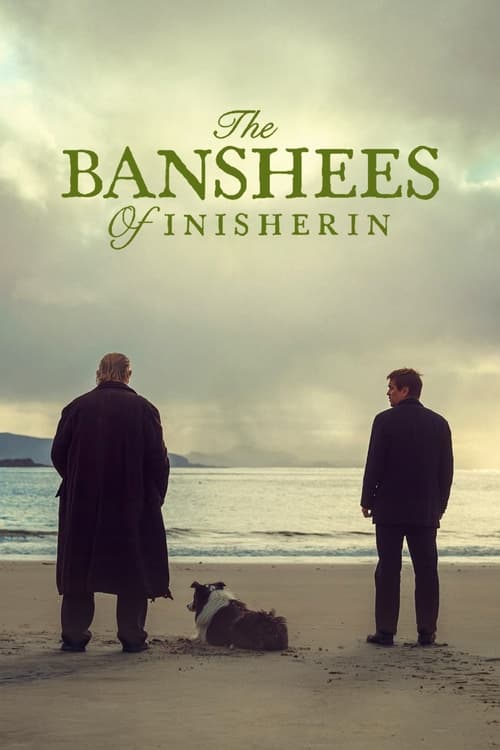
The Banshees of Inisherin
2022 · Martin McDonagh
For when you want to laugh hard and then sit with something sad and true about friendship, loneliness, and pride. A cozy-looking film that leaves a mark — comfort on the surface, challenge underneath.
What it's about
On a small Irish island in 1923, with the Civil War rumbling faintly across the water, the amiable farmer Pádraic is told by his lifelong best friend Colm that he simply doesn't want to talk to him anymore. Colm would rather spend his remaining years writing fiddle music that might outlast him than waste another afternoon on pleasant chat. Pádraic can't accept it — and his refusal to let go sets off an escalation neither man can stop.
The experience
It starts as one of the funniest films of its year — dry, absurd, perfectly timed — and then, almost without you noticing, becomes quietly devastating. The laughs and the ache arrive in the same scenes by the end.
Performances
Colin Farrell does career-best work as the sweet, wounded Pádraic, opposite Brendan Gleeson's granite stubbornness; Kerry Condon and Barry Keoghan steal scenes around them. Four performances, not a weak link.
The craft
Martin McDonagh's dialogue is the star — every exchange lands like a joke and a knife at once — set against windswept island landscapes shot with storybook beauty and a mournful, folk-tinged score. The way it shifts register from comedy of manners to something like Greek tragedy is masterful screenwriting.
Why it matters
A major awards-season force that confirmed McDonagh's stature and gave Farrell and Gleeson one of the most beloved screen pairings of the decade.
Snapshot
Set on the fictional Irish island of Inisherin in 1923 — against the distant, barely audible sounds of the Irish Civil War — The Banshees of Inisherin concerns the sudden, unexplained dissolution of a friendship between two middle-aged men. Pádraic Súilleabháin (Colin Farrell), a good-natured farmer, is informed by his longtime companion Colm Doherty (Brendan Gleeson) that he simply no longer wishes to spend time together. Colm's stated motive is a dread of wasted time: he wants to devote his remaining years to composing fiddle music that will outlast him. What follows is a slow escalation of grievance, self-mutilation, and retaliatory destruction that transforms a domestic comedy of manners into something approaching Greek tragedy — or, more precisely, something approaching Beckett. McDonagh fuses the inheritance of Irish theatrical tragicomedy with European art cinema's interest in existential impasse to produce a film that is simultaneously very funny and genuinely desolating. It is widely regarded as his masterwork.
Industry & production
Banshees was produced by Blueprint Pictures, the London-based company run by Graham Broadbent and Pete Czernin, who have been McDonagh's producing partners since In Bruges (2008). Searchlight Pictures financed and distributed the film internationally, with Film4 (UK) and Element Pictures (Ireland) as co-producers; Irish Screen Funding bodies including Screen Ireland provided additional support. The project thus sits within the transatlantic arthouse pipeline that Searchlight has maintained for prestige-adjacent work, comparable in its financing structure to the company's backing of Yorgos Lanthimos and Wes Anderson productions.
McDonagh had reportedly been developing the screenplay for several years. The fictional island of Inisherin — combining placename elements from the real Aran Islands — had existed in his imagination since at least the early 2000s, when he was working on a planned stage trilogy of island plays that was never completed as such. The Cripple of Inishmaan (staged 1997, set on Inis Meáin) was the only island play produced for theater; the film reclaims and expands the imaginative geography. Principal photography took place on Inis Mór (Inis Mhór), the largest of the Aran Islands, and on Achill Island in Co. Mayo — the two locations composited into a single fictional topography. Filming wrapped in autumn 2021 and the film premiered in competition at the Venice Film Festival in September 2022, where McDonagh won Best Screenplay and Farrell won the Volpi Cup for Best Actor.
The film earned nine Academy Award nominations — including Best Picture, Best Director, Best Actor (Farrell), Best Supporting Actor (Barry Keoghan), Best Supporting Actress (Kerry Condon), and Best Original Screenplay — though it won none of the major categories. It performed strongly in awards-circuit releases in the UK, Ireland, and North America, becoming one of the best-reviewed films of 2022 across all platforms.
Technology
Banshees was shot digitally by Ben Davis, BSC. Davis captured the film on the ARRI Alexa LF (Large Format), a sensor platform well suited to the expansive Atlantic landscapes and to the shallow-focus portraiture the film demands in its interior scenes. The LF sensor's extended dynamic range proved particularly useful in managing the extreme contrast between overcast Irish skies and dark stone interiors — a persistent challenge on the Aran Islands, where light changes rapidly and the architecture is built from gray limestone. Color grading maintained a cool, desaturated palette anchored in Atlantic greens and stone grays, with firelit interior warmth reserved for scenes of momentary human connection. Specific lens choices and DI finishing details have not been extensively documented in publicly available crew interviews at the time of writing.
Technique
Cinematography
Davis's work is the film's primary visual argument. Wide-angle establishing shots of the island's western cliffs, of stone walls running to the sea, and of sky occupying two-thirds of the frame situate the characters within a landscape that dwarfs and indifferent to their quarrel — an implicit visual rhyme with the allegorized Civil War across the water. Interiors — the pub, Pádraic's cottage, Colm's house — are shot with a tighter, more claustrophobic field of view, often picking faces out of dark backgrounds. Davis constructs a recurring formal grammar of two-shots that place characters in profile or near-profile, separated by negative space, reinforcing the theme of proximity-without-connection. The donkey Jenny receives the same careful compositional attention as the human leads, which is not a directorial accident.
Editing
Mikkel E.G. Nielsen, who edited Sound of Metal (Darius Marder, 2019) and has a long relationship with Nicolas Winding Refn, cut the film. Nielsen's approach is patient and theatrical: scenes are allowed to play out to their full dramatic duration rather than being trimmed for pace, and transitions favour hard cuts that respect scene-level beats. The editing's most distinctive quality is its willingness to hold on reaction — particularly Farrell's face — after a line lands, letting silence and held gaze carry dramatic weight that would otherwise require underscoring.
Mise-en-scène / staging
McDonagh's theatrical background — he is primarily a playwright — makes the staging unusually stage-conscious. Many scenes have a strong sense of fixed positions and choreographed movement within bounded spaces: the pub booth, the cottage threshold, the road between farms. Characters repeatedly occupy the same spatial relationships, and deviations from these patterns register as violations. The island itself functions as a set in the theatrical sense: its smallness (characters cannot avoid encountering one another) is a spatial device for forcing dramatic confrontation. Mrs. McCormick (Sheila Flitton), the aged woman who haunts the film's edges with prophetic remarks about death, is staged as a formal figure — she appears at margins and disappears without explanation, operating in a different theatrical register from the naturalistic domestic scenes.
Sound
Carter Burwell's score is among the most precisely calibrated of his career — which, given his decades-long collaboration with the Coen Brothers, is a high bar. He employs traditional Irish instrumentation (fiddle, Uilleann pipes, low strings) but avoids pastiche, building cues from modal harmonies that suggest folk music while remaining compositionally original. Diegetic music — Colm playing fiddle, whether in practice or before the pub audience — is treated with documentary care and becomes narratively load-bearing: the difference between music heard through a wall and music heard in the same room marks shifts in the friendship's status. The Civil War is represented almost entirely in sound rather than image: the faint percussion of distant cannon fire arrives across the water as an atmospheric constant, grounding the personal drama in historical catastrophe without ever depicting it directly.
Performance
Farrell's performance is the film's emotional engine. He inhabits Pádraic's fundamental decency with complete conviction, and the performance's difficult trick — making a man who is, by Colm's own testimony, dull and limited into a genuinely sympathetic figure — is accomplished through minute physical expressiveness rather than explication. The scene in which Pádraic confronts Colm in the pub after the first act of self-mutilation is among the finest sustained acting work of Farrell's career. Gleeson matches him with a performance of controlled withdrawal: Colm's cruelty is rendered not as malice but as a kind of terrible resolve, a man who has decided to spend his remaining time well and finds sentiment an obstacle. Keoghan's Dominic — a young man whose degraded home life puts Pádraic's problems in uncomfortable relief — is played at a different register, closer to tragicomic grotesque, and anchors the film's darkest tonal corner. Condon's Siobhán, Pádraic's sister, functions as the film's clearest-eyed observer and its structural conscience.
Narrative & dramatic mode
The narrative operates by accumulation of incident within a deliberately constricted geography. McDonagh declines the traditional three-act arc in favour of a rhythm closer to theatrical acts: a situation introduced, escalated, and finally pushed past recovery. The film's central formal paradox is that its inciting event — "I just don't like you any more" — is essentially incommensurable with the consequences it produces, and that incommensurability is the dramatic subject. Colm's ultimatum escalates to self-mutilation; Pádraic's response escalates to arson; both escalations are internally logical and externally absurd. This structure of disproportionate cause and consequence is recognizably Beckettian: it describes a universe in which human actions have weight but not meaning, and in which waiting for resolution is itself a form of action. The film ends in a state of damaged equilibrium rather than resolution — the island remains, the Civil War ends off-screen, the two men have destroyed each other to a draw.
Genre & cycle
Banshees occupies the sub-genre of rural Irish tragicomedy that runs from Synge through the plays of Brian Friel and Tom Murphy to contemporary screen work like The Guard (John Michael McDonagh, 2011). It participates in a broader early-2020s cycle of prestige arthouse films centered on male friendship, irreversibility, and grief — a loose cluster that includes Charlotte Wells's Aftersun (2022) and Todd Field's Tár (2022), all three released in the same awards season — though the resemblance in these cases is likely coincidental rather than intertextual. The film's allegorical frame (the island quarrel as Civil War, the war as any unresolvable partition) places it within a tradition of Irish films that use local particularity to address national trauma: The Wind That Shakes the Barley (Ken Loach, 2006), Calvary (John Michael McDonagh, 2014), and, in a different key, The Crying Game (Neil Jordan, 1992).
Authorship & method
Martin McDonagh is a London-born writer-director of Irish descent whose primary formation was as a playwright. His Leenane Trilogy (The Beauty Queen of Leenane, A Skull in Connemara, The Lonesome West, all 1996–97) established him as a major voice in late-twentieth-century Irish drama, and his subsequent plays — including The Pillowman (2003) and Hangmen (2015) — consolidated a reputation for formally rigorous dark comedy inflected with sudden violence. His film career began with Six Shooter (2004, Academy Award, Best Live Action Short), followed by In Bruges (2008), Seven Psychopaths (2012), and Three Billboards Outside Ebbing, Missouri (2017). Banshees represents a return to Irish subject matter and to McDonagh's theatrical roots after two American-set films.
Ben Davis, BSC, is a British cinematographer with wide-ranging studio and arthouse credits (Kick-Ass, the MCU's Doctor Strange and Avengers: Age of Ultron, as well as the smaller-scale Belfast (Kenneth Branagh, 2021), shot in black-and-white). His work on Banshees demonstrates a range that his studio credits can obscure. Carter Burwell has collaborated with the Coen Brothers on virtually every film from Blood Simple (1984) forward, a relationship that has produced some of the most distinctive film music of the last four decades; his independent credits include Todd Haynes's Carol (2015) and Rob Reiner's Misery (1990). Mikkel E.G. Nielsen's previous features skew toward atmospheric immersion (Only God Forgives, Refn, 2013; Sound of Metal, Marder, 2019), and his patience with silence and diegetic sound shapes Banshees's restraint in significant ways.
Movement / national cinema
The film belongs simultaneously to Irish national cinema and to transnational arthouse production. Its funding structure — co-production between British, Irish, and American entities — is emblematic of how contemporary Irish film is made: dependent on international capital while committed to distinctly local subject matter. The landscape photography of Inis Mór places it in a tradition of films that treat the western Irish seaboard as a site of existential significance, a tradition that reaches back to Robert Flaherty's Man of Aran (1934) and runs through various documentary and fiction films set on or near the Aran Islands. It also participates in a minor renaissance of ambitious Irish fiction filmmaking in the early 2020s — a cycle that includes Belfast (Branagh, 2021), The Quiet Girl (An Cailín Ciúin, Colm Bairéad, 2022), and Aftersun (Wells, though Scottish-set) — and in the broader phenomenon of Irish stage writers moving into film with theatrical sensibilities intact.
Era / period
The film is set in 1923 and released in 2022. The historical setting — the final months of the Irish Civil War — is not merely backdrop; it provides the film's allegorical architecture. The Civil War (June 1922 – May 1923), fought between pro-Treaty Free State forces and anti-Treaty IRA, was the formative trauma of independent Ireland, a fratricide that produced decades of political division and cultural repression. McDonagh uses the conflict's auditory presence (cannon fire) to suggest that the island quarrel is the macro-conflict at human scale: two men who cannot reconcile, destroying what they share rather than yield. The fact that the war ends — off-screen, mentioned in a single line — and changes nothing in the island dynamic is one of the film's bleakest jokes. Released into a post-Brexit Ireland still processing the border question and into a global moment of acute polarization, the allegory found immediate resonance, though McDonagh has been characteristically reluctant to over-specify its target.
Themes
The film's governing theme is the terror of insignificance — specifically, Colm's conviction that a life spent in idle sociability will leave no mark, and that art (his fiddle composition, titled The Banshees of Inisherin) is the only available answer to mortality. This belief drives him to sacrifice the friendship and, eventually, his fingers, in a gesture that the film regards simultaneously as heroic and monstrous. Against this is set Pádraic's counter-conviction that ordinary human goodness — being nice, feeding a donkey, maintaining friendships — is sufficient, and the film refuses to adjudicate cleanly between them. The question is whether a minor artist's minor legacy justifies cruelty to the living, and the film answers: probably not, but the living are not thereby innocent.
Secondary themes include: rural insularity and its discontents (the island as a closed system that amplifies grievance beyond any proportionate cause); the relationship between political and personal violence (the Civil War); loneliness as a structural condition of island life and of middle-age more broadly; and the Irish cultural habit — dramatized also in Synge, in Flann O'Brien, in Patrick Kavanagh — of finding transcendence and horror in the banal.
Reception, canon & influence
Critical reception. The film premiered to near-universal critical acclaim at Venice 2022, where it was considered a frontrunner for the Golden Lion (which went to All the Beauty and the Bloodshed, Laura Poitras). Reviews consistently identified McDonagh's screenplay as the work's primary achievement, while Farrell's performance was cited as a career redefinition for an actor long associated with star vehicles rather than character work. A small counter-current of critical opinion found the Civil War allegory overly schematic, but this position remained minority. The film entered the Metacritic top-tier with a score in the high 80s and was named among the year's best films by a majority of major critics' circles.
Influences on the film (backward). Samuel Beckett is the most palpable literary ancestor: the structure of Waiting for Godot — two men, a bounded space, waiting for something that will not redeem them — shadows Banshees throughout, as does Beckett's Irish-inflected absurdism. John Millington Synge's The Aran Islands (1907, prose memoir) and The Playboy of the Western World (1907) establish the island as a site of dark comedy and violence; McDonagh has acknowledged Synge's influence on his theatrical work generally. John Ford's The Quiet Man (1952), the great pastoral fantasy of rural Ireland, is an implicit visual reference that Banshees systematically undercuts — the same landscape, the same male conflict, the same stone walls, but with Ford's romantic resolution replaced by ash and severed fingers. The Coen Brothers — Burwell's presence reinforces this — are a formal influence on McDonagh's sense of how violence can be deployed comedically without becoming trivial. Ingmar Bergman's late films about solitude and the failure of human connection (Scenes from a Marriage, Autumn Sonata) are a less-discussed but plausible reference for the film's interest in the slow erosion of intimacy.
Legacy and influence (forward). It is too early to assess the film's downstream influence with confidence, given its 2022 release. What can be said: it substantially elevated Farrell's standing as a serious actor and contributed to renewed critical attention to his earlier career; it consolidated McDonagh's position as a major auteur rather than a talented genre provocateur; and it helped sustain international interest in Irish national cinema at a moment of unusual ambition. Whether it produces a visible influence on narrative filmmaking will take another decade to determine. Its aesthetic and thematic concerns — rural landscape, allegorical violence, the problem of art and legacy — are sufficiently distinctive that imitations are likely to be recognizable. It stands, as of writing, as one of the defining arthouse releases of the early 2020s, and its place in the canon of Irish cinema appears secure.
A Deleuzian reading
The camera holds on Colin Farrell's face a beat too long.
The full Deleuzian reading of The Banshees of Inisherin →
Reception
An instant awards darling out of Venice 2022, it then went a famous 0-for-9 at the Oscars — and that shutout only cemented its 'robbed' underdog status; it's since settled in as one of the decade's most beloved tragicomedies.
How The Banshees of Inisherin was received, from release to now →
Influences: the films it descends from and the films it influenced
- The Quiet Man (1952) — McDonagh and Davis systematically cite then invert Ford's visual grammar: identical Connemara stone-wall locations, the same two-shot staging of male rivalry across low walls, but Ford's pastoral resolution of masculine conflict replaced by severed fingers and ash — a deliberate deconstruction of a specific, named visual inheritance.
- Fargo (1996) — Carter Burwell scored both films using the same compositional logic — sparse melodic lines that signal tragic events as darkly absurd rather than devastating — teaching McDonagh the sonic method for holding comedy and irreversible grief in simultaneous suspension without collapsing either register.
- Scenes from a Marriage (1973) — Bergman's architecture of the two-person dialogue scene as primary dramatic unit — held on reaction shots that track emotional withdrawal across years of failed intimacy — is the direct formal model for *Banshees*'s pub confrontations and their long silences after refusal.
- Autumn Sonata (1978) — The confrontational two-hander staging decades of suppressed grievance through a single claustrophobic encounter; Ullmann's controlled withdrawal as the film's primary dramatic instrument is the performance mode Colin Farrell adapts for Pádraic's uncomprehending stillness in the face of Colm's absolute refusal.
- Who's Afraid of Virginia Woolf? (1966) — Nichols adapting Albee established the playwright-to-screen transposition method *Banshees* inherits: preserving theatrical act rhythm marked by tonal ruptures, using the single night as container for irreversible relational destruction, and treating dialogue itself as the weapon rather than a vehicle for exposition.
- The Field (1990) — Rural Irish male obsession rendered as existential proposition rather than psychological case study; the Connaught landscape photographed as moral argument — land as the thing a man will destroy himself to hold — which *Banshees* both inherits and darkly parodies through Colm's substitution of creative legacy for Bull McCabe's territorial stubbornness.
- No Country for Old Men (2007) — Negative-space two-shot staging in spare landscapes where one figure dominates and one recedes; the editing's theatrical patience — scenes held through long silences well past social comfort — and the formal discipline of withholding narrative explanation that McDonagh adopts for refusing to rationalize Colm's decision.
- In Bruges (2008) — McDonagh's own preceding film established the playwright-to-location-cinema transposition: theatrical dialogue rhythms carried intact into exterior space, buddy-conflict escalation in a confined European setting, and violence as darkly absurd punchline — the formal prototype *Banshees* refines by stripping away genre genre scaffolding and exposing the Beckettian structure beneath.
- Three Billboards Outside Ebbing, Missouri (2017) — Immediate predecessor that developed McDonagh's theatrical act structure in a rural setting, the Burwell collaboration, controlled performance of rage masking grief (McDormand's template for Farrell), and the mordant irony of irreversible choices made for insufficient reasons — all carried forward with the American register replaced by the Irish.
- The Killing of a Sacred Deer (2017) — Keoghan's Oscar-nominated performance carries the specific behavioral register developed as Martin in Sacred Deer — uncanny stillness beneath apparently sincere delivery, menace indistinguishable from innocence — directly enabling McDonagh's casting of him against type.
- The Lighthouse (2019) — Two men confined on an island where the promised departure never materializes — a Beckettian waiting structure in which escalating physical violence substitutes for the resolution that will not come; island as hermetic theatrical set; performance escalating from controlled withdrawal to full physical expressiveness as the confinement corrodes restraint.
- Belfast (2021) — Ben Davis, BSC, shot both films and developed across them the method of photographing Irish landscape — desaturated, coolly lit — to carry political allegory; offscreen civil violence rendered as ambient soundscape rather than spectacle is the same sonic grammar *Banshees* applies to its mainland gunfire heard across the water.
- The Wind That Shakes the Barley (2006) — The Irish Civil War as structuring offscreen presence that tears apart personal bonds rather than functioning as backdrop; the partition conflict rendered through intimate rural drama set in the West of Ireland — the same allegorical structure *Banshees* deploys as displaced fable rather than social-realist direct address.
- First Reformed (2017) — Still-camera framing with deliberate negative space left around the figure; held reaction shots as the primary performance register, exposing interior crisis through external stillness; theatrical patience in editing — scenes permitted to accumulate duration past comfort until the underlying violence finally surfaces.
- Dogville (2003) — Theatrical spatial grammar taken to its logical extreme — chalk-marked stage outlines replacing walls — making explicit the formal convention *Banshees* deploys naturalistically: the bounded island community as hermetic theatrical set whose spatial rules the audience must accept as premise before the drama can operate.
- Once (2006) — Diegetic Irish folk and traditional music functioning as primary emotional carrier rather than underscore: the song as a narrative event in which a character's interiority is declared outward, the same deployment *Banshees* applies when Colm plays fiddle alone at the cliff edge — the music doing what dialogue refuses to.
Similar films
- In Bruges (2008) — influence & lineage
- The Wind That Shakes the Barley (2006) — influence & lineage
- Three Billboards Outside Ebbing, Missouri (2017) — influence & lineage
- Twinless (2025) — shared sensibility
- The Ballad of Wallis Island (2025) — shared sensibility
- The Quiet Girl (2022) — shared sensibility
- Saltburn (2023) — shared sensibility
- All of Us Strangers (2023) — shared sensibility
All the films related to The Banshees of Inisherin →
Watch it with: curated runs of related films
- Gallows Wit, Unraveling Men — A run of darkly funny character studies where a man decides he's done — with a friendship, a life, a self — and the jokes keep landing right up to the edge; watch them together for how each one lets despair and comedy share the same breath.