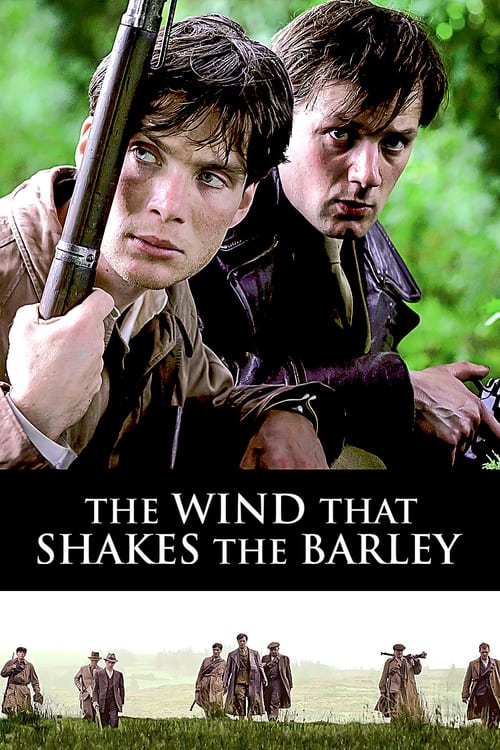
The Wind That Shakes the Barley
2006 · Ken Loach
For when you want a serious, substantial war film that engages your head as much as your gut — something to argue about afterward. Emotionally heavy; not one for a light evening.
What it's about
Ireland, 1920. Damien, a young doctor bound for a London hospital, watches British Black and Tans brutalize his village — and a friend die — and abandons medicine to join the IRA flying column his brother Teddy leads. The two fight side by side through the War of Independence, but when a treaty splits the movement, the question of what the revolution was actually for splits the brothers too.
The experience
Gripping and unsparing — the ambushes are tense and matter-of-fact, the reprisals hard to watch, and the arguments between comrades are staged with as much heat as the gunfights. It's a film that moves you and makes you angry at the same time, and its final stretch lands like a blow.
Performances
Cillian Murphy gives one of his finest early performances as Damien, tracing a gentle man's hardening with terrible clarity, and Pádraic Delaney matches him as Teddy — the brothers' bond feels real enough that watching it fracture genuinely hurts.
The craft
Ken Loach shoots revolution the way he shoots everything: handheld, naturalistic, in real Irish landscapes and soft gray-green light, with debate scenes that play like documentary because the actors are genuinely arguing. Paul Laverty's script gives every faction its best case, which is exactly why the conflict cuts so deep.
Why it matters
Winner of the Palme d'Or at Cannes in 2006 — the crowning honor of Loach's career — and a film that reopened raw arguments in Britain and Ireland about empire and independence.
Snapshot
The Wind That Shakes the Barley is Ken Loach's most widely seen historical film, a drama of the Irish War of Independence (1919–21) and the Civil War (1922–23) told through two brothers whose bond is destroyed by the compromises of national liberation. It won the Palme d'Or at the 2006 Cannes Film Festival, the crowning international recognition of a career that had by then run more than four decades. Working from a script by his long-term collaborator Paul Laverty, Loach uses a small human story — a doctor, Damien O'Donovan (Cillian Murphy), who abandons a London medical post to join the IRA flying column led by his brother Teddy (Pádraic Delaney) — to stage a materialist argument about revolution: that anti-colonial struggle carries within it an unresolved class question, and that when the fighting stops the men who bled together turn on one another over whose freedom the new state will serve. The title comes from Robert Dwyer Joyce's nineteenth-century ballad of the 1798 rebellion, folding the film's events into a longer cycle of Irish insurrection and defeat. It is at once a Loach chamber piece — plainly shot, ensemble-driven, politically explicit — and a tragedy of fratricide that ends with Teddy, now a Free State officer, presiding over Damien's execution.
Industry & production
The film was produced by Rebecca O'Brien through Sixteen Films, the London company that anchors the Loach–Laverty–O'Brien partnership, as a European co-production. Financing came from Bord Scannán na hÉireann / the Irish Film Board together with the UK Film Council and a spread of continental partners across Germany, Italy, Spain and France — the patchwork, publicly-supported model that has sustained Loach's independence from studio pressure for most of his career and that lets his films be made outside the calculus of commercial return. Reported budget figures in the modest single-digit millions of euro circulate, but I would not assert a precise number as established fact.
Production was based in County Cork, in and around the landscapes where much of the historical fighting took place, and the shoot followed Loach's established discipline of filming largely in story order. The picture became a notably strong performer in Irish cinemas, where it connected with a domestic audience for whom the period remains live memory and contested politics; it is frequently described as one of the most successful Irish-set releases of its moment, though I will not attach specific gross figures I cannot verify. Its Cannes victory drove distribution internationally and gave Loach — long a fixture of the festival — his first Palme d'Or.
The film also generated a public quarrel in the British press. Some conservative commentators attacked it before or shortly after Cannes as anti-British, with one widely-cited column drawing an inflammatory comparison to the way Nazi cinema treated its enemies; Loach and Laverty answered these attacks directly, framing the film as an honest reckoning with colonial violence rather than propaganda. The controversy is part of the film's reception history and is well documented.
Technology
This is a conventional 35mm live-action production of its era, made with no interest in technological novelty — consistent with Loach's lifelong suspicion of anything that draws attention to the apparatus. There is essentially no visual-effects work of note, no digital spectacle, and no stylized post-production grade calling attention to itself. What "technology" means here is the deliberate restriction of it: available and naturalistic light, unobtrusive camera support, and a soundscape built from location recording rather than sweetening. The film's period illusion is achieved through production design, costume and landscape rather than through effects, and its realism depends on the camera and recording chain staying as invisible as the craft allows.
Technique
Cinematography
The photography is by Barry Ackroyd, Loach's regular cinematographer of the period, and it exemplifies the house style the two developed: naturalistic light, a muted green-gray palette drawn from the Cork countryside and overcast skies, and a camera that observes rather than dramatizes. Loach and Ackroyd characteristically shoot with longer lenses from a slight remove, so that the camera behaves like a witness catching action already underway rather than a director's instrument staging it for us. Interiors are lit to look as though the light is coming only from windows, lamps or fires; faces are not glamorized. The violence — a raid, a reprisal, an execution — is filmed without the accelerating coverage of action cinema, so that brutality registers as sudden, ugly and quickly over. The landscape is a constant presence, beautiful and indifferent, against which the human cruelty plays out.
Editing
Jonathan Morris, Loach's editor across many films, cuts in the observational manner the shooting method dictates. Because performers often did not have the full script and reacted to events sprung on them, the raw material carries genuine spontaneity, and the editing preserves it — favouring the authentic reaction, letting scenes breathe, resisting the tightening and punching-up that would make the drama feel authored. The overall architecture is chronological and clear: the arc moves from occupation and radicalization, through guerrilla war, to truce, treaty and civil war, with the split between the brothers as the structural hinge. The film's symmetry — a killing of one of their own near the start (the informer among their own ranks) answered by the killing that ends it — is built in the cutting room as much as on the page.
Mise-en-scène / staging
The staging is documentary in feel: cottages, farmyards, hillsides, a rural courtroom, a barracks. Crowds and columns are composed to look like communities and irregular fighters rather than choreographed extras. Loach's celebrated set-pieces here are talk, not combat — above all a scene in which the flying column argues over the meaning of the Democratic Programme of the First Dáil, the men shouting past one another about land, debt, property and whether the Republic they are fighting for will change the ownership of anything. It is staged as a genuine political meeting, cramped and overlapping, and it is the film's ideological engine. The period is dressed with restraint; there is no antiquarian gloss.
Sound
The sound is location-based and understated, dominated by wind, rain, birdsong and the flat report of gunfire in open country rather than by score. George Fenton's music — Fenton being another long-standing Loach collaborator — is used sparingly, drawing on Irish idioms without swelling into sentimentality; Loach's practice is to keep music from instructing the audience how to feel. Diegetic song, in a culture where the ballad is itself a form of political memory, carries more weight than orchestration. The gunshots are deliberately unromantic, and the silences after violence are as important as the sound of it.
Performance
The ensemble mixes trained actors with performers cast for their fit to place and background, and the acting has the unforced quality Loach's methods are designed to produce. Cillian Murphy gives a controlled, interior performance as Damien, tracing a man radicalized almost against his own gentleness into someone capable of executing a childhood acquaintance for the cause — and then accepting his own death rather than recant. Pádraic Delaney's Teddy is the necessary counterweight: the natural leader who reads the Treaty as the pragmatic best available and hardens into an enforcer of the new state. Because scenes were often shot in sequence and information withheld from the cast, the fear and grief look discovered rather than performed, and the brothers' final scenes carry the weight of a relationship the actors lived through in order.
Narrative & dramatic mode
The film works in Loach's characteristic register: social realism organized as tragedy. The narrative is linear and causal, moving a step at a time from a specific humiliation (a young man beaten to death by the Black and Tans for refusing to give his name in English) through escalating reprisal to full political rupture. Its dramatic mode is dialectical — nearly every turn is argued as well as felt, and the central debates are given real intellectual content rather than being reduced to backdrop for the melodrama. Yet the shape is classically tragic: the two-brother structure lets the historical split of 1922 be experienced as an intimate catastrophe, and the ending — Teddy commanding the firing squad, and afterward delivering Damien's last letter to the woman he loved — closes the circle with a cruelty that is both personal and historical. The film refuses catharsis; the Free State stands, the Republic is deferred, and the survivor is left holding the letter.
Genre & cycle
It sits at the intersection of the war film, the historical drama and the political film, and specifically within the tradition of cinema about Irish republicanism and the Troubles' longer history — a lineage that runs from The Informer and Odd Man Out through Michael Collins and In the Name of the Father. Against the biographical, heroic mode of Michael Collins, Loach's film is deliberately anti-mythic: no great men, no swelling nationalism, but ordinary people and a stubborn insistence that the war's meaning lies in the social order it did or did not change. Within Loach's own body of work it belongs to his cycle of historically-set political films, most obviously Land and Freedom (the Spanish Civil War), with which it shares a structure — a committed volunteer, a searching debate about the revolution's true aims, and a bitter internal betrayal — and it anticipates his later Jimmy's Hall, which returns to Irish soil.
Authorship & method
The film is a product of Loach's mature working method and his settled creative family. Ken Loach directs in the observational, actor-protective style he had refined since the 1960s: casting for authenticity, shooting in sequence, giving actors only the pages they need and sometimes springing events on them so their reactions are real, and keeping the camera at a witnessing distance. Paul Laverty, his screenwriter since Carla's Song (1996), supplies a script that is both dramatically economical and dense with argument — Laverty's research into the period and its politics underwrites the film's insistence that the class question is the buried heart of the independence struggle. Barry Ackroyd (cinematography), Jonathan Morris (editing) and George Fenton (music) execute the naturalist aesthetic with the fluency of decades of collaboration, and producer Rebecca O'Brien assembles the co-production financing that keeps the whole enterprise independent. The result is genuinely authored by a team, but unmistakably Loachian: politics dramatized through the texture of ordinary lives, and a refusal to let the audience off the hook.
Movement / national cinema
Loach is the pre-eminent living inheritor of British social realism, the tradition running from the Free Cinema and kitchen-sink films of the late 1950s and early 1960s through his own television and cinema work. The Wind That Shakes the Barley extends that realist ethic onto historical and specifically Irish ground, functioning simultaneously as a British-authored film and, in its financing and subject, as a work of Irish national cinema engaging directly with the founding trauma of the Irish state. It thus straddles two frames: it is a landmark of committed European art-house realism, and it is a significant entry in Ireland's own long cinematic negotiation with the War of Independence, the Treaty and the Civil War — a history Irish film has often approached obliquely and which this film addresses head-on.
Era / period
The film depicts roughly 1920 to 1923: the guerrilla phase of the War of Independence under the shadow of the Black and Tans and Auxiliaries, the July 1921 truce, the December 1921 Anglo-Irish Treaty establishing the Free State and partition, and the Civil War it triggered between pro- and anti-Treaty forces. Loach dramatizes the concrete instruments of that history — the ban on speaking Irish, collective reprisals, the burning of homes, the informer, the ambush, the ceasefire that satisfies no one. Made in 2006, the film also speaks to its own moment: released amid the Iraq War and occupation, its portrait of an imperial power's counter-insurgency and of the moral corrosion of armed occupation was widely read, including by Loach himself, as resonant with the present.
Themes
The governing theme is the incompleteness of national liberation: the film argues that driving out the occupier settles nothing if the social and economic order beneath remains, and it makes the Treaty split legible as a class conflict as much as a constitutional one. Around this run its major concerns — the fratricidal logic of civil war, in which comrades and kin become executioners; the moral cost of political violence, dramatized in Damien's agonized shooting of a young informer he has known since childhood; the way empire debases both occupier and occupied; and the tension between pragmatism and principle, embodied in the brothers, with neither position offered as simply right. Underlying it all is a somber reading of revolutionary history as a recurring cycle of sacrifice and betrayal, the ballad of the title binding 1798 to 1920 as chapters in one unfinished struggle.
Reception, canon & influence
Critical reception was strong and, at Cannes, decisive: the Palme d'Or confirmed the film as a major work and gave Loach the top prize of the festival most associated with his career. Reviewers widely praised its intelligence, its refusal of heroics and its performances, while some found its politics too didactic — the argument-driven set-pieces reading to sympathetic critics as the film's substance and to others as lecture. In Britain it became a genuine public controversy, attacked in parts of the conservative press as anti-British and defended vigorously by its makers, an episode that itself became part of the film's meaning. In Ireland it was both a critical and a popular success and entered the national conversation about how the state's origins are remembered.
Looking backward, the film draws on Loach's own Land and Freedom as a template, on the British realist tradition for its ethic, and on the earlier canon of Irish-conflict cinema — against whose more mythologizing tendencies it defines itself. Looking forward, its Palme d'Or reinvigorated Loach's late career and helped set up the run of acclaimed films that followed, including his second Palme winner I, Daniel Blake (2016), and it fed directly into his return to Irish material in Jimmy's Hall (2014). More broadly it stands as a reference point for politically committed historical cinema — a demonstration that a period war film can be made as an argument about class and empire rather than a pageant of nationhood — and it remains one of the most respected screen treatments of the Irish revolutionary period.
A Deleuzian reading
A boy in a farmyard is asked his name.
The full Deleuzian reading of The Wind That Shakes the Barley →
Reception
Won the Palme d'Or in 2006 while the British tabloids torched it as anti-British propaganda — one columnist famously attacked it while admitting he hadn't seen it. Two decades on it's settled in as peak Ken Loach and a cornerstone of Irish cinema, with a fresh wave of Letterboxd love from Cillian Murphy's post-Oppenheimer fandom.
How The Wind That Shakes the Barley was received, from release to now →
How to watch The Wind That Shakes the Barley: what to notice on a first viewing
- Watch how far back the camera stays during violent moments. Loach and Ackroyd shoot with longer lenses from a slight remove, so the camera behaves like a witness catching events already underway rather than staging them. Nothing is posed for you. The violence gets no more weight than the ordinary moment before it.
- Notice the light always coming from a window or a fire. Ackroyd lights interiors as though the only sources are windows, lamps, or fires, against a muted green-gray palette drawn from the Cork countryside. Nothing here is glamorized. Faces look exactly as lit as a real room would leave them.
- Listen for how little music you hear compared to wind and rain. The sound is dominated by wind, rain, birdsong, and the flat report of gunfire, with Fenton's score used sparingly and never telling you how to feel. The silence after a shot does more work than any music would.
- Watch the meeting where the men argue instead of fight. Loach stages the column's debate over the Democratic Programme with the same cramped, overlapping, unglamorous coverage he gives an ambush, as a genuine political meeting. Arguing about who a revolution is actually for gets treated as seriously as any battle in this film.
- Watch how discovered, not rehearsed, the fear on these faces looks. Loach withheld pages and events from the cast, so Murphy's and Delaney's reactions to shocks in the story are genuinely their first ones. The surprise you see on screen is the same surprise the actor actually felt.
The whole guide to watching The Wind That Shakes the Barley, with the keys for a rewatch →
Influences: the films it descends from and the films it influenced
- Land and Freedom (1995) — Supplies the direct template for Wind's dialectical set-piece — the long, unbroken scene of militia and villagers arguing ideology at a table — transposing the Spanish Civil War's class-versus-nationalism debate onto the Irish struggle.
- Kes (1969) — Established the Loach method Wind runs on: casting non-professionals for regional authenticity, shooting in story sequence, and keeping the camera at a witnessing distance rather than dramatizing coverage.
- Cathy Come Home (1966) — Pioneered Loach's docudrama grammar — location shooting, semi-improvised delivery, and a polemical structure that stages private suffering as public indictment — the argumentative spine Wind inherits.
- The Battle of Algiers (1966) — Model for staging anti-colonial guerrilla war as newsreel-grain reportage: handheld immediacy, the cell/ambush/reprisal rhythm, and torture and execution shown without heroic framing.
- Culloden (1964) — Its 'you-are-there' documentary reconstruction of a British military massacre, shot handheld as if a camera crew were present at a historical battle, prefigures Wind's observational treatment of colonial violence.
- Rome, Open City (1945) — The neorealist root of the ethic: location shooting amid real ruins, an occupation-and-resistance plot, and a resistance leader's execution rendered as plain fact rather than martyrdom pageant.
- The Informer (1935) — The mythologizing IRA-period canon — studio-bound expressionist fog and a tragic-hero betrayal arc — that Wind consciously defines itself against by refusing romantic lighting and singular heroes.
- Odd Man Out (1947) — Earlier Troubles cinema's romantic-expressionist mode, with its doomed lyrical gunman and chiaroscuro fatalism, serves as the anti-model against which Loach's flat naturalist daylight is a deliberate rebuke.
- I, Daniel Blake (2016) — Extends the Laverty-Loach formula that won Wind its Palme — an economical script dense with argument, ordinary lives staged as political case — and took Loach's second Palme d'Or a decade later.
- Jimmy's Hall (2014) — Loach and Laverty's direct return to Irish material, dramatizing Free State clerical-political repression with the same observational method and dialectical scene construction Wind established.
- '71 (2014) — Applies immersive handheld, available-light observational camerawork to the Troubles, inheriting the naturalist you-are-inside-it aesthetic Loach and Ackroyd made the default for Irish-conflict cinema.
- The Hurt Locker (2008) — Shot by Wind's cinematographer Barry Ackroyd, it deploys his signature multi-camera observational long-lens combat coverage — reactive, telephoto, seemingly caught rather than staged.
- Even the Rain (2010) — Written by Paul Laverty with the same dialectical architecture — layering present-day labor exploitation against colonial conquest — carrying Laverty's research-driven, argument-embedding scripting outside Loach's own direction.
- Hunger (2008) — Reframes Irish republican struggle anti-mythically through bodily realism, and centers a single unbroken dialectical two-hander (the priest conversation) that functions exactly like Wind's argument set-pieces.
- Bloody Sunday (2002) — Shot by Wind's own idiom-neighbor in handheld reportage naturalism, it renders British colonial violence in Ireland as unstable documentary witness rather than dramatized spectacle.
- Michael Collins (1996) — Treats the identical Irish revolutionary period in the mythologizing pageant mode — sweeping score, star-hero framing, monumental staging — the exact craft register Wind was built to negate.
- The Banshees of Inisherin (2022) — The Irish Civil War as structuring offscreen presence that tears apart personal bonds rather than functioning as backdrop; the partition conflict rendered through intimate rural drama set in the West of Ireland — the same allegorical structure *Banshees* deploys as displaced fable rather than social-realist direct address.
- The Nightingale (2018) — sibling — naturalistic anti-colonial drama that stages occupation violence without romanticism or aestheticization, paralleling Kent's methodological refusal to make brutality exciting.
Similar films
- Bloody Sunday (2002) — influence & lineage · same viewing thread
- I, Daniel Blake (2016) — influence & lineage
- Hunger (2008) — influence & lineage
- The Battle of Algiers (1966) — influence & lineage · same viewing thread
- Lawrence of Arabia (1962) — same viewing thread
- The Banshees of Inisherin (2022) — shared sensibility
- Kes (1970) — shared sensibility
- Intermission (2003) — shared sensibility
All the films related to The Wind That Shakes the Barley →
Watch it with: curated runs of related films
- The Futility of War — A run of films about ordinary men fed into war's machinery — from the trenches to the Casbah to the Warsaw sewers — where the futility and human cost rhyme across a century and a dozen conflicts.