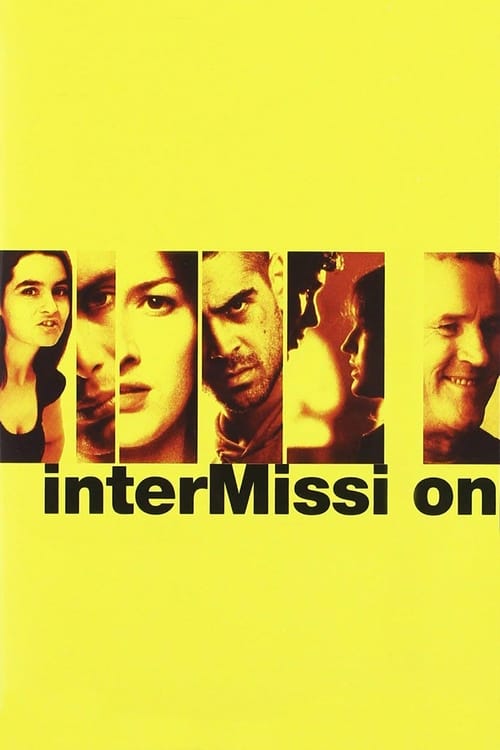
Intermission
2003 · John Crowley
For when you want a raucous, profane laugh with real heart underneath — comfort viewing for people who like their comedy with bruised knuckles.
What it's about
One badly botched break-up in Dublin sets off a chain reaction through a dozen lives — a lovesick supermarket clerk, his volatile pal planning a robbery, a bus driver with a grievance, and a swaggering cop who fancies himself the city's last hard man. Petty crime, thwarted romance, and everyday humiliation keep colliding until nearly everyone in town is tangled in the fallout.
The experience
Fast, foul-mouthed, and very funny, with sudden lurches into violence and unexpected sweetness — rowdy pub-story energy edited like a chase.
Performances
Colin Farrell tears into a genuinely nasty small-time thug, Cillian Murphy makes romantic moping oddly charming, and Colm Meaney is a riot as a self-mythologizing Dublin detective. Kelly Macdonald and Shirley Henderson give the chaos its aching, human center.
The craft
Mark O'Rowe's script snaps a dozen storylines into each other with a playwright's timing, while John Crowley shoots handheld and quick, giving Dublin a scuffed, caffeinated texture. The cross-cutting is the real show — separate lives braided so tightly the collisions feel inevitable.
Why it matters
A landmark of the new urban Irish cinema, it became the highest-grossing independent Irish film at the domestic box office and an early showcase for a generation of Irish actors about to go global.
Snapshot
Intermission is an Irish ensemble black comedy that braids a dozen-odd Dublin lives into a single chain reaction set off by one badly handled break-up. It marked the feature debut of theater director John Crowley and the screen debut of playwright Mark O'Rowe, and it arrived as a kind of statement of intent for a new, urban, unsentimental Irish cinema — far from the rural lyricism and Troubles dramas that had dominated the country's screen image. Powered by an extraordinary concentration of Irish acting talent (Colin Farrell, Cillian Murphy, Kelly Macdonald, Colm Meaney, Shirley Henderson, Brían F. O'Byrne), shot handheld and fast, and edited with the cross-cutting momentum of a network narrative, the film became the highest-grossing independent Irish film at the domestic box office on release. It is at once a local comedy of manners about Dublin's working class and a confident piece of post-Pulp Fiction, post-Altman ensemble construction — a film that uses a deliberately disreputable surface (violence, swearing, brown sauce in tea) to deliver something genuinely tender about loneliness and second chances.
Industry & production
Intermission was produced by Company of Wolves — the production banner associated with Neil Jordan and Stephen Woolley — in partnership with Parallel Films, the Dublin company run by Alan Moloney, with backing from the Irish Film Board (now Screen Ireland) and broadcaster and distributor support typical of early-2000s Irish features. It belongs to a specific moment in Irish film financing: the post-Section-481 tax-incentive landscape that, through the 1990s and 2000s, was designed to build an indigenous production base rather than simply service inward investment. The film is a textbook product of that policy ambition — modestly budgeted, locally crewed, internationally castable.
Its single most consequential industrial fact is casting. Colin Farrell appeared as the small-time hood Lehiff at the precise peak of his Hollywood ascent — fresh from Phone Booth, Daredevil, Minority Report and S.W.A.T. — and his participation in a small Irish picture, in an unglamorous supporting role and reportedly for terms far below his studio rate, gave the production both marquee value and credibility as a returning-talent project. Cillian Murphy, then emerging from 28 Days Later, anchored the central romantic strand. The result was a cast whose collective profile vastly exceeded the budget.
Commercially the gamble paid off conspicuously at home. According to Screen Ireland's own reporting at the time, Intermission became the Irish Film Board's top-grossing backed title and one of the highest-earning films of its year in Ireland, reportedly out-performing major Hollywood releases in the domestic market and becoming the most successful independent Irish film at the Irish box office to that point. Internationally its returns were respectable rather than spectacular; its real significance lay in proving that a homegrown, contemporary, urban Irish story could command a domestic audience.
Technology
Intermission is a film of its early-2000s moment technically: a 35mm production whose aesthetic decisions lean toward the lightweight, mobile, available-light look that the Dogme 95 movement and its imitators had made fashionable. The camera is handheld for long stretches, the lighting frequently naturalistic, and the overall image deliberately rougher and grainier than the glossy finish a comparable studio comedy would carry. The technological posture is subtractive rather than spectacular — the production uses mobility and naturalism, not effects or scale, as its signature, which is also a pragmatic response to budget. There are no set pieces dependent on visual-effects technology; the film's most ambitious "spectacle," a bus crash, is staged and edited for impact rather than rendered.
Technique
Cinematography
The cinematography is by the Polish director of photography Ryszard Lenczewski, a significant detail in hindsight: Lenczewski would go on to shoot Paweł Pawlikowski's My Summer of Love and co-photograph the Academy Award–winning Ida, work celebrated for its austere compositional control. In Intermission he works in a very different register — restless, handheld, close, often grabbing performances on the move in real Dublin locations. The palette favours the muted grays, browns and overcast daylight of the city rather than postcard greenery. The camera tends to crowd its actors, privileging faces and reaction over establishing geography, which suits an ensemble whose comedy and pathos live in close-up. Where the film needs energy — chases, fights, the opening assault — Lenczewski's mobility supplies it without recourse to elaborate coverage.
Editing
Editing, by Lucia Zucchetti (later a long-standing collaborator of Stephen Frears on The Queen, Mrs Henderson Presents and Philomena), is arguably the film's defining technical achievement. Intermission is structurally a network narrative — many separate storylines that intersect, collide and feed one another — and the cutting is what makes that legible and propulsive. Zucchetti interleaves strands so that a consequence in one line lands as a setup in another, sustaining comic momentum across a large cast without losing the audience. The film's rhythm is brisk, the transitions often punchy, and the ensemble architecture is held together at the cutting bench as much as on the page.
Mise-en-scène / staging
The film's world is resolutely ordinary: supermarkets, bus depots, cramped flats, greasy-spoon cafés, suburban estates. Crowley, coming from the theater, stages for performance and for the friction between characters in small, banal spaces, and the production design refuses glamour. The recurring image of a man stirring brown sauce (HP-style) into his mug of tea is exemplary of the film's mise-en-scène strategy — grounding character and milieu in a precise, faintly grotesque domestic detail that doubles as comedy. The texture is naturalistic but selectively heightened; the realism is a stage for behavior, not an end in itself.
Sound
The score is by John Murphy, a composer then strongly associated with the British crime-comedy and genre cinema of the period — Lock, Stock and Two Smoking Barrels, Snatch and 28 Days Later. His contribution sits comfortably in that idiom: rhythmic, contemporary, energizing the ensemble's momentum and underscoring the film's tonal swerves between violence and farce. The soundscape otherwise leans on the naturalistic — the clatter of Dublin streets, cafés and depots — and on the texture of the Dublin vernacular itself, which the film treats almost as a sound design element: dense, profane, fast, regionally specific dialogue that is as much music as meaning.
Performance
Performance is where Intermission is richest. Colin Farrell, against his emerging matinee image, plays Lehiff as a feral, charismatic petty criminal and detonates the film with its notorious opening. Cillian Murphy and Kelly Macdonald give the central romance — supermarket worker John and his estranged girlfriend Deirdre — a bruised sincerity that grounds the comedy. Colm Meaney is a comic highlight as Detective Jerry Lynch, a self-mythologising "Celtic soul" cop who wants a documentary made about his own hard-man heroics, a role that satirizes both television-detective machismo and the culture's appetite for it. Shirley Henderson (as Deirdre's sister, conspicuously and unhappily moustachioed), Brían F. O'Byrne, Michael McElhatton, Deirdre O'Kane, David Wilmot and Ger Ryan fill out an ensemble in which even small parts are sharply individuated. Crowley's theater background shows in the precision and generosity of the acting across the board.
Narrative & dramatic mode
The film is a multi-strand, interwoven ensemble narrative — what scholars of the form call a network or "hyperlink" narrative — organized around the principle that small choices ramify unpredictably across a community. The triggering event is deliberately minor and domestic: a clumsy, ego-driven break-up between John and Deirdre. From that single fracture the film traces consequences outward through lovers, siblings, criminals, police, bus drivers and shop workers until the whole town is implicated. The dramatic mode is tragicomic and ironic: the structure invites the audience to see connections the characters cannot, generating both comedy (mismatched motives colliding) and a melancholy sense of how loneliness and bad timing drive people. Beneath the crime-caper scaffolding — a planned robbery, a kidnapping scheme — the film's real subject is romantic and familial reconciliation, and it resolves on a note of cautious tenderness rather than cynicism.
Genre & cycle
Intermission sits at the intersection of black comedy, crime film and romantic drama, and it belongs to two overlapping cycles. The first is the international vogue, through the 1990s and early 2000s, for the ensemble network film — the lineage of Altman's Short Cuts, Tarantino's Pulp Fiction, Paul Thomas Anderson's Magnolia and Alejandro González Iñárritu's Amores Perros — which made interlocking-lives structures a recognizable genre in themselves. The second is the British-Irish crime-comedy cycle energized by Guy Ritchie's Lock, Stock films, with their fast cutting, criminal low-life, and vernacular swagger. Intermission localizes both: it takes the global network-narrative architecture and the British geezer-comedy energy and pours them into a specifically Dublin working-class idiom, producing something recognizably part of an international cycle yet unmistakably Irish.
Authorship & method
The film is best understood as the meeting of two debutant authors. John Crowley, a Cork-born theater director with a substantial stage reputation, made Intermission his first feature and brought to it a director's instinct for performance, ensemble and tonal control rather than visual flamboyance. The film launched a screen career notable for its range and its sensitivity to actors — Boy A (2007), Brooklyn (2015), The Goldfinch (2019), We Live in Time (2024) — and the empathy that distinguishes his later, gentler work is already visible beneath Intermission's rough surface. Mark O'Rowe, a Dublin playwright known for the verbally pyrotechnic monologue dramas Howie the Rookie and Crestfall, wrote the screenplay, and the film's dense, profane, propulsive dialogue and its dark-comic moral structure are recognizably his. The Crowley–O'Rowe partnership continued with Boy A, which O'Rowe adapted; O'Rowe later wrote Perrier's Bounty and made his own directorial debut with The Delinquent Season. Among collaborators, cinematographer Ryszard Lenczewski, editor Lucia Zucchetti and composer John Murphy each brought sensibilities — Eastern-European naturalism, ensemble-narrative editorial rigor, and British genre-music energy respectively — that combine into the film's particular hybrid texture. The producing presence of Neil Jordan and Stephen Woolley's Company of Wolves connects the film to an older generation of Irish-international filmmaking even as it announces a newer one.
Movement / national cinema
Intermission is a landmark of contemporary Irish cinema specifically because of how decisively it broke with the prevailing images of Irishness on screen. Where much internationally visible Irish (and Irish-themed) film had traded in rural romance, emigration, the Troubles, or heritage period settings, Intermission offered a contemporary, urban, secular, working-class Dublin — abrasive, funny, profane and unsentimental. It is part of a small wave of early-2000s Irish films (alongside titles such as Adam & Paul and the broader output nurtured by the Irish Film Board) that asserted a modern metropolitan Irish identity. As an indigenous production that succeeded commercially at home, it became an emblem of the policy case for a sustainable national cinema, and its success helped legitimize the contemporary-urban register for the films that followed.
Era / period
The film is firmly of the Celtic Tiger moment — the period of rapid Irish economic growth and rising self-confidence around the turn of the millennium — though it views that prosperity from below, among the people the boom largely passed by: supermarket shelf-stackers, bus drivers, small-time criminals, frustrated cops. Its texture of consumer brands, suburban estates and service-economy jobs is a snapshot of Dublin circa 2003, and its irreverence reflects a culture newly willing to laugh at its own pieties, including the mythologies of Irish hard masculinity that Colm Meaney's detective so precisely skewers. The film's confidence — formal and tonal — is itself a period marker: the work of a national cinema feeling, briefly, flush.
Themes
At its core the film is about loneliness, timing and the difficulty of second chances. Almost every storyline turns on someone botching an emotional decision and then struggling to repair it: John's wounded male pride, Deirdre's loneliness, Sally's self-consciousness, the various characters' grabs at money or escape. Masculinity is a sustained preoccupation — the film repeatedly examines the postures men adopt (the hard man, the maverick cop, the criminal, the wounded romantic) and the damage those postures do. Class and the unglamorous texture of ordinary working life run throughout, as does the theme of contingency itself: the network structure dramatizes how interdependent and accident-prone a community's fortunes are. For all its violence and crudity, the film's governing value is finally a forgiving humanism — the suggestion that people are foolish, fragile and worth rooting for anyway.
Reception, canon & influence
Critically, Intermission was received as a vibrant, well-acted and assured debut, frequently praised for its ensemble performances — Farrell's against-type menace and Meaney's comic turn drew particular attention — and for its energy and verbal vitality. The most common critical reservation was structural and derivative: reviewers noted the obvious debt to Pulp Fiction, Altman and the network-narrative template, and some found the interwoven design more clever than deep. Domestically it was recognized at the Irish Film & Television Awards, where Crowley was honored for direction and O'Rowe for the screenplay. Its commercial performance — the top-grossing Irish Film Board–backed release and the most successful independent Irish film at the home box office to that point — made it a genuine cultural event in Ireland.
The influences on the film are clear and acknowledged: the ensemble architecture of Altman's Short Cuts and Anderson's Magnolia, the structural and tonal example of Tarantino's Pulp Fiction, the British crime-comedy verve of Guy Ritchie, and the handheld naturalism descended from Dogme 95. O'Rowe's own theatrical voice — the vernacular monologue tradition of contemporary Irish drama — is the other major upstream source.
Its legacy forward is twofold. First, as a career launcher: it began John Crowley's transition from stage to a substantial international film career and gave Mark O'Rowe a screenwriting platform, while consolidating the screen standing of its young cast (Murphy and Macdonald especially) at an important moment. Second, as a national-cinema milestone: it helped establish the contemporary-urban, comic, unsentimental mode as a viable and commercially successful register for Irish film, demonstrating that homegrown stories could win the home audience. The film is not typically placed in the global art-cinema canon, but within the history of modern Irish cinema it occupies a secure and frequently cited place as the picture that announced a new Dublin on screen. Where the broader scholarly record on the film is comparatively thin, that historical role — rather than formal innovation — is the basis of its lasting reputation.
Sources: Wikipedia: Intermission (film)); IMDb full cast & crew; Screen Ireland — Intermission, IFB's top-grossing title; Screen Ireland — Intermission, number 1 at the Irish box office.
A Deleuzian reading
A man sits in a Dublin café and stirs brown sauce — the brown, vinegary HP kind — into his mug of tea.
The full Deleuzian reading of Intermission →
Reception
A genuine hit in Ireland in 2003 — reported at the time as the highest-grossing Irish independent film at the Irish box office — it's since settled into time-capsule status: Celtic Tiger Dublin, pre-fame Cillian Murphy, and Colin Farrell coming home between Hollywood gigs, now steadily rediscovered by Murphy completists.
How Intermission was received, from release to now →
Influences: the films it descends from and the films it influenced
- Pulp Fiction (1994) — Supplies the template Intermission openly borrows: criminal vignettes braided out of chronological order and welded together by profane, aria-length dialogue that turns small-time hoods into verbal performers.
- Short Cuts (1993) — Model for the mosaic-of-strangers architecture — a dozen lives in one city cross-cut so that a minor character in one strand becomes the pivot of another, privileging ensemble over single protagonist.
- Nashville (1975) — Originates the overlapping-dialogue, roving-ensemble city-portrait method O'Rowe and Crowley inherit second-hand, where social texture is built from many equal-weight characters rather than a plot spine.
- Magnolia (1999) — Refines the network-narrative into a clockwork of coincidence and emotional rhyme across parallel lives, the design Intermission compresses into a leaner comic register.
- Lock, Stock and Two Smoking Barrels (1998) — Source of the British-Isles crime-comedy verve: interlocking dim-criminal schemes, geezer banter, and a hurtling editorial pace dressing a heist in working-class slang.
- Trainspotting (1996) — Blueprint for kinetic urban-vernacular naturalism with a young Celtic-fringe ensemble (Kelly Macdonald carried straight over), pop-scored handheld energy applied to grubby city life.
- Festen (1998) — Dogme 95 source for the handheld, available-light shooting Lenczewski adopts — camera jostled in among the actors, ugly real interiors, naturalism as a deliberate anti-gloss stance.
- The Commitments (1991) — Establishes the Dublin working-class ensemble in the vernacular — profane, musical, comic group-portrait of the city that Intermission updates for the Celtic Tiger.
- I Went Down (1997) — Immediate Irish precedent for the homegrown crime-caper-comedy — two hapless men on a criminal errand, deadpan vernacular dialogue (also scripted by a playwright, Conor McPherson).
- Perrier's Bounty (2009) — Mark O'Rowe's own follow-on screenplay extends his signature: profane Dublin gangland caper driven by motormouth monologue and dark-comic moral reversal.
- In Bruges (2008) — Carries forward the playwright-penned Irish crime comedy — theatrical, foul-mouthed dialogue and tonal whiplash between farce and pathos, with Farrell again cast against type as a soulful thug.
- The Guard (2011) — Extends the unsentimental Irish comic-crime mode Intermission helped make commercially viable — vernacular wit, deadpan ensemble and genre play rooted in a specifically Irish milieu.
- Boy A (2007) — Direct Crowley–O'Rowe continuation: the same actor-first direction and O'Rowe screenwriting, now channeling the empathy latent in Intermission into restrained social-realist drama.
- Amores Perros (2000) — Contemporary parallel: a car-crash collision-point linking three otherwise separate strands, handheld grain and ensemble cross-cutting deployed for an urban triptych at the same moment.
- Go (1999) — Same-generation Pulp Fiction descendant — overlapping criminal night told from rotating viewpoints with comic momentum, the lighter end of the network-caper that Intermission shares.
- Snatch (2000) — Parallel refinement of the Ritchie crime-comedy — converging double-crosses, voiceover-tagged grotesques and propulsive cutting that Intermission's interwoven scams echo.
- Adam & Paul (2004) — The other founding text of contemporary-urban Irish cinema — unsentimental, handheld Dublin in real locations and street vernacular, arriving alongside Intermission as the same new register.
Similar films
- In Bruges (2008) — influence & lineage
- Short Cuts (1993) — influence & lineage
- The Banshees of Inisherin (2022) — shared sensibility
- The Wind That Shakes the Barley (2006) — shared sensibility
- Once (2007) — shared sensibility
- Kneecap (2024) — shared sensibility
- Promising Young Woman (2020) — shared sensibility
- We Live in Time (2024) — shared sensibility