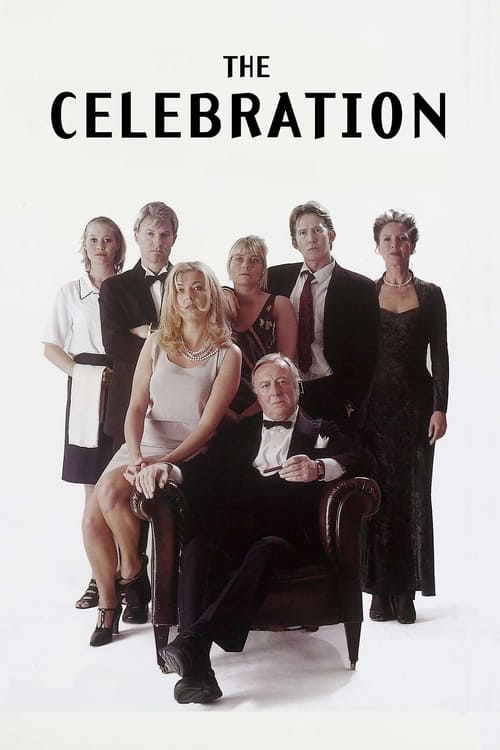
The Celebration
1998 · Thomas Vinterberg
For when you want to be gripped by the throat — a challenge, not a comfort watch; reach for it when you're in the mood for family drama with real teeth and you can handle heavy subject matter.
What it's about
A wealthy Danish patriarch turns sixty, and his extended family descends on the ancestral manor for a formal birthday dinner — toasts, songs, seating charts, the whole ritual. Then his eldest son stands up to give a speech, and what he says detonates the evening. The rest of the night is a war between one man's truth and a family's ferocious will to keep the party going as if nothing happened.
The experience
Queasy, electric, and blackly funny — you watch through your fingers as politeness itself becomes the battlefield. The handheld camera puts you at the table like an uninvited guest, and the tension never lets you settle.
Performances
Ulrich Thomsen is devastating as Christian, delivering unspeakable accusations in the mild tone of a dinner toast, while Thomas Bo Larsen plays his hothead brother as a live grenade rolling around the party.
The craft
Shot on cheap consumer video with natural light and handheld cameras under the Dogme 95 vow of chastity — no artificial lighting, no score, no gloss. The rough, grainy image should be a liability, but it turns the manor into a pressure cooker; the film feels stolen rather than staged. Watch it somewhere quiet so the silences at the dinner table can do their work.
Why it matters
The first officially certified Dogme 95 film, it won the Jury Prize at Cannes, launched Thomas Vinterberg internationally, and proved a stripped-down digital aesthetic could carry world-class drama — a permission slip low-budget filmmakers have been cashing ever since.
Snapshot
The Celebration (Festen in Danish) is the first film to carry an official Dogme 95 certificate, a distinction that made it simultaneously a manifesto in motion and a genuine artistic landmark. Directed by Thomas Vinterberg from a screenplay he co-wrote with Mogens Rukov, the film assembles the extended family of a wealthy patriarch, Helge Klingenfeldt, at his ancestral manor for his sixtieth birthday. Over the course of a single evening his eldest son, Christian, delivers a speech accusing Helge of systematically sexually abusing Christian and his now-dead twin sister Linda throughout their childhood. What follows is a sustained battle between truth and collective denial, prosecuted through the rituals of bourgeois celebration. Shot on consumer-grade digital video by Anthony Dod Mantle and edited by Valdís Óskarsdóttir, the film won the Special Jury Prize at the 1998 Cannes Film Festival and immediately altered the terms on which low-budget digital filmmaking could be taken seriously by international audiences and critics.
Industry & production
The Celebration was produced by Nimbus Film, the Copenhagen production company founded by Birgitte Hald and Morten Kaufmann that would become the institutional home of the Dogme movement in its early years. The budget was extremely modest even by late-1990s Danish standards; the decision to shoot on Mini-DV rather than 35mm was not simply an ideological concession to the Dogme manifesto but a practical consequence of the film's limited resources. Denmark's public film-support infrastructure, administered through the Danish Film Institute, had since the late 1980s sustained a domestic industry capable of punching well above the country's population weight, and The Celebration benefited from this ecosystem even while provocatively positioning itself against the conventions of prestige Danish production. The film was shot largely on location at a country manor in Jutland over a compressed schedule, with the inherent unruliness of a large ensemble cast and a single-evening timeframe transformed from a logistical constraint into a structural virtue. The film's Cannes success and subsequent wide international release — including art-house runs throughout Europe, the United Kingdom, and North America — confirmed that Nimbus Film had backed something far beyond a manifesto exercise.
Technology
The Celebration was photographed on a Sony DCR-PC3 Mini-DV camcorder, a consumer prosumer camera available off the shelf at the time, and subsequently blown up optically to 35mm for theatrical exhibition. This was an audacious industrial choice. In 1998, the dominant digital projection infrastructure did not exist; the only route to a wide theatrical release remained 35mm, and the grain, compression artifacts, and tonal compression introduced by the blow-up process were all visible on screen. Rather than concealing these, Vinterberg and Dod Mantle allowed them to accumulate as texture. The resulting image — desaturated, granular, often lurching with camera movement — read less like degraded cinema than like heightened actuality. The choice of a small, lightweight camera also had immediate spatial consequences: Dod Mantle could enter spaces, follow movement, and occupy angles unavailable to a conventional film crew. The technical limitations enforced by the Dogme Vow of Chastity — no tripods, no supplemental lighting, no non-diegetic sound — were in practice inseparable from the expressive logic of the footage. It is worth noting that Vinterberg later admitted to covering a window with tape to control light during one shot, a minor violation of the manifesto's prohibition on filtration that he subsequently confessed publicly, treating the transgression as a kind of moral reckoning continuous with the film's own subject matter.
Technique
Cinematography
Anthony Dod Mantle's work on The Celebration established him as one of the defining cinematographers of the digital era. Operating a handheld Mini-DV camera in available light — or light conditions as close to available as the rules and the budget permitted — Dod Mantle produced imagery that oscillated between intimate proximity and vertiginous instability. His framing is perpetually reactive, catching glances across dinner tables, following characters through corridors, stumbling slightly on a staircase descent in a way that implicates the camera in the household's disorientation. In the early scenes the style reads as naturalistic observation; as the evening escalates, the same handheld grammar acquires an anxious, claustrophobic pressure. The grain of the video stock, amplified by the 35mm blow-up, reinforces the sense that what is being recorded cannot easily be aestheticized away from its content.
Editing
Valdís Óskarsdóttir, the Icelandic editor who would later cut Michel Gondry's Eternal Sunshine of the Spotless Mind (2004), assembled the film with a rhythm calibrated to the mechanics of denial. She uses ellipsis and compression to sustain an atmosphere of unresolved tension — scenes do not resolve so much as interrupt; conversations are cut before consensus arrives. The structural repetition at the heart of the film — Christian makes his accusation, the party carries on, he makes it again, more guests arrive or depart, the machinery of normalcy resets — is a feat of editorial pacing. Óskarsdóttir keeps the viewer uncertain between each accusation whether the truth has finally taken hold or whether the family's capacity for collective repression will once again prevail.
Mise-en-scène / staging
Because the Dogme rules required location shooting with props intrinsic to the space, the film's visual architecture is that of an actual Danish manor house — its dining room, corridors, guest rooms, kitchen, and grounds. Vinterberg uses the building's vertical and horizontal axes as a dramatic topography: the formal spaces where the celebration is performed (the dining room, the terrace) are distinguished from the private, liminal spaces (corridors, bathrooms, the kitchen) where truth can briefly surface before being suppressed. The staging of the dining-table scenes, with Helge presiding from the head and the extended family arranged around him in a configuration that echoes both Passover seder and Last Supper imagery, gives the room's architecture a weight it cannot escape. The outdoor night sequences, lit by whatever illumination the property provided, acquire an almost pastoral eeriness that contrasts with the febrile interior.
Sound
The Celebration adheres rigorously to the Dogme prohibition on non-diegetic sound: there is no score. All music in the film is performed within the world — folk songs, a piano, a guitar — and is heard by the characters. This constraint, which might have felt impoverishing, instead sharpens the film's emotional register considerably. The eruption of communal singing becomes an act of willed denial; folk melody is weaponized as social pressure to absorb and suppress Christian's disclosures. The absence of orchestral cues that might tell the audience how to feel means that every emotional response must be generated by performance and image alone, with sound functioning as documentary evidence of the party's terrible continuity.
Performance
The ensemble performances are the film's most consistent critical achievement. Ulrich Thomsen as Christian brings a quality of dissociation to his early scenes — the performance of a man who has prepared himself for something immense and now watches from a slight distance as it unfolds — before cracking open in the film's later passages. Henning Moritzen as Helge is a masterpiece of patriarchal self-containment: the performance barely modulates even under direct accusation, its steadiness itself the most disturbing register of guilt. Thomas Bo Larsen as the volatile, racially prejudiced younger brother Michael functions as the family's id, the character most visibly performing the denial that others manage more subtly. The handheld camera's proximity to faces — often shooting in available light at distances that would be uncomfortable in 35mm — creates a documentary intimacy that the ensemble exploits.
Narrative & dramatic mode
The Celebration operates on a near-classical dramatic structure: the unities of time, place, and action are all but observed. The action unfolds over a single evening at a single location, with a central situation — the accusation — that drives every subsequent scene. This classical rigor is not incidental; it is the consequence of the Dogme constraints combining with a script that Vinterberg and Rukov had developed with considerable formal deliberation. Mogens Rukov, a celebrated teacher of screenwriting at the National Film School of Denmark, brought a structural discipline to the collaboration that shaped the film's near-theatrical architecture. The narrative rhythm is built around Christian's repeated attempts to compel acknowledgement, each rebuffed by the household's collective refusal, until the truth achieves an irreversible social reality. This is less the structure of psychological realism than of ritual or tragedy: the audience understands the outcome long before the characters accept it, and the dramatic pleasure is the excruciating interval between disclosure and recognition.
Genre & cycle
Generically, The Celebration occupies the tradition of the family-secret drama — a form with deep roots in Scandinavian theater, particularly in the work of August Strindberg and Henrik Ibsen, where bourgeois domestic propriety is the site against which suppressed truth erupts. Within cinema, the film is a close relation to Ingmar Bergman's family dramas, though its documentary aesthetic places it in a different register from Bergman's formal severity. It is also the foundational text of the Dogme 95 cycle, whose subsequent entries — including Lars von Trier's The Idiots (1998) and a series of films by Danish and international directors who obtained Dogme certificates — extended and complicated the movement's premises. The film belongs equally to a late-1990s European art cinema of social-realist reckoning that includes work by the Dardenne brothers, Ken Loach, and Mike Leigh, though its formal affiliation is specific to the Danish context.
Authorship & method
Thomas Vinterberg had made one previous feature, The Biggest Heroes (1996), and a number of short films before The Celebration. The Dogme 95 manifesto, co-authored with Lars von Trier and published in 1995 as part of a centenary event at the Odéon in Paris, was conceived as a deliberate provocation against what its authors characterized as the superficiality of the contemporary commercial cinema. Vinterberg's realization of the first Dogme film transformed the manifesto from polemic into demonstrable practice. His collaboration with Mogens Rukov was generative at the level of script architecture: Rukov's influence on Danish screenwriting culture had been substantial, and the film's structural clarity reflects a scriptwriting pedagogy unusually attentive to classical dramatic form. Anthony Dod Mantle went on from The Celebration to an international career of considerable distinction, winning the Academy Award for Cinematography for Danny Boyle's Slumdog Millionaire (2008) and collaborating repeatedly with Boyle, Lars von Trier, and others. Valdís Óskarsdóttir's subsequent career confirmed her as one of the more distinctive editors working in European and American independent cinema. The Vow of Chastity officially forbade the director from accepting an auteur credit, a rule observed in the film's initial theatrical presentation, though subsequent discourse has naturally treated Vinterberg as its author.
Movement / national cinema
The Celebration is the clearest single articulation of the Dogme 95 movement as a working filmmaking practice rather than a theoretical position. The movement was Danish in origin and institutional base, though it attracted international adherents rapidly: Korean, American, and French directors sought and received Dogme certificates in the years following. Within Danish cinema more broadly, the film arrived at a moment of unusual international vitality. Lars von Trier's Breaking the Waves (1996) had placed Danish cinema in a prominent position at Cannes two years earlier; Susanne Bier's emergence as a major director was only a few years away. The Danish Film Institute's support structures, the relatively small scale of the industry permitting tight networks of talent, and a theatrical tradition comfortable with bleak domestic subject matter all contributed to a context in which a film as uncompromising as The Celebration could be made and supported.
Era / period
The film appeared at a pivotal moment in cinema's digital transition. In 1998, DV cameras were consumer products; 35mm production remained the industry standard for anything aspiring to theatrical release. The question of whether digital video could sustain artistic ambition at the level of international festival competition was genuinely open, and The Celebration's Cannes reception — the Jury Prize awarded to a film shot on a camera anyone might own — provided a decisive data point. The late 1990s also saw a broader turn in European and American independent cinema toward social-realist modes, away from the postmodern self-referentiality that had dominated the early 1990s art-house landscape.
Themes
The film's central subject is the structural silence that enables sexual abuse within institutions of family and class. Helge's crimes are not a secret in any simple sense — several characters demonstrate degrees of knowledge or suspicion — but they have been sustained by a system of collective non-acknowledgement in which the perpetrator's social authority, expressed through wealth, property, and paternal prestige, makes accusation formally unthinkable. The Celebration is as much an anatomy of that system as it is a story about individual trauma. The birthday celebration itself — a ritual assertion of continuity, gratitude, and familial order — becomes the film's structural irony: the form of celebration is the mechanism of suppression, and Christian's hijacking of the speech-form is both a violation of ceremony and its most truthful use. The film also addresses masculine complicity: the male guests, and the brother Michael, collaborate in denial through aggression and deflection, while several of the women characters act as quiet conduits of suppressed knowledge. Race enters uncomfortably through Michael's antisemitic behavior toward his girlfriend's African heritage, widening the film's critique of the family's moral horizon without fully integrating this strand.
Reception, canon & influence
The Celebration won the Special Jury Prize at the 1998 Cannes Film Festival, a result that confirmed the film's artistic standing without the highest validation of the Palme d'Or. Critical reception was almost unanimously strong in both European and Anglophone markets, with reviewers responding particularly to the performances and the formal audacity of the DV-to-35mm strategy. The film's place in the canon of late-twentieth-century European cinema is secure; it regularly appears on best-of-decade and best-of-era lists and is taught extensively in film studies curricula as the definitive Dogme text.
Looking backward, the film's most evident debts are to Scandinavian dramatic theater — particularly Ibsen's model of accumulated domestic secret and Strindberg's unsparing family combat — and to Bergman's cinema of anguished bourgeois interiority. The improvisatory intimacy of John Cassavetes' ensemble work is also a plausible antecedent, though the directness of that lineage is less documented than the Scandinavian theatrical inheritance.
Looking forward, The Celebration's influence operated on several registers simultaneously. It provided a practical proof of concept for DV feature filmmaking at a moment when that argument needed to be made with evidence rather than theory, and its demonstrable festival success encouraged a generation of filmmakers to work with lightweight digital cameras in conditions that would previously have seemed underpowered for serious drama. Anthony Dod Mantle's career is itself a direct legacy: the visual language he developed here — responsive, granular, intimate — became foundational to a strand of digital cinematography that runs through 28 Days Later (2002) and beyond. The film was subsequently adapted for the stage, with a theatrical version that toured internationally and confirmed the narrative's essential suitability for live performance — a kind of inversion of the film's origins in the theatrical tradition of Ibsen and Strindberg. Vinterberg himself went on to direct The Hunt (2012) and Another Round (2020), each of which revisits questions of male community, complicity, and the social management of truth under pressure, suggesting that The Celebration established the moral and formal preoccupations that would define his career.
A Deleuzian reading
Watch the camera on the staircase.
The full Deleuzian reading of The Celebration →
Reception
An instant sensation — Jury Prize at Cannes 1998 and the proof-of-concept that made Dogme 95 a global story overnight. Nearly thirty years on, the movement reads as a period curiosity while Festen itself has only climbed, widely held up as the one Dogme film that fully transcends the manifesto.
How The Celebration was received, from release to now →
Influences: the films it descends from and the films it influenced
- Scenes from a Marriage (1973) — Shot on 16mm for Swedish television then re-cut and released theatrically, establishing the model for the small-format domestic drama that trades cinematic scale for performance proximity; Vinterberg inherits both the blow-up format strategy and the sustained family-confession dramatic structure.
- Cries and Whispers (1972) — Uses a single period manor house as the complete spatial world of the drama, with ensemble performance under extreme emotional pressure distributed across rooms that function as psychological traps; Vinterberg's manor topography and its vertical/horizontal dramatic axes are a direct architectural and dramaturgical inheritance.
- Winter Light (1963) — Deliberately eliminates non-diegetic music from the emotional architecture of an intimate drama, using ambient silence and diegetic sound as the only acoustic register; the austerity that Dogme's Vow of Chastity prohibition on scoring directly inherits and radicalizes into a rule.
- Faces (1968) — Shot on 16mm in available light with a handheld camera, using the social party that deteriorates across a single night as a container for emotional collapse; the foundational model for performance-reactive documentary-proximity camera work that Dod Mantle's Mini-DV method radicalizes two decades later.
- The Rules of the Game (1939) — Establishes the country estate gathering as a dramaturgical form: guests and hosts distributed across the spatial logic of a single property, with a social occasion serving as the stage on which bourgeois hypocrisy is exposed through ensemble movement through the building's architecture.
- The Battle of Algiers (1966) — Constructs documentary authenticity through grainy handheld imagery shot on location without supplemental lighting, establishing the grammar of visual roughness as a truth-claim in dramatized fiction; the conceptual model behind Dogme's embrace of video grain and available light as simultaneously ethical and aesthetic choices.
- Waiting for the Hearse (1985) — Detonates buried family cruelty across a single-location ritual meal, sustained by unity of place and overlapping table talk.
- The Firemen's Ball (1967) — Dogme reprise of the vérité ensemble-at-a-formal-event, using handheld naturalism and a party's escalating breakdown to detonate collective hypocrisy.
- The Dead (1987) — Detonates a long-delayed revelation inside the ritual of the after-dinner speech, letting the table's social choreography — who rises, who stays seated — do the work of exposition.
- Eternal Sunshine of the Spotless Mind (2004) — Editor Valdís Óskarsdóttir carried her Celebration technique directly into Gondry's film: the elliptical cut that interrupts before resolution, structural repetition with variation as the primary emotional engine, and a rhythm calibrated to keep the viewer uncertain whether closure has arrived — the same editorial grammar she had developed for prosecuting Christian's repeated accusations.
- Caché (2005) — The bourgeois family drama whose domestic comfort is menaced by a repressed past crime, refusing non-diegetic score as emotional manipulation and using static long-take observation of domestic space without orchestral cueing — The Celebration's suppressed-guilt architecture extended into a surveillance aesthetic.
- Slumdog Millionaire (2008) — Anthony Dod Mantle directly evolved the handheld digital grammar he had invented on Mini-DV for The Celebration into a mainstream spectacular register, winning the Academy Award for Cinematography and certifying that the available-light mobile-camera DV aesthetic was a global cinematic idiom rather than a low-budget compromise.
- The Hunt (2012) — Vinterberg and Anthony Dod Mantle apply the identical ensemble-accusation structure in which community collective denial overwhelms individual truth — the accusation that resurfaces through social ritual, the dinner table as tribunal, Dod Mantle's handheld grammar now on digital rather than Mini-DV — a direct formal continuation of The Celebration's thematic and technical project.
- A Separation (2011) — Builds its drama entirely around competing testimonies about a buried truth where the ritual of confrontation and accusation is the primary mechanism, using sparse location-based cinematography with no non-diegetic score and the classical unity of a defined crisis as narrative architecture — the accusation-ritual structure Vinterberg formalized, transposed to Iranian domestic law.
- Force Majeure (2014) — Isolates a bourgeois Scandinavian family in a single contained location and prosecutes their collective denial of an uncomfortable truth through sustained repetition of the dinner-table ritual, using the vacation ceremony as a collapsed social performance — the most formally direct descendant of The Celebration's structure of bourgeois self-exposure through the social occasion.
- Aftersun (2022) — Deploys consumer DV footage as both memory document and fiction, where grain, compression artifacts, and tonal instability carry emotional weight rather than signal deficiency — a formal possibility that The Celebration's Mini-DV-to-35mm blow-up strategy had validated as an expressive idiom twenty-four years earlier.
- The Last King of Scotland (2006) — The companion Dod Mantle Dogme film: available-light handheld in charged interior group scenes where camera mobility and physical proximity to performers generate a documentary texture previously considered incompatible with controlled narrative drama.
- Far from the Madding Crowd (2015) — Dogme 95's available-light, mid-distance observational staging — letting scenes run without editorial acceleration, watching characters rather than cutting to close-ups for affect — is the direct formal DNA of FFTMC's 'Dogme-observational-patience' in performance and scene construction.
- The Menu (2022) — Vinterberg established the genre grammar The Menu follows: the formal dinner party as a sealed container through which private devastation erupts into public catastrophe, with guests unable to exit the social ritual even as it destroys them — the film's spatial confinement and performative-meal escalation are The Menu's direct structural model.
- 28 Years Later (2025) — Dod Mantle's Dogme 95 handheld consumer-DV photography forged his 'shoot on the most available camera, embrace its flaws' philosophy, carried forward to the iPhone capture.
- 28 Days Later (2002) — The first Dogme 95 film, shot by Anthony Dod Mantle, where he honed the consumer-DV handheld aesthetic — degraded, intimate, available-light — that he then weaponized for 28 Days Later's look.
- The Idiots (1998) — The co-founding Dogme 95 film shot simultaneously under identical Vow of Chastity constraints — handheld DV, no score, location-only, no non-diegetic props — making the two films a paired experiment in what the same technical ruleset produces across different directorial temperaments and social milieus.
- Rosetta (1999) — Independently arrived at the same technical grammar as Dogme — handheld available-light camera fixed to the body of a performer, diegetic sound only, no score, no location modification — as a contemporaneous parallel development in European realism that confirmed Dogme's constraints were a convergent aesthetic logic, not merely a manifesto exercise.
- Breaking the Waves (1996) — Vinterberg's application of Dogme 95 rules—consumer-grade handheld video, available light, no non-diegetic music—codifies as manifesto the aesthetic Breaking the Waves had demonstrated as viable for major art-cinema competition; its Cannes triumph confirmed the institutional legitimacy of the protocol von Trier's film had informally proven.
- Dancer in the Dark (2000) — Proved a Cannes-prize serious film could be shot on a palm-sized consumer DV camera, legitimizing the desaturated handheld digital aesthetic von Trier deploys for the dramatic scenes.
- Dogville (2003) — Vinterberg, von Trier's Dogme co-author, supplies the handheld digital chamber drama of a community's buried cruelty exposed at a gathering — the sibling realization of the same vow.
- Buena Vista Social Club (1999) — The other 1998–99 test case for consumer-grade DV originated handheld and blown up to 35mm for theatrical projection, normalizing visible video artifacting as an accepted texture on cinema screens.
Similar films
- Force Majeure (2014) — influence & lineage · same viewing thread
- The Idiots (1998) — influence & lineage
- The Hunt (2012) — influence & lineage
- Funny Games (1997) — same viewing thread
- Triangle of Sadness (2022) — same viewing thread
- Caché (2005) — influence & lineage · often watched together
- The Rules of the Game (1939) — influence & lineage · often watched together
- The Battle of Algiers (1966) — influence & lineage · often watched together
All the films related to The Celebration →
Watch it with: curated runs of related films
- When Everyone Finally Snaps — A run of films where an ordinary scene — a birthday dinner, a small town, a quiet house, a man at the end of his patience — gets pushed past its breaking point until the whole social order detonates.
Film essays and courses that include it
- The Vow of Chastity: Dogme 95 and the Handheld Revolution
- Pixels and Presence: How Digital Cameras Rewrote Cinema's Grammar
- The Camera Gets Off the Tripod: Vérité from Flaherty to Bigelow
- The Difficult Love: How Cinema Learned to See Inside the Family
- No One Leaves: The Satirical Class-Horror Cycle
- The Vow of Chastity