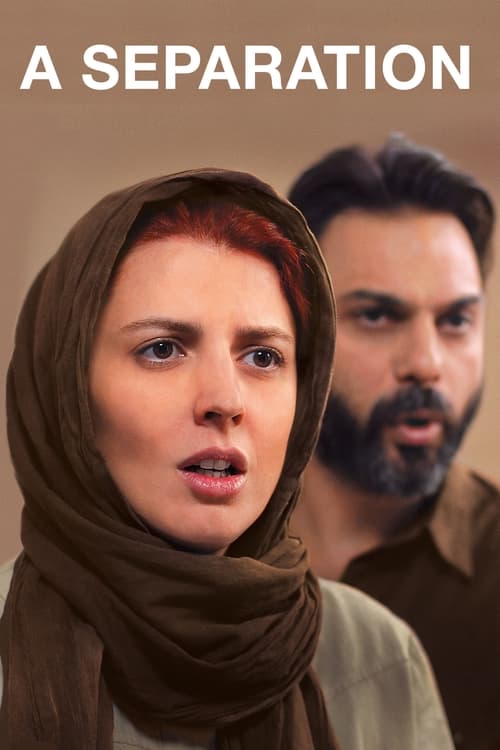
A Separation
2011 · Asghar Farhadi
A Hero came wrapped in a plagiarism suit from his own former student, which Iranian courts partly upheld — turning the moral-dilemma master into the subject of his own moral-dilemma discourse.
For when you want a film to chew on for days and debate over dinner — emotionally demanding but compulsively watchable, the rare 'serious' film that never feels like homework.
What it's about
A Tehran couple hits an impasse: she wants to emigrate for their daughter's future, he won't leave his father, who has Alzheimer's. When he hires a poor, devout woman to care for the old man, a single disputed incident in the apartment pulls both families — one secular and middle-class, one religious and working-class — into a legal and moral tangle where everyone has a reason and no one has clean hands.
The experience
Grips like a thriller even though it's all kitchens, stairwells, and courtrooms — you keep re-judging every character as new facts surface. It's tense, scrupulously fair, and quietly heartbreaking, and it sends you out arguing about who was right.
Performances
The whole ensemble is superb: Peyman Moaadi's proud, cornered Nader and Leila Hatami's resolute Simin, with Sareh Bayat and Shahab Hosseini equally vivid as the couple across the class divide — the Berlin festival famously honored the entire cast.
The craft
Farhadi's screenplay is a marvel of construction, releasing information so precisely that your sympathies keep shifting without a single cheat. Handheld camerawork through cramped apartments and courtrooms keeps you inside the argument; there's no score to tell you how to feel.
Why it matters
Winner of the Golden Bear and Iran's first Academy Award for Best Foreign Language Film, it brought Iranian cinema to a mass global audience and made Farhadi's brand of moral-puzzle drama a worldwide reference point.
Snapshot
A Separation (Persian: Jodaeiye Nader az Simin, "The Separation of Nader from Simin") is Asghar Farhadi's fifth feature and the film that carried Iranian cinema to a new register of global visibility. Its premise is deceptively domestic: Simin wants to emigrate so her daughter can grow up outside Iran; her husband Nader refuses to leave because his father has advanced Alzheimer's. From this marital impasse the film opens outward into a chain of moral and legal consequence. Nader hires Razieh, a poor and devout woman, to care for the father; an altercation over her conduct and a subsequent miscarriage pull two families—one secular and middle-class, one religious and working-class—into the machinery of the Iranian courts. The film won the Golden Bear at the 2011 Berlinale (the first Iranian film to do so) and the Academy Award for Best Foreign Language Film in 2012 (the first Iranian film to win an Oscar), with Farhadi additionally nominated for Best Original Screenplay. It is at once an intimate drama, a moral thriller, and a precise cross-section of a society organized by competing systems of truth—legal, religious, and personal.
Industry & production
The film was produced within Iran's state-supervised but artistically resilient industry, made under the Ministry of Culture and Islamic Guidance's permitting and censorship regime that governs all domestic production. Farhadi wrote, directed, and produced; the picture was shot largely on location in Tehran apartments, courtrooms, and stairwells, a practical economy that also serves the film's claustrophobic naturalism. By the standards of the international art-house market it was a modest production, and its budget is not a figure I can state precisely from the public record.
Its commercial and reputational trajectory, however, was outsized. Sony Pictures Classics handled North American distribution, and the film became one of the highest-profile foreign-language releases of its year, accumulating a long run of festival and critics' awards beyond Berlin and the Oscar—including the Golden Globe and a Best Foreign Language Film prize from numerous critics' bodies. Its success arrived against a fraught political backdrop: in the years surrounding the film, Iranian filmmakers including Jafar Panahi faced bans and imprisonment, and Farhadi himself had briefly run afoul of authorities during the production of his previous film. A Separation thus functioned both as a work of art and as a diplomatic object, repeatedly invoked in discussions of cultural exchange during a period of acute US–Iran tension.
Technology
A Separation belongs aesthetically to the digital-era turn in observational realism: handheld, available-light-leaning, shot with a mobility that presumes lightweight equipment and fast working methods in cramped real interiors. I cannot confirm the exact capture format or camera model from the reliable record, and I will not guess at it. What is evident on screen is a deliberately unglamorous image—naturalistic color, practical interior light, minimal apparent artificial fill—consistent with the documentary-inflected approach that cinematographer Mahmoud Kalari brought to the project. The technological posture is one of self-effacement: technique placed entirely in service of proximity to faces and rooms, with no spectacle of apparatus.
Technique
Cinematography
Mahmoud Kalari—himself an accomplished director and one of Iran's most respected cinematographers—shoots the film almost entirely handheld, the camera kept close to the actors and frequently reframing in response to performance rather than dictating it. The visual signature is the barrier: Farhadi and Kalari repeatedly compose through glass, doorways, and partitions, shooting figures behind windows, across thresholds, and through the frosted or reflective surfaces of the apartment. These mediating planes make literal the film's epistemology—characters are perpetually observed at one remove, their full intentions screened from us. The famous opening is a direct-address two-shot: Nader and Simin sit facing the lens, pleading their case to a divorce judge who is positioned exactly where the camera, and therefore the viewer, sits. From the first frame the audience is enlisted as adjudicator, a role the film will steadily complicate.
Editing
Hayedeh Safiyari's cutting is foundational to the film's grip. The editing favors sustained takes during charged exchanges, then accelerates around the central incident on the staircase, withholding the one piece of visual information that would resolve the central factual dispute. The film is essentially a structure of managed ignorance: scenes are cut so that the audience always knows slightly less than it believes it does, and revelations are timed to retroactively reorganize earlier scenes. Safiyari's rhythm—patient in the domestic passages, taut in the legal confrontations—keeps a fundamentally talk-driven drama at the tension level of a thriller.
Mise-en-scène / staging
Farhadi's theatrical training shows most clearly in the staging. The apartments are dense, lived-in spaces crowded with the apparatus of caregiving—the incapacitated father, the oxygen, the laundry, the schoolwork—and bodies are choreographed through doorways and narrow corridors so that overhearing, interruption, and partial witness become structural. Children are positioned as silent observers at the edges of adult conflict, particularly Nader's daughter Termeh, whose watching face anchors the film's moral stakes. The courtroom and the registrar's office are staged not as grand institutional spaces but as ordinary, overcrowded rooms, reinforcing that justice here is a matter of competing testimonies in close quarters rather than ceremony.
Sound
The film is conspicuously without a conventional score; for most of its length there is no non-diegetic music at all, only the ambient density of Tehran apartments and offices—traffic, plumbing, the father's labored presence, overlapping argument. This austerity heightens realism and denies the audience the emotional cueing that scoring usually supplies, leaving us to weigh each scene without instruction. Music is held back until the very end, where a restrained piece accompanies the final, unresolved image, its arrival all the more affecting for the silence that preceded it.
Performance
The acting is the film's glory, and the Berlin jury recognized it by awarding the Silver Bears for Best Actress and Best Actor to the entire female and male ensembles respectively—Leila Hatami (Simin), Sareh Bayat (Razieh), and Sarina Farhadi (Termeh) sharing one prize; Peyman Moaadi (Nader), Shahab Hosseini (Hodjat), Ali-Asghar Shahbazi (the father), and Babak Karimi sharing the other. The performances are calibrated to the film's realism: Moaadi's Nader is proud, exacting, and self-deceiving; Hatami's Simin is intelligent and weary; Bayat's Razieh is the moral center, trapped between economic desperation and religious scruple; Hosseini's Hodjat brings the volatility of humiliated working-class grievance. Sarina Farhadi, the director's own daughter, gives the film its devastating final beat as the child forced to choose. The casting of nonprofessional or first-time presences alongside seasoned actors furthers the documentary texture.
Narrative & dramatic mode
A Separation is a masterclass in the dramaturgy of incomplete information. Farhadi constructs a moral mystery in which the central question—did Nader know Razieh was pregnant when he pushed her from his apartment?—is never given a clean answer, and in which nearly every character lies at least once, almost always for a sympathetic reason. The mode is realist domestic drama crossed with the structure of a procedural: testimony, counter-testimony, and the slow extraction of fact. Crucially, Farhadi refuses to assign villainy. Each character's deception is legible as the product of love, fear, faith, or economic necessity, so that the audience's sympathies are continually redistributed. The film's engine is not "whodunit" but the more searching question of what it costs ordinary, decent people to be honest within rigid systems—and whether truth is even survivable for them.
Genre & cycle
The film sits at the intersection of the social-realist family drama and the moral thriller, and it can be read as a courtroom drama in which the "court" is dispersed across kitchens, stairwells, and clerks' offices rather than confined to a single bench. Within Farhadi's own work it belongs to a cycle of ensemble dramas built around a destabilizing incident and an ensuing moral reckoning—Fireworks Wednesday (2006) and especially About Elly (2009) are its closest siblings, with A Separation refining the method to its sharpest point. More broadly it participates in a strain of world art cinema concerned with class, complicity, and the ethics of small decisions, a lineage that runs through Italian neorealism to the contemporary moral realism of the Dardenne brothers.
Authorship & method
Asghar Farhadi came to cinema from theater and television; he holds degrees in dramatic literature and stage direction, and that grounding in playwriting is the key to his method. His screenplays are engineered with unusual structural rigor, built on the controlled release of information and on dialogue that performs social position with great economy. He is known for extended rehearsal and meticulous preparation, and he both wrote and produced A Separation, exercising authorial control across the production. His collaborators here are central to the achievement: cinematographer Mahmoud Kalari, whose handheld, barrier-laden image-making realizes the film's epistemology; editor Hayedeh Safiyari, his frequent collaborator, whose cutting sustains the suspense of withheld fact; and the ensemble cast he develops through rehearsal. The film deliberately eschews a composer for most of its length, making the absence of music itself an authorial decision. Farhadi would go on to win a second Foreign Language Oscar for The Salesman (2016), confirming the consistency of the method established here.
Movement / national cinema
A Separation is a landmark of post-revolutionary Iranian cinema, the tradition internationally defined by Abbas Kiarostami, Mohsen Makhmalbaf, Jafar Panahi, and the Iranian New Wave's blend of realism, ethical inquiry, and formal self-awareness. Farhadi both inherits and departs from that lineage. He shares its commitment to nonjudgmental observation, real locations, and the moral weight of everyday choices, and he works within the same censorship constraints that have shaped Iranian filmmaking's characteristic indirection. But where Kiarostami pursued contemplative minimalism and metacinematic abstraction, Farhadi turns toward dense, plotted, ensemble dramaturgy with a thriller's momentum—closer to the chamber realism of Western theatrical naturalism than to the rural, philosophical poetics of his predecessors. In doing so he opened a distinct, more dramatically propulsive avenue within Iranian cinema's global reception.
Era / period
The film is precisely of its moment: contemporary Tehran around 2010–2011, a society it renders with anthropological specificity. It registers the pressures of the period—economic strain, the impulse to emigrate among the educated middle class, the friction between secular modernity and religious tradition, and the everyday operation of a legal system in which civil and religious law intertwine. It arrived internationally during a period of heightened US–Iran political tension and a wave of repression against Iranian filmmakers, which sharpened its reception as a humane counter-image of Iranian life. As a period document it is invaluable precisely because it is not "about" politics in any declarative way; it lets the structures of contemporary Iranian society reveal themselves through the grain of a single dispute.
Themes
The film's great subject is truth and its cost—how honesty collides with self-protection, and how systems built to determine fact instead generate further lies. Braided through it is class: the chasm between Nader and Simin's educated secular household and Razieh and Hodjat's precarious religious one structures every misunderstanding, and the film is unsparing about how economic power inflects whose word is believed. Faith and secularism are set in genuine tension without caricature—Razieh's phone call to a religious authority before she will touch the incapacitated old man is among the film's most quietly profound images of conscience. The film also examines gender and the law, mapping the constrained agency of women within marriage, work, and the courts. And running beneath all of it is caregiving and obligation—to a failing parent, a child, a spouse—and the impossibility of honoring every duty at once. The closing image makes the deepest theme explicit: every separation in the film, marital, social, generational, finally lands on a child made to choose.
Reception, canon & influence
Critical reception was close to unanimous in its admiration. The film was widely cited as among the best of 2011 and recurs on critics' lists of the strongest films of its decade; reviewers singled out the screenplay's architecture, the ensemble performances, and Farhadi's refusal of easy moral resolution. Its awards haul—the Golden Bear and dual ensemble acting prizes at Berlin, the Academy Award and Golden Globe for Best Foreign Language Film, and the Original Screenplay nomination—made it the most decorated Iranian film in history to that point and a benchmark for what world cinema could achieve with the most domestic of materials.
Influences on the film (backward): the realist and ethical traditions of the Iranian New Wave, especially Kiarostami's attention to truth and observation; the legacy of Italian neorealism in its location shooting and ordinary protagonists; the moral realism of the Dardenne brothers, whose handheld, consequence-driven dramas it strongly recalls; and the dramaturgical inheritance of theatrical naturalism—the Ibsen–Arthur Miller tradition of the family secret and the social trap—channeled through Farhadi's stage training. Its strategy of withholding decisive information also owes something to the Hitchcockian management of audience knowledge, repurposed for moral rather than suspense-thriller ends.
Legacy (forward): the film durably elevated the international standing of contemporary Iranian cinema and established Farhadi as a leading world auteur, paving the way for his subsequent international work (The Past, 2013; The Salesman, 2016) and for broader festival attention to socially engaged Iranian drama. Its model—the ordinary incident that exposes a society's fault lines, told through a morally distributed ensemble—has been widely admired and emulated within and beyond Iran. More than a decade on, it stands as a canonical reference point for the ethics of realism: proof that the most rigorous suspense can be built not from violence or spectacle but from the question of whether ordinary people can afford to tell the truth.
A Deleuzian reading
Start with the first shot.
The full Deleuzian reading of A Separation →
Reception
No reappraisal needed — it swept the Golden Bear, the Oscar, and near-universal acclaim on arrival, and a decade-plus later it has only climbed, routinely landing in the top ten of best-of-the-21st-century polls (including BBC's 2016 critics' list).
How A Separation was received, from release to now →
Influences: the films it descends from and the films it influenced
- Bicycle Thieves (1948) — Establishes the neorealist engine A Separation runs on: real locations, an ordinary working protagonist, and an entire moral universe wrung from a single small domestic incident rather than plot spectacle.
- Close-Up (1990) — Models the courtroom-as-dramaturgy and the treatment of testimony as unstable evidence, where competing self-justifying accounts of one event become the film's structure — Farhadi's interrogation/judge scenes inherit this directly.
- Where Is the Friend's House? (1987) — Pioneers the child-observer placed at the eye-level of adult moral failure, the device Farhadi uses with Termeh watching her parents lie and choose.
- Through the Olive Trees (1994) — Builds drama from the gap between what is performed for others and what is true, blurring testimony and fiction — the epistemic instability Farhadi weaponizes for moral suspense.
- Rosetta (1999) — Supplies the handheld camera locked to a protagonist's back, scoreless soundtrack, and consequence-driven ethics where each economic-survival decision compounds — the Dardenne grammar Kalari adapts.
- L'Enfant (2005) — Extends the handheld moral-realist method to a desperate choice made under financial pressure, the exact register of consequence Farhadi gives Nader's lie about the caregiver's fall.
- The Circle (2000) — Stages confinement through doorways, thresholds and barred spaces and shoots women's social entrapment in available light — the threshold-choreography Farhadi formalizes in the apartment and stairwell.
- A Woman Under the Influence (1974) — Models the rehearsal-built, naturalistic ensemble in which a household crisis is performed in overlapping close detail, the acting method Farhadi develops through extended rehearsal.
- Who's Afraid of Virginia Woolf? (1966) — Carries the Ibsen–Miller theatrical naturalism of the buried family secret detonated through escalating dialogue — the playwriting architecture Farhadi brings from his stage training.
- Rear Window (1954) — Demonstrates suspense built purely from managed audience ignorance — restricting what we know to what a character can see — which Farhadi repurposes from thriller mechanics to moral uncertainty about whether the caregiver was pushed.
- About Elly (2009) — The immediate prototype: an accident among a middle-class group triggers a cascade of lies, with the decisive fact (Elly's disappearance) withheld and an ensemble's guilt distributed exactly as A Separation refines.
- The Celebration (1998) — Builds its drama entirely around competing testimonies about a buried truth where the ritual of confrontation and accusation is the primary mechanism, using sparse location-based cinematography with no non-diegetic score and the classical unity of a defined crisis as narrative architecture — the accusation-ritual structure Vinterberg formalized, transposed to Iranian domestic law.
- Loveless (2017) — Uses a domestic rupture and a withheld event (the missing child) to expose a society's fault lines through a coldly naturalistic ensemble, inheriting Farhadi's incident-as-x-ray structure.
- Leila's Brothers (2022) — Directly extends the Farhadi model in Iran: a family's economic trap detonated through doorway-staged shouting matches and a morally distributed ensemble where every member's self-interest is legible.
- Anatomy of a Fall (2023) — The domestic legal procedural structured around competing testimonies that the film formally refuses to adjudicate; institutional machinery shown to produce verdicts uncorrelated with truth; epistemological refusal as structural commitment rather than narrative sleight of hand.
- Monster (2023) — Farhadi's information-management dramaturgy — withholding specific facts across multiple scenes so that each revelation forces a retrospective re-reading of moral positions — is directly operative in Monster's triptych architecture, where the same dialogue lands differently depending on which section's perspective the audience carries.
- The Seed of the Sacred Fig (2024) — Stages domestic confrontation as a quasi-juridical event — testimony, counter-testimony, contested evidence, each character simultaneously witness and suspect — making the domestic space function as a tribunal; Rasoulof inherits this structure and radicalizes it so that the actual state judicial apparatus becomes the domestic space's explicit antagonist rather than its structural analog.
- Joyland (2022) — Choreographs an ensemble domestic drama in which the camera withholds moral judgment while patriarchal law and family duty grind competing claims — the pressurized household staging Sadiq mirrors.
- All Your Faces (2023) — Stages moral conflict as mediated testimony before an institutional figure, granting each party unbroken argument so the audience adjudicates — the same balanced-listening ethic as restorative mediation.
- Goodbye Julia (2023) — Supplies the moral-secret engine Kordofani builds on — a single concealed culpability, known to one character and the audience but hidden from another, metastasizing through a domestic space and fracturing it along lines of class and belief.
- Talvar (2015) — Perfects the epistemological drama in which every party's account is partial and self-serving, staged inside legal and class friction, with the film itself declining to issue a verdict — the exact moral posture Talvar assumes.
- Yellow Letters (2026) — The three-generation household as pressure chamber — a dependent grandparent physically constraining where the adults can go — combined with escalation through offices, forms and depositions in which each party is legible and no one can be cast as the antagonist.
- Fjord (2026) — Farhadi's magistrate's office, with litigants addressing an unseen official positioned at camera height and every account left equally plausible, is the closest working model for Fjord's frontal hearing staging and suspended judgement.
- Aasha (2026) — The moral-escalation engine: every new fact reassigns blame instead of resolving it, so a two-hander of mutually justified parties ratchets tighter with each disclosure and the audience is repeatedly made to switch sides.
- The Past (2013) — Reapplies the controlled-information screenplay — a past event slowly excavated through conflicting testimony — with the same scoreless, naturalistic ensemble method.
- The Salesman (2016) — Repeats the engine of an off-screen assault whose truth is rationed to the audience, sustaining moral suspense through withheld fact rather than depicted violence.
- A Hero (2021) — Extends the testimony-and-reputation moral thriller, where a single contested act is re-narrated by competing parties until truth becomes a social negotiation.
- The Hunt (2012) — Builds a community-wide moral thriller from an unverifiable accusation, distributing culpability across an ensemble and keeping the audience uncertain of the literal truth — the same ethics-of-knowledge suspense.
- It Was Just an Accident (2025) — The model moral-dilemma thriller of withheld certainty—an accusation hangs on facts the audience can never fully verify—shot in domestic available light without a score.
- Mother (2009) — Melodrama-crime hybrid where a parent's protective action generates criminal liability and narrative truth is permanently withheld from viewer and characters alike — the structural parallel to Mother is precise, both films using crime-genre conventions to expose the catastrophe of protective love while refusing consolation.
- Force Majeure (2014) — Bourgeois couple drama structured around a moral ambiguity that neither character resolves by the final frame — behavioral specificity in performance, extended scenes without close-up emotional anchoring — producing the same audience position of suspended moral judgment that Östlund achieves through different national cinema means.
- The Last Duel (2021) — The dramatic engine is competing accounts of a disputed violent event adjudicated in a legal setting, with the institutional apparatus weighting testimony by gender, class, and religious standing; Farhadi's long-take staging of interrogation scenes materializes the epistemic pressure and credibility asymmetry that Scott's court sequences enact in a medieval frame.
- Graduation (2016) — Builds a scrupulously balanced moral drama of escalating compromise with no non-diegetic score, restrained naturalism, and an ending that withholds resolution — the same ethical-ambiguity engineering.
- 45 Years (2015) — A marriage fracturing through an accumulation of small withholdings, behavioral realism that trusts the audience to infer motive from performance alone.
- The Death of Mr. Lazarescu (2005) — Extends dense overlapping moral-procedural naturalism through bureaucratic and clinical encounters, escalating crisis via observed argument rather than score or suspense cutting.
- Poetry (2010) — A screenwriter-director builds an escalating ethical dilemma out of ordinary acts and class friction, distributing moral complicity rather than assigning villainy.
Similar films
- About Elly (2009) — influence & lineage
- A Hero (2021) — influence & lineage
- It Was Just an Accident (2025) — influence & lineage
- Close-Up (1990) — influence & lineage
- Amour (2012) — same viewing thread
- Anatomy of a Fall (2023) — same viewing thread
- Parasite (2019) — shared sensibility
- Minari (2021) — shared sensibility
All the films related to A Separation →
Watch it with: curated runs of related films
- When the Family Comes Undone — Watch these when you want intimate, one-household dramas where love and grief are the same thing — a parent fading, a marriage on trial, a child at the center of the wreckage.