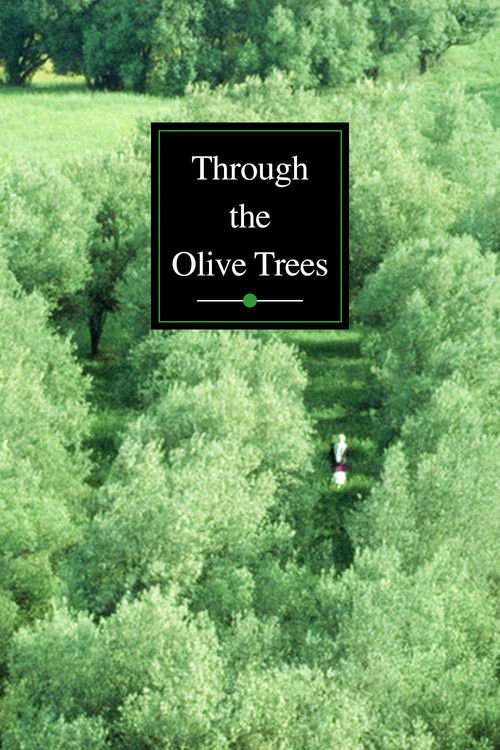
Through the Olive Trees
1995 · Abbas Kiarostami
For when you want something humane and unhurried that makes you think about love, class and cinema itself — a contemplative evening film that rewards calm attention over channel-surfing energy.
What it's about
A film crew arrives in an Iranian village to shoot a scene, and when an actor drops out, the director casts Hossein, a local young man — opposite Tahereh, the young woman he has actually proposed to and whose family refused him. Take after take, they must play a couple on camera while their real, unresolved courtship continues in the pauses. The line between the movie being made and the lives being lived gets thinner with every setup.
The experience
Gentle, patient and quietly funny, with a slow-building emotional pull — the repetitions of filmmaking become suspense, because each ruined take is another chance for Hossein to plead his case. The final stretch is one of the most quietly breathtaking things you'll see.
Performances
The cast are largely nonprofessionals playing versions of themselves, and Hossein's guileless, stubborn sincerity gives the film a truthfulness no script could fake.
The craft
Kiarostami folds a real courtship inside the making of his own earlier film, so documentary and fiction keep trading places — a film-within-a-film built from long takes, dusty roads and olive groves. The famous closing shot, held at an immense distance, turns landscape itself into storytelling.
Why it matters
The capstone of Kiarostami's Koker Trilogy and a key work in the wave of Iranian cinema that captivated the world in the 1990s, hugely influential on filmmakers drawn to blurring fiction and reality.
Snapshot
Through the Olive Trees (Zir-e derakhtan-e zeytun) is the final panel of Abbas Kiarostami's so-called "Koker Trilogy," and one of the purest expressions of the reflexive, fiction-within-documentary method that made him the most internationally celebrated Iranian filmmaker of his generation. Nominally the film follows the making of a scene from Kiarostami's own earlier feature And Life Goes On (also known as Life and Nothing More…, 1992), in which a young man, Hossein, must repeatedly perform a mundane exchange of dialogue with a young woman, Tahereh. Off the set, Hossein is genuinely in love with Tahereh and has proposed marriage; she, or her family, has refused him on grounds of class and literacy. The "film" thus becomes a frame in which a real courtship plays out during the breaks between takes, culminating in a celebrated long-held final shot across an olive grove whose outcome Kiarostami deliberately withholds. Completed in 1994 and released internationally through 1994–95, it premiered in competition at Cannes and consolidated Kiarostami's standing on the festival circuit two years before the Palme d'Or he would win for Taste of Cherry. It is a small film of enormous conceptual ambition: a love story told almost entirely through the apparatus of its own filming.
Industry & production
The film was produced within the framework that had shaped Kiarostami's career since the 1970s: the Institute for the Intellectual Development of Children and Young Adults (Kanun), the state-affiliated body where he founded the filmmaking department in 1969 and made much of his early work. Kanun is credited as the production entity, with the picture also carrying French co-production and distribution involvement — the marketing arm Miramax/foreign distributors and the French connections around Kiarostami's Cannes profile were increasingly central to how these films reached the world. (The precise financing split is not something I can state with confidence beyond the Kanun base and international distribution partners; I would not want to invent budget figures, which are not reliably documented for this film.)
The production's defining industrial fact is that it grew directly out of a prior Kiarostami production. And Life Goes On had itself been made as a fictionalized return to the region devastated by the June 1990 Manjil–Rudbar earthquake, which killed tens of thousands in northern Iran and destroyed the village of Koker where Kiarostami had shot his 1987 film Where Is the Friend's House?. Through the Olive Trees takes the shooting of one scene from And Life Goes On as its ostensible subject, restaging the film crew's presence in the earthquake zone. Production therefore returned to the same Gilan-region landscapes — rubble, half-standing houses, hillside olive groves, and the winding roads that recur across all three films. Kiarostami worked, as was his lifelong practice, with a small crew and largely with non-professional local performers, casting people from the region and building the drama around their real speech, hesitations, and rhythms.
Technology
Technologically the film is modest and deliberately so; Kiarostami's aesthetic was built on economy of means rather than apparatus. It was shot on 35mm color film in a roughly Academy/standard ratio, with predominantly natural light and location sound gathered in real environments rather than on stages. Kiarostami's signature technological instrument is not a camera innovation but a spatial one: the automobile and the long lens, which allow him to film conversation and movement across great distances of landscape while compressing figures against terrain. Nothing about the production depended on optical effects or post-production trickery; the "special effect" of the film is entirely structural — the layering of a real crew, a staged crew, and a real emotional situation. It is worth noting that the celebrated final shot's extreme long take is a product of disciplined staging and lens choice rather than any technological novelty.
Technique
Cinematography
The cinematography, credited to Hossein Djafarian (with camera work associated with the Kiarostami unit), is defined by the long shot and the long take. Kiarostami repeatedly places his camera at a distance from his subjects, letting human figures become small marks moving through hillsides, olive terraces, and zigzagging paths — a compositional signature already familiar from Where Is the Friend's House? The film's most analyzed image is its final sequence: a single sustained take, filmed from a high vantage, in which Hossein pursues Tahereh down a slope, through the olive trees, and out across an open green field, the two figures dwindling to specks. The refusal to cut in, to give a reverse shot, or to let the audience hear the decisive words is the film's entire meaning delivered as a camera decision. Elsewhere the camera favors the static frame and the patient hold, trusting duration and landscape over montage.
Editing
Editing — Kiarostami habitually cut his own films or worked in close control of the cut — is characterized by restraint and by the withholding of conventional coverage. The film's reflexive structure means that many "scenes" are repetitions: the same fragment of And Life Goes On dialogue performed again and again, take after take, so that editing becomes a study of variation and failure rather than of continuity. The decisive editorial gesture is the absence of a cut in the finale — a refusal that converts the whole prior film into a build-up whose resolution is denied.
Mise-en-scène / staging
The mise-en-scène is layered in a way that is central to the film's argument: within a single frame we frequently see the fictional film being staged (director, clapperboard, crew adjusting a scene) and, simultaneously or in the margins, the "real" life of the performers leaking through. Kiarostami stages the boundary between performance and reality as a physical, spatial thing — the set, the truck, the space just off-camera where Hossein pleads his case. The rubble of the earthquake and the terraced olive groves are not backdrop but structuring elements, giving the human drama a scale that dwarfs and dignifies it.
Sound
Sound is predominantly diegetic and location-based: wind through trees, engines, the ambient noise of a working set, the flat repetition of rehearsed lines. Kiarostami generally avoids non-diegetic scoring in this period, preferring silence and environmental sound; music, where it appears, is sparing. The soundscape reinforces the documentary texture — we hear the awkwardness of amateurs speaking, the director's off-screen instructions, the mechanical interruptions of filmmaking.
Performance
The performances come from non-professionals, most famously Hossein Rezai as Hossein, the young mason whose blunt, persistent, self-taught eloquence about class and love gives the film its emotional engine. Mohammad Ali Keshavarz, an established professional actor, plays the film director figure, providing a poised counterweight to the amateurs around him. Kiarostami's method — drawing performance out of real personalities through repetition, patience, and the blurring of a person's life into their role — means that "acting" here is inseparable from being; Hossein's monologues about wanting an educated wife and about the reasoning that the illiterate should marry the illiterate carry the unpolished conviction of lived speech.
Narrative & dramatic mode
The dramatic mode is reflexive realism: a fiction that continually exposes and thematizes its own construction. The narrative operates on nested levels — the film we are watching, the film-within being shot, and the "real" lives of the participants — with the seams between them deliberately visible. The dramatic tension is minimalist and almost entirely deferred: it rests on whether Tahereh will accept Hossein, a question posed early and answered, if at all, only in the ambiguous final long shot. Kiarostami substitutes duration, repetition, and open-endedness for conventional plotting; the "story" is less an arc than an accumulation of takes, waits, and conversations. The famous open ending is the purest instance of his refusal of narrative closure, inviting the viewer to supply the meaning the film withholds.
Genre & cycle
Generically the film sits at the intersection of art-cinema drama, romance, and the "film about filmmaking." Its most important cyclical belonging is to the Koker Trilogy — Where Is the Friend's House? (1987), And Life Goes On (1992), and Through the Olive Trees (1994) — a grouping named for the village and unified by shared landscape and by each film recursively containing or responding to the one before. It should be noted that Kiarostami himself was ambivalent about the "trilogy" label, which was applied largely by critics and festival programmers; he suggested the films were connected by geography rather than conceived as a planned cycle. The film also belongs to a broader Kiarostami cycle of self-reflexive works (extending toward Close-Up in 1990) that treat cinema's relationship to reality as their true subject.
Authorship & method
Through the Olive Trees is a near-total authorial work: Kiarostami wrote, directed, and exercised close control over the edit, as was his lifelong practice. His method — non-professional casting, location shooting in real communities, scripting that leaves room for improvisation and real speech, and a structural fascination with the line between documentary and fiction — is fully mature here. Key collaborators include cinematographer Hossein Djafarian and the Kanun production apparatus; the professional actor Mohammad Ali Keshavarz anchors the cast, while Hossein Rezai supplies its raw center. Kiarostami's authorship is defined less by visual flourish than by a philosophy of restraint: the withheld reverse shot, the long take, the trust in landscape and duration, and the ethical humility of letting non-actors carry their own lives into the frame. This is an auteurism of subtraction — meaning generated by what the director declines to show or resolve.
Movement / national cinema
The film is a landmark of the Iranian New Wave, and specifically of the post-revolutionary Iranian cinema that, under the constraints of the Islamic Republic's censorship regime, developed a globally admired language of allegory, indirection, and humanist realism. Kiarostami is the central figure of this movement's international breakthrough, and Through the Olive Trees — together with the films of contemporaries and successors such as Mohsen Makhmalbaf and, later, Jafar Panahi and Asghar Farhadi — helped define what the world understood as "Iranian cinema" in the 1990s: rural or provincial settings, children and non-professionals, ethical simplicity married to formal sophistication, and a self-reflexive interest in the act of representation. The film's engagement with real disaster (the 1990 earthquake) grounds this movement's abstraction in a specific national landscape and history.
Era / period
Made in 1994 and circulating internationally in 1994–95, the film belongs to the peak decade of festival-driven world cinema, when a small number of non-Western auteurs — Kiarostami foremost among them — became canonical figures in European and North American film culture. Domestically it belongs to a period of relative, negotiated openness in Iranian art cinema, in which filmmakers worked within and around state constraints. The trilogy as a whole spans the late 1980s to mid-1990s, and Through the Olive Trees closes that arc just before Kiarostami's international apotheosis with the 1997 Palme d'Or for Taste of Cherry.
Themes
The film's governing theme is the porous boundary between cinema and reality — the way filming both records life and intervenes in it. Around this run several intertwined concerns: class and literacy as barriers to love, dramatized through Hossein's insistence that his poverty and the objection to his illiteracy should not disqualify him (and his counter-argument that the educated and uneducated might redress each other's lack); persistence and hope in the aftermath of catastrophe, with the earthquake's devastation as a constant backdrop against which ordinary desire — to marry, to build a house, to continue — becomes quietly heroic; and the ethics of representation, Kiarostami's recurring meditation on what a director owes the real people he films. The open ending crystallizes the film's deepest theme: that meaning, like love, is something the viewer must complete, and that cinema's honesty lies partly in refusing to pretend it knows the outcome.
Reception, canon & influence
Through the Olive Trees premiered in competition at the 1994 Cannes Film Festival and was received as a major work by an already-revered auteur; it was selected as Iran's submission for the Academy Award for Best Foreign Language Film for that year, though it did not secure a nomination. Critically it was embraced by the influential Western cinephile establishment — Kiarostami's champions among European critics and, in the United States, notably the critical enthusiasm that surrounded his work in the 1990s — as confirmation of his standing. Its precise commercial performance was modest, as with most subtitled art films of the period, and I would not want to attach specific box-office figures I cannot verify.
The influences on the film are, first, Kiarostami's own preceding work — it is quite literally built on And Life Goes On and reaches back to Where Is the Friend's House? — and, more broadly, the traditions of Italian neorealism (non-professional casting, location shooting, everyday drama) and of documentary-fiction hybridity that Kiarostami absorbed and transformed. Its forward influence is substantial and well-documented in its broad strokes: the film reinforced a model of reflexive, ethically self-aware realism that shaped later Iranian filmmakers — Panahi (who worked as an assistant in Kiarostami's orbit), Farhadi, and others — and it fed directly into the international art-cinema conversation about self-reflexivity and the long take, admired by figures across world cinema who cited Kiarostami as a touchstone. Its most tangible legacy is the closing shot itself, which became one of the most discussed endings in modern cinema and a shorthand for the "open," interpretively generous ending. Within Kiarostami's own body of work it is the hinge between his early Kanun-rooted humanism and the more austere, philosophically radical films — Taste of Cherry, The Wind Will Carry Us — that followed. It endures in the canon less as a popular favorite than as an essential text for anyone tracing how cinema learned to film its own relationship to the real.
A Deleuzian reading
Two figures crossing a green field, so far off you could cover them with a thumb.
The full Deleuzian reading of Through the Olive Trees →
Reception
A Cannes competition title in 1994 that helped make Kiarostami the festival darling of the decade, it was slightly overshadowed at the time by the films around it; the Criterion Koker Trilogy box later cemented it as the capstone of one of cinema's great trilogies rather than a footnote.
How Through the Olive Trees was received, from release to now →
How to watch Through the Olive Trees: what to notice on a first viewing
- Watch people become tiny marks against hillsides and terraces. Kiarostami keeps the camera at a real distance from his characters throughout, letting them shrink against olive terraces and earthquake rubble rather than filling the frame. You're always aware of how much bigger the landscape is than any one person's story.
- Notice the same few lines of dialogue repeated take after take. A short fragment of dialogue from Kiarostami's earlier film gets performed again and again on camera, with each attempt slightly different from the last. Watching the same words fail and succeed differently each time becomes its own kind of drama.
- Watch for the clapperboard and crew inside the same frame. Kiarostami keeps the filmmaking apparatus visible within shots, director, crew, and clapperboard sharing space with performers whose real lives leak in around the edges. You're never allowed to forget you're watching a film about the making of a film.
- Listen for wind, engines, and ordinary set noise instead of music. Kiarostami avoids a conventional score almost entirely here, letting location sound and the mechanical interruptions of filmmaking carry the soundtrack instead. The lack of music keeps the film feeling closer to overheard life than to storytelling.
- Watch Hossein argue his case to anyone who will listen. Hossein Rezai plays the young mason with a blunt, self taught eloquence, reasoning out loud about class and literacy every chance the production gives him. A nonprofessional actor's own conviction is doing work that a scripted performance usually can't.
The whole guide to watching Through the Olive Trees, with the keys for a rewatch →
Influences: the films it descends from and the films it influenced
- Where Is the Friend's House? (1987) — First film in the Koker trilogy, whose non-professional child cast, real Gilan village locations, and repeated-quest structure Olive Trees literally re-films — its actors and terrain become the diegetic subject of the later movie.
- Close-Up (1990) — Establishes Kiarostami's documentary-fiction hybrid method — restaging real events with the real people who lived them — that Olive Trees extends by having a non-actor replay his own courtship on camera.
- Life, and Nothing More… (1992) — Completes the reflexive spiral by fictionalizing the making of Life, and Nothing More… — re-casting its non-professionals and turning its production into the next film's plot.
- Taste of Cherry (1997) — Descendant that pushes the withheld-reverse-shot and open-ending devices to their limit — the car-window conversations and the video-coda rupture extend Olive Trees' refusal to resolve.
- The Mirror (1997) — Directly inherits Olive Trees' reflexive rupture: mid-film the child actor quits and the fiction collapses into documentary, exactly the film-within-a-film seam Kiarostami exposed.
- A Moment of Innocence (1996) — Sibling reflexive-realist work that restages a real past event by casting the actual participants to re-enact it, sharing Kiarostami's documentary-fiction ethics and open freeze-frame ending.
- A Separation (2011) — Builds drama from the gap between what is performed for others and what is true, blurring testimony and fiction — the epistemic instability Farhadi weaponizes for moral suspense.
- It Was Just an Accident (2025) — Panahi served as assistant director here, absorbing Kiarostami's method of directing non-professionals to re-enact lived reality and letting a resolution hang unresolved in a long final take.
- The Lunchbox (2013) — Embodies the Iranian art-house ethic of understatement and the courage to withhold the ending, resolving a courtship on an ambiguous, unreadable long-shot rather than closure.
- No Bears (2022) — Panahi assisted on this film, absorbing its meta-structure of a director-figure directing non-actors on a real location, plus the long-take rural framing and the running gag of a filmmaker's authority meeting village reality that No Bears redeploys directly.
- Possible Love (2026) — A film shoot serves as the frame for a courtship across a class divide. The crew's control over who speaks, and how, becomes part of the romance's power imbalance.
- And Life Goes On (1992) — The direct predecessor Olive Trees is built atop: it invents Kiarostami's reflexive device of a director-surrogate returning to a filmed location, which Olive Trees recurses one level deeper by dramatizing the making of a scene from it.
- Bicycle Thieves (1948) — Ancestral neorealist template of non-professional casting and location shooting of everyday economic hardship that Kiarostami absorbed and turned reflexive.
- Paisan (1946) — Rossellini's rough location realism and use of real inhabitants over trained actors is the neorealist documentary-fiction lineage Kiarostami cites as foundational.
- The Cow (1969) — Founding Iranian New Wave work whose village-set social realism and non-professional performance established the national tradition Kiarostami radicalized formally.
- The House Is Black (1963) — Poetic Iranian documentary whose blend of observed reality and lyrical framing prefigures the withheld, contemplative long-shot ethic of Kiarostami's landscape.
- The Wind Will Carry Us (1999) — Extends the auteurism of subtraction — off-screen characters, long-shot distance, and duration replacing plot — that Olive Trees pioneered in its final zigzag-path shot.
- The White Balloon (1995) — Panahi, an assistant in Kiarostami's orbit and working from his script, carries forward real-time non-professional child realism shot in actual streets.
- The Apple (1998) — Next-generation Iranian New Wave film reconstructing a true story with the real family playing themselves on location — the participatory non-professional method Olive Trees modeled.
- About Elly (2009) — Farhadi inherits the withheld-information and open-ending structure — meaning generated by what is declined and left unresolved — descending from Kiarostami's auteurism of subtraction.
- Ten (2002) — Late Kiarostami that abstracts the car-bound, fixed-frame, non-professional real-speech conversations Olive Trees rehearsed into a whole structural system.
- Certified Copy (2010) — Carries the cinema-and-reality inquiry abroad — the couple's status as real or performed stays deliberately unresolved, the same reflexive ambiguity as Olive Trees' film-within-a-film.
- Goodbye, Dragon Inn (2003) — Sibling festival-world slow-cinema work extending the non-scored diegetic soundscape, extreme long take, and duration-over-event aesthetic Kiarostami helped canonize.
Similar films
- Taste of Cherry (1997) — influence & lineage · same viewing thread
- The Wind Will Carry Us (1999) — influence & lineage · same viewing thread
- Close-Up (1990) — influence & lineage · same viewing thread
- Certified Copy (2010) — influence & lineage · same viewing thread
- Where Is The Friend's House? (1987) — influence & lineage · same viewing thread
- The Cow (1969) — influence & lineage
- The Mirror (1997) — influence & lineage · same viewing thread
- Life, and Nothing More… (1992) — same viewing thread
All the films related to Through the Olive Trees →
Watch it with: curated runs of related films
- Where Fiction Meets the Real — Watch these in sequence for the way each lets a staged fiction quietly dissolve into something documentary-real — and the real get restaged as fiction — usually while someone is on a road or a walk.