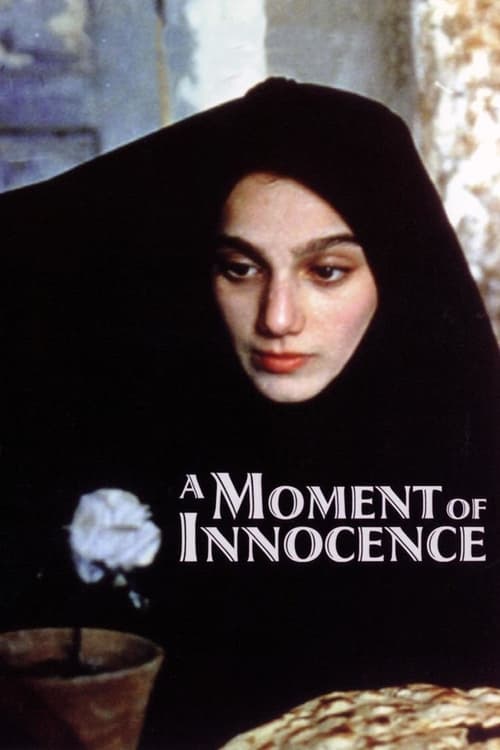
A Moment of Innocence
1997 · Mohsen Makhmalbaf
For when you want a film to chew on for days — one that's warm and funny in the watching and keeps unfolding afterward. A thoughtful-evening pick: modest in scale, big in what it leaves you with.
What it's about
At seventeen, during a protest under the Shah, the director Mohsen Makhmalbaf stabbed a policeman. Twenty years later, the two men meet again — and instead of an apology, they make a film: each coaches a young actor to play his younger self as they attempt to restage the incident that marked both their lives. The film follows the rehearsals, where the two men's memories, and their hopes for who they were, refuse to line up.
The experience
Playful, wintry, and unexpectedly moving — it starts as a wry game about making a movie and gradually becomes something tender about regret, youth, and the wish to redo one irreversible moment. It's short, gentle, and it lands with surprising force.
The craft
Makhmalbaf builds the film out of its own making — auditions, coaching sessions, retakes — so that reconstruction and confession become the same act, all shot with disarming simplicity against snowy Tehran streets. A marriage proposal, a loaf of bread, and a flower pot carry more weight here than most films' entire plots. The final image is one of the most celebrated in Iranian cinema.
Why it matters
A touchstone of the Iranian cinema that captivated the world in the 1990s, it showed how far the line between fiction and documentary could bend — and stands as Makhmalbaf's most personal reckoning with his own militant youth.
Snapshot
A Moment of Innocence — Persian title Nun o Goldoon (نون و گلدون), usually rendered "Bread and Flower Pot" — is Mohsen Makhmalbaf's reflexive reconstruction of the defining trauma of his own youth. In 1974, at seventeen, Makhmalbaf was an anti-Shah Islamist militant who stabbed a policeman during an attempt to seize the officer's weapon; he was shot, arrested, and imprisoned until the 1979 revolution freed him. Roughly two decades later, while Makhmalbaf was casting his audition-film Salaam Cinema (1995), the very policeman he had wounded reportedly presented himself among the applicants. Out of that improbable reunion the director built a film in which the two men — the former militant and the former officer — collaborate to restage the stabbing, each coaching a young actor to play his younger self. The result is at once a memoir, a making-of, and a moral fable, and it is widely regarded as one of the summits of the Iranian New Wave. It belongs to the same self-interrogating tradition as Abbas Kiarostami's Close-Up, folding documentary premise, staged rehearsal, and outright fiction into a single continuous gesture that ends on one of the most celebrated freeze-frames in modern cinema.
Industry & production
The film was produced within the Iranian art-cinema ecosystem of the mid-1990s, a period in which directors such as Kiarostami, Jafar Panahi, and Makhmalbaf himself achieved sustained international festival visibility even as they worked under domestic censorship and modest budgets. A Moment of Innocence is a low-budget production in the characteristic manner of the movement: small crew, real locations in and around Tehran, non-professional or semi-professional performers, and a shooting method that blurs preparation with the finished work. It emerged directly from Makhmalbaf's Salaam Cinema, and the two films share a preoccupation with the audition, the camera, and the ethics of directing ordinary people. The picture circulated principally through the festival and art-house circuits abroad rather than through wide commercial release, and it was internationally distributed as A Moment of Innocence. Precise budget and box-office figures for the film are not part of the reliable public record, and I will not invent them; what is documented is its strong critical reception on the festival circuit in 1996–1997.
Technology
Technologically the film is unremarkable by design, and that plainness is part of its meaning. It was shot on 35mm film using naturalistic, largely available-light setups consistent with the resource-light practice of Iranian cinema in the period. There are no optical spectacle, no elaborate camera rigs, and no post-production trickery beyond the decisive final freeze — a device achieved through the oldest and simplest means of the medium, the held frame. The film's power comes not from apparatus but from its structural conceit, and Makhmalbaf deliberately foregrounds the humblest tools of production — the director's instructions, the actor's rehearsal, the clapper of a scene about to be shot — as its true subject.
Technique
Cinematography
The cinematography favors a documentary immediacy: hand-held and shoulder-mounted mobility during the coaching scenes, plainer compositions during the staged reconstructions, and an overall preference for the texture of real Tehran streets and interiors over pictorial polish. Winter light, damp pavements, and the muted palette of the city give the film a wintry, unglamorous surface against which the emotional warmth of its ending registers all the more strongly. The camera is treated as a participant rather than an invisible observer — characters address it, are positioned for it, and are repeatedly reminded of it. I am not able to confirm the director of photography credit with certainty from memory, and rather than attribute the work to a specific cinematographer erroneously, I note that the visual scheme is fully continuous with the stripped-down house style Makhmalbaf pursued across the mid-1990s.
Editing
Editing is the film's true engine, because the whole work is an exercise in cutting between levels of reality — between the "real" present of the shoot, the rehearsed past, and the imagined ideal each man carries of that day. The film braids two parallel productions (the young Makhmalbaf's storyline and the young policeman's storyline) and moves fluidly between them, so that the audience is continually re-calibrating what it is watching. The editing withholds and delays the climactic act, building toward the final tableau that arrests the movement of the story entirely. Makhmalbaf frequently edited or closely supervised the cutting of his own films; I cannot confirm the exact editing credit here without risk of error, so I flag the point rather than assert a name.
Mise-en-scène / staging
Staging is the film's most brilliant dimension, precisely because staging is its story. We watch the two older men block the scene: where the girl should stand, how the young militant should approach, where the knife (here a prop, and a moral object) should be hidden under the flat bread. The mise-en-scène is doubled and self-conscious — every setup we see being built is also the setup we are watching as a film. Makhmalbaf exploits the theatrical geometry of the encounter (the officer on his beat, the young woman who approaches to ask directions as a decoy, the militant closing in) so that the same few square meters of street become a stage rehearsed over and over. The famous conclusion resolves this staging into a single held image in which the two young performers, refusing the script of violence, extend bread and a flower instead — the mise-en-scène itself becomes the moral argument.
Sound
The soundtrack is predominantly naturalistic — street ambience, footfalls, the overlapping voices of direction and correction. Dialogue carries the film, much of it the running argument between the two older men about how their shared past should be remembered and represented. Music is used sparingly rather than as continuous underscoring. I do not have a reliable attribution for the film's composer and will not manufacture one; what can be said with confidence is that the sound design privileges the human voice and the everyday acoustics of the city over any sweeping score.
Performance
The performances are the film's ethical heart because the principals are, in a sense, playing themselves. The former policeman — credited as Mirhadi Tayebi — appears as an older man still nursing a romantic and heroic self-image of the day he was stabbed, insisting that the young actor portray him as dashing and beloved. Makhmalbaf directs a younger performer to embody his own teenage self, and the tension between the two older men's competing memories drives the drama. The young non-professional actors cast to play the pair as youths give tentative, searching performances that are precisely right for characters who are, literally, learning their roles on camera. The acting is thus layered: real people performing versions of themselves, directing surrogates who perform versions of them.
Narrative & dramatic mode
The narrative mode is radically reflexive and meta-cinematic. There is no clean fictional fourth wall; the film is structured as the making of a reconstruction, and its "plot" is the negotiation over that reconstruction. This places the work in the register of the essay-film and the docufiction hybrid, where autobiography, documentary, and staged fiction are deliberately made indistinguishable. The dramatic engine is not suspense about what happened — the historical event is known from the outset — but suspense about how it will be remembered and re-enacted, and whether the restaging can transform the meaning of the original violence. The climactic freeze-frame is the film's dramatic pivot: by stopping time at the instant of decision, Makhmalbaf substitutes reconciliation for the recorded fact of the stabbing, offering art as a form of retroactive grace.
Genre & cycle
Nominally classed as drama and comedy — and it is genuinely funny in its portrait of the vain, wounded ex-policeman and the frictions of directing — the film sits most naturally in the cycle of self-reflexive Iranian films about filmmaking that defined the international image of Iranian cinema in the 1990s. Its closest kin is Kiarostami's Close-Up (1990), with its restaging of a real event by its real participants, and the films of the Koker orbit that fold documentary and fiction together. Within Makhmalbaf's own output it forms a loose cycle with Salaam Cinema (1995) and The Silence (1998), and with his broader movement from ideologically committed early work toward humanist meta-cinema.
Authorship & method
A Moment of Innocence is a signature Makhmalbaf work in that it turns the director's own biography into method. Born in Tehran in 1957, Makhmalbaf joined an underground anti-Shah Islamist group as a teenager, committed the 1974 stabbing that lands at the center of this film, and spent years in prison before the revolution released him; he then became one of the Islamic Republic's most prominent filmmakers before evolving into a humanist and eventually a dissident voice. The film's method is participatory and improvisational: casting the historical actors of an event to re-perform it, allowing their present-day disagreements to reshape the material, and privileging process over polished result. On the key craft collaborators — cinematographer, editor, and composer — the public record as I can reliably recall it is thin, and I decline to assign specific names I cannot verify. What is not in doubt is that the conception, the autobiographical source, and the reflexive design are wholly Makhmalbaf's, and that the film is inseparable from his own life story and from the family filmmaking workshop (the Makhmalbaf Film House) through which he trained his relatives and collaborators.
Movement / national cinema
The film is a canonical work of the Iranian New Wave in its second, internationally celebrated phase. That movement — encompassing Kiarostami, Panahi, Makhmalbaf, and later the director's daughter Samira Makhmalbaf — was distinguished by neorealist location shooting, non-professional casts, child and everyday protagonists, and an insistent inquiry into the boundary between reality and representation. A Moment of Innocence exemplifies the movement's reflexive strain, its ability to make political and ethical meaning under censorship through allegory and formal ingenuity, and its transformation of material poverty into aesthetic principle. It is frequently cited alongside Close-Up as a defining statement of Iranian cinema's self-questioning method.
Era / period
Produced in mid-1990s Iran, the film belongs to a moment of relative cultural opening under the reformist currents that would culminate in Mohammad Khatami's 1997 presidency, when Iranian art cinema enjoyed unprecedented festival prestige abroad. It also looks back across a generation: its historical layer is set in 1974, in the last years of the Pahlavi monarchy and the atmosphere of militant opposition that preceded the 1979 revolution. The film thus spans two Irans — the pre-revolutionary state whose policeman the young Makhmalbaf attacked, and the post-revolutionary state in which both men have grown middle-aged — and quietly measures the distance between the certainties of youth and the doubts of maturity.
Themes
Its central themes are memory, reconciliation, and the ethics of representation. The film asks whether a violent past can be re-authored, whether art can undo or redeem historical harm, and how two people can hold irreconcilable memories of the same event. It meditates on innocence and its loss — the "moment" of the title is the instant before violence, which the film ultimately refuses to complete. It interrogates the filmmaker's power over his subjects and his past, turning the act of directing into a moral test. And in its closing image of bread and flower offered in place of a knife, it advances a humanist, almost pacifist argument: that the gestures of ordinary kindness might be substituted for the scripts of ideological violence that the older men, and the nation, once followed.
Reception, canon & influence
Critically, A Moment of Innocence was received abroad as a major achievement and helped consolidate Makhmalbaf's international reputation in the second half of the 1990s; it circulated widely on the festival and art-house circuit and drew particular praise for its ending, often described as among the most moving final shots in Iranian cinema. I am wary of citing specific festival prizes or numerical honors from memory and will not fabricate an awards list, but the film's standing on international "best of Iranian cinema" and best-of-the-1990s reckonings is secure and frequently reaffirmed by critics. Looking backward, its influences are the reflexive experiments of the Iranian New Wave — above all Kiarostami's Close-Up, with its restaging of reality by real participants — and Makhmalbaf's own evolution from committed revolutionary to self-doubting artist. Looking forward, the film reinforced the international model of Iranian docufiction and reflexive cinema that shaped the work of the next generation, including the films made within Makhmalbaf's own family workshop, and it remains a touchstone in scholarship and teaching on the ethics of reenactment, autobiography on screen, and the porous border between documentary and fiction.
Reception
Banned in Iran on release even as it won admirers at Locarno, it spent years as the connoisseur's Makhmalbaf pick — now it's routinely ranked among the very best Iranian films of the '90s, championed by critics like Jonathan Rosenbaum.
How A Moment of Innocence was received, from release to now →
How to watch A Moment of Innocence: what to notice on a first viewing
- Watch the two older men block the scene together. Makhmalbaf and the man he stabbed argue over where the girl should stand, how the boy should approach, where to hide the knife under the bread, rehearsing the same street corner over and over. The planning itself is the film. Every choice about staging a memory is also an argument about what that memory means.
- Notice characters looking straight into the camera. Makhmalbaf keeps the camera present as a participant rather than a hidden observer, with people positioned for it, addressed by it, and reminded out loud that it's there. You're never allowed to forget that everything you're watching is being built in front of you.
- Watch the ex-policeman coach his own younger double. Mirhadi Tayebi wants the boy playing him to look dashing and beloved, still holding onto a romantic version of the day he was stabbed, twenty years and one grudge later. You're watching a man direct his own memory into something more flattering than what happened.
- Follow two separate rehearsals happening at once. The film keeps switching between the young militant's storyline and the young policeman's storyline, plus the older men's arguments about both, so you're tracking several versions of one day. The switching keeps reminding you that a single afternoon can be remembered as several different stories at once.
- Notice the flat winter light on wet streets. The film stays gray, damp, and unglamorous throughout, Tehran shot for texture rather than beauty, plain streets standing in for a plain, unresolved memory. The drab surface keeps the street plain, so small human gestures stand out.
The whole guide to watching A Moment of Innocence, with the keys for a rewatch →
Influences: the films it descends from and the films it influenced
- Close-Up (1990) — Casts the actual people from a real event to reenact it for the camera, the docufiction reenactment-by-original-participants method Makhmalbaf inherits wholesale by recalling the real policeman he stabbed to replay the stabbing.
- Through the Olive Trees (1994) — Builds a film out of restaging a real courtship, with a non-professional actor openly negotiating and reshaping his role between takes — the same porous rehearsal-as-subject structure Makhmalbaf turns on his own biography.
- Salaam Cinema (1995) — Makhmalbaf's own prior experiment making the audition and the act of directing ordinary people into the film's subject, establishing the participatory casting method he reuses here.
- The 400 Blows (1959) — Ends on a held freeze-frame of a face that suspends narrative resolution — the formal device Makhmalbaf answers with his celebrated frozen final image of the bread and flower offered instead of the knife.
- Bicycle Thieves (1948) — Neorealist template of non-professional casts, real locations, and available light that the Iranian New Wave adapted and that governs this film's handheld, unlit-street shooting.
- Man with a Movie Camera (1929) — Bares the filmmaking apparatus — cameraman, editing bench, the act of shooting shown inside the film — the reflexive gesture Makhmalbaf extends by making the direction of two young re-enactors visibly part of the story.
- 8½ (1963) — Converts the director's own creative and moral crisis into the film's organizing structure, the autobiography-as-method that Makhmalbaf sharpens into literal self-interrogation of his terrorist past.
- Persona (1966) — Doubles two figures into mirrored, interchangeable presences and ruptures the illusion by exposing the celluloid itself — precursor to Makhmalbaf's doubled mise-en-scène of past and present selves played by two actors.
- The Cow (1969) — Founding Iranian New Wave work whose neorealist non-professional performance and village-location realism seed the national tradition Makhmalbaf's handheld naturalism grows from.
- Death of Yazdgerd (1982) — Brings the actual participants back to restage a past incident, each producing an incompatible version — recursive reenactment of memory as irreconcilable testimony.
- The Apple (1998) — Product of the Makhmalbaf Film House workshop that casts a real family to reenact their own confinement, directly applying the father's participatory people-playing-themselves method.
- Blackboards (2000) — Extends the family-workshop practice of non-professional casts and itinerant handheld shooting in unscripted real terrain into a new subject.
- This Is Not a Film (2011) — Reflexive cinema wholly about its own making and the ethics of representation under constraint, carrying forward the Iranian meta-cinematic mode this film helped canonize.
- The Act of Killing (2012) — Has real perpetrators restage their own crimes for the camera, globalizing the ethics-of-reenactment inquiry — the perpetrator confronting his act through performance — that Makhmalbaf pioneered with his own assailant-and-victim reunion.
- Taste of Cherry (1997) — Shares the available-light handheld car-and-street realism and closes by revealing the crew and video camera, the same year's twin gesture of exposing the fiction's own construction.
- The Mirror (1997) — Has its child lead abruptly quit the fiction mid-film and refuse to keep acting, staging the identical rupture where a performer's real refusal reshapes the docufiction in real time.
- Gabbeh (1996) — Makhmalbaf's adjacent-year film weaving memory and reenactment across time through available-light color realism, sharing the memory-and-reconciliation formal preoccupation.
- Life, and Nothing More… (1992) — Reflexively restages a real event from the director's own past with the actual people who lived it, kin to the Close-Up/Koker docufiction of participants replaying themselves.
- No Bears (2022) — An Iranian New Wave landmark of reflexive docufiction in which the director restages a real event with its actual participants, sharing No Bears' method of interrogating authorship and the reliability of the recorded image.
Similar films
- Close-Up (1990) — influence & lineage · same viewing thread
- The Mirror (1997) — influence & lineage · same viewing thread
- Taste of Cherry (1997) — influence & lineage · same viewing thread
- The Cow (1969) — influence & lineage
- No Bears (2022) — same viewing thread
- Through the Olive Trees (1995) — same viewing thread
- Where Is The Friend's House? (1987) — same viewing thread
- Life, and Nothing More… (1992) — same viewing thread
All the films related to A Moment of Innocence →
Watch it with: curated runs of related films
- Where Fiction Meets the Real — Watch these in sequence for the way each lets a staged fiction quietly dissolve into something documentary-real — and the real get restaged as fiction — usually while someone is on a road or a walk.