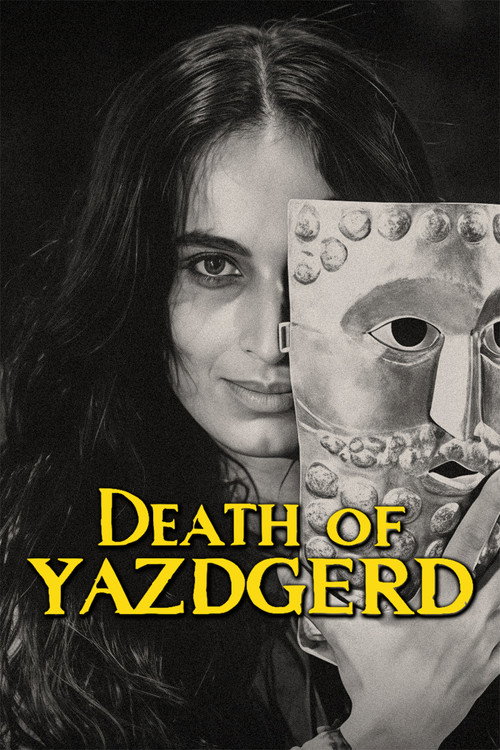
Death of Yazdgerd
1982 · Bahram Beyzai
For when you want a film to argue with — something dense and theatrical to chew on for days, not comfort viewing. Reach for it when a single-room drama with life-and-death stakes sounds more thrilling than a battle scene.
What it's about
In the summer of 651, the last king of Persia's Sassanid empire is found dead in a mill on the edge of the realm he was fleeing, his crown missing and Arab armies closing in. A royal commander and a priest arrive to accuse the miller and his family of murdering him for his jewels. What follows is not a trial but a spiral of testimony: the miller, his wife, and their daughter act out competing versions of the king's last night, each of them taking a turn playing the dead monarch, each retelling undoing the one before.
The experience
Intense, wordy, and hypnotic — almost all of it unfolds in one firelit room, and the tension comes from language and performance rather than action. It plays like a ghost story crossed with an interrogation, and it keeps you off balance about who is telling the truth right up to the end.
Performances
Susan Taslimi is ferocious as the miller's family square off against their accusers — the whole cast works at a heightened, ritual pitch, shifting characters mid-scene without ever losing you.
The craft
Beyzai adapted his own stage play and leans into its theatricality: torchlight, wind, and shadow inside the mill; performers rotating through roles like a ritual; a script whose formal, incantatory Persian dialogue carries the drama. It shows how confinement can be a strength — one room, a handful of actors, and an empire's fall made vivid through pure staging.
Why it matters
Made just after the Iranian revolution and long suppressed at home, it became a touchstone of Iranian art cinema and the clearest showcase of Beyzai's fusion of Persian performance traditions with film. Its timing — a story about one order violently replacing another — gave it a charge that has never faded.
Snapshot
Death of Yazdgerd (Persian: Marg-e Yazdgerd) is Bahram Beyzai's chamber epic about the end of an empire staged as a village inquest. In the summer of 651 CE, the last Sassanid king, Yazdgerd III, fleeing the Arab-Muslim armies that had shattered his realm, is found dead in a mill outside Merv. His body lies among the millstones; the crown is gone. A royal commander and a priest arrive to investigate, presuming the miller and his family have murdered the king for his jewels. What follows is not a trial in any procedural sense but a spiral of contested testimony: the miller, his wife, and their daughter narrate — and physically re-enact — competing accounts of the king's last night, each version dissolving into the next, each performer in turn stepping into the role of the dead monarch. Adapted by Beyzai from his own stage play, the film compresses the collapse of a thousand-year civilization into a single confined space and a handful of bodies. It is among the most rigorously theatrical films in Iranian cinema, and one of the most linguistically dense: Beyzai's archaic, incantatory Persian is as much the film's subject as its medium.
Industry & production
The film was produced in the immediate aftermath of the 1979 revolution, during a period when the Iranian film industry was being institutionally reconstituted and its rules of the permissible were still unsettled. Beyzai — already established as a filmmaker, playwright, and scholar — mounted the production as an adaptation of a play he had written around the revolutionary years. The exact financing and production-company arrangements are not well documented in accessible English-language sources, and this dossier will not guess at figures. What is clear is that the project was conceived economically by necessity and by design: a near-single location, a tiny cast, and a compressed shooting scale that mirrors the austerity of the drama.
The film's subsequent life was shaped by censorship. Beyzai's career is defined by a long antagonism with official cultural gatekeepers both before and after the revolution, and several of his films faced bans, shelving, or restricted release. Death of Yazdgerd — a work that dramatizes the very moment Islam displaced Zoroastrian Iran, and that treats that transition as a scene of violence, ambiguity, and loss rather than triumph — was politically combustible, and it did not circulate freely inside Iran. It became far better known internationally and on the festival and academic circuit than through domestic commercial exhibition. Precise release and box-office data are genuinely thin, and should be treated as such.
Technology
Technologically the film is deliberately unassuming. It was shot on 35mm color film using the conventional apparatus of early-1980s Iranian production; there is no reliance on optical spectacle, process work, or elaborate camera machinery. The technological interest lies instead in what Beyzai withholds. By confining the action to a single interior lit largely as though by natural and practical sources — the gray stone of a working mill, shafts of daylight, the implied glow of fire and lamp — the film foregrounds the plainness of its materials against the grandeur of its historical subject. The "technology" that matters here is pre-cinematic: the mechanics of the mill itself, the grinding stone as a recurring image of implacable process, and the human voice as the primary instrument of storytelling.
Technique
Cinematography
The visual strategy is one of concentration. The camera works within the mill's stone walls, using the architecture — low ceilings, the great wheel and stones, doorways admitting hard light — to frame and reframe a shifting configuration of accusers and accused. Beyzai, whose command of screen space is among the most sophisticated in Iranian cinema, choreographs long, mobile takes in which the composition reorganizes itself around whoever seizes the narrative. Depth is used to keep the silent listeners present at the edges of the frame while a single figure performs. The specific director of photography credit is not something this dossier can attribute with confidence from the available record, and it is better to leave that gap open than to fill it with a false name.
Editing
Beyzai is well known for editing his own films, exercising unusually tight authorial control over rhythm and structure, and Death of Yazdgerd bears the marks of that sensibility whatever the precise credit. The cutting is subordinated to performance: rather than fragmenting the space into a conventional shot/reverse-shot grammar, the film tends to let scenes run so that the actors' transformations — the switch from testimony into re-enactment, from villager into king — happen before the eye without an edit to soften them. The montage logic is that of the theater's blackout and re-entrance rather than the cinema's découpage, and the film's forward motion comes from the accretion and contradiction of stories rather than from cutting rhythm.
Mise-en-scène / staging
This is the film's center of gravity. Death of Yazdgerd is essentially a filmed metamorphosis of a stage work, and its mise-en-scène draws directly on Beyzai's lifelong study of Iranian traditional performance — the ta'zieh passion play, the naqqāli tradition of dramatic storytelling, ritual and folk theater. The single set becomes a stage on which the three family members conjure, by gesture and repositioning alone, a whole cast of absent figures: the fleeing king, the queen, the courtiers, the invading soldiers. Props are minimal and made to carry symbolic weight; the millstone, the sacks of grain, a piece of cloth serving as royal garment become the furniture of an improvised ritual. The staging insists on its own theatricality rather than disguising it, so that the audience is always aware of watching people play at history — which is precisely the film's argument about how history is made.
Sound
Sound in the film is dominated by the human voice. Beyzai's dialogue is written in an elevated, deliberately antique register of Persian, thick with rhythm and rhetorical figure, and the actors deliver it with an almost liturgical cadence. The effect is closer to recitation than to naturalistic speech. Against this, the ambient sound of the mill — the grinding stone, the water, the wind at the door — provides a low, continuous ground bass of labor and time. Any musical scoring is used sparingly; the film's principal music is the prosody of the language itself. This dossier will not attribute a specific composer credit it cannot verify.
Performance
Acting is the film's true special effect. The cast is required to slip continuously between registers — to be villagers pleading for their lives one moment and, the next, to embody the dead king and his court in full tragic stature — and to do so without the safety net of costume change or scene break. The performances are consequently large, stylized, and physically exact, in keeping with the traditions of theatrical playing that Beyzai revered. Susan Taslimi, one of Beyzai's most important collaborators of this period, is central to the ensemble, and her work here belongs to the extraordinary run of roles she gave in his early-1980s films. The company plays as a tight ensemble rather than a star vehicle; the drama depends on the actors' capacity to hand the narrative back and forth like a relay.
Narrative & dramatic mode
The film's dramatic mode is inquisitorial and recursive. Its most cited structural cousin is Kurosawa's Rashomon: a death, an investigation, and a succession of mutually incompatible eyewitness accounts that never resolve into a single truth. But Beyzai's version differs in a decisive way. Where Rashomon separates its narrators, Death of Yazdgerd keeps its storytellers in one room, so that each new account is a rebuttal, a revision, or a seizure of the floor from the previous one. The re-enactment is collective and continuous, and the identity of the performers keeps sliding: the miller's family become the very royalty they are accused of killing. The result is a drama about narration itself — about who has the power to tell the story of a death, and about how testimony under threat becomes a theater of survival. There is no reliable narrator and, pointedly, no verdict.
Genre & cycle
Nominally a historical drama, the film sits athwart genre. It is a historical film with almost no conventional spectacle of history; a courtroom or inquest drama with no court; a chamber tragedy in the classical sense. It belongs less to any commercial cycle than to Beyzai's own personal genre — the "mythic-historical" investigation, in which a moment from the Iranian past is reopened not to reconstruct it but to interrogate its meaning. Within Iranian cinema it stands as a landmark of the "theatrical film," a strain in which the resources of the stage are imported into cinema deliberately and unapologetically, against the grain of the neorealist tendency that would come to dominate the country's international profile.
Authorship & method
Death of Yazdgerd is a near-total auteur work. Beyzai wrote the source play, adapted the screenplay, and directed, and — consistent with his practice across his filmography — exercised authorial control extending into editing and design. His method is inseparable from his scholarship: Beyzai is a foundational historian of Iranian theater and ritual performance, the author of influential studies of drama in Iran, and his films continually test cinema against the deep traditions of ta'zieh, naqqāli, and folk drama. He is also a writer of famously demanding Persian, and his authorship is audible in every line's diction. The specific collaborators — cinematographer, composer, editor of record — are not all reliably documented in the sources available for this dossier, and rather than assign credits speculatively it is more honest to say that the film's decisive collaboration is the one between Beyzai and his ensemble of actors, Susan Taslimi foremost among them, on whom the entire conceptual apparatus of re-enactment depends.
Movement / national cinema
The film is a product of Iranian cinema at a hinge point, standing between the pre-revolutionary Iranian New Wave — of which Beyzai was already a key figure — and the internationally celebrated post-revolutionary art cinema that would follow. Beyzai's project runs somewhat against the current of that later movement. Where filmmakers such as Kiarostami would become famous for a stripped, quasi-documentary realism, Beyzai pursued a maximally theatrical, densely literary, mythologically saturated cinema rooted in indigenous performance traditions. Death of Yazdgerd is one of the purest statements of that alternative national-cinema lineage: an art cinema that looks not to European modernism first but to the Iranian stage and to Iran's own historical imagination.
Era / period
Made in 1982, the film is unmistakably a work of its revolutionary moment, even as it reaches back thirteen centuries for its subject. The choice to dramatize 651 CE — the exact seam where Zoroastrian, imperial Iran gave way to the Islamic order — is not neutral in a film produced three years into the Islamic Republic. The period setting allows Beyzai to stage questions about legitimacy, conquest, faith, and the fate of the powerless under sweeping historical change while displacing them safely into antiquity. That displacement was not safe enough to spare the film from restriction, which itself locates the work precisely in its era.
Themes
The film's governing theme is the unknowability of history and the violence of its telling. It asks who owns the story of a death, and answers that the story belongs, provisionally and dangerously, to whoever can perform it most persuasively under duress. Related to this is the theme of power and its inversion: peasants who become kings by narration, a monarch reduced to a corpse in a mill, the great humbled and the small elevated within the space of a story. There is a sustained meditation on conquest and cultural extinction — the end of a religion, a language, a dynasty — and on the moral ambiguity of that transition, which the film refuses to render as either tragedy or deliverance. Underlying all of it is Beyzai's abiding concern with theater as a mode of truth: the idea that re-enactment, not evidence, is how a people metabolize catastrophe.
Reception, canon & influence
Critically, Death of Yazdgerd has come to be regarded as one of Beyzai's major achievements and as a touchstone of theatrical cinema, admired especially for its language, its structural daring, and its performances. Its reputation has grown chiefly through international festival exposure, scholarship, and cinephile circulation rather than through domestic commercial success, given the constraints on its release in Iran; readers should understand that quantitative measures of its reception are scarce and this dossier declines to fabricate them.
Looking backward, the film's influences are legible and largely indigenous. Its deepest debts are to Iranian traditional performance — ta'zieh, naqqāli, folk and ritual theater — the very traditions Beyzai spent his life studying, alongside the classical Persian historical and epic imagination that gives the Yazdgerd story its resonance. Among cinematic antecedents, the Rashomon model of irreconcilable testimony is the most frequently and fairly invoked point of comparison.
Looking forward, its legacy lies less in a school of imitators than in the demonstration it offered — that Iranian cinema could be built on the country's own theatrical inheritance rather than on imported realism, and that a single room and a few actors could hold an empire's collapse. It stands within Beyzai's own body of work as a crucial statement preceding his most internationally beloved film, Bashu, the Little Stranger, and it remains a reference point for later discussions of theatricality, historiography, and voice in Iranian film. Its influence is best measured not in box office but in the persistence with which scholars and filmmakers return to it as proof of a road Iranian cinema could take.
Reception
Completed just after the revolution and promptly banned in Iran, it spent decades circulating only through bootlegs and cinephile whispers — and is now routinely ranked among the greatest Iranian films ever made, a masterpiece its home country has never officially screened.
How Death of Yazdgerd was received, from release to now →
How to watch Death of Yazdgerd: what to notice on a first viewing
- Watch how the family uses a piece of cloth as a costume. A millstone, sacks of grain, and a length of cloth are all the props the miller's family has to conjure an entire vanished royal court. You watch history get built out of whatever objects happen to be lying around a mill.
- Watch an actor turn from villager into king without a cut. Beyzai lets the transformation from testimony into re-enactment happen inside one continuous shot, so the switch happens live, in front of you. There is no edit to soften the leap, so the performer's own body has to carry the whole change.
- Listen for how formal and rhythmic the Persian dialogue sounds. The actors deliver Beyzai's archaic, elevated language with an almost liturgical cadence, closer to recitation than to ordinary conversation. The language itself sounds like ritual, which tells you this is testimony being performed, not simply spoken.
- Notice the silent listeners kept visible at the edge of the frame. Beyzai uses depth to keep everyone present even while one person performs, so the room's whole audience stays in view during each account. You always see who else is listening and judging, not just who is currently speaking.
The whole guide to watching Death of Yazdgerd, with the keys for a rewatch →
Influences: the films it descends from and the films it influenced
- Rashomon (1950) — Establishes the recursive-reenactment inquest in which each witness physically re-performs a single killing before a tribunal, producing irreconcilable testimony rather than a resolved fact — the exact structural engine Beyzai adapts.
- Twelve Angry Men (1957) — Confines an entire moral judgment to one room in near-real time, reconstructing an unseen crime purely through cross-examined speech and deep-space blocking of bodies around a table.
- The Persecution and Assassination of Jean-Paul Marat... (Marat/Sade) (1967) — Builds a play-within-film in which performers reenact a historical assassination while sliding audibly between their assigned role and their 'own' voice — the register-switching between narration and possession that drives Beyzai's actors.
- The Cow (Gaav) (1969) — Founds the Iranian New Wave chamber drama on theatrical metamorphosis — a villager assuming the identity of his dead cow — proving a single enclosed setting and a metamorphosing performance could carry the whole film.
- Al-mummia (The Night of Counting the Years) (1969) — Grounds cinema in indigenous ritual and classical-language delivery, staging history through hieratic, incantatory declamation and slow processional blocking rather than imported realism — the parallel Arab-world proof of Beyzai's road.
- Downpour (Ragbar) (1972) — Beyzai's own earlier authorship, working out the folk-theater blocking, gestural stylization and demanding Persian diction that structure the ensemble staging of Yazdgerd.
- The Stranger and the Fog (Gharibeh va Meh) (1974) — Beyzai's direct experiment in ta'zieh- and naqqāli-derived cinema, with processional ritual staging and incantatory delivery that Yazdgerd compresses into one mill room.
- Ivan the Terrible (1944) — Treats history as staged tableau through hieratic, stylized gesture and deep-space theatrical composition, a precedent for rendering an empire's fate as ritualized performance rather than naturalistic action.
- Ballad of Tara (1979) — Takes the ta'ziyeh frontality of Tara to its limit: one location, one night, the same actors re-performing contested versions of a killing directly to camera, with Taslimi again as the verbally combative female speaker who controls the reenactment.
- Bashu, the Little Stranger (1989) — Extends the same Taslimi-centered apparatus and register-switching between dialects/languages, making the actor's shifting vocal identity the film's structural spine as it is in Yazdgerd.
- Close-Up (1990) — Has real participants reenact their own contested event before a quasi-judicial camera, dissolving the line between testimony and performance in a recursive restaging of guilt.
- A Moment of Innocence (Nun va Goldoon) (1996) — Brings the actual participants back to restage a past incident, each producing an incompatible version — recursive reenactment of memory as irreconcilable testimony.
- About Elly (2009) — Reconstructs a disappearance through mutually incriminating accounts inside a confined group, extending the chamber-inquest of contradictory testimony into contemporary realism.
- A Separation (2011) — Structures its drama as cross-examined, irreconcilable testimony before judicial authority, inheriting the Rashomon-via-Yazdgerd model of truth adjudicated in a room.
- The Salesman (2016) — Folds a theatrical layer (a Death of a Salesman staging) into a chamber drama of private judgment, using the play-within-film as commentary on the surrounding inquest.
- Vanya on 42nd Street (1994) — Films a bare-stage rehearsal in which actors metamorphose in and out of their roles with no scenic illusion, the same theatrical-metamorphosis premise that a few actors and a space suffice to summon a whole world.
- Dogville (2003) — Stages an entire community on a bare, chalk-outlined set through Brechtian anti-realist theatricality, insisting like Yazdgerd that a single deliberately non-illusionistic space can hold a collective reckoning.
Similar films
- Close-Up (1990) — influence & lineage
- Rashomon (1950) — influence & lineage
- Bashu, the Little Stranger (1989) — influence & lineage
- A Separation (2011) — influence & lineage
- Ballad of Tara (1979) — shared sensibility
- Chess of the Wind (1976) — shared sensibility
- The Cow (1969) — shared sensibility
- A Moment of Innocence (1997) — shared sensibility