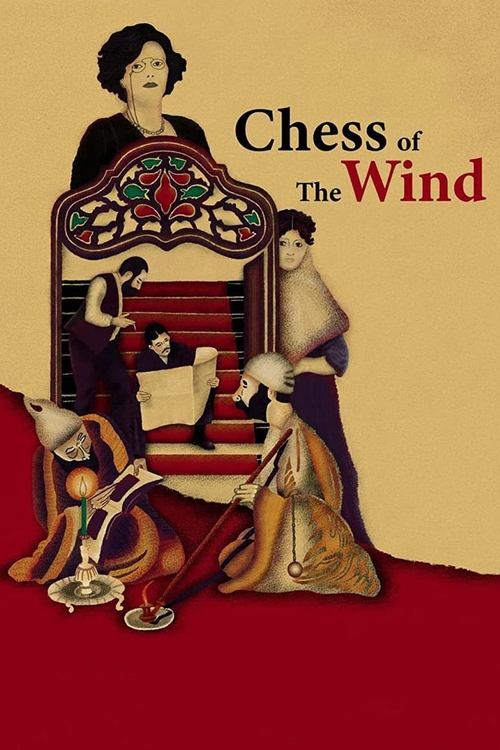
Chess of the Wind
1976 · Mohammad Reza Aslani
For a night when you want something rare and ravishing to sink into — a rediscovered treasure with the pull of a ghost story and the bite of a thriller. A film for patient viewers who love atmosphere.
What it's about
In a grand Qajar-era Tehran mansion, the lady of the house has died, and the household closes in around her paraplegic heiress like wolves in brocade — a stepfather, suitors, and servants all circling the inheritance. What begins as a genteel estate dispute tightens into gothic menace and open class warfare, with the servants watching everything.
The experience
Hypnotic and candlelit, slow-burning and increasingly sinister — a chamber piece where every glance is a move in a deadly game. It casts a genuine spell, then coils tight.
The craft
Mohammad Reza Aslani, a poet steeped in Persian painting, composes lamplit interiors like old-master canvases, while Sheyda Gharachedaghi's avant-garde score of scraped strings keeps the beauty on edge. The Scorsese-backed restoration is luminous — this is a film to see as big and dark as possible.
Why it matters
Screened once in 1976, banned after the revolution, and presumed lost until the negatives turned up in a junk shop decades later, its 2020 restoration was hailed as one of the great buried treasures of Iranian cinema.
A Qajar-era mansion, a dead matriarch, and a household circling her paraplegic heiress like wolves in brocade — Mohammad Reza Aslani's only pre-revolutionary feature is a Gothic chamber piece of hypnotic, candlelit menace. Screened once in Tehran in 1976 to hostile audiences, it was banned after the revolution and presumed lost for decades until the negatives surfaced in a junk shop in 2014; Martin Scorsese's World Cinema Project restoration finally revealed it to the world in 2020 as one of the great buried treasures of the Iranian New Wave. Aslani, a poet and documentarian steeped in Persian painting, composes interiors like Vermeer by lamplight while the plot tightens into pure class warfare — servants watching masters, masters devouring each other. Sheyda Gharachedaghi's avant-garde score, all scraped strings and ceremonial percussion, keeps the film balanced between art cinema and horror. Watch for the washerwomen at the courtyard fountain, a chattering Greek chorus who understand everything the aristocrats cannot.
A Deleuzian reading
Outside, at the fountain in the courtyard, the washerwomen are doing the laundry and talking about the family that owns them.
The full Deleuzian reading of Chess of the Wind →
Reception
Booed at the 1976 Tehran film festival (where a botched screening reportedly showed the reels out of order), then banned after the 1979 revolution and presumed lost for decades — until the negatives turned up in a Tehran junk shop in 2014. After a Scorsese-backed World Cinema Project restoration premiered at Cannes Classics in 2020, it was reborn as a masterpiece of pre-revolutionary Iranian cinema.
How Chess of the Wind was received, from release to now →
Influences: the films it descends from and the films it influenced
- Cries and Whispers (1972) — Confines a household of scheming, dying women to a single manor rendered in static, saturated painterly tableaux—the crimson-and-amber chamber lighting and female power struggle that Aslani's candlelit interiors directly echo.
- Day of Wrath (1943) — Builds gothic domestic dread through slow, Vermeer-like static compositions lit by soft candle and window light, the deliberate pictorial stillness Chess of the Wind adopts for its tableau staging.
- The Servant (1963) — Stages a servant-master role inversion inside one house, the domestic power struggle over control and status that Aslani reworks between his maid and paralyzed heiress.
- The Exterminating Angel (1962) — Traps a bourgeois cast in a decaying mansion as a chamber allegory of a paralyzed class devouring itself, the confinement-as-class-satire structure Chess inherits.
- Kwaidan (1964) — Fuses theatrically stylized, painterly horror compositions with Tōru Takemitsu's dissonant non-diegetic score—the exact marriage of pictorial framing and avant-garde sound Aslani pursues.
- The Damned (1969) — Films a wealthy family annihilating itself over inheritance amid operatic, decadent period staging, the greed-driven dynastic self-destruction Chess dramatizes in Qajar dress.
- The Cow (1969) — Founding Iranian New Wave chamber film whose sparse, allegorical village realism established the movement and production idiom Aslani works within.
- Ugetsu (1953) — Long-take, elegantly composed ghost-gothic in which household greed and class ambition doom the family, modeling the painterly restraint behind Chess's supernatural-tinged dread.
- The Brick and the Mirror (1966) — The most direct formal heir to the literary-auteur strand: frames-within-frames built from mirrors, doorways and lattice screens, deliberately paced camera moves through a single house, and stylized non-naturalistic delivery that treats speech as constructed text.
- Under the Shadow (2016) — Extends Chess's fusion of Iranian domestic drama with gothic horror—a woman trapped in a single dwelling where class and political terror surface as supernatural dread.
- A Girl Walks Home Alone at Night (2014) — Carries forward Persian-language gothic craft with stylized high-contrast chamber compositions and a moody, avant-garde-leaning score.
- The Duke of Burgundy (2014) — A two-woman chamber drama of domination and power reversal inside an ornate house, pairing retro painterly interiors with experimental sound design in Chess's lineage.
- The Others (2001) — Candlelit gothic-mansion chamber horror built on household secrets and inheritance, sustaining the painterly-darkness-and-domestic-dread craft Aslani refined.
- Prince Ehtejab (1974) — Near-contemporary Iranian film about a dying Qajar aristocrat and his servant-mistress in a rotting manor, the closest sibling in decaying-aristocracy gothic and inheritance decadence.
- Barry Lyndon (1975) — A same-era experiment in candlelit, natural-light interiors composed after old-master painting, a parallel pursuit of the Vermeer tableau on screen.
- The Spirit of the Beehive (1973) — Honey-lit painterly interiors and gothic dread in an isolated house, coding political allegory under dictatorship exactly as Iranian New Wave films veiled critique.
- Repulsion (1965) — Claustrophobic single-interior psychological gothic in which an enclosed domestic space curdles into madness and murder, the confinement-to-derangement arc Chess shares.
- Ballad of Tara (1979) — Contemporary Iranian experiment in painterly frontal composition and slow lateral tracking through a fixed set, with a female protagonist held in the center of the frame — and, like Tara, a film whose craft argument was suppressed and only later recovered.
Similar films
- The Cow (1969) — influence & lineage
- The Others (2001) — influence & lineage
- Ballad of Tara (1979) — shared sensibility
- The Handmaiden (2016) — shared sensibility
- The Seed of the Sacred Fig (2024) — shared sensibility
- The Night of Counting the Years (1969) — shared sensibility
- Death of Yazdgerd (1982) — shared sensibility
- The Assassin (2015) — shared sensibility
All the films related to Chess of the Wind →