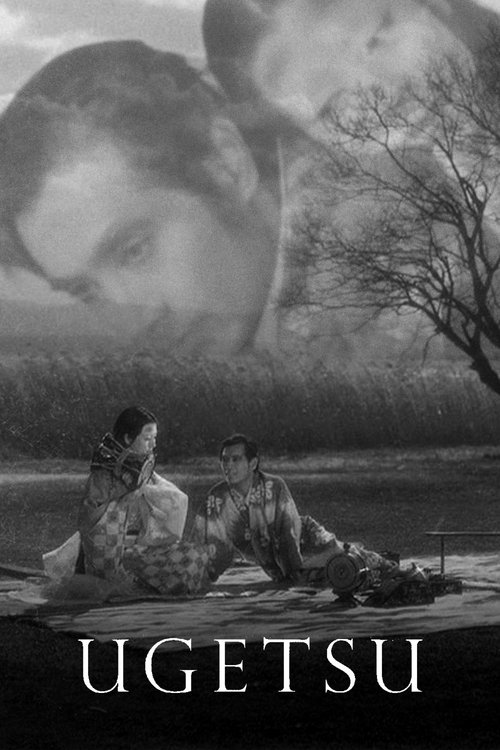
Ugetsu
1953 · Kenji Mizoguchi
For a contemplative evening when you want something haunting and beautiful rather than scary — a film to sit with in the dark and think about for days. This is a challenge-and-reward watch, not comfort food, though it's gentler than its reputation suggests.
What it's about
In sixteenth-century Japan, with civil war rolling through the countryside, a potter named Genjuro discovers soldiers will pay handsomely for his wares, while his neighbor Tobei dreams of trading his farm clothes for samurai armor. Both men chase their ambitions across a war-torn landscape — Genjuro drawn toward wealth and a mysterious noblewoman, Tobei toward glory — while the wives they leave behind face the war's dangers alone.
The experience
Slow, hushed, and quietly hypnotic — the film glides rather than cuts, and the ghost story seeps in so gradually that the uncanny feels like a natural deepening of the world. It builds to an emotional weight that lands softly and stays with you.
Performances
Machiko Kyō is mesmerizing as the spectral Lady Wakasa, seductive and mournful at once, and Kinuyo Tanaka brings devastating tenderness to Miyagi, the wife who waits.
The craft
Mizoguchi's long, flowing takes and drifting crane shots make the camera feel like a spirit moving through the story, and a misted lake crossing ranks among the most beautiful sequences ever photographed in black and white. Every frame is composed with painterly control; it rewards the biggest, darkest screen you can find.
Why it matters
A Silver Lion winner at Venice that helped open Western eyes to Japanese cinema in the 1950s, it now sits on virtually every list of the greatest films ever made and shaped generations of filmmakers' ideas about how the supernatural can live inside realism.
Snapshot
A potter named Genjuro, seduced by riches and then by a ghost, loses the wife who waited for him at home. His companion Tobei, chasing samurai glory, abandons a wife driven into prostitution. Set against the ceaseless civil wars of sixteenth-century Japan, Ugetsu (雨月物語, Ugetsu Monogatari) holds these twin parables of male appetite inside an aesthetic so controlled and so unhurried that the supernatural intrudes not as shock but as a deepening of the real. It won the Silver Lion at Venice in 1953, the second of three consecutive years in which Mizoguchi took a major prize at that festival, and it is now ranked among a handful of films — Tokyo Story, Rashomon, Sunrise — that define what the medium can do when every formal element is in service of moral vision.
Industry & production
Ugetsu was produced by Daiei Motion Picture Company under the driving hand of studio head Masaichi Nagata, who had by the early 1950s identified international festival exposure as a commercial and prestige strategy for Japanese cinema. The breakthrough of Kurosawa's Rashomon — which won the Golden Lion at Venice in 1951 and an Honorary Academy Award in 1952 — confirmed the appetite of Western festival audiences for Japanese period films, and Nagata moved aggressively to satisfy it, channeling resources toward Mizoguchi's projects. Ugetsu was shot in 1953 on a modest but competent studio budget; the standing sets at Daiei's Kyoto facilities served the film's interior scenes while location work — most critically, the sequences on Lake Biwa — gave the film its defining atmospheric images. The production timeline was characteristically grueling under Mizoguchi's perfectionism: the director was notorious for insisting on dozens of retakes and for reworking scripts during shooting, a practice that strained cast and crew but that yielded a texture of accumulated conviction in the final cut.
Technology
Ugetsu was shot on 35mm black-and-white film stock, which, in the hands of cinematographer Kazuo Miyagawa, became an instrument of extraordinary tonal range. The film exploits the period's capabilities for deep focus photography and for graduated effects — particularly the soft-focus and gauze-filter work used in the sequences inside Lady Wakasa's mansion, where the image itself grows luminous and slightly unreal. The lake sequence, perhaps the most technically celebrated in the film, achieves its sense of suspension through mist, careful exposure control, and the slow lateral movement of the camera mounted on a boat. No special optical effects in the contemporary sense are employed; the uncanny is produced through purely photographic and staging means, a discipline that makes the supernatural sequences far more haunting than any composite or matte work could have achieved. Post-production technology was standard for Daiei at the period; the film's power lies in the image as captured rather than as assembled.
Technique
Cinematography
Kazuo Miyagawa, who had shot Kurosawa's Rashomon three years earlier, brings to Ugetsu a complementary but distinct visual grammar — slower, more lateral, more inclined to survey than to penetrate. His characteristic move is the long, gliding tracking shot that follows characters through space without cutting, maintaining spatial coherence while allowing events to accrue within a single duration. The camera's relationship to its subjects is consistently that of a wary, compassionate observer: it rarely enters close-up, preferring to keep bodies in mid-ground against readable environments. This distance is ethical as much as aesthetic, producing what critics have identified as a quality of fatedness — the characters move through a world the camera already understands to be indifferent to their desires.
The compositions throughout favor deep, layered frames in which foreground objects (a kiln, a doorframe, standing reeds) anchor the image while action unfolds in depth. The night and mist sequences on the lake are balanced between legibility and obscuration: enough detail to read the action, enough atmospheric density to dissolve the boundary between the physical and the spectral. Miyagawa's handling of the Wakasa mansion sequences — interior lamplight against darkness, the softened edges of the image — creates a visual register of the enchanted that operates entirely within the camera's optical properties.
Editing
The editing of Ugetsu is conspicuous primarily through its restraint. Mizoguchi's "one scene, one cut" ideal — frequently discussed in accounts of his method — is here approached not as a rigid rule but as a guiding principle: scenes are constructed from the fewest possible cuts consistent with narrative clarity, and transitions between sequences tend to be abrupt spatial jumps rather than psychological sutures. The effect is that the film's emotion accumulates in duration rather than in montage rhythm; grief, desire, and consequence are felt as states that the camera inhabits rather than events the editing announces. The cut back to Miyagi's ghost at the film's close, and the dissolve that reveals the household's true state, are among the most economically devastating transitions in the medium.
Mise-en-scène / staging
Mizoguchi's staging is inseparable from his moral argument. The film opens with horizontal movement — villagers, soldiers, refugees — that establishes the civil-war period as a world of lateral displacement, ambition pushing people out of their proper stations. As the two male protagonists pursue their respective fantasies, the staging increasingly places them inside enclosed or delimited spaces (the merchant's pavilion on the lake, Wakasa's mansion, the samurai encampment) that feel like traps of desire. The domestic spaces of the wives, by contrast, are rendered with plain, earthy specificity — the kiln, the cooking pot, the road — and these spaces accrue a moral weight their husbands cannot perceive.
The Wakasa sequences are staged in a key of Noh theater aesthetics: slow, ceremonial movement; surfaces that are beautiful and blank; the sense of ritual repetition that belongs to the world of the dead. This theatrical reference is not merely decorative — it locates the supernatural within an existing Japanese performance tradition and signals to a knowing audience that Genjuro has crossed into a mode of existence governed by different rules.
Sound
Fumio Hayasaka's score blends Japanese traditional musical textures with Western orchestration in a manner that refuses easy exoticism; the music accompanies rather than explains, and at its most effective — the lake crossing, the Wakasa banquet — creates an atmosphere of dolorous suspension. Hayasaka, who also scored Kurosawa's Rashomon and Ikiru, was among the most sophisticated film composers working in postwar Japan, and his collaboration with both major directors of the period gives the era a particular sonic coherence. The film's use of diegetic sound — the distant percussion of battle, the wind across reeds, the physical texture of pottery being shaped — grounds the supernatural sequences in a world of material consequence, making the departures from it more vertiginous.
Performance
Machiko Kyō as the Lady Wakasa brings to the role an extraordinary quality of suspension between states: she is tender and formal, yearning and already beyond yearning, human enough to plead and inhuman enough to terrify. Her performance is constructed through stillness and controlled tempo rather than through psychological display. Masayuki Mori as Genjuro conveys the particular texture of a man whose intelligence is perfectly matched to his capacity for self-deception; his scenes inside Wakasa's mansion have the quality of a man who knows he should leave and cannot name why he stays. Kinuyo Tanaka as Miyagi — the wronged wife whose suffering the film places at its moral center — achieves what Mizoguchi's heroines characteristically achieve: an endurance so complete it transcends sentiment and becomes something closer to the tragic absolute.
Narrative & dramatic mode
Ugetsu is structured as a double parable with interlocking ironies. Genjuro's trajectory is a ghost story in which the man, not the spirit, is the one who is lost; the supernatural functions not as threat from outside but as the externalization of an interior vacancy. Tobei's trajectory is comic in its skeleton — a fool's errand rewarded by grotesque accident — and devastating in its consequence, his fantasy of honor won by appropriating a dead man's trophies while his wife is sold into degradation to survive. The film refuses to resolve these parables into simple moral propositions; instead it allows them to echo against each other, creating a structure in which male ambition in its two dominant registers (romantic/aesthetic and martial/social) destroys exactly what it claims to seek. The final sequence — Genjuro returned, the household restored in routine, Miyagi's voice heard but her form absent — achieves a mode of the elegiac that owes something to classical Japanese literary traditions of mono no aware (the pathos of things) without being reducible to them.
Genre & cycle
Ugetsu operates within the jidaigeki (period film) tradition while inflecting it with the aesthetics of the ghost story (kaidan). The kaidan genre has deep roots in Japanese literary and theatrical tradition — Lafcadio Hearn's translations of such tales had already brought them to Western attention — and Ueda Akinari's source collection belonged to a late-Edo literary mode that deliberately layered supernatural events within historical settings to create moral fables about desire and consequence. Mizoguchi adapts this dual inheritance into a film that belongs generically to neither jidaigeki nor pure kaidan but occupies a third space in which the period setting provides not samurai action but the conditions of social upheaval that expose human weakness. This positioning partly explains the film's unusual durability across cultures: it does not depend on familiarity with Japanese historical periods to produce its effects.
Authorship & method
By 1953 Kenji Mizoguchi had been directing for three decades, having made his first films in the early 1920s. His body of work is marked by a persistent return to female suffering under patriarchal and economic structures — a preoccupation biographical accounts have traced to his childhood, during which his sister was sold into geisha apprenticeship. Whether or not this biographical reading is reductive, it points toward the consistency of Mizoguchi's moral perspective: across silents, melodramas, period films, and social realist works, the director returned again and again to women whose intelligence and dignity are destroyed by systems and men they cannot escape.
His primary screenwriting collaborator for the late-career masterworks was Yoshikata Yoda, who co-wrote the Ugetsu screenplay with Matsutaro Kawaguchi. Yoda worked with Mizoguchi across many years and many films, functioning as an interpreter of the director's often inarticulate but insistent moral intuitions into narrative structure. The source material — two stories from Ueda Akinari's Ugetsu Monogatari (1776), augmented by elements from a Guy de Maupassant story for the Tobei subplot — was selected and shaped to serve Mizoguchi's characteristic thematic concerns rather than for any straightforward fidelity to the originals.
Kazuo Miyagawa's cinematographic contribution to the late-period Mizoguchi films is difficult to overstate; the visual grammar of Ugetsu, Sansho the Bailiff, and several other works is as much his as the director's. The two men shared a commitment to the long take and to spatial integrity that made their collaboration among the most productive in the history of the medium. Fumio Hayasaka's score and the production design team at Daiei's Kyoto studios complete the key creative ensemble.
Movement / national cinema
Ugetsu belongs to the extraordinary wave of Japanese cinema that emerged internationally between 1950 and 1955, a period that brought Kurosawa, Ozu, and Mizoguchi to Western critical attention simultaneously. This wave was not a movement in the sense of a shared manifesto or coordinated program; it was rather the convergence of mature individual visions with a moment of international receptivity, enabled by the Venice Film Festival's systematic openness to Japanese submissions and by the marketing instincts of Masaichi Nagata at Daiei. The three directors represent divergent aesthetics — Kurosawa's kinetic dynamism, Ozu's radical stasis, Mizoguchi's sinuous long-take humanism — and the critical tendency to group them as a unified "Japanese cinema" obscures more than it reveals, though it was historically decisive in establishing the culture's global prestige.
Era / period
The film is set during the Sengoku period (the era of warring states, roughly mid-fifteenth to early seventeenth centuries), which functions in Japanese cultural imagination as a time of maximum social disorder — the peasant could aspire, the lord could fall, ambition and accident conspired equally. This historical setting is used not for its action potential but for its social-structural logic: Genjuro and Tobei's fantasies of upward mobility are products of a moment when the customary hierarchies have been violently loosened, and their destruction is the system reasserting its terms. The period thus becomes a universalizing frame: a time when anything seemed possible and nothing, finally, was.
Themes
The film's central argument concerns the cost of male desire — specifically desire for wealth, status, and romantic possession — and the violence this desire enacts on women who are its collateral damage. Genjuro's aesthetic and erotic obsession with Wakasa is explicitly linked to his earlier obsession with selling his pottery; Lady Wakasa is not simply a temptation but the fulfillment of a mode of acquisitive seeing that the film diagnoses as fatal. Tobei's samurai fantasy is the same acquisitive logic in its social register, the desire to be recognized and elevated, with Ohama's degradation the price of his delusion.
The supernatural is not opposed to the real in Ugetsu but is continuous with it. The ghost of Wakasa is the externalization of Genjuro's own fatal desire; the ghost of Miyagi at the film's close is the truth of what home means, available only when it is too late. The film's most searching implication may be that the men were haunted before they ever encountered a ghost — haunted by ambition, by social fantasy, by the failure to recognize what they already possessed.
Reception, canon & influence
Ugetsu won the Silver Lion at the Venice Film Festival in 1953, confirming Mizoguchi's position — already established by The Life of Oharu's international recognition the previous year — as one of the major directors of world cinema. Western critical reception in the 1950s was shaped by the filters of Japanese cinema's novelty and by the interpretive frameworks available at the time; the film was often received as an exotic masterwork rather than analyzed on its own aesthetic terms. The serious scholarly literature on Mizoguchi in English is relatively sparse compared to what exists for Kurosawa or Ozu; Donald Richie's writing on Japanese cinema remains a foundational resource, though Mizoguchi has attracted less monographic attention in English than his reputation warrants.
The film's influences backward include Ueda Akinari's late-Edo literary tradition, the Noh theater's theatrical grammar for representing the supernatural, and the entire pre-war Japanese cinema tradition in which Mizoguchi had worked for two decades. The Guy de Maupassant connection — evident in the Tobei subplot's ironic structure of social aspiration meeting grotesque reality — places the film in a wider tradition of literary naturalism adapted to non-European settings.
Looking forward, Ugetsu's influence has been diffuse but deep. Its model of the long take as a vehicle for moral seriousness was absorbed — through direct viewing and through the critical literature — by European art cinema directors of the 1960s. Andrei Tarkovsky's cinema of duration, spiritual weight, and the interpenetration of the living and the dead is the most frequently cited descendant, and the resemblance is real even if direct influence is difficult to document precisely. Theo Angelopoulos's use of the long take to create a cinema of historical elegy shares structural affinities with Mizoguchi's approach. American directors of the New Hollywood generation — Coppola in particular has cited Japanese cinema's influence — encountered Ugetsu as part of the broader discovery of world cinema that shaped their ambitions. The film entered the Criterion Collection and has maintained a consistent presence on canonical lists of the greatest films ever made, including the Sight & Sound polls. Its influence on subsequent filmmakers working with supernatural material has been less about specific devices than about the demonstration that the uncanny, handled with sufficient formal conviction, need not break the moral seriousness of the work it inhabits.
A Deleuzian reading
The shot everyone carries out of *Ugetsu* comes near the end.
The full Deleuzian reading of Ugetsu →
Reception
It won the Silver Lion at Venice in 1953 and was a key film in the West's postwar 'discovery' of Japanese cinema; it has never really left the canon since, landing in the top ten of the Sight & Sound critics' poll in both 1962 and 1972.
How Ugetsu was received, from release to now →
Influences: the films it descends from and the films it influenced
- The Story of the Last Chrysanthemum (1939) — Mizoguchi fully develops the one-scene-one-cut principle here — entire dramatic units absorbed into sustained lateral tracking shots without cutaway — the direct formal model Ugetsu inherits and refines.
- Sisters of the Gion (1936) — Mizoguchi's earliest systematic use of the lateral tracking shot as moral instrument, establishing the camera's impassive-witness position that refuses melodramatic close-up in favour of sustained spatial observation.
- A Page of Madness (1926) — Japanese cinema's first systematic deployment of non-naturalistic imagery — distorted angles, superimpositions — to externalize a character's interior state, establishing the precedent Ugetsu inherits for rendering the supernatural as psychological reality.
- Nosferatu (1922) — Achieves supernatural dread through location photography, shadow composition, and staging rather than in-camera optical tricks — the direct model for Miyagawa's photographic uncanny in Ugetsu's ghost sequences.
- The Rules of the Game (1939) — Lateral deep-focus tracking that holds figures at multiple depths simultaneously, staging social action across layered planes in a single unbroken movement — the European formal ancestor of Miyagawa's multi-plane compositions.
- Rashomon (1950) — Kazuo Miyagawa shot this film, developing his technique of dappled atmospheric lighting, shooting into direct light sources, and fluid camera movement through foliage — a visual vocabulary he carried directly into Ugetsu three years later.
- Sunrise: A Song of Two Humans (1927) — Kazuo Miyagawa's extended moving-camera shots that follow characters continuously through environments — prioritizing spatial exploration over analytical coverage — directly descend from the Murnauian principle of the camera as sustained moral witness, which Mizoguchi absorbed through his documented study of German silent cinema.
- Gate of Hell (1953) — Kinugasa's jidaigeki uses Heian court ceremony as Noh-derived theatrical formality, structuring male obsession consuming female life through the same period-drama staging logic; both films debuted at major European festivals in the same year, representing a shared moment of Japanese art cinema's formal self-consciousness.
- Harakiri (1962) — Kobayashi structures formal confrontations using Noh theater's jo-ha-kyū rhythmic pacing — slow ceremonial buildup followed by explosive rupture — and stages them with near-static camera, where stillness carries greater weight than movement, inheriting Ugetsu's Noh-derived performance grammar.
- Onibaba (1964) — Wide-angle deep-focus lateral tracking through a period landscape, with a supernatural mask sequence that renders the uncanny through staging and lighting rather than optical effects; the structural logic of male absence enabling female transgression directly extends Ugetsu's formal and narrative vocabulary.
- Kwaidan (1964) — Takes Ugetsu's approach to the supernatural-without-optical-effects to its formal limit: each episode uses Noh-theater set design — painted skies, abstracted landscapes — where the frame itself is theatricalized so that ghosts are rendered through deliberate artifice rather than realism.
- Andrei Rublev (1966) — Tarkovsky inherits Mizoguchi's fundamental equation between camera endurance and moral seriousness: the extended duration of individual shots carries spiritual weight through their refusal to cut, treating the long take as an ethical stance rather than a stylistic flourish.
- The Travelling Players (1975) — Angelopoulos extends Mizoguchi's one-scene-one-cut principle into a device for historical elegy: lateral tracking shots traverse decades within a single unbroken movement, the pan absorbing historical transitions that editing would otherwise separate.
- Nostalghia (1983) — The extended candle-crossing sequence — a single take in which duration and spiritual commitment become inseparable — is Tarkovsky's most formal tribute to Mizoguchi's durational ethics; water as boundary medium dissolving ontological states echoes Ugetsu's lake sequence.
- Ran (1985) — Kurosawa incorporates Noh theater's costuming, masked performance register, and jo-ha-kyū staging rhythms — particularly in the Lady Kaede scenes — directly inheriting the Noh-derived grammar Mizoguchi used to render stillness as latent violence.
- In the Mood for Love (2000) — Wong's slow-motion lateral tracking shots following characters through constricted corridors directly inherit Mizoguchi's lateral track as a technique for rendering suppressed desire; the camera's sideways glide refuses the direct frontal address that confession or close-up would offer.
- Kagemusha (1980) — Kazuo Miyagawa's static long-take grammar — camera as motionless witness to dissolution — directly informs Kagemusha's opening sustained tableau and ceremonial interior scenes, where the fixed frame absorbs ceremony rather than analyzing it.
- Dreams (1990) — Renders ghost-and-folklore material through scroll-painting deep staging and mono-no-aware dissolves, the same pictorial-tableau grammar Kurosawa uses to make the supernatural feel painted rather than special-effected.
- Hour of the Wolf (1968) — Mizoguchi's unbroken camera movement that drifts from living characters to arrive at the presence of the dead — transitions between registers of reality achieved through spatial continuity alone, without editorial rupture — prefigures Bergman's refusal to mark Johan's demonic visions as ontologically distinct from his waking experience.
- The Life of Oharu (1952) — The immediately preceding Mizoguchi–Miyagawa collaboration where the soft-focus gauze filter for memory and interiority was first deployed and the episodic descending chronicle of female suffering under patriarchal systems established the structural template Ugetsu refines.
- Sansho the Bailiff (1954) — The same Mizoguchi–Miyagawa partnership one year on; the long lateral tracking shot holding Tamaki on the shore at the moment of separation directly continues Ugetsu's grammar of the sustained unbroken take as emotional and moral measure.
- Throne of Blood (1957) — Mizoguchi uses fog on Lake Biwa as a threshold material between living and dead — not atmospheric decoration but a spatial condition that dissolves ontological categories — within the same Sengoku-period register and with the same Noh-influenced durational lateral staging as Throne of Blood.
- Samurai I: Musashi Miyamoto (1954) — Mizoguchi uses temporal ellipsis and offscreen space to enact transformation the film refuses to dramatize directly — the same strategy Inagaki employs when Musashi's chrysanthemum-room breakthrough happens between dissolves rather than on screen.
- The River (1951) — Contemporaneous humanist cinema built on the mobile, unhurried long take and recurring water imagery to frame a cyclical fable of loss and return.
- Eternity and a Day (1998) — The mobile long-take and crane choreography in which the dead re-enter the frame during a single continuous movement is the direct ancestor of Angelopoulos's uncut passages where the past materializes inside the shot.
- The Music Room (1958) — Long-take moving-camera duration fused with classical (Noh-derived) performance in an elegiac tale of ruined status — a precedent for treating diegetic classical music and slow temporal rhythm as the film's dramatic spine.
- Chikamatsu Monogatari (1954) — Kazuo Miyagawa's crane-borne mobile long take and Fumio Hayasaka's sparse jō-ruri-inflected score — the identical craft team and moving-camera credo one year prior.
- Street of Shame (1956) — The Mizoguchi–Miyagawa partnership's crane-borne long takes gliding through continuous space; Street of Shame transposes that same choreographed camera from period ghost tale to the fixed geography of a modern brothel.
Similar films
- Rashomon (1950) — influence & lineage · often watched together
- Ran (1985) — influence & lineage · often watched together
- Onibaba (1964) — influence & lineage · often watched together
- The Life of Oharu (1952) — influence & lineage
- Gate of Hell (1953) — influence & lineage
- Sansho the Bailiff (1954) — influence & lineage
- The Rules of the Game (1939) — influence & lineage · often watched together
- Andrei Rublev (1966) — influence & lineage · often watched together
All the films related to Ugetsu →
Watch it with: curated runs of related films
- Haunted Castles and Restless Ghosts — A run of enchanted ruins, restless dead, and grief that won't stay buried — watch these when you want dread and reverie sharing the same frame.