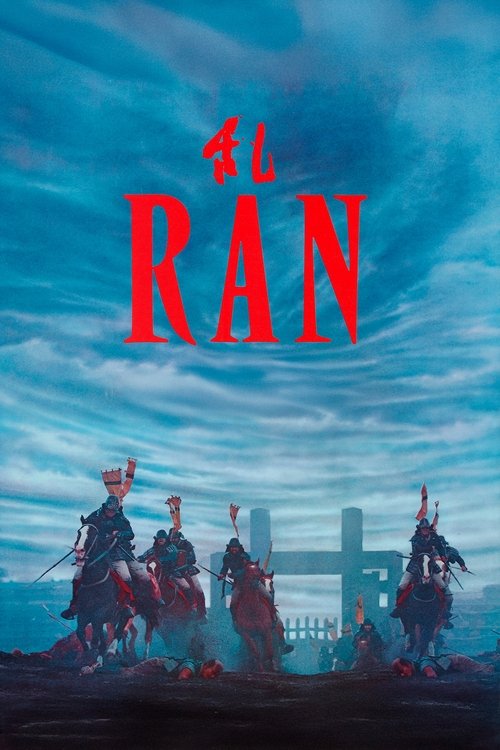
Ran
1985 · Akira Kurosawa
For when you want to give an entire evening to something monumental — the kind of film you clear the calendar for and think about for days after. Pure challenge, richly rewarded.
What it's about
An aging warlord in sixteenth-century Japan decides to divide his hard-won domain among his three sons and retire on his own terms. The one son who warns him it will end in ruin is banished for his honesty; the two who flatter him begin circling each other, and their father, like wolves. What follows is Shakespeare's King Lear reforged as a samurai epic — a family collapse played out with whole armies.
The experience
Overwhelming in the best sense: vast, deliberate, and building to battle sequences of almost silent, terrible beauty. It's slow-burning tragedy at epic scale — grief you can see coming from miles away and still can't stop.
Performances
Tatsuya Nakadai is shattering as the old lord, aging from iron-willed conqueror to hollow-eyed ghost across three hours. Mieko Harada, as a daughter-in-law with her own long game, delivers some of the most chilling scenes in the film.
The craft
Kurosawa, in his mid-seventies, marshaled thousands of extras and color-coded armies — red, yellow, blue — across volcanic plains so every battle reads like a moving painting, and the great castle siege is one of the most awe-inspiring sequences ever staged. Tōru Takemitsu's mournful score and the film's daring use of silence do the rest. This is the definition of a big-screen film.
Why it matters
His final epic and by wide consensus the summation of his career, it proved a master in his seventies could still out-scale anyone in world cinema. It remains the benchmark for Shakespeare transposed across cultures.
Snapshot
Akira Kurosawa's Ran is a monumental transposition of Shakespeare's King Lear into sixteenth-century Japan, following an aging warlord, Hidetora Ichimonji, who divides his domain among his three sons and is destroyed by the forces he himself has set in motion. Running at nearly three hours and marshaling thousands of extras, hundreds of horses, and color-coordinated armies across volcanic landscapes, the film is at once an intimate portrait of senility and guilt and one of the most expensive and logistically ambitious productions in Japanese cinema history. It stands as Kurosawa's final large-scale epic and, by many accounts, the summation of his artistic life.
Industry & production
Ran emerged from roughly a decade of development. Kurosawa has described beginning from the legend of Mōri Motonari, the sixteenth-century feudal lord celebrated for warning his three sons that a single arrow breaks easily while three bound together do not — an allegory for clan unity. Inverting that moral, Kurosawa imagined what would happen if those three sons chose division over solidarity. Only later did he recognize the structural affinity with King Lear, and the two source currents flowed together into the finished screenplay, written with his long-term collaborators Hideo Oguni and Masato Ide.
Financing proved arduous. Japanese studios balked at the scale and cost, and the project stalled for years. The breakthrough came through the French producer Serge Silberman — who had backed Luis Buñuel's late career and was alert to European prestige in world cinema — whose company Greenwich Film Productions provided the co-production funding that made Ran possible. The partnership between Nippon Herald Films, Herald Ace, and Silberman's outfit reflected a structure that had become necessary for Kurosawa after the commercial disappointments of the 1970s had eroded his standing with domestic financiers. Ran became one of the most expensive Japanese films made to that point; specific budget figures vary across sources, but the production was widely reported as costing somewhere in the range of eleven to twelve million dollars, a figure that set records in the Japanese industry.
Principal photography took place across multiple locations in Japan, most notably on the slopes of Mt. Aso in Kyushu and at Kumamoto Castle. A full-scale castle set was constructed specifically to be burned during the film's climactic assault sequence. Emi Wada's costume department spent years fabricating the production's elaborate armor, robes, and accessories by hand; her department produced hundreds of individually crafted pieces.
Technology
Ran was shot on 35mm using multiple camera setups, particularly during large-scale battle sequences — a method consistent with Kurosawa's established practice. The cinematographic scope was handled by three directors of photography working simultaneously: Asakazu Nakai, who had been Kurosawa's principal collaborator since the 1940s; Takao Saitō; and Masaharu Ueda. This multi-DP configuration allowed Kurosawa to cover his massive compositions from different focal lengths simultaneously without re-staging.
Telephoto lenses were used extensively throughout, their compression of spatial depth lending the landscapes a quality of abstraction — armies moving like massed pigment rather than individual soldiers. The burning of the Third Castle was photographed for real; no reconstruction or re-shoots were possible once the structure was ignited, which required coordinating all camera operators precisely in advance. The art direction by Yoshirō Muraki and Shinobu Muraki, who had worked with Kurosawa across many films, created sets and locations of exceptional physical density.
Technique
Cinematography
Kurosawa organized the film's visual grammar around color as a structural principle. Each of Hidetora's three sons commands armies identified by a primary color: yellow for Tarō's first clan, red for Jirō's second clan, blue-green for Saburō's third clan. Hidetora himself, stripped of allegiance by the film's midpoint, wears white — the color of death and mourning in Japanese tradition. This chromatic coding allows the audience to read formations and loyalties at a distance, turning tactical geography into something legible even in chaos.
The cinematography of the battle for the Third Castle is the sequence most often cited by scholars and filmmakers. Kurosawa removes all diegetic sound — the clash of swords, the screams, the gunshots — and replaces it with Tōru Takemitsu's score playing uninterrupted beneath images of carnage. The effect is hallucinatory, dissociating the spectator from the ordinary pleasures of action-film momentum and forcing a kind of terrible contemplation. The decision was deliberate: Kurosawa has said that the conventional sound design of war films glamorizes violence, and the silence of the victims is closer to a truthful representation of slaughter.
Editing
Kurosawa edited his own films, and Ran is cut with the deliberate, expansive rhythm typical of his late style. There is little of the kinetic cross-cutting that defined Seven Samurai (1954). Instead, the editing accommodates duration — scenes hold on faces and landscapes past the point of conventional efficiency, allowing guilt, grief, and vacancy to register in real time. The transitions between sequences often use visual rhymes or abrupt tonal contrasts rather than conventional continuity, creating a sense of fate snapping shut rather than events unfolding naturally.
Mise-en-scène / staging
The staging of Ran draws heavily on Noh theater conventions. Noh's use of slow, formalized movement, masked or mask-like faces, and heightened stillness as an expression of interior states runs through the film's most charged moments. Hidetora's deterioration is staged as a kind of Noh performance: he often moves in arrested, stylized postures, and Kurosawa's compositions place him at the center of formal geometric arrangements that suggest ritual rather than drama. The castle interiors use Noh's vocabulary of threshold and threshold-crossing — doorways, ramps, and raised platforms carry symbolic weight that exceeds their narrative function.
Sound
Beyond the celebrated silencing of the Third Castle battle, Takemitsu's score is a sustained achievement. Takemitsu — one of the major composers of twentieth-century contemporary classical music, whose work consistently negotiated between Japanese tradition and European modernism — produced a score for Western orchestra that nonetheless absorbs the tonal coloration of gagaku (Japanese court music). The score avoids the emotional signposting typical of Hollywood epic scoring; instead it creates an atmosphere of desolation and inevitability. The orchestral passages at the film's end, over Hidetora's death and the final image of the blind Tsurumaru on the castle ramparts, are among the most haunting in film music.
Performance
Tatsuya Nakadai's performance as Hidetora is the film's gravitational center. Nakadai — who had collaborated with Kurosawa previously on Yojimbo (1961), Sanjuro (1962), and Kagemusha (1980) — plays Hidetora with Noh-derived stylization in the physical register and naturalistic anguish in the emotional one. His eyes are frequently described as vacant, a calculated choice that lets the audience read blankness as both senility and horror. He wears makeup that references Noh masks without fully submitting to them.
Mieko Harada as Lady Kaede is the film's most fully realized antagonist, a character who combines elements of Goneril, Regan, and Lady Macbeth. Her control of register — moving from apparent submission to cold fury within single scenes — gives the film much of its psychological danger. Pita (the Japanese entertainer whose full name is Peter, known for cross-dressing performances) plays Kyōami, Hidetora's jester and the figure loosely analogous to Lear's Fool, bringing theatrical eccentricity rather than naturalism to the role.
Narrative & dramatic mode
Ran adapts King Lear by reassigning the central figure's children: the three daughters become three sons (Tarō, Jirō, and Saburō), and the film eliminates Lear's gradual loss of retinue in favor of the accelerating violence of clan warfare. The Cordelia function — honest loyalty that the patriarch cannot hear — is carried by Saburō, the youngest son, whose bluntness gets him disinherited early and who returns, too late, from exile.
The Gloucester-Edgar subplot has no direct equivalent, but the film compensates with Lady Kaede's plot of vengeance (she was displaced by Hidetora's conquests) and the character of Lady Sue, Jirō's Buddhist wife, whose spiritual resignation counterpoints Kaede's ruthlessness. The film's dramatic mode is explicitly tragic in the Aristotelian sense: Hidetora's catastrophe is a direct consequence of his past crimes, and the film allows no possibility of redemption. Where Lear offers at least a moment of reconciliation with Cordelia before the final catastrophe, Ran grants Hidetora and Saburō barely an instant together before Saburō is killed. The film ends with the image of the blind Tsurumaru — a figure blinded by Hidetora's cruelties — standing alone on a clifftop, a survivor of a world that has consumed itself.
Buddhist ideas of karma and cyclical violence underpin the narrative structure more explicitly than any Shakespearean framework alone could account for: the film understands Hidetora's punishment not merely as dramatic justice but as the inexorable operation of moral causation.
Genre & cycle
Ran belongs to the jidaigeki tradition — Japanese period drama, specifically the samurai film set in the Sengoku era. It inherits the conventions of the chambara action film while transcending them, placing Kurosawa in dialogue with his own genre legacy. Within the international context, it operates as a prestige historical epic, following a trajectory of films like Bernardo Bertolucci's 1900 (1976) and Luchino Visconti's late work, in which scale and visual grandeur become vehicles for tragedy rather than spectacle.
It also participates in a late-career Kurosawa cycle — following Dersu Uzala (1975) and Kagemusha (1980) — in which large canvases, aging protagonists, and the retrospective weight of violence figure prominently. This cycle constitutes something like an extended meditation on the costs of power and the fragility of civilization.
Authorship & method
Kurosawa's authority over every element of Ran was absolute and well-documented. He spent years producing detailed watercolor storyboards for the film before production began — a method he employed throughout his career, but which took on particular intensity here as a way of sustaining the vision during the extended period of financial uncertainty. These storyboards, which are exhibited and reproduced as artworks in their own right, reveal the degree to which the film's compositions were architecturally predetermined.
His three cinematographers worked from these storyboards and from Kurosawa's direction in a model closer to a painter superintending assistants than to the conventional director-DP collaboration. Asakazu Nakai's relationship with Kurosawa dated to Sanshiro Sugata (1943); the technical and aesthetic trust accumulated over four decades is evident in the confidence of the film's visual language.
Tōru Takemitsu's contribution is significant enough to require separate acknowledgment. The relationship between Takemitsu's score and Kurosawa's images in the battle sequence constitutes a genuine compositional dialogue rather than a conventional underscoring function. Emi Wada's costume design, which won the Academy Award, was not incidental decoration but structural information: the color-coded armies are legible precisely because the costumes are so rigorously systematized.
Movement / national cinema
Ran belongs to Japanese cinema's jidaigeki tradition while exceeding it. Its French co-production finance and its Shakespearean source mark it as consciously positioned within world cinema rather than purely domestic filmmaking. The film was widely seen internationally as representing the summit of a national tradition — the Japanese historical epic — at the moment when that tradition's most celebrated practitioner was reaching the end of his productive life.
Kurosawa's position in Japanese cinema was, by the 1980s, paradoxical: revered internationally to a degree that shaped how world cinema understood Japan, while remaining a somewhat embattled figure domestically, dependent on foreign financing and on the advocacy of directors like George Lucas and Francis Ford Coppola, whose championing of Kagemusha helped secure its international distribution.
Era / period
Ran appeared at the mid-point of the 1980s, a decade when epic historical cinema was being revisited internationally. It shares a cultural moment with films such as Sergio Leone's Once Upon a Time in America (1984) and Andrei Tarkovsky's late work — films oriented toward retrospection, scale, and the weight of history. In Japanese cinema, it coincided with the consolidation of the art-film tradition as a separate prestige category from genre filmmaking. The decade also saw increasing international co-production as a financing mechanism for ambitious national-cinema projects.
Themes
The film's governing themes are the legibility of the past in the present — karma as historical logic — and the impossibility of severing power from violence. Hidetora built his domain through conquest, massacre, and betrayal, and the film insists that these crimes cannot be left behind: they return in the form of Lady Kaede's vengeance and in the moral structure of the catastrophe that destroys his family. The possibility of breaking the cycle is entertained through the figures of Saburō and Lady Sue, both of whom embody a kind of Buddhist non-attachment to power, but the film does not reward their goodness with survival.
The blindness motif — Tsurumaru's physical blindness, Hidetora's moral blindness to the true loyalties of his sons, the inability of power to see clearly — runs through the film as both literal condition and metaphor. The final image of the blind man alone on the rampart, a figure from whom all support has been removed, crystallizes these themes without resolving them.
Reception, canon & influence
Critical reception: Ran was not an immediate commercial success in Japan. Internationally, it was received with near-unanimous critical admiration, though some critics found its grandeur overwhelming or its tone unrelenting. Roger Ebert placed it on his list of great films. At the Academy Awards, the film received nominations for Best Director, Best Cinematography, and Best Art Direction, winning only for Best Costume Design — a distribution of recognition that struck many observers as undervaluing the film's directorial achievement. Its exclusion from the Best Foreign Language Film category was widely noted as an anomaly, though the record on the precise circumstances of that exclusion is not entirely clear in the sources available.
Influences on the film (backward): King Lear is the most direct literary source. The legend of Mōri Motonari provided the historical armature. Noh theater — particularly the tradition of zeami and the formal vocabulary of mask-performance — inflects the staging, performance style, and use of stillness throughout. John Ford's approach to landscape as moral terrain has often been cited in relation to Kurosawa's visual method more broadly, and Ran's use of wide, open compositions for tragedy rather than grandeur is continuous with that influence.
Legacy (forward): The color-coded army system and the large-scale battle staging of Ran have been widely absorbed into the grammar of epic cinema. The film's mode of rendering combat as visually spectacular but morally unambiguous in its horror influenced the approach to medieval warfare in films and television that followed, including the battle sequences of Peter Jackson's Lord of the Rings trilogy. The silencing of the battle — using score in place of diegetic sound — has been cited as an influence on directors working in the tradition of slow cinema who seek to denaturalize violence. Takemitsu's score is regularly discussed in film music scholarship as a model for the integration of avant-garde compositional ideas into narrative film. Ran is taught widely in film studies curricula as both a canonical Kurosawa text and as a case study in adaptation, specifically in the transformation of a Western dramatic text through Japanese theatrical and cultural forms.
A Deleuzian reading
A white-haired man walks down the steps of a burning castle.
The full Deleuzian reading of Ran →
Reception
Acclaimed abroad on release but famously snubbed at home — Japan declined to submit it for the Foreign Language Oscar, prompting a Sidney Lumet-led campaign that got Kurosawa a Best Director nomination instead. Once seen as the grand late work of a fading master, it's now routinely argued to be his outright greatest film, cemented by the 2016 4K restoration.
How Ran was received, from release to now →
Influences: the films it descends from and the films it influenced
- Throne of Blood (1957) — Kurosawa developed here the foundational method of transposing a Shakespearean tragic structure through Noh theatrical conventions — geometric blocking, mask-derived performance register, stylized death ritual — that he then applies to King Lear in Ran, with the same production lineage of watercolor pre-visualization and Noh-informed staging vocabulary.
- Kagemusha (1980) — Kurosawa prototyped Ran's color-coded army system directly here — each clan assigned a dominant banner and costume hue legible at telephoto distance — and established the multi-camera telephoto battle staging that Ran scales to larger troop numbers, longer duration, and greater compositional severity.
- Seven Samurai (1954) — Kurosawa first deployed the multi-camera simultaneous shooting technique for battle sequences in this film, positioning multiple telephoto-lens cameras across a single rain-soaked engagement to capture unrepeatable action from several angles — the foundational technical method Ran applies at far greater scale in its castle and field battles.
- Kwaidan (1964) — Kobayashi integrates Noh and traditional theatrical staging conventions into an episodic cinematic form — with formalized geometric compositions and color palettes assigned per episode — establishing the formal vocabulary for theatrical-cinematic synthesis, including the use of abstract painted environments as spiritual registers, that Ran extends to its full-scale epic.
- Ugetsu (1953) — Mizoguchi established the formal principle that tragedy in jidaigeki could be rendered through durational stillness and the long take as a vehicle for Buddhist karmic consequence — using restraint rather than dramatic emphasis to accumulate moral weight — a pacing logic Ran inherits for its treatment of calamity as slow accumulation rather than dramatic crisis.
- The Searchers (1956) — Ford's deployment of wide landscape compositions as moral register — situating human obsession within an indifferent geographic scale, using vastness to diminish rather than celebrate — is the visual-philosophical model the dossier explicitly identifies as a Kurosawa inheritance, operative in Ran's panoramic rendering of human folly against open sky and scorched terrain.
- Alexander Nevsky (1938) — Eisenstein and Prokofiev developed audiovisual counterpoint here — score and image entering compositional dialogue rather than underscore relationship, with the ice-battle sequence structured through musical rhythm rather than diegetic sound — directly prefiguring the compositional method by which Takemitsu's score replaces battle sound in Ran, treating music as the primary informational channel during combat.
- Andrei Rublev (1966) — Tarkovsky renders the Tatar raid sequence through long-take observation and formalized chaos — visually overwhelming but aesthetically positioned as spiritually catastrophic rather than thrilling — establishing for the prestige historical epic the method of locating moral meaning inside spectacular violence through durational formal rigor, a method Ran deepens in its castle-burning and battle sequences.
- Double Suicide (1969) — Shinoda pioneered the integration of traditional Japanese theatrical conventions — Bunraku puppetry, visible kuroko stage-hands as structural devices — into cinematic narrative form while collaborating with Takemitsu as composer, establishing the precise combination of traditional theatrical vocabulary and avant-garde compositional scoring that Kurosawa channels through Noh conventions in Ran.
- Chimes at Midnight (1965) — Kurosawa's central battle strips diegetic sound and replaces it with Takemitsu's score — using the same device as Shrewsbury to argue that feudal massacre exceeds human comprehension — while inheriting the formal bipolarity between intimate interiors and vast, indifferent exteriors.
- The Hidden Fortress (1958) — The multi-camera battle sequences—simultaneously-running cameras capturing cavalry and infantry from multiple angles through telephoto lenses—represent the fullest development of the technique Hidden Fortress pioneered, while the negative-space compositions of solitary figures surrounded by burned landscape extend the widescreen grammar established in the mountain approach sequences to their most austere and geometrically precise extreme.
- Harakiri (1962) — Toru Takemitsu composed both scores, in each case integrating traditional Japanese instruments (biwa, percussion) within a modernist framework that frames violence as ritual; Ran also inherits Harakiri's formal argument that the visual grandeur of feudal martial spectacle is the aesthetic face of moral catastrophe.
- The Lord of the Rings: The Two Towers (2002) — The Helm's Deep battle sequence absorbs Ran's color-coded army grammar — opposing forces distinguished by systematized costume and visual-design logic at massive scale, with armor and banner color doing the work of legibility rather than close-up dramaturgy — and its compositional approach to medieval battle as visually spectacular but tonally grave, an explicit inheritance the dossier identifies.
- Hero (2002) — Zhang extends Ran's device of using color as narrative structure by making it an explicit chapter-organizing system: each dominant hue encodes a different narrator's perspective and reliability, transforming Kurosawa's battlefield-coding principle — where color identifies armies and their moral vectors — into a fully articulated narratological instrument.
- Princess Mononoke (1997) — Miyazaki assigns opposing forces a systematized color logic — warm industrial tones for the ironworks humans, cool organic tones for the forest spirits — and renders large-scale battle sequences through formalized visual design rather than conventional action editing, inheriting Ran's system for making the moral stakes of warfare legible through color information at the level of production design.
- Farewell My Concubine (1993) — Chen Kaige integrates Peking opera's performance conventions — stylized physical vocabulary, the requirement that actors shift between theatrical formalism and emotional naturalism within a single scene — into cinematic drama, extending Ran's model of the Noh-naturalistic performance fusion to a different East Asian theatrical tradition and its attendant register-control demands.
- The Assassin (2015) — Hou applies durational restraint and theatrical stillness to a martial historical setting — systematically withholding violent confrontation in favor of formal contemplation, extended atmospheric sound design, and long-held compositions — extending Ran's principle that violence in historical Asian cinema should be aesthetically suppressed rather than spectacular, and that moral consequence accrues through duration.
- The Lord of the Rings: The Return of the King (2003) — Kurosawa's battle-camera grammar — telephoto lenses pulled back to the scale where individual soldiers become illegible but army-as-organism becomes readable — is the direct compositional model for ROTK's Pelennor Fields; Jackson's crane-and-telephoto shots of the mûmakil charges replicate the specific logic of making a battlefield comprehensible only at distance, treating mass movement as abstract choreographic pattern.
- The Dark Knight Rises (2012) — Kurosawa choreographed hundreds of real mounted soldiers into geometric battle formations legible as continuous wide shots, building action through spatial architecture rather than editorial fragmentation; this practical mass-staging discipline is a direct ancestor of how Nolan blocks the ground-level Gotham streets battle.
- 13 Assassins (2010) — The extended battle sequence choreographed across a purpose-composed wide-shot landscape, with score withdrawal during the fighting itself and battle rendered as spectacle of moral catastrophe rather than heroic triumph, directly models Miike's approach to the climactic village sequence.
- Black Panther (2018) — Kurosawa's staging of hereditary legitimacy as public spectacle — the court pageantry that doubles as political argument, the natural landscape as formal arena for succession ritual — provides the compositional grammar for the warrior-falls challenge sequence's fusion of ceremony, combat, and dynastic claim.
- Nope (2022) — Kurosawa's use of clouds, fog, and natural light as expressive correlates of psychological and social states — weather deployed as argument rather than atmosphere — is the most frequently cited formal analog for van Hoytema and Peele's treatment of the California sky as an active dramatic participant.
- Shadow (2018) — Establishes color (or its absence) as the governing design grammar of an epic — assigning chromatic blocks dramatic meaning — the principle Shadow inverts by making the single decision to drain color its organizing logic.
- Henry V (1989) — The siege rendered in near-silent slow motion under a mournful orchestral lament, with diegetic battle sound suppressed, is the formal template for Branagh's 'Non Nobis' elegy.
- Come and See (1985) — Released in the same year, Klimov's film formally denaturalizes cinematic violence through non-naturalistic sound design — alternating deafening assault with sudden silence — working the identical problem as Ran's diegetic-silence battle through opposite means; both films propose that atrocity requires sonic defamiliarization from conventional action-film sound design to register as morally real.
- The Last Emperor (1987) — Kurosawa and cinematographer Takao Saito use color-coded army regiments as structural visual markers within anamorphic widescreen compositions, staging feudal ceremony and its violent dissolution with the same deliberate theatricality Bertolucci and Storaro apply to Qing court ritual.
- Dreams (1990) — Anamorphic-widescreen battle tableaux with color-coded armies translated directly from Kurosawa's own pre-shoot canvases — the same pictorial-segment-palette discipline that gives each 'Dreams' episode a single dominant hue.
- Othello (1951) — Kurosawa adapts King Lear by translating the text into a visual system in which location landscape and castle architecture mirror psychological collapse, with battle sequences organized as fragmented montage of color and chaos rather than continuous action — converging on Othello's Shakespeare-as-genuine-cinema argument from a Japanese formal tradition.
- Star Wars: The Last Jedi (2017) — Source of saturated, emblematic single-color design — Snoke's all-crimson throne room and the red salt bleeding through white Crait echo Kurosawa's use of color as theatrical declaration.
Similar films
- Throne of Blood (1957) — influence & lineage · same viewing thread
- Seven Samurai (1954) — influence & lineage · often watched together
- Kagemusha (1980) — influence & lineage
- Hamlet (1996) — same viewing thread · often watched together
- Hamlet (1948) — same viewing thread · often watched together
- Henry V (1989) — same viewing thread
- Andrei Rublev (1966) — influence & lineage · often watched together
- The Searchers (1956) — influence & lineage · often watched together
All the films related to Ran →
Watch it with: curated runs of related films
- Shakespeare's Kings and Killers — Watch these near each other and the same machinery keeps turning in new tongues — the murdered king, the usurped crown, the prophecy and the ambition that curdles into slaughter — as Olivier, Welles, Kurosawa, Polanski and Branagh each bend Shakespeare to the screen.