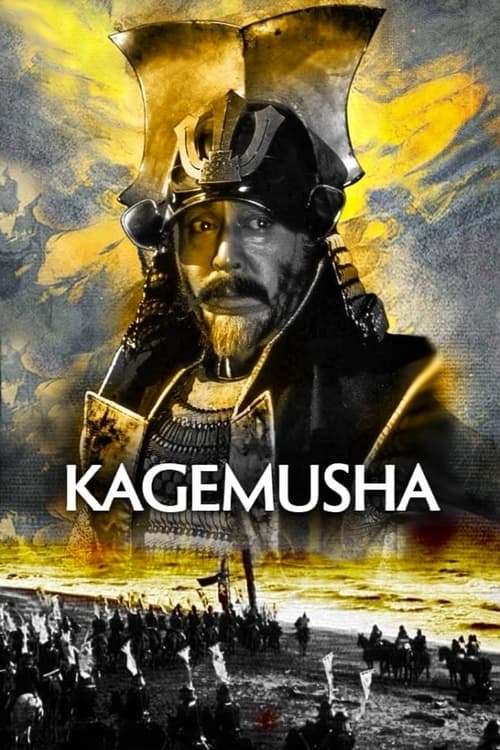
Kagemusha
1980 · Akira Kurosawa
For a patient evening when you want to sink into an epic and come out moved — this is a challenge-and-reward film, not background viewing. Pick it when you're in the mood for grandeur with a broken heart inside it.
What it's about
In war-torn sixteenth-century Japan, a petty thief is spared execution because he happens to be the exact double of Shingen, a feared warlord. When the real Shingen dies, the clan's generals secretly install the thief in his place, and a man who owned nothing must convincingly become a legend — fooling rivals, retainers, even the dead man's family — while enemy clans circle. The masquerade has to hold, because the clan's survival depends on the world believing Shingen still lives.
The experience
Stately, hypnotic, and slowly devastating: long, painterly scenes punctuated by dream sequences and massed armies moving like weather. It starts with the sly comedy of impersonation and deepens into something mournful — a film that leaves you quiet at the end.
Performances
Tatsuya Nakadai carries the film in a dual role as both the dying warlord and the thief who replaces him, letting you watch a nobody gradually grow into a great man's posture — and be hollowed out by it.
The craft
Kurosawa shot it at enormous physical scale — real locations, real armies of extras, banners and cavalry filling the widescreen frame — and drenched it in bold, almost hallucinatory color, including a nightmare sequence painted like one of his own canvases. The battle scenes are staged for awe and grief rather than excitement. It's one of the great big-screen experiences in the historical epic tradition.
Why it matters
Financed with help from two of Hollywood's most powerful directors after a decade in which Kurosawa struggled to work, it won the Palme d'Or at Cannes and restored him to international standing, paving the way for his late masterpieces. It remains a touchstone for filmmakers staging warfare at scale.
Snapshot
A petty thief is pressed into service as a body double for the dying Sengoku warlord Shingen Takeda; when Shingen dies, the thief sustains the impersonation for three years until it collapses—and the Takeda clan with it. Kagemusha is Kurosawa's meditation on the vacancy at the center of power: the man who embodies a legend discovers that the legend requires a corpse to function. Shot at vast scale across locations throughout Japan, the film moves from the intimate comedy of doubled identity to the apocalyptic—the annihilation of an entire military culture in a single afternoon of gunfire. Kurosawa spent years preparing it; it took two of Hollywood's most powerful directors to get it financed; it won the Palme d'Or at Cannes and re-established his international standing after a decade of professional difficulty. The film stands as the immediate precursor and structural dry-run for Ran (1985), together forming his late period's great inquiry into the ruin wrought by dynastic ambition.
Industry & Production
By the mid-1970s Kurosawa occupied an anomalous position in world cinema: revered abroad and commercially marginalized at home. Dodes'ka-den (1970) had failed at the Japanese box office, leaving him without reliable studio backing. He had traveled to the Soviet Union to direct Dersu Uzala (1975)—which won the Academy Award for Best Foreign Language Film—but that arrangement was a one-off, and upon returning to Japan he spent years developing projects that could not attract funding.
Kagemusha gestated for roughly a decade. Kurosawa researched Sengoku-period chronicle sources on the Takeda clan and accumulated hundreds of preparatory paintings—detailed full-color storyboards rendered by his own hand, depicting every significant composition in the film. These images, later exhibited and published, are significant cultural objects in their own right. When the project finally went to production, Toho agreed to co-produce, but the budget required exceeded what Japanese studios were willing to commit alone.
The decisive intervention came from George Lucas and Francis Ford Coppola, who served as international executive producers in a partnership that secured distribution backing from 20th Century Fox for territories outside Japan. Both directors were vocal admirers of Kurosawa's influence on their own work—Seven Samurai's shadow lay across The Hidden Fortress's acknowledged debt, and the debt of American New Hollywood to Kurosawa's editing and spatial grammar was widely understood. Their sponsorship was as much a public act of homage as a financial transaction. The arrangement gave Kurosawa a budget that allowed the scale of cavalry charge and panoramic battle the material demanded.
Casting the double role proved turbulent. Shintaro Katsu, the star of the long-running Zatoichi series and one of Japan's most physically formidable screen presences, was initially announced for the lead. Production broke down almost immediately—accounts differ in particulars, but the essential conflict concerned creative control on set, with Kurosawa unwilling to accommodate the star's working methods. Katsu departed, and Tatsuya Nakadai was cast to play both Shingen Takeda and the unnamed thief. The substitution proved consequential: Nakadai's performance is calibrated, internally modulated, and technically precise in ways that align with Kurosawa's direction.
Technology
Kagemusha is photographed in anamorphic widescreen, exploiting the format's horizontal breadth for two distinct purposes: the compression of large formations in telephoto long-shot, and the staging of intimate confrontations within palatial interiors where the frame's width becomes a measure of social distance. Kurosawa had worked with widescreen since The Hidden Fortress (1958), but the scale of Kagemusha—cavalry numbering in the hundreds, banners identifying clan divisions across the frame—pushed the format's logistical demands considerably further.
The production employed two directors of photography simultaneously, Takao Saitō and Masaharu Ueda, a practice Kurosawa had developed for managing complex multi-camera setups on large exterior sequences. Using multiple cameras allowed him to capture unrepeatable action—horses charging, flags collapsing, bodies falling—from several angles simultaneously, then cut among them. The approach influenced his editing grammar directly: he could assemble a battle from angles he had actually acquired, rather than reconstructing action through matched single-camera coverage.
The film's color design is applied systematically: the Takeda clan is coded in red and black; rival houses carry their own chromatic signatures. This functions less as realism than as visual taxonomy, allowing the audience to orient themselves within mass sequences where individual recognition is impossible. Kurosawa had been thinking in terms of color design since Dodeskaden; in Kagemusha the system is rigorous enough to function as narrative information in the closing carnage, where color becomes the medium through which the spectator traces which force is dying.
Technique
Cinematography
The film opens with a single long-duration static shot: three men—Shingen, his brother Nobukado, and the thief, all three in identical dress—seated across the frame, held for an extended duration before any cut. The composition is frontal, nearly symmetrical, and formally inert. It is among the most deliberate opening declarations in Kurosawa's filmography, establishing identity-as-performance as the film's governing problem before a word is spoken. Telephoto lenses are deployed in the battle sequences to compress cavalry formations into dense, layered masses, making the individual movement of each horse visible within the crush of the whole—a simultaneously democratic and overwhelming visual register.
Editing
Kurosawa edited his own films throughout his career, and Kagemusha is cut with the unhurried confidence that characterizes his late work. The contrast between the extreme stillness of the observational interior scenes and the rapid assembly of the battle montages is marked, and the transition between these registers—the quiet camp before Nagashino, then the catastrophic engagement itself—is managed with a deliberateness that gives the violence its full weight. The final battle sequence employs a kind of obsessive repetition: the same motion (Takeda cavalry riding into musket fire) is cut from multiple angles and repeated until the impossibility of the charge has been made viscerally apparent.
Mise-en-scène / Staging
The formal staging of court scenes places Kurosawa's compositional instincts in dialogue with Noh theater's presentational tradition. Figures are arranged frontally; spatial depth is organized along a horizontal axis rather than a perspectival recession; movement is spare and purposive. The thief's learning to occupy Shingen's stillness is itself dramatized through his gradual adoption of the warlord's characteristic posture and seated position. Kurosawa films this transformation incrementally rather than through dramatic revelation, so that by the film's middle section the audience registers the thief's authority as almost credible—which is exactly the trap the film is setting.
The dream sequences break entirely from the film's prevailing naturalism. In one, the thief confronts Shingen's ghost amid a hallucinatory landscape of shifting colors—the sequence is painted, raw, expressionistic, and among the most formally unusual passages in Kurosawa's sound-era work. It suggests an interior psychological dimension that the rest of the film withholds, making it function almost like a Romantic parenthesis inside an otherwise historical-materialist narrative.
Sound
Shinichirō Ikebe's score weaves orchestral forces with traditional Japanese instruments. The main theme is insistent and metronomic, and it accrues gravity through repetition—by the final battle it has become a funeral march rather than a martial fanfare. The sound design of the battle sequences is notably deliberate: Kurosawa foregrounds the crack of musket fire as a mechanical, unmistakable sound, not the diffuse roar of conventional epic-battle audio, so that each volley registers as a specific event with specific consequences. Silence is used structurally: the film withholds ambient sound at key moments of impersonation, isolating the thief within an acoustic stillness that mirrors his isolation from genuine social relation.
Performance
Nakadai carries the film's central paradox—a man without social identity who must perform the concentrated identity of one of Japan's most powerful warlords—through physical discipline rather than psychological expressionism. His Shingen is economical, massive in stillness; his thief is initially volatile and compressed. The film tracks the crossing of the two characterizations: as the thief inhabits Shingen more deeply, he simultaneously empties himself. The supporting ensemble, including Tsutomu Yamazaki as Nobukado and Kenichi Hagiwara as the impatient heir Katsuyori, gives the political machinery of the film its texture.
Narrative & Dramatic Mode
The screenplay, by Kurosawa and Masato Ide, structures the narrative as a prolonged formal problem: the thief successfully imitates the signs of power without access to the substance, and the tragedy is not that the impersonation is discovered but that it is—largely—not. Power is revealed to be a set of conventions that any adequately disciplined body can fulfill. The film's dominant tone in its first two thirds is something close to dark comedy: the generals who know their lord is dead conspire in bad faith alongside the generals who do not; the thief becomes gradually more invested in a role that was imposed on him. The final third abandons comedy for elegy. Katsuyori's decision to break with the military strategy that made the Takeda formidable—to advance cavalry against Nobunaga's entrenched musketeers at what the film represents as the decisive engagement—is depicted as an act of ego rather than strategy. The massacre that follows is rendered not as heroic sacrifice but as institutional suicide.
Genre & Cycle
Kagemusha belongs to the jidaigeki tradition—Japanese period drama—and more specifically to its epic sub-form, the large-scale Sengoku war film. Kurosawa had been central to the formation of this genre in the postwar decades, and Kagemusha represents a late-career return to its formal conventions while subjecting those conventions to skeptical pressure. The chambaras and heroic individual combats that characterize earlier entries in the genre are largely absent; there is no lone swordsman here, no decisive single encounter. What remains is mass: undifferentiated cavalry, undifferentiated musket fire, undifferentiated death. The film situates itself in a cycle of Sengoku epics that had run through Japanese cinema from the 1950s, but its mood is revisionary rather than celebratory.
Authorship & Method
Kurosawa's collaborative relationships were long-standing and exacting. He had worked with cinematographer Takao Saitō on several late films, and the sustained partnership gave the crew an understanding of his visual priorities that reduced the friction inherent in large-scale production. His practice of comprehensive pre-visualization through storyboards—which for Kagemusha ran to hundreds of detailed paintings—meant that decisions about composition, color, and cutting were largely settled before shooting began. This made him a director of exceptional preparation rather than improvisation, though his ability to respond to conditions on set was equally documented.
The collaboration with composer Shinichirō Ikebe, who would also score Ran, established a musical approach suited to Kurosawa's late aesthetic: ceremonial rather than dramatic, emphasizing weight and duration over melodic development. The writer Masato Ide had been a close collaborator across Kurosawa's later career; their joint scripts typically begin from historical chronicle and move toward moral allegory.
Movement / National Cinema
By 1980 Kurosawa occupied an ambiguous position within Japanese national cinema. The New Wave directors who had emerged in the late 1950s and 1960s—Oshima, Imamura, Yoshida—had repositioned themselves against the classical tradition he represented. Domestic funding for his projects had dried up. Yet internationally his status was undiminished, and the Lucas-Coppola intervention underlined the paradox: he was more valued by the heirs to his influence than by the industry that had formed him. Kagemusha was, in this sense, a repatriation as much as a homecoming—a film that Japanese audiences received as the return of a master, partly because foreign validation had preceded and underwritten it.
Era / Period
The film appeared at a moment when the international art-film circuit was reassessing the canon of world cinema's great directors. Kurosawa's enforced absence from large-scale production in the 1970s had given his reputation the quality of retrospective distance; Kagemusha functioned, on its Cannes premiere, as a re-emergence rather than a continuation. The film belongs to the early 1980s' brief period of sustained international interest in epic historical filmmaking from non-Western cinemas, a period that also included the maturation of the New German Cinema and a renewed European interest in historical spectacle.
Themes
The film's central theme is the performance of identity under institutional necessity. The thief is required to become Shingen not because he resembles him but because the clan requires Shingen's continued existence to function. His individual will, desires, and history are subordinated to a social role that existed before him and that will require his erasure when it no longer needs him. This is not presented sentimentally: the thief is a criminal of negligible social standing, and the film does not romanticize his adoption of aristocratic dignity. What it registers, with some compassion, is that the role transforms him regardless—that he begins to grieve for the clan's horse, to feel responsible for the heir's recklessness, to inhabit a set of loyalties that were never his.
The futility of military ambition is a related preoccupation. Shingen is dead before the film has properly begun; all the strategic calculation that follows is conducted on behalf of a corpse. The Takeda clan's ultimate destruction follows not from any single miscalculation but from the structural impossibility of indefinitely sustaining a vacuum at the center of power. The battle of Nagashino, as depicted, is less a military defeat than a historical inevitability—the moment when the tactical assumptions that made the Takeda formidable encounter the technology that has superseded them.
Reception, Canon & Influence
Backward influences: Kurosawa drew on Sengoku-period historical chronicle and on his own earlier engagement with the jidaigeki form, from Rashomon (1950) through Seven Samurai (1954) and the subsequent chambara films. The premise of the double and the philosophical problem of identity recall his engagement with Shakespeare—which would become explicit in Ran's Lear adaptation—and with the Noh theater tradition's formalization of role and mask. His compositional vocabulary in the interior scenes is deeply indebted to Japanese classical painting, an influence he had cultivated since his training as a visual artist in the 1930s.
Critical reception: Kagemusha premiered at the Cannes Film Festival in May 1980, where it won the Palme d'Or—the capstone of Kurosawa's international rehabilitation after the decade's difficulties. The film was nominated for two Academy Awards, for Best Foreign Language Film and Best Costume Design, and the costume work by Kurosawa's regular collaborator was widely noted as integral to the film's visual argument about rank and display. Critical reception in Japan and internationally was substantially positive, with the scale of the production and Nakadai's performance receiving consistent attention. Some critics noted that the film's formal ambitions occasionally produced a coolness of register—the tragedy is apprehended intellectually before it is felt—though this has been revisited as a deliberate structural choice rather than an emotional deficit.
Forward influences: Ran (1985) is the direct heir, taking the dynastic-ruin material and pressing it toward explicit Shakespearean tragedy with an enlarged palette and intensified formal experiment. Beyond Kurosawa's own subsequent work, Kagemusha's influence is diffuse but traceable: its approach to the battle sequence as mass event rather than heroic individual encounter, its systematic color-coding of military factions, and its use of silence and stillness within large-scale historical spectacle were absorbed into the grammar of the international epic film. It is regularly cited in discussions of films seeking to combine historical authenticity with formal ambition, and it remains one of the canonical texts for the study of Japanese cinema's late classical period.
A Deleuzian reading
The film begins with a man looking at himself.
The full Deleuzian reading of Kagemusha →
Reception
A triumph on arrival — it shared the Palme d'Or at Cannes in 1980 and got a Best Foreign Film Oscar nomination — but its afterlife has been spent in the shadow of Ran, with Kurosawa himself calling it something of a dress rehearsal. Recent decades have seen cinephiles push back and claim it as a masterwork in its own right.
How Kagemusha was received, from release to now →
Influences: the films it descends from and the films it influenced
- Rashomon (1950) — Kurosawa's own earlier film establishes identity as a formal rather than psychological question — the same event rendered incompatible by competing witnesses — which Kagemusha literalizes: the double who performs lordship until performance becomes indistinguishable from the original.
- Ugetsu (1953) — Kazuo Miyagawa's static long-take grammar — camera as motionless witness to dissolution — directly informs Kagemusha's opening sustained tableau and ceremonial interior scenes, where the fixed frame absorbs ceremony rather than analyzing it.
- Seven Samurai (1954) — Kurosawa's multi-telephoto camera setup for battle, compressing collective action into dense, overlapping planes of bodies in motion, is the direct technical ancestor of Kagemusha's battle staging, the method refined across the intervening decades into greater stillness.
- Lawrence of Arabia (1962) — Freddie Young's SuperPanavision 70 telephoto lenses compress desert armies into shimmering, flattened planes of color and heat; Kagemusha adopts this optic grammar wholesale for its cavalry sequences, treating massed troops as visual events rather than military maneuvers.
- Harakiri (1962) — Kobayashi strips the jidaigeki form to expose moral vacancy beneath samurai ritual through formal rigor rather than statement; Kagemusha inherits both the genre skeleton and the skeptical gaze, redirecting it from honor codes toward the vacancy of political power itself.
- Kwaidan (1964) — Yoshio Miyajima's cinematography translates Noh theater's frontal, mask-wearing formalism into systematic widescreen color staging; the tableau-like ceremonial frames and color-saturated set design organized around symbolic hue are the direct visual antecedent of Kagemusha's clan-taxonomy sequences.
- Au Hasard Balthazar (1966) — Bresson deploys silence not as absence but as structural weight, making sudden specific sound events land with disproportionate force; this formal model underlies Kagemusha's sound design, where extended ceremonial near-silence makes the musket volleys function as rhythmic punctuation rather than illustration.
- The Hidden Fortress (1958) — Kurosawa scales the vertical hierarchy framing and telephoto army compositions of Hidden Fortress to full epic dimensions; scenes of the double observed from distance against ranked cavalry directly develop the negative-space-and-scale visual logic established in the mountain sequences, while the comic-pov structure reappears inverted—the low-status impersonator now occupying the high-status frame position.
- Samurai I: Musashi Miyamoto (1954) — Kurosawa's return to jidaigeki epic uses color as deliberate emotional grammar — battle-banner palettes, landscape tonalities marking psychological states — extending the Eastmancolor tonal approach Inagaki and Kinugasa had established as the period film's prestige register in the 1950s.
- Dersu Uzala (1975) — Directly enabled by the international viability Dersu's acclaim restored, and extending its telephoto massed-figures-and-weather epic scale into color widescreen.
- Samurai III: Duel at Ganryu Island (1956) — Carries the Eastmancolor jidaigeki tableau to its apex, treating landscape and light as the primary compositional subject the way the beach-sunrise duel does.
- Ran (1985) — The direct formal heir: Kurosawa retains the dual-cinematographer arrangement (Nakai and Saitō), systematic clan color-coding (red, yellow, blue for Hidetora's sons), and Noh-derived frontality, while pressing the ceremonial aesthetic toward explicit Shakespearean tragedy with a more expressionistically enlarged and degraded palette.
- The Last Emperor (1987) — Vittorio Storaro's color taxonomy — imperial yellow as spatial confinement, gray-blue as historical diminishment — absorbs Kagemusha's method of using hue to map hierarchical space and track the temporal arc of power's vacancy across a single life.
- The Thin Red Line (1998) — John Toll's stillness-against-violence rhythm and the sound design's extended passages of ambient jungle sound punctuated by close-registered gunfire descend from Kagemusha's structural silence and musket-fire specificity, redeployed as a formal argument about war's indifference to individual consciousness.
- Hero (2002) — Christopher Doyle's color-coded narrative segments — each hue corresponding to a perspective and a moral argument — systematize Kagemusha's clan color taxonomy into a narrative grammar where color organizes epistemology rather than merely identifying faction.
- The Last Samurai (2003) — John Toll's telephoto-compressed final battle sequence and the systematic color differentiation of traditional samurai (earth tones, indigo) versus Meiji military (khaki, gray) descend from Kagemusha's grammar of reading political faction and historical transition through color and compressed spatial plane.
- Thirteen Assassins (2010) — Miike's revisionary jidaigeki skepticism — samurai codes exposed as self-serving performance by men who have never questioned them — and his staging of mass combat as collective butchery in a constrained, rigged environment invert Kagemusha's open-field telephoto grammar while inheriting its argument about war's abstraction from individual heroism.
- The Lord of the Rings: The Return of the King (2003) — Kurosawa's system of color-coding opposing armies through banner and uniform — allowing viewers to track military situation through color-field rather than individual figure across chaotic terrain — is the formal precedent for ROTK's use of gold Rohirrim, white Gondor, and black Mordor as legible political identities within Pelennor Fields' visual complexity.
- Braveheart (1995) — Gibson's massed-formation battle staging — infantry blocks rendered as geometric patterns against open terrain before dissolving into close-quarters chaos — directly adapts Kurosawa's method of intercutting strategic overview with individual human scale within the same sequence, a technique Gibson explicitly cited during production.
- Dreams (1990) — Contains Kurosawa's prototype painted dream sequence and was the project where he committed to full-color storyboard-paintings as a pre-visualisation method, the working process that generated 'Dreams' shot-by-shot.
- 13 Assassins (2010) — The use of static wide shots and minimal traditional instrumentation to convey feudal inevitability, with the dying order's weight registered through stillness rather than action, establishes the elegiac mode and score-restraint approach Miike inherits for the film's first half.
- Shadow (2018) — Supplies the dying-warlord-and-double engine that Shadow rebuilds — the commoner trained to impersonate a great man, with sovereignty staged as hollow performance and the substitution as the narrative's withheld design.
- Barry Lyndon (1975) — Kubrick uses period-accurate pigments as a visual taxonomy of rank — the red of English regimentals, the blue of Prussian officers — solving the same problem Kagemusha solves through clan color-coding: how to make faction and hierarchy instantly legible across a widescreen frame without dialogue.
- Days of Heaven (1978) — Nestor Almendros establishes a rhythm of extreme stillness interrupted by elemental violence, with silence treated as structural duration rather than neutral absence; this oppositional grammar runs parallel to Kagemusha's stillness-montage contrast and its strategy of using quiet to give specific sound events catastrophic weight.
Similar films
- Ran (1985) — influence & lineage
- Rashomon (1950) — influence & lineage
- Seven Samurai (1954) — influence & lineage
- Harakiri (1962) — influence & lineage
- Ugetsu (1953) — influence & lineage
- Throne of Blood (1957) — shared sensibility
- Gate of Hell (1953) — shared sensibility
- Yojimbo (1961) — shared sensibility
All the films related to Kagemusha →