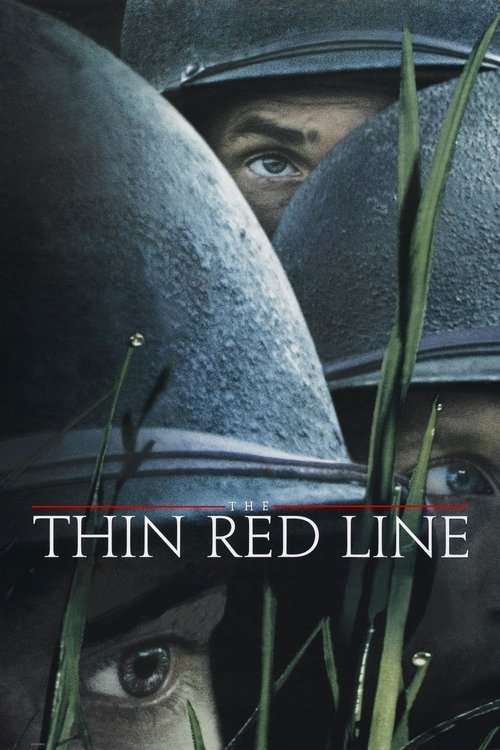
The Thin Red Line
1998 · Terrence Malick
For a contemplative night when you want a war film that asks questions instead of delivering thrills — when you're ready to surrender to a slow, meditative three hours. Definitely a challenge, and it rewards patience generously.
What it's about
An Army rifle company lands on Guadalcanal in World War II and fights its way up a grassy hill held by the Japanese, while the film drifts among the soldiers' inner voices — their fears, their memories, their questions about why men kill in the middle of paradise. It's a combat film that keeps looking past the combat, at the jungle, the light, the birds, the men.
The experience
Dreamlike and devastating at once — battle sequences of real terror floating in long passages of quiet, voiceover, and staggering natural beauty. It works on you like music; you come out moved and a little dazed rather than pumped up.
Performances
Jim Caviezel is the film's soul as a soldier who seems half out of the war already, and Nick Nolte burns as a colonel consumed by ambition — two poles of an enormous ensemble stacked with famous faces in small parts.
The craft
Terrence Malick's camera moves like wind through the grass — light, uncommanded, as interested in a leaf as a firefight — and Hans Zimmer's score is among his most transcendent. The sound and image are the argument here; it demands a big screen and good speakers more than almost any war film.
Why it matters
Malick's return after twenty years of silence, released head-to-head with Saving Private Ryan in the same awards season — the two films split the argument about what a war movie should be, and this one's poetic approach echoes through ambitious war cinema since. Both were nominated for Best Picture.
Snapshot
Terrence Malick's third feature — arrived after a twenty-year silence — is a meditation on war, nature, consciousness, and evil set against the 1942–43 American assault on Guadalcanal. Adapted from James Jones's 1962 novel, the film dissolves conventional battle-film structure into a stream of lyrical voiceover, uncommanded camera movement, and philosophical interiority, producing what many critics have come to regard as the most formally ambitious American war film ever made. It arrived in the same awards season as Steven Spielberg's Saving Private Ryan, an adjacency that sharpened debate about what a war film is permitted to ask and how it is permitted to ask it. Neither film conceded ground to the other; both were nominated for Best Picture at the 71st Academy Awards, and their co-existence crystallized a fork in the road of the genre that has been navigated by filmmakers ever since.
Industry & production
Malick's return to Hollywood after Days of Heaven (1978) was long anticipated and frequently rumored; he had spent the intervening decades in Paris and Texas, working on scripts that came to nothing, translating philosophical texts, and, by most accounts, resisting the machinery of the industry. The project originated with producers Robert Michael Geisler and John Roberdeau, who had optioned Jones's novel and pursued Malick for years before securing his commitment. Grant Hill served as a co-producer and became the principal liaison for a shoot that expanded far beyond its original parameters.
Principal photography began in 1996 and eventually ran for roughly six months, with locations scouted in the Daintree rainforest region of Far North Queensland, Australia — standing in for Guadalcanal — and supplementary coastal and beach work conducted in the Solomon Islands themselves. The production assembled what was, on paper, an astonishing ensemble: Sean Penn, Nick Nolte, Jim Caviezel, Elias Koteas, Jared Leto, Adrien Brody, John Cusack, Woody Harrelson, John C. Reilly, Ben Chaplin, and Dash Mihok, alongside brief appearances by or footage shot with Billy Bob Thornton, Martin Sheen, Gary Oldman, Mickey Rourke, Lukas Haas, Viggo Mortensen, and Bill Pullman. Much of this material was reduced to near-nothing or excised entirely in post-production. Adrien Brody, who had been led to understand he would have a leading role, found himself reduced to a handful of lines; he has spoken about the experience publicly and with evident bewilderment. Malick's editorial process, which reportedly involved well over a million feet of exposed negative and editing rooms full of footage that would never be seen, became one of the production legends of the late 1990s.
The studio behind the film was 20th Century Fox, which had granted Malick final cut — a concession that both reflected his singular status and exposed the studio to a film that resisted every commercial reflex. The finished film runs approximately 170 minutes.
Technology
The film was shot on 35mm anamorphic and spherical formats, exploiting the latitude of photochemical negative to hold detail across the extreme tonal ranges Malick and his cinematographer John Toll required: the blinding white of an open hilltop under Pacific sun, the near-darkness of jungle shadow, the golden-hour light for which Malick had been famous since Days of Heaven. No significant digital visual effects were used in the traditional sense, and the film's naturalism is photographic rather than computational. Lens choices skewed wide, particularly for the ground-level grass and foliage shots that became the film's visual signature, requiring close proximity to organic material and exploiting the optical distortion of wide angles to make the non-human world loom. The production's scale demanded sophisticated on-location sound recording that would later be extensively layered in post, but the technology of the shoot itself was classical in orientation — the innovation was in how analog tools were used, not in the deployment of new ones.
Technique
Cinematography
John Toll — who had previously won Academy Awards for Legends of the Fall (1995) and Braveheart (1996) — brought to The Thin Red Line a willingness to follow Malick into conditions that conventional production logic would refuse. The cinematography is defined by several interlocking strategies. First, the camera is permitted to detach from human action and attend to the non-human: stalks of kunai grass, a parrot, the surface of a river, clouds moving over a ridgeline. This is not cutaway material in the conventional sense; it is treated as equal in weight to any shot of a human face. Second, the film exploits natural and available light to a degree unusual for a studio production of this scale, privileging the particular quality of tropical dawn and dusk over controlled artificial lighting. Third, the camera's relationship to actors is exploratory rather than predetermined: it circles, approaches, retreats, discovers, often catching actors in states of absorption or transit that a locked-off setup would have missed. The cumulative effect is of a consciousness — not a character's, not the director's, but something ambient — moving through both the battlefield and the island's ecology with equal attention and equal bewilderment.
Editing
The editing by Billy Weber and Saar Klein is structural rather than rhythmic in the conventional sense. Malick's films have always been edited from a vast oversupply of footage, and the process here was legendarily protracted. The cut that reached audiences abandons chronological battle-film causality in favour of associative logic, allowing voiceover from multiple characters to carry the film's argument while images form a parallel, sometimes contrapuntal, visual essay. Conventional action-sequence editing — shot/reverse-shot, eyeline matching, the grammar of cinematic spatial clarity — is present but intermittent. Sequences of violence are intercut with images of the natural world not as relief or contrast but as a question: the editing refuses to let the viewer settle into the visual conventions of either war spectacle or its humanist critique.
Mise-en-scène / staging
Malick's on-set method deliberately loosens the grip of the screenplay. He is known to direct actors toward states and situations rather than lines, encouraging discovered behavior over rehearsed delivery, and to reposition cameras in response to what actors do rather than blocking actors to pre-positioned cameras. The result is staging that has the texture of improvisation even when it isn't: actors' bodies occupy space in ways that feel ungoverned by compositional convention. The human figure is frequently small within the frame or partially obscured by vegetation, reversing the anthropocentric hierarchy of most commercial cinema. In the film's set-piece assault on the Japanese-held ridge — the film's closest approach to conventional war-film spectacle — the staging manages to render tactical confusion and individual extremity simultaneously, without sacrificing either to the other.
Sound
The sound design, supervised by Eugene Gearty and Guntis Sics, treats the Guadalcanal environment as a continuous sonic presence against which human violence intrudes rather than dominates. Insect choruses, wind, bird calls, and rainfall are woven into the mix at volumes that would conventionally be reduced to allow dialogue or score precedence. Combat sounds are rendered with physical specificity — the acoustic difference between incoming and outgoing fire, the dampened quality of sound in dense jungle — but they do not carry the heroic or spectacular weight that much of the genre's sound design had established as normative. The effect is immersive in a manner opposite to Saving Private Ryan's: where Spielberg's sound design achieves presence through shock and immediacy, Malick's achieves it through sustained environmental density.
The score by Hans Zimmer operates as an almost entirely ambient field: long, slow, wordless choral material and spare orchestral gestures rather than conventional thematic development. The film also makes prominent use of a Melanesian choral piece — a Solomon Islands Christian hymn sung by indigenous voices — that frames several of the film's most formally meditative passages and places the Western military narrative within an older acoustic and spiritual world it cannot comprehend.
Performance
The performances in The Thin Red Line are distributed across a large ensemble in ways that prevent identification with any single protagonist, a formal strategy that mirrors the philosophical argument. Jim Caviezel's Private Witt — serene, detached, almost mystical — functions less as a conventional hero than as a point of philosophical orientation. Sean Penn's First Sergeant Welsh provides a counter-argument: skeptical, embodied, insistently material. Nick Nolte's Lieutenant Colonel Tall is the film's most conventionally dramatic performance, and among its most powerful: a career officer's ambition expressed as something close to pathology. The fragmentation of Adrien Brody's and others' expected roles means that several performances exist only as remnants, but even in truncated form many carry the atmospheric weight Malick solicits. The ensemble mode of performance extends Malick's earlier interest in non-professional or semi-professional actors alongside established stars, and the mixture of naturalism and stylization in voiceover delivery — actors speaking internal states in registers they would never use in conventional dramatic scenes — produces a tonal uniformity that is the film's own.
Narrative & dramatic mode
The film abandons conventional narrative exposition. It has no establishing backstory, no character arcs resolved through dramatic confrontation in the standard sense, no privileged protagonist whose trajectory organizes events causally. Instead, it proceeds by lyrical accumulation: philosophical voiceover spoken by multiple characters (and sometimes by an unidentified or unattributable voice), images that function as meditation rather than plot information, and dramatic sequences that are embedded within this larger contemplative structure rather than the reverse. The result is closer to essay film or visual poem than to dramatic narrative as Hollywood had defined it, though it is fully capable of conventional dramatic power when it chooses — the ridge assault, the death of Sergeant Keck, the meeting between Witt and Welsh at the film's close — making the meditative framework feel like a deliberate philosophical choice rather than an absence of dramatic skill.
Genre & cycle
The Thin Red Line belongs to the war film genre while fundamentally contesting its conventions. Where the classical Hollywood war film — from The Big Red One to Apocalypse Now to Platoon — organizes combat experience around group identity, tactical objective, moral testing, and survivor testimony, Malick's film disperses these functions and submits them to philosophical interrogation. It shares with the anti-war film tradition a skepticism about militarist ideology, but it is not an anti-war film in the polemical sense: it does not argue against war so much as refuse the aesthetic terms through which war is typically narrated. The film arrives within a late-1990s cycle of major war productions — Saving Private Ryan, Thin Red Line, The Patriot, Enemy at the Gates — that followed the cultural relaxation of taboos about representing World War II as American studios increasingly targeted the generation of filmmakers and audiences for whom that conflict was historical rather than living memory.
Authorship & method
Malick studied philosophy at Harvard and as a Rhodes Scholar at Magdalen College, Oxford, before entering the AFI Conservatory. He translated Heidegger's Vom Wesen des Grundes (published in 1969) before turning to filmmaking, and the Heideggerian preoccupations of his work — being-in-the-world, the question of nature, the forgetting of being — are widely noted by scholars without, for the most part, being asserted by Malick himself, who gives essentially no interviews. His authorial signature is among the most consistent in world cinema: the lyrical voiceover, the camera's attention to the non-human, the use of natural light, the philosophical gravity, the protracted and transformative editorial process. In The Thin Red Line, these elements operate at maximal intensity.
John Toll's contribution has been discussed above; he was a trusted collaborator whose technical control allowed Malick's formal instincts to operate at scale. Hans Zimmer's score represents an unusually restrained register for a composer whose subsequent career would take a different direction, and the collaboration has the character of a composer subordinating his own aesthetic to the film's. The editing relationship between Malick and his editors is more process than partnership in the conventional sense: Malick is reported to work intensely and for extended periods in the editing room, and the editorial voice of his films is his own.
Movement / national cinema
The film belongs squarely within American cinema and the tradition of the Hollywood auteur, but Malick's formal and philosophical project draws on sources that exceed that tradition. The film's closest formal ancestors in world cinema are European: the essay films of Alain Resnais, the visual lyricism of Andrei Tarkovsky, and — at greater remove — the contemplative duration of Carl Theodor Dreyer. Malick's use of nature as philosophical argument has a specifically American intellectual genealogy in Emerson and Thoreau, and the transcendentalist strand of American literature runs underneath the surface of all his work, including this film.
Era / period
The film was produced and released in the long 1990s moment of American cultural stocktaking around World War II, when Steven Ambrose's popular history, the Spielberg-Hanks franchise, and a wave of memorial projects constructed what critics have called the "greatest generation" narrative. Malick's film inhabits this cultural moment while remaining largely indifferent to its ideological project. The film was released in December 1998 — a late-year qualifying run, then wider release in January 1999 — and both it and Saving Private Ryan were nominated for Best Picture at the 71st Academy Awards, where neither won (the award went to Shakespeare in Love). The Thin Red Line received seven nominations in total but won none.
Themes
The film's central philosophical argument concerns the relationship between nature and human violence. The question, voiced explicitly in Witt's opening monologue and returned to throughout, is whether the evil of war is ontologically distinct from the natural world or continuous with it: is there another world within this one, and if so, what is it? This Heideggerian and quasi-mystical inquiry runs alongside a more concrete examination of what military hierarchy and collective violence do to individual consciousness, and whether individual consciousness can maintain its integrity — its "spark," in the film's terms — within the machinery of war. Mortality, transcendence, brotherhood, the soul, and the question of divine presence in a world of suffering are elaborated not as answers but as sustained questions. The film refuses consolation and refuses nihilism simultaneously, occupying a philosophical space of genuine uncertainty that is unusual in popular cinema.
Reception, canon & influence
Backward influences. James Jones's novel, which Malick had been interested in since the 1970s, is the direct source and provides the basic narrative architecture and many of the characters, though Malick's adaptation is philosophical where Jones's novel is more sociological and character-driven. The 1964 film adaptation directed by Andrew Marton is generally considered a negligible precursor. Malick's own Badlands (1973) and Days of Heaven (1978) are the essential precursors within his own career. The philosophical voiceover and lyrical landscape cinematography of Days of Heaven are extended and radicalized here. From European cinema, the contemplative practices of Tarkovsky — the sustained attention to elemental materials, the voiceover as philosophical rather than narrative device, the willingness to let a film expand to the duration its argument requires — are the most frequently cited influences by scholars, though Malick has not confirmed them. The American transcendentalist literary tradition (Emerson, Thoreau, Whitman) supplies the film's foundational conception of nature as morally and metaphysically legible.
Critical reception. Initial critical response was respectful but divided. Those critics who approached the film through war-film conventions found it evasive or self-indulgent; those who approached it as philosophical cinema found it revelatory. Roger Ebert awarded it four stars upon release. Over the subsequent two decades, the critical consensus has shifted decisively: the film is now widely regarded as among the major American films of its decade and among the finest war films ever made. Its reputation has grown as the framework for evaluating it — contemplative cinema, the essay film tradition, philosophical art cinema — has become more broadly available to Anglo-American criticism.
Forward influence. The film's legacy operates on several levels. For Malick himself, it inaugurated the mature phase of his career: The New World (2005), The Tree of Life (2011), To the Wonder (2012), Knight of Cups (2015), Song to Song (2017), and A Hidden Life (2019) all develop the formal and philosophical vocabulary consolidated here, and together they constitute a body of work with no precise analog in mainstream American filmmaking. Emmanuel Lubezki, who became Malick's cinematographer from The New World onward, has cited The Thin Red Line as formative in his understanding of what the camera could be asked to do in a narrative film. More broadly, the film demonstrated to a generation of filmmakers that a studio-funded, wide-release film could operate at the formal ambition of art cinema without abandoning either serious subject matter or serious production values. Its influence on subsequent war films is harder to trace directly than to feel atmospherically: the willingness to treat combat as a philosophical occasion rather than a spectacle, and to situate human violence within the moral weight of the natural world, recurs in films from Alejandro González Iñárritu's The Revenant (2015) to Ruben Östlund's and Chloe Zhao's various explorations of the human figure within non-human landscapes. That it remains in regular critical circulation, that it is taught in film programs as a formal exemplum, and that its reputation has only strengthened with distance from its opening-weekend comparison with Saving Private Ryan suggests that its canonical position is now secure.
A Deleuzian reading
Halfway up the hill, with men dying in the grass around him, the camera leaves them.
The full Deleuzian reading of The Thin Red Line →
Reception
In 1998 it was the 'other' WWII movie — respectfully received, seven Oscar nominations, zero wins, and thoroughly overshadowed by Saving Private Ryan. Today the tables have turned among cinephiles, who routinely argue it's the deeper, more enduring film of that famous head-to-head year.
How The Thin Red Line was received, from release to now →
Influences: the films it descends from and the films it influenced
- Badlands (1973) — Sissy Spacek's voiceover narrates feelings and observations uncoupled from onscreen events, establishing the contrapuntal image/voiceover device — detached lyrical commentary rather than explanatory narration — that Malick systematized across multiple soldiers' consciousnesses in Thin Red Line.
- Days of Heaven (1978) — Nestor Almendros's practice of shooting almost exclusively in the magic-hour window, treating available natural light as a structural rather than technical decision, directly established the natural-light-primacy principle that John Toll extended and adapted to tropical Queensland.
- Ivan's Childhood (1962) — Tarkovsky's debut established WWII as the occasion for lyrical dream sequences where forest and river carry spiritual weight, intercutting associatively with battle material — the same forest-as-consciousness grammar Malick applied to Guadalcanal's jungle.
- Mirror (1975) — Tarkovsky's non-linear interweaving of personal memory, historical footage, and lyrical imagery under a disembodied voiceover — creating an essay-film mode where images argue in parallel rather than illustrate narration — is the direct structural model for Malick's associative montage across multiple voiceover consciousnesses.
- Stalker (1979) — Tarkovsky's camera rests on grass, water, and industrial detritus as subjects equal in weight to human actors, refusing to subordinate the non-human world to narrative function — the exact logic Malick applies to kunai grass, parrots, and the Guadalcanal riverscape.
- Picnic at Hanging Rock (1975) — Russell Boyd's available-light cinematography treats the Australian landscape as an active overwhelming presence that diminishes and eventually absorbs human figures — figures dwarfed by non-human environment as formal thesis — a visual logic Malick and Toll transpose directly to the Pacific, also shooting in Australia.
- Apocalypse Now (1979) — Willard's disembodied voiceover positions war as an occasion for philosophical self-examination rather than tactical narration, while Walter Murch's layered environmental sound design — river, jungle, rotor wash — models the immersive sonic ecology that Malick and sound designer Lars Ulland extended to the Pacific.
- Come and See (1985) — Klimov deconstructs heroic war-film grammar by dissolving narrative causality into sensory and psychological immersion — environmental sound that swamps music, figures overwhelmed by landscape — establishing the formal vocabulary for war as traumatic consciousness that Malick directly inherits.
- A Bridge Too Far (1977) — Inherits A Bridge Too Far's ensemble-no-protagonist WWII dispersal and polyphonic perspective distributed across many soldiers, but dissolves Goldman's clear causal chain of institutional failure into interior-monologue fragmentation — collective catastrophe retained while chain-of-command critique is dissolved into metaphysics.
- Fitzcarraldo (1982) — Malick and cinematographer John Toll extend the long-take observational grammar of jungle-as-protagonist — allowing the environment to fill around human drama rather than be subordinated to it — while Malick's counterpoint of Fauré's 'Agnus Dei' against Pacific combat applies the same European-music-versus-tropical-landscape formal principle as Caruso against Amazonian chaos.
- The Right Stuff (1983) — Malick extends Kaufman's formal grammar — large male ensemble staged across anamorphic widescreen landscape through physical reticence, philosophical voiceover as counter-narrative to institutional heroism — into WWII via John Toll's cinematography, which explicitly rhymes with Deschanel's approach to natural light and negative space.
- Kagemusha (1980) — John Toll's stillness-against-violence rhythm and the sound design's extended passages of ambient jungle sound punctuated by close-registered gunfire descend from Kagemusha's structural silence and musket-fire specificity, redeployed as a formal argument about war's indifference to individual consciousness.
- The New World (2005) — Malick and incoming cinematographer Emmanuel Lubezki extended Thin Red Line's natural-light primacy into a fully handheld, available-light system with no artificial sources, retaining the contrapuntal voiceover structure and the camera's free attention to grass, water, and animal life as the film's primary subjects.
- The Tree of Life (2011) — Malick and Lubezki pushed the non-human camera attention and essay-film voiceover to cosmological scale — dinosaurs, nebulae, and a Texas suburb within the same associative montage logic — while the philosophical voiceover addressed God directly rather than the morality of the battlefield.
- Uncle Boonmee Who Can Recall His Past Lives (2010) — Weerasethakul's camera rests on jungle, fireflies, and catfish with the same contemplative weight it gives human faces and cuts associatively between living, dead, and animal states under minimal dialogue — extending Malick's non-human camera attention and essay-film logic into Southeast Asian animist cosmology.
- Beasts of the Southern Wild (2012) — Ben Richardson's wide-angle ground-level photography — camera below knee height, figures silhouetted against sky, natural light only — and Hushpuppy's philosophical voiceover that addresses an indifferent cosmos rather than explaining plot both directly inherit the visual and narrative grammar Malick established.
- A Hidden Life (2019) — Malick's return to WWII applies the full Lubezki wide-angle natural-light system to Austrian farmland, with the same Heideggerian opposition of authentic individual conscience against institutional mass violence — the moral interiority is identical to Witt's and Staros's, now given a protagonist whose resistance is as interior as any soldier's in Guadalcanal.
- Train Dreams (2025) — Converts a novel's interior prose into layered, free-floating voiceover set against an indifferent natural world, the same wager on voice-as-fidelity Train Dreams makes.
- Gladiator (2000) — Hans Zimmer's score for Malick's film — ambient, choral, deploying wordless voices as textures rather than melodies — is the immediate compositional laboratory for the glossolalia technique he develops further in Gladiator with Lisa Gerrard, where vocal sound registers grief as sensation rather than language.
- We Were Soldiers (2002) — John Toll's warm amber-toned anamorphic cinematography for Pacific jungle combat — a lyrical, saturated alternative to Kamiński's cold documentary grammar released the same year — established a warm-palette combat-film register that Semler's Ia Drang work directly extends and normalizes for mainstream war films.
- All Quiet on the Western Front (2022) — John Toll's anamorphic widescreen oscillates between extreme close-ups of grass, hands, and faces and vast landscape compositions that dwarf figures — the proximity-withdrawal alternation Berger adopts as his primary cinematographic mode — while Malick's editorial refusal to provide interpretive voiceover for combat behavior establishes the behaviorist grammar Friend and Berger inherit.
- The Revenant (2015) — Malick's precedent of interrupting a genre survival narrative with lyric first-person narration and elemental landscape shots that reframe combat as spiritual inquiry pioneers the lyric-vision-interruption mode The Revenant inherits and deepens.
- Hacksaw Ridge (2016) — Malick and John Toll established silence, ambient natural sound, and interior voiceover as the register for a soldier's spiritual experience of war — a model Gibson selectively absorbs for Doss's contemplative passages, the film's interior life suspended against carnage.
- Dunkirk (2017) — Broke Hollywood war-film convention by fragmenting Guadalcanal combat into disoriented sensory impressions distributed across a de-centered ensemble with no tactical overview; Dunkirk's refusal to give any character — or the audience — a strategic map of the evacuation descends from Malick's phenomenological grammar.
- Saving Private Ryan (1998) — Arriving in the same awards season with the same WWII subject, Spielberg's kinetic grammar of combat — handheld crash-zoom, desaturated palette, de-centred sound — defines the formal opposite pole to Malick's lyrical deconstruction, and their co-existence crystallized the binary within which all subsequent war films have been positioned.
- Full Metal Jacket (1987) — John Toll's long-lens compression of the Guadalcanal landscape — flattening soldiers against grass and sky into figures in an indifferent composition — and Malick's episodic fragmentation of combat experience into separate consciousness streams situate the film as the poetic counterpart to FMJ's analytic mode: both films use formal structure to enact a duality-of-man thesis rather than illustrate it.
- Platoon (1986) — Competing voice-over-diary war film that multiplies the interior monologue across soldiers, deepening Platoon's the-war-within into philosophical reverie.
- The English Patient (1996) — Shares the staging of intimacy against vastness and the memory-voiceover register — private interior recollection floating over wartime landscape photography — as a rival 1990s mode of the lyrical war epic.
- Tigerland (2000) — Shares the anti-war voiceover-frame device, narrating combat through a soldier's interior reflection and withholding spectacle, the same refusal of war-film bombast Tigerland's Paxton narration enacts.
- Letters from Iwo Jima (2006) — Privileges contemplative pacing and soldiers' interior subjectivity over action spectacle in a Pacific campaign, the meditative anti-war mode Letters favors over kinetic battle.
- Enemy at the Gates (2001) — A contemporaneous prestige WWII film that likewise refracts mass combat through individual interiority and long-lens isolation of figures against an overwhelming landscape.
Similar films
- Saving Private Ryan (1998) — influence & lineage
- Apocalypse Now (1979) — influence & lineage
- A Hidden Life (2019) — influence & lineage
- Days of Heaven (1978) — influence & lineage
- Platoon (1986) — same viewing thread
- Paths of Glory (1957) — same viewing thread
- 1917 (2019) — same viewing thread
- The Bridge (1959) — same viewing thread
All the films related to The Thin Red Line →
Watch it with: curated runs of related films
- The Futility of War — A run of films about ordinary men fed into war's machinery — from the trenches to the Casbah to the Warsaw sewers — where the futility and human cost rhyme across a century and a dozen conflicts.