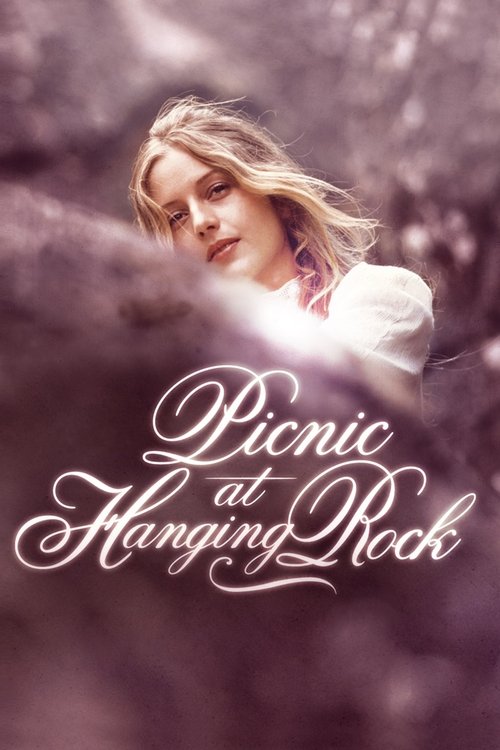
Picnic at Hanging Rock
1975 · Peter Weir
For when you want atmosphere over plot — a hazy, haunting spell of a film for a quiet evening, and one you'll be turning over long after. Frustrating if you need resolution; mesmerizing if you can let it stay a mystery.
What it's about
On Valentine's Day, 1900, the girls of a strict Australian boarding school are taken on a picnic to Hanging Rock, an ancient volcanic outcrop rising out of the bush. A few of the girls, drawn to the rock, climb up beyond where they're permitted — and some of them never come back. What follows is not a detective story but the slow unraveling of the school and the community around a disappearance that refuses to be explained.
The experience
Dreamlike and quietly eerie — sun-dazed afternoons, pan pipes, white dresses against ancient stone — with an unease that seeps in rather than strikes. It's slow, sensuous, and hypnotic, and its refusal to give you answers is exactly what makes it stick.
Performances
Rachel Roberts is formidable as the headmistress, a monument of Victorian control who cracks by degrees as the school's order collapses around her.
The craft
Weir and his cinematographer shoot the bush in soft, overexposed light that makes the whole film feel remembered rather than witnessed, and the sound design lets the landscape hum with something older than the characters. It's ravishing on a big screen — one of the most purely beautiful unsettling films ever made.
Why it matters
More than any single film, it announced the Australian New Wave to the world and launched Peter Weir's international career, and its imagery — girls in white vanishing into ancient rock — has echoed through moody mystery-making ever since.
Snapshot
Picnic at Hanging Rock is the film that, more than any other single title, announced the arrival of a mature Australian cinema to the world. Adapted from Joan Lindsay's 1967 novel, it stages a deceptively simple premise — on Valentine's Day, 1900, a party of schoolgirls from Appleyard College picnic at the base of an ancient volcanic outcrop in the Victorian bush, and three of them, along with a teacher, walk into the rock and are never seen again — and refuses, pointedly and permanently, to explain it. Peter Weir's second feature turns an unsolved disappearance into a meditation on the incompatibility of Edwardian colonial order and a landscape that predates and outlasts it. Its reputation rests on a paradox: it is among the most sensuous and beautiful films of its national cinema, and one of the most quietly unsettling. The withheld resolution, far from a flaw, is the work's organizing principle, and it has made the film a touchstone for filmmakers drawn to ambiguity, dread, and the eroticism of repression.
Industry & production
The film is a product of the Australian film revival of the early-to-mid 1970s, which was underwritten by new public funding bodies after decades in which feature production in Australia had nearly ceased. The project originated with actress and producer Patricia Lovell, who optioned Lindsay's novel; the McElroy brothers, Hal and Jim, produced, and financing came through the South Australian Film Corporation together with the Australian Film Commission (the federal funding apparatus then in its formative years). This was a modestly budgeted picture by international standards, and its commercial and critical success at home and abroad helped validate the entire public-investment model that the revival depended upon.
Weir came to the project off the strength of his eccentric debut feature The Cars That Ate Paris (1974) and a body of shorts and television work. The screenplay was written by Cliff Green, who hewed closely to Lindsay's prose. Principal photography took place at the actual Hanging Rock formation near Mount Macedon in Victoria, while the imposing Martindale Hall in South Australia stood in for Appleyard College — a substitution that fused the two states' landscapes into a single fictional geography. The shoot was constrained by budget and weather, and the production has often been described as logistically difficult, with the rock itself an unpredictable and physically demanding location.
Technology
The film was shot on 35mm color stock and exhibited in the standard theatrical practice of its day. Its most discussed technical gambit is photochemical and in-camera rather than mechanical: cinematographer Russell Boyd's use of diffusion to soften and bloom the image. Boyd has described stretching a bridal or wedding veil across the lens to scatter light and produce the picture's hazy, luminous quality, augmented by the warm, low-angled light of "magic hour" shooting. This was not exotic optical-printing technology but a craft solution executed at the point of capture, and it gives the film a tactile, hand-made softness quite distinct from the harder clarity of contemporaneous Hollywood photography. Beyond this, the production relied on the conventional tools of mid-1970s location filmmaking; the innovation here is aesthetic intent applied to ordinary equipment rather than novel apparatus.
Technique
Cinematography
Russell Boyd's photography is the film's signature achievement and won him a BAFTA Award. The diffused, golden imagery — soft focus at the edges, light blooming through foliage and around the girls' white dresses — converts a real geological site into something dreamlike and slightly unreal. Boyd and Weir repeatedly frame the human figures as small against the rock, and use low and craning angles to make the formation loom with a watchful presence. Slow zooms, lingering close-ups of faces and natural detail (lizards, insects, stone), and a generally unhurried camera establish a contemplative rhythm. The visual strategy is consistent and deliberate: beauty is deployed not as decoration but as a lure, drawing the viewer toward the same seductive disappearance that claims the girls.
Editing
Editor Max Lemon's cutting favors a dilated, trance-like temporality over conventional dramatic propulsion. The picnic sequence in particular slows to near-suspension, with dissolves, slow motion, and elongated holds dissolving ordinary chronology. Time is a thematic concern within the story — clocks stop at the rock — and the editing enacts that suspension formally, so that the audience experiences the same loosening of temporal grip that the characters describe. After the disappearance, the film shifts to a more fragmented register, withholding the connective tissue that a mystery narrative would ordinarily supply and leaving gaps that are never filled.
Mise-en-scène / staging
The production design draws a stark opposition between two worlds. Appleyard College is a realm of corseted Victorian-Edwardian order: starched white dresses, gloves and boots, rigid timetables, ornate interiors, and the suffocating decorum of a transplanted English institution. The rock and the surrounding bush are its antithesis — wild, ancient, indifferent. The staging repeatedly shows the trappings of European civilization being shed or undone at the rock: the girls remove their stockings and shoes, loosen their formality, and drift upward as if drawn by the place itself. Costuming carries much of the thematic weight, with the immaculate white muslin of the girls reading simultaneously as innocence, virginal eroticism, and a fragile cultural artifact ill-suited to its environment.
Sound
The soundtrack is among the film's most celebrated elements. Bruce Smeaton composed original music, but the most indelible auditory presence is the haunting pan-flute (panpipe) playing of the Romanian musician Gheorghe Zamfir, whose breathy, keening lines became inseparable from the film's identity. Weir also drew on the European classical canon — most famously the slow movement of Beethoven's Fifth Piano Concerto ("Emperor"), and Bach — counterposing high European art against the Australian wilderness. The natural soundscape is equally important: amplified insect drone, wind, and an enveloping ambient hum that builds an atmosphere of low, inexplicable threat. Sound, like image, is used to seduce and disquiet rather than to clarify.
Performance
The ensemble performances are pitched toward stillness and interiority. Anne-Louise Lambert, as the ethereal Miranda, is photographed almost as an icon — the much-quoted comparison of her to a Botticelli angel comes from within the film — and her presence is less a conventional character than a luminous absence-in-waiting. Rachel Roberts, the established British actress, gives the headmistress Mrs. Appleyard a controlled, slowly unraveling severity that becomes the film's most overtly dramatic thread as the institution disintegrates. Dominic Guard, as the young Englishman Michael Fitzhubert who becomes obsessed with finding the girls, supplies the audience's surrogate yearning. The performances throughout favor restraint and suggestion over explicit emotional statement, in keeping with the film's reticence.
Narrative & dramatic mode
The film's structure is built on a withheld center. It establishes the conventions of a mystery — a disappearance, a search, an investigation, a survivor (Irma) recovered with no memory — and then systematically declines to deliver the resolution those conventions promise. There is no explanation, no body, no culprit, no supernatural confirmation. This refusal is rooted in the source: Lindsay's novel originally contained a final chapter offering a strange, quasi-metaphysical account of the vanishing, which was excised before publication and issued only posthumously as The Secret of Hanging Rock; the novel's enduring ambiguity carries directly into Weir's film. Dramatically, the picture redirects energy away from the lost girls and toward the consequences of the mystery for those left behind — the corroding effect of the unexplained on the school, the community, and Mrs. Appleyard in particular. It operates less as a whodunit than as a study of how a rationalist, ordered society fractures when confronted with something it cannot comprehend or control.
Genre & cycle
Picnic at Hanging Rock resists clean genre classification, which is part of its lasting fascination. It is nominally a mystery and a period drama, but it functions equally as an atmospheric horror film without overt horror content — dread arises entirely from suggestion, landscape, and the unknown. It belongs to a strand of "weird" or uncanny cinema in which the natural world is figured as a malign or unknowable force, and it is frequently cited as a foundational text of "elevated" or arthouse horror well before that label existed. Within Australian cinema it sits at the head of a cycle of films preoccupied with the bush as a site of European disorientation and threat, a recurring national anxiety about a continent that resists settler comprehension.
Authorship & method
The film is the clearest early statement of Peter Weir's career-long preoccupations: ordinary or rationalist communities confronted by forces — natural, spiritual, cultural — beyond their understanding, a theme he would pursue through The Last Wave, Witness, Dead Poets Society, The Truman Show, and Master and Commander. Weir's method here is one of mood over exposition, trusting atmosphere and ambiguity to do the work that plot mechanics conventionally perform. His key collaborators were essential to the result: cinematographer Russell Boyd, whose diffused imagery defined the film's look and who would continue to work with Weir across decades; composer Bruce Smeaton, augmented by Weir's curatorial use of Zamfir and the European classical repertoire; editor Max Lemon, whose dilated cutting shaped its hypnotic tempo; and screenwriter Cliff Green, who preserved the novel's reticence rather than resolving it. Producer Patricia Lovell's early advocacy for the material was the project's enabling act. The authorship is genuinely collaborative, but the controlling sensibility — the willingness to leave the central question open — is unmistakably Weir's.
Movement / national cinema
The film is a cornerstone of the Australian New Wave, the renaissance of Australian feature production that ran roughly from the early 1970s through the early 1980s, enabled by federal and state funding bodies. It belongs specifically to the "period film" or "AFC genre" tendency within that movement — handsomely mounted, literary, often set in a colonial past and concerned with national identity and landscape — alongside films such as Weir's own later work and the costume dramas that followed. Picnic was among the first Australian films of the era to achieve significant international art-house distribution and acclaim, and it did much to establish the idea that Australian cinema had a distinctive voice rooted in its land and history. Its success helped open international doors for a generation of Australian directors, Weir among the first to cross over to Hollywood.
Era / period
Made in 1975, the film is a product of a confident, exploratory moment in world cinema in which atmosphere, ambiguity, and authorial vision were commercially viable. It looks back, in its setting, to the year 1900 — the cusp of Australian Federation in 1901 — and uses that threshold deliberately: a colonial society at the height of its imported Victorian-Edwardian confidence, poised at the edge of nationhood, suddenly destabilized by the land it presumes to govern. The film's interest in repression and the unconscious also reflects its own 1970s moment, reading the Edwardian past through a distinctly post-1960s sensibility about sexuality and authority.
Themes
The film's central opposition is between European colonial civilization and an ancient, indifferent natural world. The rock — geologically far older than any human presence — figures as a force that absorbs the intruders, dramatizing settler Australia's unease about a continent it cannot truly possess or understand. Repressed sexuality runs throughout: the girls' regimented chastity, the dreamy eroticism of the picnic, the loosening of clothing and decorum at the rock, and Michael's idealizing fixation all suggest desire straining against Victorian containment. Time and its dissolution form another thread — the stopped clocks, the suspended editing, the sense of a portal or rupture in ordinary chronology. And the film is finally about the limits of knowledge itself: the human need for explanation set against a universe that may simply offer none. Class, the fragility of social institutions, and the corrosive power of the unexplained on a closed community round out its concerns.
Reception, canon & influence
Picnic at Hanging Rock was a critical and commercial success that traveled well beyond Australia, and it is now firmly established in the canon of both Australian and world cinema; it appears regularly on lists of the greatest Australian films and has been the subject of extensive scholarly attention. Russell Boyd's cinematography was honored with a BAFTA Award, and the film's restoration and re-release (Weir prepared a slightly shortened "director's cut" in the late 1990s) have kept it in circulation for successive generations.
Looking backward, the film draws on identifiable sources: most directly Joan Lindsay's novel and its deliberate withholding of resolution; the broader European art-cinema tradition of mood and ambiguity; the Pre-Raphaelite and Botticelli-inflected visual idealization of the girls, which the film names explicitly; and a Romantic-Gothic lineage in which landscape is charged with the uncanny. Looking forward, its influence has been wide and durable. It is routinely cited as a precursor to a strain of slow, atmospheric, ambiguity-driven art-horror, and its imagery of white-clad girls in a hazy, dreamlike landscape has been echoed by later filmmakers — Sofia Coppola's The Virgin Suicides is among the most frequently noted descendants, and directors such as David Lynch have been associated with its mode of unresolved dread (specific attributions of direct influence vary, and should be treated as critical commonplaces rather than documented statements). The story's grip on the popular imagination was strong enough that many initially believed it recounted a true event, a testament to the film's verisimilitude. Its afterlife extends to a 2018 television miniseries adaptation of the novel. More than the particulars of any single homage, the film's lasting legacy is conceptual: it demonstrated that a refusal to explain could be more powerful, and more enduring, than any solution — and that the most frightening thing a film can show is an absence.
A Deleuzian reading
Two watches stop at the same minute at the foot of the rock.
The full Deleuzian reading of Picnic at Hanging Rock →
Reception
A landmark hit at home that put the Australian New Wave on the map, though it took until 1979 to get a proper US release — American distributors balked at a mystery with no solution. Now it's Criterion-canonised as one of cinema's great acts of ambiguity.
How Picnic at Hanging Rock was received, from release to now →
Influences: the films it descends from and the films it influenced
- L'Avventura (1960) — Establishes the disappearance-without-solution structure, letting a vanished girl become a permanent absence the landscape absorbs while the narrative refuses any explanatory closure.
- Last Year at Marienbad (1961) — Pioneers the dilated, unstuck editing in which time stalls and loops, the same hypnotic temporal suspension Max Lemon's cutting reaches for around the rock.
- The Innocents (1961) — Freddie Francis's gauze-diffused widescreen and the reading of repressed sexuality as the true haunting prefigure both Boyd's veil and the film's ambiguous, never-confirmed supernatural.
- Black Narcissus (1947) — Treats environment as an erotic-spiritual force that erodes a sealed, repressed colonial religious community — the landscape-undoes-discipline template Appleyard College inherits.
- Vampyr (1932) — Achieves waking-dream dread by shooting through gauze placed before the lens, the diffusion-as-unreality technique Russell Boyd revives with bridal-veil fabric over the camera.
- The Birds (1963) — Weir's strategy of refusing causal explanation — the girls vanish, the film offers no account, the landscape absorbs event without meaning — extends The Birds' narrative method of withholding interpretive resolution while maintaining the physical precision of documented event.
- The Wind (1928) — Weir treats landscape as a malevolent psychological presence that overwhelms and unbalances its characters, the expressionist nature-as-antagonist approach applied to a female ordeal.
- Mädchen in Uniform (1931) — Russell Boyd's bridal-veil diffusion over the lens is the descendant of the soft-focus treatment of von Bernburg, and Weir builds the same institutional time-marking — clocks, corsets, timetables — as the pressure that produces the girls' escape.
- Days of Heaven (1978) — Extends the magic-hour, naturally-lit Pre-Raphaelite tableau — figures small against golden fields — that Boyd's dawn-and-dusk photography pioneered for period landscape.
- The Last Wave (1977) — Weir and Boyd reprise the authorial signature directly: a rationalist protagonist overwhelmed by ancient Aboriginal forces beyond European comprehension.
- The Virgin Suicides (1999) — Renders white-clad girls in sun-hazed, soft-diffused images and centers their vanishing on a deliberately withheld explanation — the most frequently cited direct homage.
- The Piano (1993) — Carries forward the Antipodean-landscape-as-psyche and costume-as-repression idiom, dramatizing female desire constrained by colonial Victorian propriety.
- The Falling (2014) — Transposes the swooning-schoolgirl motif into a mass fainting epidemic, treating repressed adolescent sexuality and unexplained collective trance as the engine of dread.
- Innocence (2004) — Stages an enclosed girls' school as a dreamspace of white uniforms and ritual whose internal logic is deliberately never explained to the viewer.
- Lake Mungo (2008) — Builds Australian elevated horror entirely from absence and unresolved grief, proving Weir's thesis that the most frightening thing a film can show is a vanished person never recovered.
- The Thin Red Line (1998) — Russell Boyd's available-light cinematography treats the Australian landscape as an active overwhelming presence that diminishes and eventually absorbs human figures — figures dwarfed by non-human environment as formal thesis — a visual logic Malick and Toll transpose directly to the Pacific, also shooting in Australia.
- Memories of Murder (2003) — Weir and cinematographer Russell Boyd develop the visual grammar—wide, slow landscape shots where terrain consumes rather than frames human figures, the environment absorbing the disappeared without yielding explanation—that Kim Hyung-goo transposes directly to the Hwaseong agricultural fields.
- The Proposition (2005) — Russell Boyd's diffusion-filtered, heat-haze-softened Australian landscape photography codes settler-colonial anxiety as an atmospheric condition, establishing the visual vocabulary for representing European unease in the antipodean environment that The Proposition extends.
- The Wailing (2016) — Weir's model of landscape as absorptive presence — the terrain that takes without explanation — and his anti-horror-rhythm of languorous pacing and ambient-wrongness sound design (Zamfir's panpipes as sonic unease) establishes the mode of epistemic non-resolution Na works within.
- The Power of the Dog (2021) — Russell Boyd's soft-focus, backlit photography of the Australian landscape as a site of uncanny psychological threat — geography exceeding realism — establishes the antipodean landscape-gothic mode that Campion enters and transforms; the diegetic pan-flute ambience as environmental unease is the direct precursor of Campion and Greenwood's diegetic-score-integration strategy.
- Walkabout (1971) — Frames white-uniformed colonial children dwarfed by and out of place within an ancient indigenous Australian landscape, staging the same colonial-vs-ancient-land collision.
- Wake in Fright (1971) — Anchors the Australian New Wave's vision of the sun-blasted outback as a malign, civilization-dissolving force rather than scenic backdrop.
- Don't Look Now (1973) — Builds dread through premonitory, associative cross-cutting where editing — not plot — carries foreboding toward an event already sensed but withheld.
- The Wicker Man (1973) — Codifies folk-horror's pagan-charged landscape in which a rational outsider is quietly undone by a closed community's older order.
- Aguirre, the Wrath of God (1972) — Russell Boyd's diffused natural-light cinematography and Gheorghe Zamfir's pan-flute score function in precisely the same register as Popol Vuh — non-diegetic, kosmische atmosphere converting landscape into psychological force — while the colonial protagonists are dissolved by an environment that refuses their categories of mastery.
- 3 Women (1977) — Russell Boyd's anamorphic widescreen uses shallow focus and slow drifting camera movement to render the Australian landscape as a dreamlike psychic force that literally absorbs and dissolves female characters — a parallel formal solution to Rosher's desert cinematography in 3 Women, where the Californian landscape functions as both setting and unconscious threat.
- Rabbit-Proof Fence (2002) — Models the staging opposition Noyce inherits: a starched colonial institution (school/orphanage) set against an inscrutable, sacred Australian landscape, sustained by duration restraint and environmental sound instead of plot.
- The Shout (1978) — Russell Boyd's bridal-veil-gauzed, sun-flared exteriors paired with a narrative that sustains Todorov's fantastic to the final frame — an event that admits neither natural nor supernatural resolution — is the identical formal wager made three years later in Devon.
- Valerie and Her Week of Wonders (1970) — Russell Boyd shot through a bridal veil taped over the lens to bloom the highlights, paired with a pan-flute/ethnographic score and a plot that never resolves — the identical formula of diffusion plus withheld explanation for filming adolescent female sexuality.
- The Beguiled (1971) — A cloistered girls' school photographed through gauze-diffused light that aestheticizes adolescent eroticism, with the central act of violence elided entirely — the same refusal to stage the decisive rupture that governs Siegel's cutting around the amputation.
Similar films
- L'Avventura (1960) — influence & lineage · often watched together
- The Last Wave (1977) — influence & lineage
- Wake in Fright (1971) — influence & lineage
- The Piano (1993) — influence & lineage
- Walkabout (1971) — influence & lineage
- The Wicker Man (1973) — influence & lineage
- Last Year at Marienbad (1961) — influence & lineage
- Dead Poets Society (1989) — same viewing thread
All the films related to Picnic at Hanging Rock →
Watch it with: curated runs of related films
- Restless Youth, Rigid Walls — Watch these as one long walk through the school years — the teachers who crack you open, the friends who pull you off the sidelines, the first loves and the institutions you push against — where a beloved tearjerker and a surreal boarding-school revolt turn out to be cousins.