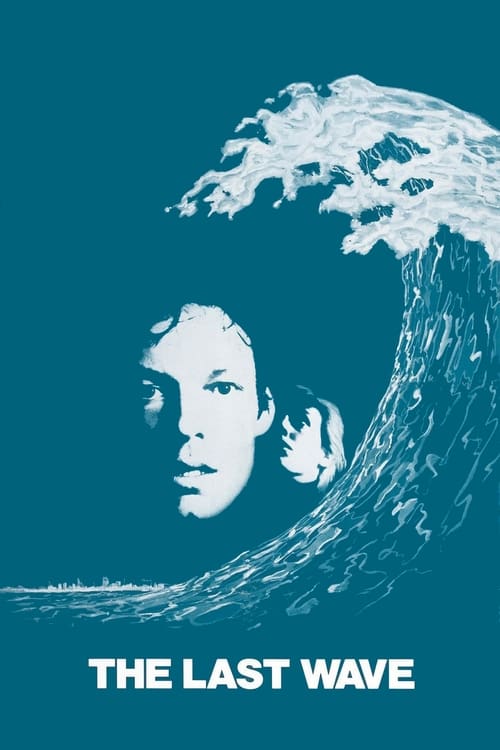
The Last Wave
1977 · Peter Weir
For when you want a film to chew on for days — a cerebral, atmospheric creep-out for a stormy night, firmly on the challenge side of the ledger.
What it's about
A comfortable Sydney tax lawyer takes on the defense of five Aboriginal men accused of killing one of their own — a death the courts call a drunken brawl but that he comes to suspect was a ritual execution under tribal law. As he's drawn toward his watchful clients and the older law they answer to, freak weather batters the city and his nights fill with dreams of water and drowning that feel less like dreams than warnings.
The experience
A slow flood of dread — quiet, rain-soaked, and genuinely eerie, the kind of unease that seeps in through weather and silence rather than shocks. It leaves you unsettled in a way that's hard to shake and harder to explain.
Performances
Richard Chamberlain plays the lawyer's unraveling certainty with real conviction, and David Gulpilil is magnetic as the client who seems to know far more than he'll say — every scene between them hums.
The craft
Peter Weir builds terror out of the ordinary: rain that won't stop, hail from a clear sky, water dripping down a staircase, a sound design of low rumbles and murmurs that makes the everyday feel haunted. The dream sequences are staged with such matter-of-fact strangeness that waking life stops feeling safe.
Why it matters
A cornerstone of the Australian New Wave that pushed its national cinema toward the mystical and confronted white Australia with the deeper history beneath its cities, and a key step in Weir's rise to international standing.
Snapshot
The Last Wave is Peter Weir's second major feature and the film in which the unease that flickered beneath Picnic at Hanging Rock (1975) hardens into open dread. David Burton (Richard Chamberlain), a Sydney corporate and tax lawyer, is drawn into the defense of five Aboriginal men accused of killing one of their own in what the prosecution treats as a drunken brawl but which Burton comes to suspect was a ritual execution under tribal law. As he is pulled into the orbit of his clients — chiefly the watchful Chris Lee (David Gulpilil) and the implacable elder Charlie (Nandjiwarra Amagula) — Burton's own waking life dissolves into prophetic dreams of water, drowning, and a city engulfed. The film fuses courtroom drama, occult mystery, and an apocalyptic eco-horror keyed to a premonition that white Australia has built itself on ground it does not understand. It is one of the defining works of the Australian New Wave and remains, despite its problematic vantage on Indigenous spirituality, one of the most atmospherically distinctive films of the 1970s.
Industry & production
The Last Wave was produced at the high-water mark of the government-supported revival of Australian feature filmmaking. It was made by the McElroy brothers — Hal and Jim McElroy — who had produced Picnic at Hanging Rock and were among the key producing partnerships of the era, with backing drawn from the institutional architecture that defined the period: the Australian Film Commission and state funding, plus involvement that brought international distribution through United Artists. The casting of Richard Chamberlain, an established American television star (familiar from Dr. Kildare and a string of TV roles), was a calculated commercial decision: it gave a small Australian production an internationally legible lead and a marketable face, while the surrounding cast was largely Australian and Aboriginal.
The production's most consequential and sensitive dimension was its engagement with Aboriginal performers and law. Weir cast Nandjiwarra Amagula, a Groote Eylandt elder and magistrate, in the pivotal role of Charlie, and David Gulpilil — already a landmark presence in Australian cinema after Walkabout (1971) — as Chris. The involvement of genuine Aboriginal authority lent the film weight but also placed Weir in negotiation with material that was not his to freely invent; the production by various accounts proceeded with consultation, though the historical record on the precise terms of that collaboration is thinner than one would wish, and should be treated with corresponding caution. What is clear is that the film's claims about "secret" tribal lore in an urban setting are Weir's dramatic construction rather than a documentary account of any actual belief system.
Technology
The film was shot on 35mm color stock using conventional late-1970s production technology; there is no significant claim to technical innovation at the level of hardware. Its distinction lies entirely in how standard tools were marshalled toward an oppressive, saturated atmosphere — rain rigs, water tanks, and controlled interior lighting deployed to make weather itself a character. The climactic visions and the recurring imagery of water intruding into domestic and civic space were achieved through practical means (deluge effects, flooding, miniatures and staging) rather than optical trickery, consistent with the resources and conventions of the period. Where the film feels uncanny, the effect is overwhelmingly photographic and acoustic rather than the product of any special-effects breakthrough.
Technique
Cinematography
The cinematography by Russell Boyd — Weir's collaborator on Picnic at Hanging Rock and one of the great image-makers of the Australian revival — is the film's signal achievement. Boyd renders Sydney as a city under permanent meteorological siege: low skies, sodium-lit wet streets, water sheeting down windows and pooling where it should not be. The palette runs to bruised greens, browns, and slate, with light frequently filtered through glass and rain so that the world appears submerged before any literal flood arrives. Boyd's compositions repeatedly trap Chamberlain's lawyer behind panes, frames, and reflections, visualizing a man sealed off from the truth pressing in on him. The contrast between the precise, rational geometry of Burton's professional milieu and the dim, charged spaces of his encounters with the Aboriginal characters is carried largely by the photography.
Editing
The editing (by Max Lemon) is built around the porous boundary between Burton's waking and dreaming life. Rather than cordoning off the visions as discrete set-pieces, the film lets premonition bleed into ordinary scenes, so that the audience, like Burton, loses confidence in which images are "real." The pacing is deliberately slow and accretive — a gathering rather than a propulsion — which is consonant with Weir's broader sensibility in this period: suspense generated by dread and withheld explanation rather than incident.
Mise-en-scène / staging
Weir's staging insistently juxtaposes two orders of space: the glass-and-concrete rationalism of the modern Australian city — offices, courtrooms, the suburban home — and the older, hidden topography beneath it, climaxing in the discovery of a sacred underground site. The film's governing spatial idea is verticality and burial: that beneath the visible city lies another reality, sacred and ignored. Domestic interiors are repeatedly invaded by water and by Aboriginal presence, collapsing the boundary between the secure private sphere and the cosmic forces outside it.
Sound
Sound is central to the film's power. The score is credited to Charles Wain, and the soundscape integrates didgeridoo and tribal-inflected textures with ambient and electronic unease; rain, water, and low drones function less as accompaniment than as a continuous pressure on the nerves. The film treats sound as premonition — the murmur of approaching catastrophe — and the acoustic design is as responsible as the photography for the sense that the ordinary world is acoustically haunted. (Precise details of the score's instrumentation and authorship are less fully documented than the film's visual collaborations, and are best stated with that caveat.)
Performance
Chamberlain plays Burton with a controlled, increasingly frayed rationalism — a man whose professional composure is the very thing being dismantled. The performance is deliberately recessive, a vessel for disorientation rather than a vehicle for star charisma, which is part of why the casting works against expectation. David Gulpilil brings his singular watchfulness and physical eloquence to Chris, mediating between worlds. The most arresting presence is Nandjiwarra Amagula as Charlie: a non-professional whose genuine authority and stillness give the film its gravitational center and supply a weight no trained actor could counterfeit. The dynamic between Chamberlain's anxious intellect and Amagula's silent certainty is the film's true confrontation.
Narrative & dramatic mode
The screenplay — credited to Weir with Tony Morphett and Petru Popescu — grafts the machinery of the legal procedural onto the structure of a supernatural revelation. The courtroom plot (can tribal law be acknowledged within white jurisprudence? was the killing ritual or accident?) is ultimately a Trojan horse for a metaphysical inquiry: Burton's investigation of his clients becomes an investigation of himself, and the mystery's true object is not the murder but the protagonist's identity and the fate of the world. The dramatic mode is one of escalating dread and epistemic instability — the film systematically erodes the distinction between evidence and omen, deposition and dream. It refuses the consolations of explanation; the ending is apocalyptic and ambiguous rather than resolved, a deliberate withholding that aligns it with the open, unsolved structure of Picnic at Hanging Rock.
Genre & cycle
The Last Wave sits at an unusual intersection: it is at once a legal drama, an occult/supernatural thriller, and a precursor of what would later be called eco-horror or "apocalyptic dread" cinema. It belongs to a 1970s vein of films in which Western rationality confronts older or alien forces it cannot accommodate. Within Weir's own output it forms a clear pair with Picnic at Hanging Rock: both are "uncanny landscape" films in which the Australian environment harbors a power that engulfs the European colonial presence. It also anticipates a later cycle of films concerned with premonition, environmental catastrophe, and the return of the repressed.
Authorship & method
The Last Wave is a key text for understanding Peter Weir's authorship. His abiding preoccupation — the rational, ordered Western subject confronted by mystery that cannot be assimilated — is here at its most explicit. Weir's method favors atmosphere over exposition, suggestion over statement, and the orchestration of image and sound to produce unease rather than the delivery of plot information. The film consolidates his recurring collaboration with cinematographer Russell Boyd, whose work was instrumental to the look of the Weir films of this period. The screenplay collaboration with Tony Morphett (an experienced Australian writer) and Petru Popescu (a Romanian-born novelist) brought a more overtly mystical, premonitory dimension than the more elliptical Picnic. Editor Max Lemon and the sound and music team complete the authorial signature: a cinema of mood, dread, and the sublime. Weir would carry this sensibility forward into Gallipoli (1981) and The Year of Living Dangerously (1982) before his move to Hollywood, where the theme of an outsider confronting an unreadable world persists in films such as Witness (1985) and The Truman Show (1998).
Movement / national cinema
The film is a central document of the Australian New Wave (the "Australian Film Revival") of the 1970s, the burst of features enabled by new federal and state funding bodies that put Australian cinema on the international map. Together with Picnic at Hanging Rock, it helped define a recognizable strain of that movement — the "AFC genre" of handsomely photographed, atmospheric films preoccupied with landscape, the colonial past, and national identity. Crucially, The Last Wave is among the era's most direct attempts to place Aboriginal Australia at the symbolic center of the national story, framing white settlement as a precarious surface over a deeper, sacred reality. That ambition is also the source of its enduring critical tension: the film speaks about Aboriginal spirituality from a non-Indigenous vantage, using it as the engine of a white protagonist's crisis — a vantage that later scholarship has read as both pioneering and appropriative.
Era / period
Produced in 1977, the film belongs to a moment of intense national self-examination in Australia, in the years following the dismantling of the White Australia policy, the 1967 referendum, and the rise of land-rights consciousness. Its anxiety about a buried Indigenous reality returning to overwhelm modern white society can be read as a cultural symptom of that reckoning. More broadly, it shares the mid-to-late-1970s international mood of millenarian unease and distrust of rational institutions, translating the decade's apocalyptic temper into a specifically Australian, specifically colonial register.
Themes
The film's controlling theme is the return of the repressed at a civilizational scale: the conviction that white Australia has built its prosperity in willful ignorance of a sacred order it displaced, and that this ignorance carries a coming reckoning. Water is the master image — rain, flood, the wave of the title — figuring both purification and annihilation, the unconscious and the apocalypse. Dream and prophecy are presented as a mode of knowledge superior to legal evidence and scientific reason; Burton's premonitions are truer than the case files. The film stages a confrontation between two epistemologies — the documentary, adversarial truth of the law versus the cyclical, sacred truth of Dreamtime — and finds the former hollow. Running beneath all of this is a meditation on identity and belonging: Burton's discovery that he may himself be implicated in the prophecy collapses the comfortable distance between the white observer and the world he presumed to judge.
Reception, canon & influence
The Last Wave was received as a major work of the Australian revival and confirmed Weir as a filmmaker of international stature in the wake of Picnic at Hanging Rock; it circulated widely abroad and contributed to the global visibility of the new Australian cinema. Critical response then and since has consistently singled out Russell Boyd's cinematography and the film's sustained atmosphere of dread as its triumphs, while more recent criticism has interrogated its representation of Aboriginal culture — its construction of "secret" lore, its use of Indigenous spirituality as a backdrop to a white man's existential crisis, and the asymmetry of who gets to be the film's subject. Both readings are now part of its critical afterlife.
Influences on the film (backward): It draws on the gothic and uncanny strain of Weir's own Picnic at Hanging Rock and, more distantly, on the lineage of films in which Western reason meets an unassimilable Other; Gulpilil's presence explicitly connects it to Nicolas Roeg's Walkabout (1971), another landmark in cinematic encounters between white Australia and Indigenous reality. Its premonitory, water-soaked dread also resonates with the contemporaneous wave of occult and apocalyptic thrillers of the 1970s.
Legacy (forward): The film is now a fixture in accounts of the Australian New Wave and of Weir's career, frequently studied alongside Picnic at Hanging Rock as the twin pillars of his Australian period. It is an important early reference point for "eco-horror" and for cinema that frames environmental and colonial catastrophe as a metaphysical inevitability, and it remains a recurrent case study in debates about the cinematic representation of Indigenous Australians. Its imagery of a modern city facing inundation, and its conviction that the land itself keeps an account that settlement cannot escape, have only grown more resonant. Specific commercial figures and award tallies are not reproduced here, as the reliably attested record on those particulars is uneven; what is secure is the film's standing as a canonical, much-debated work of 1970s Australian cinema.
A Deleuzian reading
Water pools on a floor where no water has any business being.
The full Deleuzian reading of The Last Wave →
Reception
Landed to respectful but puzzled reviews in 1977 — many critics admired the mood while finding it murky next to Picnic at Hanging Rock. Decades later, a Criterion release and the slow-burn 'eerie cinema' revival recast it as one of the Australian New Wave's great unsettling films.
How The Last Wave was received, from release to now →
Influences: the films it descends from and the films it influenced
- Walkabout (1971) — Establishes the David Gulpilil screen presence and the cross-cut grammar that sets Indigenous reality against uncomprehending white perception — the casting and montage logic Weir borrows wholesale.
- Picnic at Hanging Rock (1975) — Weir and Boyd's prior collaboration codifies the diffused, atmosphere-over-exposition look and the refusal to resolve a disappearance, the template The Last Wave reworks in a rain key.
- Don't Look Now (1973) — Its premonitory associative editing — flash-forwards bleeding into present action — and water-as-drowning master image directly model Weir's dream-bleed cutting and apocalyptic premonitions.
- The Wicker Man (1973) — Pioneers the procedural-as-Trojan-horse: an investigator's rational inquiry is the very mechanism delivering him to a ritual fate he cannot read, the structural engine of Weir's lawyer.
- Rosemary's Baby (1968) — Builds occult dread from ordinary bureaucratic procedure and a recessive protagonist's slow apprehension — the calm, suggestion-not-statement register Weir adopts over genre shock.
- Wake in Fright (1971) — Inaugurates the Australian New Wave's hostile, metaphysically charged landscape in which the settler subject is psychically unmoored — the eco-dread substrate Weir formalizes.
- Performance (1970) — Its superimposition and identity-dissolving montage establish the dream-bleed editing vocabulary — image overlaid on image to collapse waking and visionary states.
- L'Avventura (1960) — Models the unresolved disappearance plot and recessive, affect-flattened lead performance, where landscape becomes a psychic field rather than a setting to be explained.
- Gallipoli (1981) — Carries the Weir-Boyd signature forward into a fatalistic premonitory structure where doom is felt as metaphysical inevitability long before it arrives.
- The Year of Living Dangerously (1982) — Extends the core Weir theme — the rational Western subject confronting an unreadable mystical order (wayang, Billy Kwan's cosmology) that his logic cannot assimilate.
- Witness (1985) — Transposes the procedural-as-Trojan-horse into Hollywood: a detective's investigation deposits him inside a closed community whose law and order he can witness but never join.
- The Truman Show (1998) — Reprises water as the master boundary image of a controlled, unreadable world and the recessive protagonist's dawning apprehension that reality is not what reason told him.
- Lake Mungo (2008) — Australian uncanny built on drowning and a documentary-procedural frame that, like Weir's, smuggles grief and the return of the repressed past beneath an evidentiary surface.
- The Babadook (2014) — Continues the Australian return-of-the-repressed lineage, externalizing buried domestic trauma as an encroaching force, atmosphere and dread privileged over explanation.
- Take Shelter (2011) — Reworks Weir's central device — a rational family man tormented by apocalyptic visions of an oncoming storm and flood that the film refuses to confirm or deny as prophecy or madness.
- Ten Canoes (2006) — Reclaims, with Gulpilil's narration and an Indigenous-authored storytelling structure, the representational authority over Aboriginal lore that The Last Wave was later criticized for appropriating.
- Long Weekend (1978) — Near-contemporary Australian eco-horror enacting the same conviction — the land keeps an account settlement cannot escape — through nature's escalating retribution on heedless whites.
Similar films
- Picnic at Hanging Rock (1975) — influence & lineage
- Wake in Fright (1971) — influence & lineage
- Walkabout (1971) — influence & lineage
- Gallipoli (1981) — influence & lineage
- Don't Look Now (1973) — influence & lineage
- Last Night (1998) — shared sensibility
- Hour of the Wolf (1968) — shared sensibility
- The Wailing (2016) — shared sensibility
All the films related to The Last Wave →