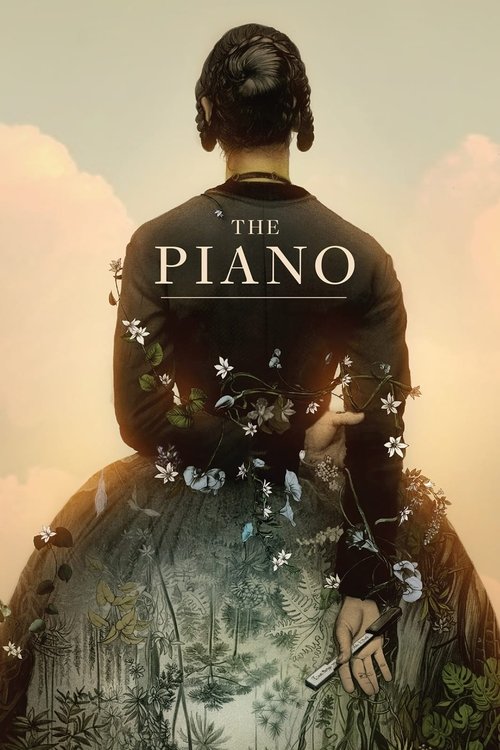
The Piano
1993 · Jane Campion
For a rainy night when you want romance with weight — passion that costs something, not comfort food. Reach for it when you want to be swept up and slightly unsettled at once.
What it's about
Ada, a Scottish woman who hasn't spoken since childhood, is shipped to 1850s New Zealand with her young daughter for an arranged marriage to a landowner she's never met. Her voice lives in her piano — which her new husband abandons on the beach and then trades to Baines, a rough neighbor who has gone half-native. Baines offers Ada a deal to earn it back, key by key, and the bargain becomes a slow-burning battle of will, desire, and possession in the mud of the frontier.
The experience
Sensual and strange in the best way — moody, tactile, charged with things unsaid. It moves like a Gothic novel: slow, humid, and quietly erotic, with an undertow of danger that keeps tightening.
Performances
Holly Hunter is astonishing — she plays a woman who never speaks and makes her the loudest presence in every scene, doing her own piano playing on top of it. Anna Paquin, around ten years old, won an Oscar as Ada's fierce, chattering daughter; both she and Hunter took home Academy Awards.
The craft
Campion shoots the New Zealand coast like an alien planet — black sand, drowned light, hooped skirts dragging through mud — and Michael Nyman's rolling piano theme became one of the most famous scores of the decade. It's a film of textures: wet wool, keys, skin. See it on the biggest screen you can, with the sound up.
Why it matters
It won the Palme d'Or at Cannes — making Campion the first woman to take the prize — plus three Oscars, and it opened the door for a generation of female-led, female-directed art films to reach mainstream audiences.
Snapshot
Jane Campion's The Piano is a Gothic romance of radical interiority set against the mud and tidal violence of nineteenth-century New Zealand. Ada McGrath (Holly Hunter), a mute Scottish woman sent to a colonial marriage she did not choose, carries her upright piano ashore on a remote black-sand beach, and that instrument — too heavy to transport inland, bartered away by her new husband Alisdair Stewart (Sam Neill) to the semi-assimilated frontiersman George Baines (Harvey Keitel) — becomes the erotic and psychic center of one of the most formally distinctive films of the 1990s. Winner of the Palme d'Or at Cannes 1993 (shared with Chen Kaige's Farewell My Concubine), three Academy Awards — Best Actress (Hunter), Best Supporting Actress (Anna Paquin), Best Original Screenplay (Campion) — and a global arthouse success that brought a New Zealand/Australian production to mainstream audiences worldwide, the film remains a landmark in feminist cinema, in the literature of colonial Gothic, and in the sustained use of music as character.
Industry & production
The Piano was produced by Jan Chapman for the Australian company Jan Chapman Productions in co-production with the French company CiBy 2000, which also backed directors including Pedro Almodóvar and David Lynch during this period. The French partnership provided access to European financing and distribution and positioned the film firmly within the transnational arthouse economy rather than the Hollywood studio system. The Australian Film Commission provided additional support. Campion had developed the screenplay across several years, and the project was therefore unusually author-driven for a production of its eventual scale and reach.
The casting brought international names — Keitel and Neill — alongside Hunter, an American actress already known for her intensity in films by the Coen brothers and Jonathan Demme, who was cast in part because she was already an accomplished pianist. Hunter's ability to perform the score herself was not incidental to the production; it determined the possibility of the film's central performance, in which Ada's hands at the keyboard must read as the extension of a specific subjectivity rather than as a technical service. Anna Paquin, then eleven years old and previously without film experience, was cast as Flora after an extensive open audition process in New Zealand schools — one of the more consequential casting decisions of the decade, given Paquin's subsequent Academy Award win.
Principal photography took place on location in New Zealand, centered on Karekare beach on the Waitākere Ranges coast west of Auckland — a site of black volcanic sand, iron-gray surf, and dense native bush that Campion and cinematographer Stuart Dryburgh recognized as irreplaceable. The conditions were physically arduous: the beach is accessible only by a steep track, the weather on the Tasman-facing coast is unpredictable, and the logistics of filming on tidal sand with heavy equipment and period costumes were substantial. The dense rainforest interiors — Stewart's land, Baines's hut — were shot in the same general region, preserving the visual and tonal coherence between landscape zones.
Technology
The film was shot on 35mm, and no unusual photographic technology distinguishes it at the level of equipment. What distinguishes the use of available technology is the deliberate rejection of the period spectacle grammar that might have accompanied a more conventional costume drama: no warm-toned stock, no nostalgic haze. Dryburgh exposed for the cold, green-gray light of the New Zealand west coast and worked with limited artificial supplementation outdoors, accepting the ambient pallor as a tonal given.
Michael Nyman composed the score, and the decision to have Holly Hunter perform all piano pieces for the production — both the source music heard by characters within the film and the recorded soundtrack — was a technical and artistic commitment that shaped the post-production soundtrack process. Nyman's work was recorded separately for commercial release but the piano performances on screen are Hunter's own. The music was mixed with exceptional prominence in the final film, at times swelling to near-overwhelming levels, which was a deliberate post-production choice.
Technique
Cinematography
Stuart Dryburgh's work on The Piano is among the most rigorous exercises in tonal consistency in 1990s cinema. The palette is cool and desaturated — the greens of the bush are dark and wet rather than lush, the sky over Karekare rarely blue — and this chromatic restraint makes the few moments of warmth (candlelight, firelight, interior lamplight at Baines's hut) carry an almost physical charge. Dryburgh favors compositions in which the human figure is simultaneously dwarfed by environment and pressed close to the camera frame: we feel both the vastness of colonial wilderness and the claustrophobic intimacy of Ada's interior world. Close-ups of hands — on keys, on flesh, gripping, tracing — are used structurally, not decoratively; they are the film's primary erotic and emotional register. The decision to shoot the beach arrival in long shots before pressing into Ada's face and hands establishes a visual grammar of oscillation between landscape and subjectivity that the film sustains throughout.
Editing
Veronika Jenet edited the film, and the cutting rhythm is slow by the standards of early-1990s commercial cinema — not the flattened duration of art cinema minimalism, but a deliberate pacing that gives silences room. The film's use of ellipsis is notable: scenes end before their expected emotional conclusions; time between sequences is often unclear; the relationship between Ada and Baines develops in an atmosphere of lacunae rather than continuous causality. This elliptical structure reinforces the film's interest in what cannot be spoken or shown directly, and it creates a dreamlike uncertainty about chronology that becomes especially acute in the final sequences.
Mise-en-scène / staging
Campion's staging consistently encodes power, desire, and constraint through spatial arrangement. The scenes in which Baines negotiates his "lessons" with Ada are choreographed as a series of small transgressions — each visit renegotiating the perimeter of physical contact in a manner that renders the hut's confined space as something like a stage for an improvised, wordless negotiation. Stewart's house, by contrast, is all constriction and mutual opacity: characters occupy the same rooms without access to one another. The costumes — Ada's severe Victorian blacks contrasted with the looser, Maori-marked dress of Baines — do significant characterization work, and the mud that perpetually adheres to fabrics and boots is a constant reminder that this is not idealized pastoral space.
The film's famous structural emblem is the key: the piano key Ada uses to communicate, then the piano key Baines cuts from the instrument as a declaration, then the key Ada sends as a message that Stewart intercepts. Objects circulate through the film as encrypted communications, foregrounding what language cannot carry.
Sound
The sound design of The Piano is organized around a dialectic between Ada's internal musical voice — the Nyman score — and the ambient acoustic world she inhabits: wind, surf, bush, the English and Maori voices around her. Ada's muteness is not a silence; it is a refusal of a particular channel of communication, and the film's sound mix honors this by treating her piano playing as, in effect, her speaking voice. When the piano is present, it dominates; when it is absent, the film becomes almost brutally environmental. The sequence in which Ada's fingers find shapes of keys on a table in the dark — and we hear nothing — is among the most affecting deployments of silence in the film precisely because we have been trained to expect the score.
Performance
Holly Hunter's performance is built on radical physical restriction and radical expressiveness simultaneously — a face and body that must communicate everything normally routed through speech. Her eyes and hands carry the film's emotional architecture. Hunter was nominated for and won the Academy Award for a role that contains, by conventional measure, almost no dialogue; the performance argues implicitly for a physiognomic and kinetic theory of screen acting at odds with the dialogue-centered methods dominant in American performance culture.
Harvey Keitel brings a quality of self-exposure — a deliberate roughness, an unwillingness to protect himself from the audience — that makes Baines legible as a man genuinely altered by colonial encounter, however incompletely and self-servingly the film renders that encounter. Sam Neill's Stewart is perhaps the most technically demanding role: a man whose violence and rigidity are not cartoonishly villainous but emerge from recognizable, culturally-specific repressions.
Anna Paquin's Flora is the film's wild card — a child who has absorbed her mother's situation without fully comprehending it, and whose betrayal of Ada to Stewart is played with a guileless transparency that makes it devastating precisely because it is not treachery but misunderstanding.
Narrative & dramatic mode
The film opens with Ada's interior monologue — "The voice you hear is not my speaking voice but my mind's voice" — establishing at the outset that we are inhabiting a perspective that has a rich inner life inaccessible to the characters around her. This is not the omniscient narration of the classic literary adaptation; it is first-person and provisional, and it frames the entire film as an act of retrospective witnessing. Ada did not die; she is telling us a story from survival.
The narrative mode is Gothic in the literary tradition: isolated landscape, a dark house, a wife whose interiority is suppressed by marital authority, the eruption of forbidden desire, mutilation (Stewart's axe on Ada's finger). Campion engages this tradition knowingly rather than naively, and the film has been read as both an extension and a critique of the Gothic's characteristic ambivalence about female desire — the degree to which it is liberatory or simply another form of subjection. The ending, in which Ada chooses Baines and imagines her own drowning before pulling herself free, is deliberately ambiguous about the status of the choice: is this freedom, or merely a different constraint dressed in romantic light?
Genre & cycle
The Piano belongs to no clean genre but draws on several: the period romance, the Gothic novel adaptation (without being an adaptation), the colonial melodrama, the feminist art film. It arrived at a moment when the international arthouse circuit was receptive to a certain kind of women's cinema that combined formal sophistication with frank engagement with female desire — a cycle that also included work by Sally Potter, Kathryn Bigelow (in a different register), and Claire Denis. The film's commercial success was unusual for this mode, and it helped validate the funding mechanisms — European co-production, festival prestige, limited platform release — that sustained that cycle through the decade.
It also belongs to a cycle of films engaging with colonial New Zealand and Maori culture that accelerated in New Zealand cinema in the late 1980s and 1990s, though The Piano remains controversial within postcolonial film studies for the degree to which Maori characters — present in significant numbers, including the crucial figure of Baines's tattooed cultural positioning — are rendered as background or symbol for a narrative whose center of gravity remains entirely European. Scholars including Lynda Dyson and Rosemary Du Plessis have analyzed this tension extensively.
Authorship & method
Jane Campion is the film's author in the fullest sense: director and sole credited screenwriter, and the sensibility that pervades The Piano is continuous with her earlier features. Her debut feature Sweetie (1989) established an interest in damaged female subjectivity rendered through off-center framing and tonal instability; An Angel at My Table (1990), her account of the life of Janet Frame, developed her capacity to sustain a woman's interior world across an extended, episodic structure. The Piano synthesized these modes into a more classically shaped narrative while retaining the formal strangeness.
Campion trained at the Australian Film, Television and Radio School (AFTRS) in Sydney, and her approach is recognizably shaped by that institution's engagement with European art cinema alongside the practical demands of antipodean production. She has spoken in interviews about the influence of the Brontë sisters — particularly Emily Brontë's Wuthering Heights — on the film's landscape logic and romantic intensity, though the screenplay is not an adaptation of any single source.
Stuart Dryburgh (cinematographer) was working on one of his first major international productions; his subsequent career has included work with a range of directors, but The Piano remains the film with which his name is most closely associated. The visual grammar he developed with Campion — cool, precise, anti-pastoral — was essential to the film's tonal identity.
Michael Nyman (composer) was associated at the time with the school of British minimalism — repetitive, pulse-based structures influenced by Philip Glass and Steve Reich — and had worked extensively in theater and with director Peter Greenaway. His score for The Piano became his most widely heard work, with "The Heart Asks Pleasure First" achieving a rare degree of popular recognition for a contemporary classical composition. The score's insistence — its harmonic stubbornness, its refusal to resolve in conventional emotional directions — is in dynamic relationship with Hunter's silent presence.
Veronika Jenet (editor) shaped the film's elliptical rhythm, and her work here is among the more underacknowledged achievements in a production whose other departments attracted more critical attention.
Movement / national cinema
The Piano occupies an unusual position in relation to national cinema: it is a New Zealand story, shot in New Zealand, but produced within Australian and French infrastructure, directed by a New Zealand-born filmmaker who trained and largely worked in Australia, and starring American and British actors. It is frequently claimed by New Zealand cinema as a landmark national film while also being discussed as an Australian co-production and as a product of transnational arthouse finance.
The film's success coincided with, and helped amplify, a period of international visibility for New Zealand cinema — a cycle that included Lee Tamahori's Once Were Warriors (1994) the following year, a film that engaged with contemporary Maori experience in a diametrically opposed register. The contrast between the two films was noted extensively in critical discourse of the mid-1990s, and together they established that New Zealand filmmaking could sustain significant international attention.
Era / period
The film belongs to the early 1990s arthouse moment — a period in which the Palme d'Or and the Academy Awards occasionally aligned, in which European co-production sustained ambitious filmmaking from outside the Anglo-American mainstream, and in which feminist cinema achieved its most sustained international commercial reach. The early 1990s also saw debates about "women's cinema" as a category intensify in academic film studies, and The Piano became a central text in those debates — both celebrated and interrogated.
Its period setting (mid-nineteenth century) is handled without the heritage-film luster associated with the Merchant Ivory productions of the same era. Where those films aestheticized the past as an object of nostalgic contemplation, Campion's colonial New Zealand is wet, muddy, and unresolved — closer in feeling to the raw colonial fiction of Patrick White or Janet Frame than to the mannered Edwardian surfaces of James Ivory's work.
Themes
Language and silence: Ada's muteness is the film's organizing formal and thematic problem. Campion uses the condition not as tragedy but as epistemological position — Ada knows and perceives what others do not because she has developed alternative channels. The film is broadly concerned with what exceeds or evades verbal articulation, and music is proposed as the more adequate language.
Desire and agency under patriarchal constraint: The erotic economy of the film — Baines's initial transactions, which have correctly been described as coercive by some critics — has generated substantial scholarly debate about whether Ada's desire constitutes free choice or a traumatic bonding. The film does not fully resolve this, and it is not clear that Campion intends it to. What is clear is that the film places female desire at its center as the primary moving force of the narrative, and that Ada's choices, however constrained, drive events.
The body and music as identity: Ada's piano is not a possession in the ordinary sense; it is continuous with her body. Her terror when Stewart leaves it on the beach, and her willingness to risk everything to recover access to it, are legible only if we understand that the instrument is her self. Nyman's score enacts this: the piano music does not accompany Ada, it is Ada.
Colonialism and indigenous encounter: The film's treatment of Maori New Zealand is present but peripheral in a way that has been the subject of sustained critical scrutiny. Baines is marked as a man who has gone beyond the colonial boundary — Maori tattoos, Maori language, identification with Maori community — but the film does not follow the consequences of this positioning or grant Maori characters equivalent interiority.
Reception, canon & influence
Critical reception: The film's Palme d'Or — shared with Farewell My Concubine — was accompanied by the additional Jury Prize for Best Actress, making the Cannes 1993 competition among the most discussed of the decade. Campion became the first woman to win the Palme d'Or, a distinction noted widely at the time and since. The film's subsequent awards campaign resulted in eight Academy Award nominations; its three wins confirmed a commercial and critical reach unusual for a production of its origin and mode.
Reviews were enthusiastically positive in the main, though some critics noted ambivalences in the film's treatment of colonial history and in the erotics of the Ada-Baines relationship. The film generated immediate academic attention: it became a central text in feminist film theory by the mid-1990s, with extensive discussion in journals including Screen, Camera Obscura, and Framework, and it appeared on syllabi in women's studies and postcolonial studies as well as film courses.
Influences on the film (backward): Campion has cited the Brontë sisters — particularly Wuthering Heights — as a foundational influence on the film's landscape logic and its treatment of wild, ungovernable passion. The Gothic romance tradition more broadly, including Thomas Hardy's fiction, shapes the film's investment in constraint and transgression. From cinema, Campion's AFTRS training exposed her to European art cinema — Godard, Truffaut, the French New Wave — and that exposure is evident in the film's willingness to use ellipsis and formal estrangement. The Australian New Wave, including Gillian Armstrong's My Brilliant Career (1979), had already established that Pacific-region filmmakers could engage seriously with women's historical experience on an international stage.
Legacy and forward influence: The Piano shaped subsequent women's filmmaking in its demonstration that formally ambitious work centered on female interiority could achieve both festival validation and commercial reach. It influenced the ways in which landscape and music could be used structurally — as psychological projections rather than merely setting or accompaniment. Michael Nyman's score had a specifically measurable influence on the aesthetics of film scoring in the 1990s, as his repetitive, harmonically resistant approach was widely imitated in the arthouse score market, though rarely with equivalent coherence of purpose.
The film is often cited as a reference point in discussions of the "colonial Gothic" — a subgenre or mode in which the violence of colonial history is rendered through Gothic formal conventions — and its influence on subsequent New Zealand and Australian filmmaking is traceable through films that engage the landscape-as-psychological-force premise that Campion and Dryburgh established. Campion's own subsequent career — The Portrait of a Lady (1996), Holy Smoke (1999), In the Cut (2003), and the television work Top of the Lake (2013, 2017) — has continued to develop the interests established here, and The Piano remains the film against which her other work is most frequently measured.
A Deleuzian reading
Start with the piano left on the beach.
The full Deleuzian reading of The Piano →
Reception
It arrived already canonized — sharing the 1993 Palme d'Or (making Campion the first woman ever to win it) and taking three Oscars — and rather than fading, it's climbed further, cracking Sight & Sound's greatest-films poll in 2022 as Campion's renaissance renewed interest.
How The Piano was received, from release to now →
Influences: the films it descends from and the films it influenced
- Picnic at Hanging Rock (1975) — Russell Boyd's photography establishes the structural grammar The Piano inherits — alternating between wide environmental shots of the antipodean landscape and extreme close-ups of female bodies, externalizing interior desire as gothic pressure through the landscape-to-subjectivity oscillation.
- Jeanne Dielman, 23 quai du Commerce, 1080 Bruxelles (1975) — Akerman's systematic use of sustained silence and domestic physical action as the sole register of female subjectivity — with no psychological explanation offered — is the formal precedent for Ada's non-verbal physicality and Campion's deployment of silence as dramatic instrument rather than dramatic absence.
- Days of Heaven (1978) — Néstor Almendros's desaturated naturalistic palette, Linda Manz's first-person retrospective female voiceover narration, and the elliptical causal structure between landscape spectacle and human action are direct precursors to Dryburgh and Campion's method of oscillating between environmental grandeur and interior state.
- Tess (1979) — Geoffrey Unsworth and Ghislain Cloquet's desaturated period photography strips the Victorian English landscape of nostalgic warmth, rendering environment as cold and constraining rather than picturesque — the chromatic strategy Dryburgh directly adapts for colonial New Zealand to deny the period-drama comfort of warm tones.
- Rebecca (1940) — George Barnes's cinematography encodes female interiority through oppressive domestic interiors and Joan Fontaine's first-person retrospective voiceover — the Brontë gothic-on-film grammar of constrained female narration and subjective dread that The Piano inherits as its primary narrative architecture.
- The Draughtsman's Contract (1982) — Michael Nyman composed his first major film score here, developing the repetitive minimalist architecture — short motifs that accumulate, vary, and return — that Campion imported directly; The Piano's score-as-speaking-voice device is genealogically continuous with Nyman's Greenaway laboratory.
- The French Lieutenant's Woman (1981) — Harold Pinter's screenplay uses deliberate structural lacunae — scenes that end before their expected emotional resolution, time gaps without causal explanation — to encode female desire as narrative withholding rather than psychological exposition, the elliptical-lacunae editing grammar Jenet employs in The Piano.
- Sweetie (1989) — Sally Bongers's cinematography uses floor-level angles and close-ups of hands and feet as primary psychological registers — the hands-as-primary-register grammar The Piano systematizes and elevates to structural principle, with Ada's fingers functioning as the film's erotic and emotional instrument.
- An Angel at My Table (1990) — Campion's portrait of Janet Frame uses first-person retrospective female narration over New Zealand landscape with elliptical time-skipping, directly piloting the narrative grammar — retrospective voice, lacunary time, southern landscape as interiority — that The Piano formalizes into feature-film structure.
- The Virgin Spring (1960) — Campion's use of natural period light, deliberate pacing, and physical economy in performance for a story of female violation and constrained agency in an isolated landscape extends Virgin Spring's visual and ethical grammar into 1990s art cinema.
- The Miracle Worker (1962) — A mute protagonist whose meaning is carried entirely through hands, touch and gesture, extending the hands-and-touch cinematography and language-as-threshold device into a sensory register.
- Portrait of a Lady (1996) — Campion and Dryburgh working together again directly extend the desaturated palette, elliptical editing lacunae, and female constraint narrative into Henry James — the most formally continuous descendant in the Campion filmography, retaining the same chromatic restraint and the same structural use of withheld causality to encode interior states.
- Bright Star (2009) — Greig Fraser's cool naturalistic predominantly daylight cinematography and Abbie Cornish's non-verbal physical performance register — restrained to gesture, eyes, and breath — extend Campion's gothic-interiority method into Romantic-era England, with the score again functioning as the speaking voice of desire that social convention prohibits.
- The Power of the Dog (2021) — Ari Wegner's cool desaturated natural-light palette, Jonny Greenwood's score operating as psychological speaking voice, and the isolated New Zealand landscape standing in for colonial Montana constitute a direct continuation of The Piano's formal grammar — landscape-as-subjectivity, score-as-character, elliptical causality — transposed to a masculine-coded genre.
- Gattaca (1997) — Michael Nyman's score — solo piano motifs that accrue emotional weight through repetition and small melodic variation rather than conventional dramatic swelling — is the compositional template Nyman extends directly into Gattaca, where the piano functions as an institutional heartbeat underscoring routine rather than event.
- Sense and Sensibility (1995) — Campion's structuring of Ada's piano-playing as the site of interiority that speech is prohibited from expressing directly precedes the function of Marianne's singing and piano in Lee's film: diegetic music as the permitted channel for feeling that social convention refuses.
- Tokyo Sonata (2008) — Campion's use of diegetic piano performance as emotional fulcrum — physical virtuosity substituting for spoken feeling, a character's hidden musical gift as inner-life cipher — directly anticipates Kenji's concealed lessons as narrative structure and the Debussy leitmotif as the film's controlled release valve for two hours of withheld emotion.
- Far from the Madding Crowd (2015) — Michael Nyman's sparse score functions as an externalization of Ada's inner life rather than dramatic commentary from outside, establishing the template for period-film music that substitutes for ambient silence — the direct precursor to FFTMC's ambient-pastoral-substitution approach to sound design.
- Phantom Thread (2017) — Campion's gothic romance where a woman uses her artistic practice as an instrument of covert agency within a controlling domestic arrangement — the craft itself as power rather than submission — directly anticipates Anderson's inversion in which Alma's poisoning converts Woodcock's dressmaking dynamic against him.
- Portrait of a Lady on Fire (2019) — Campion and Stuart Dryburgh establish a mode of imaging female interiority through available exterior light and contained physical gesture — the female body's relationship to period and domestic space as political condition — in a film where the woman's subjectivity is communicated through what she makes rather than what she says, anticipating Mathon's available-light grammar.
- Where the Crawdads Sing (2022) — Precedent for the near-mute woman defined by interiority rather than dialogue, set inside an untamed wilderness that reads as simultaneously erotic refuge and site of male threat.
- Lone Star (1996) — Stuart Dryburgh's low-key naturalism — interiors lit as if only by the lamps, windows and fires visible in frame — is the exact photographic method he brings to Lone Star's cantinas, back offices and night exteriors, so period and present differ in texture without a filter announcing the shift.
- Daughters of the Dust (1991) — Arthur Jafa's photography charges the South Carolina Gullah landscape with Black female interiority, using ritualistic non-verbal performance as primary register and refusing Hollywood psychological grammar — a simultaneous feminist art-film working in the same transnational arthouse mode as Campion, with landscape carrying the same subjective weight.
- Orlando (1992) — Alexei Rodionov's cool desaturated period photography and Tilda Swinton's systematically non-verbal physical performance — restrained to gesture, gaze, and breath — constitute a simultaneous feminist arthouse parallel to The Piano's project of using constrained female embodiment as both subject matter and cinematic form.
- The Piano Teacher (2001) — Isabelle Huppert's Erika Kohut uses the piano and its associated social performance as the medium of erotic control and self-punishment, replicating The Piano's equation of instrument with female sexuality and constraint — the same economy in which musicianship becomes the only permitted register of desire.
- Brokeback Mountain (2005) — Rodrigo Prieto's desaturated Western landscape photography — where Wyoming sky and mountain encode states of interior desire and prohibition that the characters cannot voice — applies the landscape-to-subjectivity oscillation grammar and the elliptical time-gap editing structure to a parallel story of desire constrained by social law.
- The Handmaiden (2016) — Chung Chung-hoon's persistent extreme close-ups of hands — writing, touching, turning pages — as the film's primary erotic register replicates The Piano's hands-as-primary-register grammar exactly, while the Victorian Gothic interior serves the same structural function of female constraint that Ada's colonial wilderness does.
- Three Colors: Blue (1993) — Nyman's score functions as Ada's interiority by cutting in and out of scenes without diegetic grounding — the same score-as-interiority logic as Preisner's music in Blue — while Hunter's suppression-based performance renders maximum psychological pressure through minimal expression on the identical formal premise as Binoche's.
- A Zed & Two Noughts (1985) — Michael Nyman's minimalist score, whose film-composing voice ZOO helped establish, carries that insistent looping sonic signature into mainstream art cinema.
- Pride & Prejudice (2005) — Precedent for a score whose piano is diegetically performed by the characters, blurring soundtrack and story — the model for Marianelli's on-screen keyboard playing woven into Elizabeth's world.
- "Wuthering Heights" (2026) — Ancestor of the gothic-desire register: mud, cloth, and the body as the vocabulary of forbidden longing, with an operatic emotional pitch and elemental landscape standing in for repressed will.
- The Nightingale (2018) — ancestor — female-authored antipodean colonial drama that binds landscape, tactile natural texture, and diegetic song to a woman's interiority, the sensibility Kent's diegetic ballads and close handheld framing descend from.
Similar films
- Tess (1979) — influence & lineage · same viewing thread
- An Angel at My Table (1990) — influence & lineage
- The Power of the Dog (2021) — influence & lineage
- The Piano Teacher (2001) — influence & lineage
- The Handmaiden (2016) — influence & lineage
- Ida (2013) — same viewing thread
- The Pianist (2002) — shared sensibility
- The Portrait of a Lady (1996) — shared sensibility
All the films related to The Piano →
Watch it with: curated runs of related films
- The World Against Her — A run of women worn down or driven to extremity by a merciless community, marriage, or economy — watch them near each other and the sacrifice, the drift, and the violence start to rhyme.