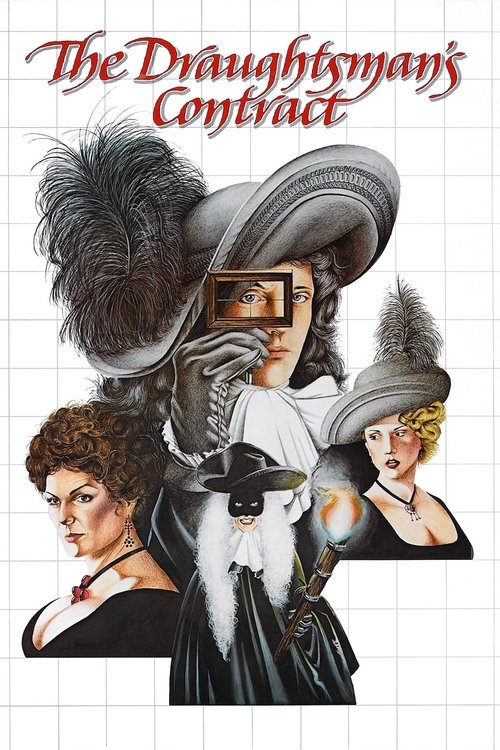
The Draughtsman's Contract
1982 · Peter Greenaway
For when you want something elegant and wicked to puzzle over — a murder mystery you solve with your eyes, best with your full attention and no phone. Firmly on the challenge end, but a playful challenge.
What it's about
In 1694, a cocky young draughtsman is hired to make twelve drawings of a Wiltshire country estate while the master of the house is away — under a contract that includes, in writing, the sexual compliance of the lady who hired him. Then the husband turns up dead, and odd details keep appearing in the drawings: a ladder here, a shirt there, clues that someone may be arranging the scenery around him. The artist who thought he controlled the picture begins to suspect the picture controls him.
The experience
Cool, witty, and deliciously sinister — a chess game played in powdered wigs, where every elaborately rude line of dialogue hides a knife. It moves at a stately pace and asks you to watch closely; the unease creeps up on you.
Performances
Anthony Higgins plays Neville's arrogance with such relish that watching the ground shift under him becomes the film's cruel pleasure, and Janet Suzman gives Mrs Herbert a poise that keeps you guessing what she knows.
The craft
Nearly every shot is composed like a formal painting — symmetrical, framed, often seen through the artist's own gridded drawing device — so the film literally teaches you to look for what doesn't belong in the frame. Michael Nyman's insistent, churning baroque-style score is half the experience; it looks and sounds superb on a big screen.
Why it matters
The film that brought Peter Greenaway from the experimental fringe into art-house fame, and a founding work of the ornate, formally daring British cinema of the 1980s.
Snapshot
The Draughtsman's Contract is the film with which Peter Greenaway, after more than a decade of experimental shorts and feature-length conceptual works, crossed into something resembling commercial visibility. Set in 1694 on a Wiltshire country estate, it follows Mr Neville (Anthony Higgins), an arrogant young draughtsman engaged by Mrs Herbert (Janet Suzman) to produce twelve drawings of her husband's property — a commission whose contract stipulates, alongside payment, her sexual compliance. As Neville fixes the grounds in a rigid optical grid, the absent Mr Herbert turns up dead, and details in the drawings appear to encode the circumstances of the murder. The film is at once a Restoration comedy of manners, a country-house mystery, and a structuralist essay on vision, property, and representation. It announced a fully formed sensibility — ravishing, cold, verbally dense, formally obsessive — and, through Michael Nyman's Purcell-derived score, a sound that would become inseparable from Greenaway's name.
Industry & production
The film is a product of a specific, brief, and consequential moment in British film financing. It was made under the auspices of the British Film Institute Production Board, the BFI's low-budget production arm, and was among the early works associated with the launch of Channel 4 and its Film on Four commissioning strategy, which from 1982 reoriented British cinema toward television-backed feature production. Greenaway came to it not from the conventional industry but from sixteen years as an editor at the Central Office of Information, the government film unit, where he cut public-information documentaries — work that left a visible imprint on his taste for taxonomy, list-making, and bureaucratic framing.
The budget was modest by any feature standard; precise figures vary across accounts and I would not assert a single number with confidence. What matters is the constraint: the production worked largely with a single principal location and a small ensemble, which suited Greenaway's already tableau-based conception. Filming took place at Groombridge Place, a moated seventeenth-century manor on the Kent–Sussex border, whose formal gardens and geometry the film exploits as both subject and metaphor. Greenaway has repeatedly described an original assembly far longer than the released version — a cut running, by his account, well over three hours, with additional drawings, subplots, and connective material — subsequently reduced to roughly 105–108 minutes. Some of the discarded thematic threads (notably around color and a fruit motif) survive only as traces. Released through the BFI, the film became an unexpected arthouse success in Britain and abroad, disproportionate to its origins, and effectively underwrote Greenaway's subsequent feature career.
Technology
The Draughtsman's Contract was shot on 35mm film. Its most discussed technical ambition concerns light: the production sought a painterly, period-appropriate luminosity, and the film is frequently — and inevitably — compared to Kubrick's Barry Lyndon (1975) for its evocation of candlelit and natural-light interiors and its compositional debt to eighteenth-century painting. Where Kubrick pursued fast lenses and genuine candlelight, Greenaway and his cinematographer pursued a more frankly artificial, theatrically lit pictorialism; the comparison is one of aspiration rather than method. The technological story here is less about novel apparatus than about the disciplined deployment of conventional photochemical tools toward an extreme of formal control — fixed frames, deep stable compositions, and a color palette tuned to greens, blacks, ivory, and the chalk-white of faces and wigs.
Technique
Cinematography
The cinematography is by Curtis Clark, an American-trained cinematographer who later became prominent in the field of digital-cinema standards and imaging technology. His work here is governed by stillness and frontality. The camera tends to sit square to its subjects, observing them as the draughtsman observes the estate — through an implied grid. Greenaway's own drawing device, the perspectival framing instrument Neville uses, becomes a model for the film's optics: the world is something to be squared up, measured, and fixed in place. Compositions are symmetrical, balanced, and saturated with detail; the eye is invited to inventory each frame as one would a painting. Movement, when it comes, is deliberate and rare. The lighting alternates between cool exterior greens and the warmer, lamp-lit chiaroscuro of the interiors, consistently subordinating naturalism to picture-making.
Editing
The film was edited by John Wilson, but the editorial logic is unmistakably Greenaway's own, formed by his COI years. The structure is overtly numerical: twelve drawings across twelve appointed sittings, an arithmetic scaffold that organizes the narrative into discrete, almost cataloged units. Scenes are built as a series of held tableaux rather than as continuity-driven dramatic beats; cutting serves enumeration and juxtaposition more than psychological momentum. This gives the film its characteristic rhythm — stately, accretive, and faintly forensic, as though the viewer were being asked to assemble evidence panel by panel.
Mise-en-scène / staging
Mise-en-scène is the film's true subject. The estate is presented as an arena of artifice in which every element — costume, posture, foliage, statuary — is arranged for the eye. Costumes are by Sue Blane (later celebrated for The Rocky Horror Picture Show), whose towering wigs, stiff silhouettes, and starched formality push the period toward stylization rather than reconstruction. The most striking staging device is the so-called living statue: a near-naked, body-painted figure who roams the grounds in poses of classical sculpture, never acknowledged by the characters, functioning as an unexplained, faintly absurd intrusion of the human into the ornamental order. Bodies are blocked frontally and held in arrangement; the grounds themselves, with their geometric parterres and avenues, supply a ready-made grid that mirrors the draughtsman's instrument.
Sound
The soundtrack is dominated by Michael Nyman's score, discussed below, but the film's sound world also foregrounds language and ambient texture: birdsong, the rustle of grounds and gardens, the clipped report of dialogue delivered in a heightened, near-declamatory register. Greenaway treats the verbal track as architecture, layering aphorism, double-entendre, and circumlocution until speech becomes a kind of ornament in its own right.
Performance
Performance is pitched at the artificial, presentational mode the film demands. Anthony Higgins plays Neville with a brittle, swaggering insolence — a man whose class overreach the drama will punish. Janet Suzman, a distinguished classical actress, brings controlled hauteur to Mrs Herbert, while Anne-Louise Lambert as her daughter Mrs Talmann supplies the cooler intelligence that ultimately outmaneuvers the draughtsman. Hugh Fraser, Neil Cunningham, and the surrounding ensemble of relatives and servants deliver Greenaway's elaborate, epigrammatic dialogue with the timing of Restoration comedy. The acting is not naturalistic; it is, deliberately, a performance of performance, suited to a world in which everyone is posing.
Narrative & dramatic mode
The dramatic mode fuses three registers. As a mystery, the film withholds and scatters clues across Neville's drawings — a ladder against a wall, a discarded shirt, a pair of boots — that may or may not testify to a murder and may or may not be authored by the characters who profit from incriminating him. As a comedy of manners, it stages a verbal duel among landed gentry, all wit, contract, and concealed motive. As a structuralist construction, it subordinates plot resolution to pattern: the audience is never granted the certainty of a conventional whodunit. The murder's solution is deliberately occluded; the film is more interested in who controls representation — who gets to draw, to interpret, to own the image — than in delivering a culprit. Neville, who believes himself the master of vision, is revealed as its dupe, ensnared by a conspiracy of women and heirs who understand that the one who reads the picture, not the one who makes it, holds the power.
Genre & cycle
The film sits athwart several genres without fully belonging to any. It draws on the country-house murder mystery, the heritage costume drama, and the Restoration stage comedy of Wycherley and Congreve, whose linguistic textures it consciously imitates. Yet it stands apart from the contemporaneous British "heritage cinema" cycle (the Merchant Ivory tradition, the Brideshead adaptations) precisely by refusing that mode's nostalgic warmth and humanist sympathy. Where heritage film invites the viewer to luxuriate in the past, Greenaway estranges it — turning the period film into a cold conceptual machine. It belongs more properly to a cycle of art-cinema works that interrogate vision and representation than to any national-popular genre.
Authorship & method
The film is the work of a director-author in the strongest sense, and its making is best understood through Greenaway's collaborators. Greenaway himself trained as a painter, and his cinema is governed by the eye of someone for whom the frame is a canvas and the catalog a native form. His prior films — Vertical Features Remake (1978), A Walk Through H (1978), and the encyclopedic mock-documentary The Falls (1980) — had already established his obsessions with numbering, mapping, and pseudo-taxonomic systems; The Draughtsman's Contract is the point at which those obsessions found a narrative vehicle.
Three collaborators are decisive. Cinematographer Curtis Clark realized the painterly, frontal image. Costume designer Sue Blane built the visual extravagance. Above all, composer Michael Nyman supplied the film's aural signature: a score constructed from the ground basses of the seventeenth-century English composer Henry Purcell, recomposed through Nyman's driving, repetitive, minimalist idiom. The result fused period source material with a propulsive modern pulse and became one of the most recognizable film scores of its era — the foundation of a Greenaway–Nyman partnership that ran through A Zed & Two Noughts, Drowning by Numbers, and The Cook, the Thief, His Wife & Her Lover. Editor John Wilson executed the film's enumerative cutting. The screenplay is Greenaway's own, and its dense, aphoristic, sexually punning dialogue is as much an authorial fingerprint as the imagery.
Movement / national cinema
The film belongs to British cinema, but to an unusual stratum of it: the avant-garde and artists' film culture nurtured by the BFI Production Board and adjacent to the structural-materialist film movement of 1970s Britain. Greenaway's formation lay closer to gallery and experimental film than to the commercial industry, and The Draughtsman's Contract can be read as the moment that sensibility negotiated a truce with narrative feature filmmaking. It is also, importantly, a foundational text of the Channel 4–era renaissance in British film, which from 1982 onward made space for idiosyncratic, auteur-driven work that the mainstream industry would not have financed.
Era / period
The film is doubly periodized. Diegetically it is set in 1694 — the late Stuart, post-Glorious-Revolution England of landed estates, dynastic anxiety, and Protestant succession, a context the film invokes through its talk of property, inheritance, and (in Mrs Talmann's marriage to the Germanic Mr Talmann) Continental encroachment. Produced in 1982, it is equally a document of its own moment: early-Thatcher Britain, the birth of Channel 4, and a cinema renegotiating its relationship to the national past. The film's preoccupation with property, contract, and ownership reads as period costume and contemporary commentary at once.
Themes
The governing theme is vision and its limits — the conceit that to draw the world is to possess and command it, and the demonstration that the draughtsman who trusts his own eye is blind to the human schemes unfolding around him. From this flow the film's other concerns: the entanglement of sex, money, and power codified in the literal contract; property and inheritance as the true engine of human behavior; the unreliability of representation, since the drawings simultaneously document reality and frame a man for a crime he may not have committed. Class is everywhere — Neville's fatal error is presumption beyond his station. And gender: the women of the estate, underestimated throughout, prove the controlling intelligences, turning the systems of male vision and contract against their author. The living statue, mute and ignored, hovers over all of it as an emblem of the human reduced to ornament.
Reception, canon & influence
Critically, the film was received as a startling arrival — visually opulent, intellectually forbidding, and unlike anything else in British cinema of its moment. It found a substantial international art-house audience and gave Greenaway a reputation, fairly or not, as the painterly intellectual of British film: admired for his compositional rigor and erudition, charged by detractors with coldness, misanthropy, and a preference for system over feeling. It is now firmly canonized as his breakthrough and as a landmark of 1980s art cinema.
Its backward-looking influences are explicit: the comedy-of-manners language of Restoration drama; the landscape and still-life traditions of Dutch and English painting; the perspectival theory and drawing instruments of the period; and, in cinema, the painterly period-light ambition that Barry Lyndon had recently made famous. Forward, its legacy is twofold. It launched the Greenaway–Nyman collaboration and, with it, a model of film scoring in which minimalist, source-derived music becomes a co-equal authorial voice — a lineage felt across later art and even mainstream cinema's appetite for driving minimalist scores. And it established the template for Greenaway's own subsequent work — A Zed & Two Noughts, Drowning by Numbers, The Cook, the Thief, His Wife & Her Lover, Prospero's Books — extending its concerns with cataloging, the framed image, the body, and the corruption beneath ornamental surfaces. As both a singular object and a point of origin, The Draughtsman's Contract remains the essential entry point to one of European cinema's most uncompromising bodies of work.
A Deleuzian reading
Begin with the instrument.
The full Deleuzian reading of The Draughtsman's Contract →
Reception
A tiny BFI/Channel 4-funded art film that became a surprise international hit in 1982, turning Peter Greenaway from an experimental obscurity into British art cinema's most talked-about export — and it's still the film even Greenaway skeptics tend to concede is the one that works.
How The Draughtsman's Contract was received, from release to now →
Influences: the films it descends from and the films it influenced
- Barry Lyndon (1975) — Established the painterly available-/candle-light period image and frontal, painting-derived compositions that Greenaway and Curtis Clark adopt as their model for lighting 17th-century interiors and gardens like Dutch and English canvases.
- Last Year at Marienbad (1961) — Pioneers the fixed-frame frontal symmetry of formal gardens with human figures arranged and frozen as statuary, plus narration as unreliable, endlessly re-staged representation — the staging and narrative grammar Greenaway inherits.
- The Falls (1980) — Greenaway's own encyclopedic mock-documentary of 92 alphabetized entries supplies the pseudo-taxonomic, enumerative cataloging structure that the Contract's twelve drawings convert into a narrative engine.
- Vertical Features Remake (1978) — Builds film as a numbered structural-film system of landscape verticals and counting schemes, the editing-as-inventory logic carried directly into the Contract's serial drawing sessions.
- Zorns Lemma (1970) — Models the structural-film principle of ordering images by an external enumerative scheme (the alphabet) as the film's organizing form — the editing/enumerative-structure idiom Greenaway transplants into fiction.
- The Servant (1963) — A country-house chamber drama where class, surveillance and erotic power are staged through mannered, aphoristic Pinter dialogue — the genre/country-house-mystery and declamatory-dialogue register Greenaway sharpens.
- La Ricotta (1963) — Stages tableaux vivants in which live actors hold and break Old-Master compositions, the living-statue staging device Greenaway reuses to make the draughtsman's framed views literalize and animate.
- The Color of Pomegranates (1969) — Frontal, symmetrical, planimetric compositions treating the static frame as a painting to be read — cinema as picture-making over storytelling.
- The Hypothesis of the Stolen Painting (1978) — A sequence of meticulously composed drawings encodes clues to a murder, turning image-interpretation into paranoid conspiracy across rigidly painterly frames — the same 'reading a picture reveals a secret society' mechanism, by a director who would soon inherit Ruiz's DP Vierny.
- A Zed & Two Noughts (1985) — Extends the frontal symmetry and obsessive cataloging while reuniting Greenaway with Michael Nyman's Purcell-derived minimalist score as co-equal authorial voice.
- Drowning by Numbers (1988) — Makes the enumerative-structure facet literal by counting 1–100 across the frame, scored again by Nyman from Mozart ground-bass material in the Contract's recompositional method.
- The Cook, the Thief, His Wife & Her Lover (1989) — Pushes the fixed-frame frontal tableau and stylized costume into color-coded theatrical sets, with Nyman's driving score and the same corruption-beneath-ornament theme.
- Prospero's Books (1991) — Carries the framed-image and cataloging obsessions into densely layered painterly compositions, extending the Contract's structuralist book-of-images conceit to its limit.
- The Piano (1993) — Adopts the Greenaway–Nyman scoring model wholesale — Michael Nyman's minimalist, source-derived music functioning as a co-equal authorial voice rather than underscore.
- The Favourite (2018) — Revives the country-house intrigue of vision and power with declamatory period wit and baroque wide-angle symmetrical compositions, descending from the Contract's restoration-comedy-meets-mystery template.
- The Grand Budapest Hotel (2014) — Systematizes the frontal-symmetry, fixed-frame planimetric tableau into a comic-formal grammar, inheriting Greenaway's treatment of the frame as a flat, centered, painting-like surface.
- Girl with a Pearl Earring (2003) — Builds its drama around the artist's gridded drawing-frame as a literal optical apparatus, foregrounding the camera-obscura/act-of-representation motif central to the seed.
- Saltburn (2023) — The country-house outsider-artist as predatory observer, framing the estate through baroque symmetrical compositions and a propulsive period-pastiche score that aestheticizes class menace.
- Orlando (1992) — Establishes the frontal, symmetrical period tableau — restoration costume-and-garden compositions shot as framed paintings — that Ben Van Os and Jan Roelfs imported directly into Orlando's staging discipline.
- Emma. (2020) — Greenaway's rigidly symmetrical, front-on framing of a formal English estate as a decorative grid of manners is a direct precedent for Emma.'s treatment of Hartfield as an ornamental, geometrically staged social space.
- Passion (1982) — In the same year, reconstructs painterly tableaux vivants and makes light and composition the explicit subject, paralleling Greenaway's vision-and-power inquiry into who controls the framed image.
- Caravaggio (1986) — A Channel 4–era British painter's cinema built from chiaroscuro tableau and the artist's eye as subject, sharing the era/channel-4-renaissance moment and painterly-light, art-and-power program.
- The Belly of an Architect (1987) — Greenaway's own earlier feature that codifies the rigid symmetrical frontality, framed-window compositions, and a numerate Englishman undone within a grand estate — Belly transplants the same staging to Rome.
- The Duellists (1977) — Rigorously composed static period tableaux lit after Vermeer and de La Tour, sharing the Dutch-interior pictorial sources Scott drew on for his candlelit rooms.
- The French Lieutenant's Woman (1981) — Fixed frontal tableaux, candle and daylight sources, and dialogue delivered at proscenium distance so the historical world is openly displayed as constructed artifice rather than inhabited.
Similar films
- A Zed & Two Noughts (1985) — influence & lineage
- The Cook, the Thief, His Wife & Her Lover (1989) — influence & lineage
- Prospero's Books (1991) — influence & lineage
- Caravaggio (1986) — influence & lineage
- The Servant (1963) — influence & lineage
- Barry Lyndon (1975) — influence & lineage
- The Belly of an Architect (1987) — shared sensibility
- The Hypothesis of the Stolen Painting (1978) — shared sensibility
All the films related to The Draughtsman's Contract →