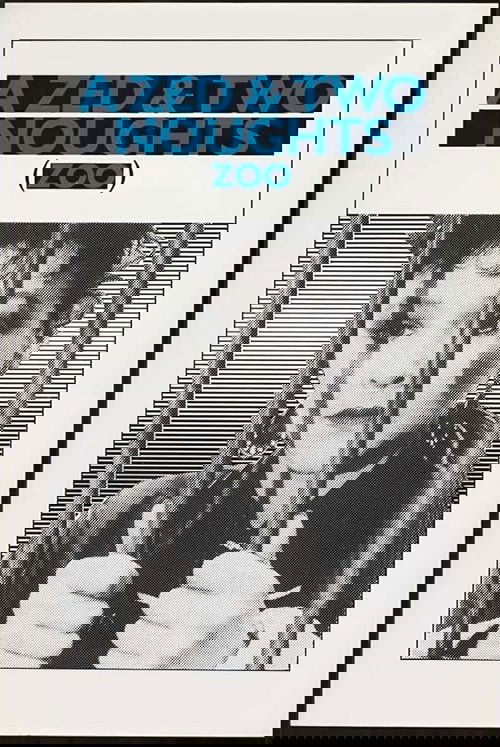
A Zed & Two Noughts
1985 · Peter Greenaway
For when you want art-house at full strength — a film to puzzle over and argue about, not to relax with. Reach for it when you're in the mood to be challenged, and skip it when you want a plot to hold your hand.
What it's about
Identical twin zoologists lose their wives in a freak car crash caused by a swan hitting the windscreen. Grief tips them into obsession: they begin filming the decay of animal bodies in time-lapse, trying to make sense of death by watching it happen, while both grow entangled with the woman who was driving the car and lost a leg in it. The zoo where they work becomes the stage for their unraveling.
The experience
Cold, gorgeous, and genuinely strange — less a story than a mesmerizing pattern of symmetries, lists, and images of rot that are somehow beautiful. It keeps you at arm's length emotionally while pulling you in visually; expect to be fascinated and unsettled in equal measure.
Performances
Real-life brothers Brian and Eric Deacon play the twins, their genuine resemblance making the film's games with doubling eerily convincing.
The craft
Every frame is composed like a painting — symmetrical, densely layered, lit like Dutch old masters — with Michael Nyman's driving, repetitive score winding the imagery into a kind of visual music. The time-lapse decay sequences are unforgettable: repulsive in subject, hypnotic in execution. This one genuinely needs a big screen and good speakers to cast its spell.
Why it matters
It cemented Peter Greenaway's reputation as British cinema's great formalist provocateur, the bridge between his breakthrough and the later films that made him an art-house household name.
Snapshot
A Zed & Two Noughts — its title spelling out "Z-O-O," and its three letters the visual rhyme of a zed flanked by two zeros — is Peter Greenaway's second theatrical feature, made in the immediate wake of his breakthrough The Draughtsman's Contract (1982). Where the earlier film cloaked its structural games in a Restoration costume mystery, ZOO abandons conventional narrative pleasure almost entirely in favour of a delirious, symmetrical fugue on decay, taxonomy, twinship, and the urge to make order out of mortality. Two zoologist brothers, the identical (or near-identical) twins Oswald and Oliver Deuce, lose their wives in a freak car accident caused when a swan strikes a windscreen. Their grief curdles into obsession: with the decomposition of animal bodies, which they film in time-lapse; with the surviving driver, Alba Bewick, who loses first one leg and then the other; and ultimately with their own dissolution. It is a film organized less by plot than by catalog, list, and visual symmetry — a Greenaway hallmark — and it remains one of the purest distillations of his project: cinema as a Borgesian encyclopedia of the body and its undoing.
Industry & production
ZOO belongs squarely to the ecology of 1980s British art-film financing. It was produced through a coalition typical of Greenaway's early features: the British Film Institute Production Board (then a crucial patron of non-commercial British filmmaking), with backing from Channel 4's Film Four International and Dutch involvement via Allarts, the company associated with producer Kees Kasander, who would become Greenaway's long-term producing partner. The film's substantially Dutch setting — Rotterdam, its zoo, and the optical-illusion vocabulary of Dutch art — reflects this Anglo-Dutch production base, and it inaugurated a Netherlands axis that would run through much of Greenaway's subsequent career.
The institutional context matters. Greenaway came to features late and sideways, out of years at the Central Office of Information as an editor and out of his own experimental shorts and "structuralist" catalog films (The Falls, A Walk Through H, Vertical Features Remake). The Draughtsman's Contract had been an unexpected success for the BFI and Channel 4, and ZOO was in part the difficult, deliberately less ingratiating follow-up — a film that tested how far an art-cinema audience would follow Greenaway's appetite for system over story. Commercially it was a modest and divisive release rather than a hit; precise figures are not something I can reliably cite here, but its reputation was built on the festival and repertory circuit rather than the box office.
Technology
The film was shot on 35mm. Its defining technical achievement is the suite of time-lapse decomposition sequences, in which fruit, a shrimp, a fish, a crocodile, a swan, a dog, a zebra and finally larger subjects are filmed rotting over hours and days, compressed into accelerated motion. These required purpose-built rigs, controlled lighting, and the patient mechanics of interval photography — a deliberate echo of Eadweard Muybridge's nineteenth-century motion studies, a reference Greenaway has repeatedly acknowledged as foundational to his sense of cinema as serial scientific observation. The time-lapse apparatus is also diegetic: the brothers' cameras and lamps appear on screen, and in the film's closing image snails crawl across the equipment, shorting it out — the organic world reclaiming the machine built to document its death.
The other technological signature is photographic rather than mechanical: the meticulous reconstruction of seventeenth-century Dutch painterly light, achieved through hard directional sources standing in for north-facing studio windows. This is less a single device than a sustained discipline of lighting and lens choice in service of pictorial citation.
Technique
Cinematography
The cinematography is by Sacha Vierny, and his arrival is one of the most consequential events in Greenaway's career. Vierny was a veteran of the French art cinema — director of photography on Alain Resnais's Hiroshima mon amour and Last Year at Marienbad, and on Buñuel's Belle de Jour — and he brought to Greenaway a tradition of architectural, deep-focus, exquisitely composed image-making. ZOO began a collaboration that would last essentially to the end of Vierny's life. His work here is built on frontality, symmetry, and a chiaroscuro modeled directly on Vermeer: pooled light from the side, deep shadow, figures arranged in shallow, stage-like planes. The camera tends to observe rather than participate, holding still or moving with measured lateral and tracking gestures, refusing the psychological intimacy of the close-up in favour of the tableau.
Editing
The credited editor is John Wilson, who cut Greenaway's early features. The editing logic is structural rather than dramatic: the film is sectioned by the procession of decaying animals, by the alphabet, by the accumulating amputations of Alba, and by the doubling of the twins. Cutting serves the catalog — it lists, it pairs, it returns. The time-lapse inserts function as punctuation, recurrent intrusions of accelerated death into the slow, frieze-like present tense of the live action.
Mise-en-scène / staging
Production design is by Ben van Os and Jan Roelfs, the Dutch design partnership for whom ZOO was the first of several Greenaway collaborations. Their work is fundamental to the film's meaning: interiors are composed as paintings, with figures positioned to recreate specific Vermeer canvases, and the world is dressed in the props of the vanitas still life — fruit, flowers, glass, animal carcasses — arranged for symmetry and slow corruption. Greenaway stages almost everything as a frontal, balanced composition, the frame split or mirrored, the human body placed within a taxonomy of objects. The amputee Alba's progressive reduction and the twins' physical near-identity make the human figure itself a subject of the film's obsession with pairing, halving, and bilateral symmetry.
Sound
Michael Nyman composed the score, continuing the partnership begun on The Draughtsman's Contract. The music is propulsive, repetitive, minimalist — driving ostinati built on borrowed harmonic frames — and it operates in counterpoint to the morbid imagery, lending the decay sequences a paradoxical exuberance and momentum. The cue associated with the time-lapse material became one of Nyman's signature pieces and a touchstone of his early concert and film work. Beyond the score, the soundtrack is dense with naming and recitation — the catalog made audible — and with the ambient noise of the zoo, animals offscreen as a constant reminder of the bestiary the film is anatomising.
Performance
The twins Oswald and Oliver Deuce are played by Brian Deacon and Eric Deacon, real-life brothers cast to embody the film's fixation on doubling. Their performances are deliberately flattened, declarative, closer to recitation than to naturalistic acting — appropriate to a film that treats characters as terms in a system. Andréa Ferréol, the French actress known from Marco Ferreri's La Grande Bouffe, plays Alba Bewick, the driver and double amputee, and gives the film its most fleshly, sardonic, humane presence — a body literally being subtracted, yet the warmest figure on screen. Frances Barber appears as Venus de Milo, the prostitute-storyteller whose name extends the film's running joke about classical fragments and missing limbs. The acting register throughout is anti-psychological by design.
Narrative & dramatic mode
ZOO is barely a narrative in the conventional sense; it is a structure that generates incident. Its mode is encyclopedic and combinatorial — Greenaway organizing material by list, symmetry, and rule rather than by cause and motivation. The car crash provides an originating trauma, but the film proceeds by accretion and parallelism: each decaying animal, each amputation, each Vermeer citation rhymes with the others. Dialogue functions as exposition of systems (Darwinian evolution, taxonomy, the alphabet) rather than as the expression of interiority. The dramatic engine is the audience's recognition of pattern and the slow conviction that all these systems are elaborate, doomed defenses against death. It is closer to the essay-film, the catalog, and the baroque allegory than to the well-made drama — a mode Greenaway had refined in his experimental shorts and here scaled up to feature length.
Genre & cycle
Nominally a comedy-drama, the film resists genre as much as it resists narrative. It sits within the art-cinema tradition while drawing on the iconography of the horror and body-genre film (decay, dismemberment, the medical), the absurdist black comedy (the matter-of-fact grotesquerie owes something to a European surrealist lineage), and the science documentary it parodies and reveres. Within Greenaway's own oeuvre it forms part of an unofficial cycle of "number" and "system" films — alongside the counting structure of Drowning by Numbers (1988) — in which an arbitrary ordering principle is laid over a story of mortality. It is best understood not by genre but by authorship: it is a "Greenaway film," a category he was in the process of inventing.
Authorship & method
A Zed & Two Noughts is a near-pure expression of Greenaway's method. Trained as a painter before he was a filmmaker, Greenaway approaches cinema as a branch of the visual arts and of cataloging, and ZOO foregrounds his lifelong obsessions: the list, the encyclopedia, the conviction that narrative is an overrated and tyrannical organizing principle. The film is saturated with Vermeer — Greenaway has cited a fascination with the small, finite corpus of Vermeer's surviving paintings, the idea of a complete and knowable set, which mirrors the film's own taxonomic drive. The naming is itself authorial method: the amputating surgeon is called Van Meegeren, after Han van Meegeren, the notorious twentieth-century forger of Vermeers; the prostitute is Venus de Milo; the brothers are "Deuce," the two. Every proper noun is a clue in a closed system.
The key collaborators define a method as much as a crew. Sacha Vierny (cinematography) supplied the painterly, architectural image. Michael Nyman (music) supplied the driving minimalist counter-rhythm. Ben van Os and Jan Roelfs (design) built the painted world. John Wilson (editing) realized the structural cut. This nucleus — Greenaway, Vierny, Nyman, van Os and Roelfs — would recur across the subsequent decade and constitutes one of the most identifiable authorial signatures in late-twentieth-century European cinema. Greenaway also wrote the screenplay, as he did throughout this period; the writing is indivisible from the conceptual architecture.
Movement / national cinema
The film belongs to a remarkable mid-1980s flowering of British art cinema enabled by Channel 4 and the BFI — the moment that also produced Derek Jarman, Sally Potter, Terence Davies, and the Greenaway of The Draughtsman's Contract. Against the grain of the heritage film and the social-realist tradition, this was a self-consciously avant-garde, painterly, intellectual British cinema. At the same time, ZOO is a deliberately European film: its Dutch setting, its French cinematographer and lead actress, and its citation of Dutch Golden Age painting place it in dialogue with continental modernism — Resnais and the nouveau roman, Buñuel's surrealism, the structural rigors of the European art film — as much as with anything domestically British. Greenaway is in this sense a hinge figure between British and European avant-gardes.
Era / period
ZOO is a product of the early-to-mid 1980s, the Thatcher years, when public-service and arts-council funding still underwrote a genuinely experimental national cinema before the market pressures of the later decade narrowed the field. It also captures a specific technological and aesthetic moment: the time-lapse decay sequences look back to nineteenth-century chronophotography (Muybridge) while anticipating the image-saturated, database-driven aesthetics Greenaway would pursue into the digital era with Prospero's Books and The Pillow Book. The film sits at a threshold between the analog, painterly cinema of the past and the encyclopedic, multiplied image of the future Greenaway was already imagining.
Themes
The governing theme is decay as the universal solvent of all human systems of order. Against death, the film arrays a series of grand ordering schemes — Darwinian evolution and the origin of species; the taxonomy of the zoo; the alphabet; the closed catalog of Vermeer's paintings; the bilateral symmetry of the body and of twins — and watches each fail to hold mortality at bay. Twinship and doubling pervade everything: the two brothers, the two zeros, the paired and halved compositions, Alba's two lost legs, the obsessive symmetry of the frame. The body is the film's central battleground — desired, dissected, decomposed, amputated, filmed rotting. Art and forgery (Vermeer and Van Meegeren) raise the question of authenticity and copy that doubling everywhere implies. And beneath the cool, systematic surface runs an unmistakable thread of grief: the entire baroque apparatus is, finally, a way of not looking at — and of looking obsessively at — the deaths of two wives.
Reception, canon & influence
Backward (influences on the film). ZOO is a dense weave of citation. Its visual DNA is Dutch Golden Age painting, above all Vermeer, with the vanitas still-life tradition supplying its iconography of fruit, flowers and carcasses. Its motion-study conceit derives explicitly from Eadweard Muybridge. Through Sacha Vierny it inherits the architectural, memory-haunted formalism of Resnais (Marienbad) and the deadpan surrealism of Buñuel. Its structural, list-driven, encyclopedic imagination is deeply Borgesian and connects to the literary nouveau roman. And it draws on the iconography of natural-history documentary and Darwinian science, which it both reveres and travesties.
Critical reception. The film was, and remains, divisive. Admirers received it as Greenaway's most rigorous and beautiful work, a triumph of painterly cinema and conceptual nerve; detractors found it cold, airless, and pleased with its own erudition — a reaction Greenaway courted. It was never a popular success in the manner of The Draughtsman's Contract, and it built its standing on the repertory, festival, and academic circuits, where it became a key text for the study of post-narrative and structuralist cinema.
Forward (legacy / what it shaped). Most immediately, ZOO consolidated the authorial team and aesthetic that Greenaway would carry through Drowning by Numbers, The Cook, the Thief, His Wife & Her Lover, Prospero's Books, and The Pillow Book — a body of work that made him one of the most distinctive (and contested) auteurs of his generation. Michael Nyman's score for the film helped establish his international reputation as a film composer and gave him one of his enduring concert pieces. More diffusely, the film's fusion of painterly tableau, time-lapse organic process, and catalog logic anticipated and influenced later artists working at the border of cinema and the gallery — its lineage can be traced into the museum-scale, body-obsessed image-making of figures like Matthew Barney and into the wider vocabulary of art-house and music-video imagery that mines decay and symmetry for spectacle. As a demonstration that a film could be organized by system, citation, and visual rhyme rather than by story, A Zed & Two Noughts remains a foundational reference point for any account of late-twentieth-century cinema's flight from narrative.
A Deleuzian reading
Start with the rot.
The full Deleuzian reading of A Zed & Two Noughts →
Reception
Critics in 1985 were largely baffled or repelled — too clinical, too designed, too much rot — and it did little business; today it's treasured by Greenaway devotees as the moment his mature style snapped into place, and the decay sequences are now the stuff of cinephile legend.
How A Zed & Two Noughts was received, from release to now →
Influences: the films it descends from and the films it influenced
- Last Year at Marienbad (1961) — Sacha Vierny's gliding architectural camera and frozen statuary tableaux, married to Robbe-Grillet's combinatorial nouveau-roman structure, is the exact formal toolkit Vierny carried directly into ZOO.
- Belle de Jour (1967) — Vierny's clinical, deadpan surrealist staging here—erotic and uncanny incidents framed with affectless precision—supplies the anti-psychological tableau register he reused for Greenaway.
- The Falls (1980) — Greenaway's own 92 alphabetised case-study structure establishes the catalogue/encyclopaedia-as-narrative-engine that ZOO inherits wholesale, replacing plot with taxonomic list.
- The Draughtsman's Contract (1982) — The immediate precedent: a closed game/contract system, frontal symmetrical framing of figures pinned within architecture, and Nyman's driving minimalist counter-rhythm.
- Barry Lyndon (1975) — Compositions built directly from Old Master canvases, lit and framed as painting-in-motion—the painterly tableau ethos ZOO transposes onto Vermeer and the Dutch vanitas tradition.
- Persona (1966) — Twinship and the merging/doubling of two figures studied as faces and surfaces rather than psychologies—the anti-psychological doubling logic central to the Deuce brothers.
- Animal Locomotion (Muybridge motion studies) (1887) — The serial chronophotographic decomposition of movement into gridded frames is the literal conceptual model for ZOO's time-lapse motion-study and decay sequences.
- Drowning by Numbers (1988) — Extends ZOO's system-over-story method by counting 1-to-100 across the frame, continuing the same Vierny-and-Nyman authorial nucleus and numeric catalog logic.
- The Cook, the Thief, His Wife & Her Lover (1989) — Pushes the painterly tableau further—color-coded rooms staged after Frans Hals, frontal symmetry, Nyman score—applying ZOO's vanitas iconography to food, flesh and decay.
- Prospero's Books (1991) — Radicalizes the encyclopaedic-combinatorial drive into 24 cataloged books with layered painterly digital tableaux, the apotheosis of ZOO's taxonomy-and-order aesthetic.
- The Pillow Book (1996) — Treats the body itself as a catalog and text to be inscribed and listed, continuing ZOO's fusion of taxonomy, the body, and structural enumeration.
- The Grand Budapest Hotel (2014) — Inherits the rigorously frontal, symmetrical framing and the taxonomic staging of people and objects as a catalog—craft, not theme, descended from Greenaway's compositional system.
- Dogtooth (2009) — Deploys anti-psychological deadpan performance and clinical static framing to present human behavior as a closed system/experiment, extending ZOO's affectless taxonomic gaze.
- Cremaster Cycle (1994) — Carries ZOO's fusion of symmetry, organic process and museum-scale body-obsession into gallery cinema, mining decay and biological transformation for ritualized spectacle.
- The Duke of Burgundy (2014) — Builds an erotic ritual around lepidopteral taxonomy, cataloging and repetition with anti-psychological performance, directly echoing ZOO's collecting/specimen logic.
- The Metamorphosis of Birds (2021) — Models the Dutch-still-life program directly, arranging figures and vanitas objects into symmetrical, painterly frames with mannered non-naturalistic posing and decay/symbolic props lifted from seventeenth-century Netherlandish composition.
- Caravaggio (1986) — A parallel Thatcher-era British art-cinema project staging tableaux vivants that reconstruct Old Master paintings, sharing ZOO's painter-into-filmmaker tableau method and public-funding milieu.
- The Piano (1993) — Michael Nyman's minimalist score, whose film-composing voice ZOO helped establish, carries that insistent looping sonic signature into mainstream art cinema.
- Dimensions of Dialogue (1982) — A parallel surrealist practice using time-lapse and stop-motion to animate the decay and recombination of organic matter and meat as raw material, kin to ZOO's decomposition sequences.
- The Belly of an Architect (1987) — Sibling in which Vierny's bilaterally symmetrical, Vermeer-lit tableaux and a clinical obsession with decay and the body's corruption directly anticipate Belly's memento-mori physiology.
Similar films
- The Cook, the Thief, His Wife & Her Lover (1989) — influence & lineage
- The Draughtsman's Contract (1982) — influence & lineage
- Caravaggio (1986) — influence & lineage
- Last Year at Marienbad (1961) — influence & lineage
- Wallace & Gromit: The Curse of the Were-Rabbit (2005) — shared sensibility
- Dead Ringers (1988) — shared sensibility
- Koyaanisqatsi (1983) — shared sensibility
- Wallace & Gromit: Vengeance Most Fowl (2024) — shared sensibility