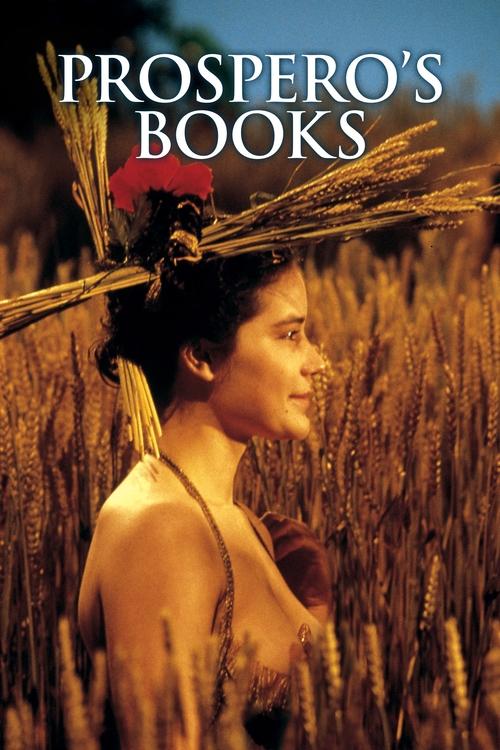
Prospero's Books
1991 · Peter Greenaway
For when you want cinema as pure sensory spectacle and are happy to abandon conventional storytelling entirely — an art-installation of a movie for an adventurous night. Definitely challenge viewing, and best met with curiosity rather than expectations.
What it's about
Shakespeare's The Tempest reimagined as a torrent of images: an exiled magician-scholar on an enchanted island conjures a storm to bring his old enemies within reach, while his daughter and the son of his chief rival fall in love. The radical twist is in the telling — Prospero speaks nearly every character's lines himself, dictating the play into being as if writing it before our eyes.
The experience
Overwhelming by design — every frame is layered with nude spirits, calligraphy, water, and painterly tableaux, with text and images stacked inside one another until the screen feels like an illuminated manuscript come alive. It's not a film you follow so much as one you surrender to; expect to be dazzled, provoked, and occasionally lost.
Performances
John Gielgud, then in his late eighties, is magisterial as Prospero — voicing virtually the entire play himself, a lifetime of Shakespearean authority poured into one final grand statement.
The craft
Peter Greenaway uses then-cutting-edge digital compositing to layer frames within frames, animate the magician's library of books, and saturate every shot with allusions to Renaissance and Baroque painting. It's one of the densest visual objects ever put on film and absolutely demands the biggest screen and best sound you can give it.
Why it matters
A landmark of experimental filmmaking that anticipated digital cinema's layered, screen-within-screen aesthetics, and the pinnacle of Greenaway's project of treating film as painting, text, and theater at once.
Snapshot
Prospero's Books is Peter Greenaway's adaptation of Shakespeare's The Tempest, conceived less as a staging of the play than as a meditation on its authorship. Greenaway seizes on a long-standing critical reading — that Prospero, the exiled magician-scholar who conjures a storm and an island of spirits, is a surrogate for Shakespeare the playwright-magus — and literalizes it. John Gielgud's Prospero does not merely speak his own lines; for most of the film he speaks everyone's lines, dictating the entire play into being, the other characters mouthing words that originate in his voice and pen. Around this conceit Greenaway builds one of the densest visual artifacts in late-twentieth-century cinema: an image-surface layered, framed-within-framed, and saturated with allusions to Renaissance and Baroque painting, calligraphy, anatomy, cartography, and the encyclopedic catalog. The "books" of the title are the twenty-four volumes Prospero's loyal Gonzalo smuggled aboard his exile boat, and the film visualizes each as a magical object, so that the narrative of The Tempest is continually interrupted and re-grounded in a fantasia of knowledge. It is simultaneously a Shakespeare film, a painter's film, and — most consequentially for film history — one of the earliest features to integrate high-definition digital image-compositing into a 35mm production.
Industry & production
The film was produced by Kees Kasander, Greenaway's regular producer, as an international co-production drawing financing across the Netherlands, France, Italy, the United Kingdom, and Japan — the kind of patchwork European art-cinema arrangement that characterized Greenaway's career after the breakout success of The Draughtsman's Contract (1982) and the commercial high point of The Cook, the Thief, His Wife & Her Lover (1989). Crucially, the project carried Japanese involvement: the broadcaster NHK, then a leader in high-definition television research, provided access to the electronic imaging facilities that made the film's signature layering possible.
The film's origin lies as much with its star as its director. Gielgud, then in his late eighties and one of the most celebrated Prosperos of the English stage, had for years wanted to commit a film Tempest to the screen, and had reportedly sounded out major directors over the decades. The partnership with Greenaway gave that ambition its eccentric form. Greenaway assembled his standing repertory of collaborators — cinematographer Sacha Vierny, composer Michael Nyman, and the production-design partnership of Ben van Os and Jan Roelfs — alongside the calligrapher Brody Neuenschwander, who hand-rendered the on-screen text, and costume work led by Emi Wada, the designer whose work on Kurosawa's Ran had won an Academy Award. The production was theatrical and labor-intensive, marshaling a large cast of performers, dancers, and nude extras in elaborate pageant tableaux. Distributed as an art-house release, it was never a mass-market proposition; precise budget and box-office figures are not something I can responsibly cite here, and the film's reputation rests on its aesthetic ambition rather than its commercial performance.
Technology
Prospero's Books is a landmark in the prehistory of digital cinema. While the film was photographed conventionally on 35mm, its images were built up electronically using high-definition video tools — centrally the Quantel "Graphic Paintbox," a then-cutting-edge digital paint-and-compositing system, worked through Japanese HDTV facilities associated with NHK. This allowed Greenaway to superimpose, inset, and animate multiple image layers with a flexibility that optical printing could not match: text could scroll and shimmer across the picture, a second framed image could float inside the first, calligraphy could be written "live" into the frame, and the pages of the imaginary books could bloom with water, fire, anatomy, and motion. The electronically composited material was then transferred back to film for theatrical release.
The historical significance is that this is one of the first features to fold high-definition digital image-manipulation into the body of a feature film as a primary expressive instrument rather than an invisible effect. It sits at the hinge between the optical and the digital eras, anticipating the layered, text-laden, multi-window image-making that would become commonplace only a decade or more later.
Technique
Cinematography
Sacha Vierny — the cinematographer of Alain Resnais's Hiroshima mon amour and Last Year at Marienbad, and Greenaway's most important camera collaborator — gives the film a deep, lacquered, painterly light. The compositions are frontal and architectural, organized around long lateral tracking movements through colonnades, baths, and libraries that recall the processional camera of Greenaway's earlier work. Vierny's lighting quotes the chiaroscuro of Rembrandt and the saturated pageantry of Venetian painting (Veronese, Tintoretto), and the staging repeatedly invokes specific canvases — the famous bathing and anatomy tableaux evoke, among others, Rembrandt's Anatomy Lesson. The base photography is in effect the ground onto which the digital layers are painted.
Editing
The film's "editing" is unusual because much of its montage happens within the frame rather than between shots: images are stacked simultaneously through compositing, so that transitions are often dissolves between layered planes, irises, and inset windows that open and close like turning pages. The result is a cinema of accretion and superimposition more than of cutting. The pacing is deliberately non-naturalistic, governed by the rhythm of catalog and procession; The Tempest's already-compressed dramatic timeline is suspended inside a much slower, ceremonial tempo. I would not want to over-attribute specific editorial choices to a named editor where I cannot verify the credit precisely.
Mise-en-scène / staging
This is the film's center of gravity. Van Os and Roelfs's sets — vast baths, scriptoria, galleries — are populated by a teeming human frieze of courtiers, nymphs, putti, and nude figures arranged as living Renaissance and Mannerist paintings. Greenaway choreographs pageant and dance into the staging, and the density of the human body — fertile, decaying, classical, grotesque — is constant. Emi Wada's costumes translate Dutch and Italian painting into fabric. The mise-en-scène is encyclopedic by design: every corner of the frame is loaded with allusion, and the twenty-four books are visualized as distinct conceits — among them a Book of Water, a Book of Mirrors, an anatomy "Book of Birth" after Vesalius, an Atlas, a Book of the Dead, a harsh book of geometry, and finally the Folio of plays into which the film itself folds.
Sound
Michael Nyman's score is the film's pulse. His characteristically driving, minimalist, repetition-based music — scored for his ensemble's hard-edged textures — supplies forward momentum to images that might otherwise stall in their own density. The sound design layers Gielgud's voice, choral and instrumental music, and environmental sound into a thick aural weave that mirrors the visual layering, with the spoken text foregrounded as the generative act of the entire fiction.
Performance
Gielgud's Prospero is the film's engine and its justification. The performance is vocal above all: Gielgud speaks not only Prospero's words but, in the central conceit, the lines of nearly every other character, so that the supporting cast often appears as figures being written and ventriloquized into existence. It is a valedictory, magisterial late-career turn from one of the great Shakespearean voices, harnessed to an experiment that risks subordinating performance to design. The other players function largely as bodies within the tableau — emblematic rather than psychological — which is the film's deliberate method and, for some viewers, its coldness.
Narrative & dramatic mode
Greenaway retains The Tempest's plot — the usurped Duke Prospero raising a storm to wreck his enemies' ship, the spirit Ariel, the "monster" Caliban, the romance of Miranda and Ferdinand, the eventual renunciation of magic — but subordinates linear drama to a reflexive, essayistic, catalog structure. The organizing device is authorship: we watch the play being composed even as it is performed, the text materializing as calligraphy and being voiced into the mouths of its characters. Only late in the film, as Prospero approaches his act of forgiveness, do the other characters begin to speak in their own voices — a dramatic release that coincides with the author relinquishing control. The closing movement literalizes the bibliographic metaphor: the twenty-four books give way to two final volumes — a book of Shakespeare's plays and the manuscript of The Tempest itself — folding the film we have watched into the First Folio and into the play's famous abjuration of the magician's art.
Genre & cycle
Nominally a fantasy and a Shakespeare adaptation, Prospero's Books belongs more truly to a small cycle of avant-garde, anti-illusionist literary films and to Greenaway's own body of structuralist work. As filmed Shakespeare it stands apart from the naturalistic, performance-centered tradition; it is closer to a tradition of painterly, formally radical adaptation. Within the early-1990s wave of prestige Shakespeare on screen — a period that also produced more conventionally accessible films — Greenaway's is the deliberate outlier, treating the source as raw material for a meditation on books, bodies, and image-making rather than as a story to be told straight.
Authorship & method
Prospero's Books is among the purest expressions of Greenaway's signature obsessions. Trained as a painter and steeped in structuralist filmmaking, Greenaway built his cinema on numbered lists, catalogs, encyclopedias, and games (the counting of Drowning by Numbers, the alphabet of A Zed & Two Noughts); on the human body in its sexuality and decay; and on the unresolved rivalry between painting's static frame and cinema's moving image. Here those concerns converge: the twenty-four books are a catalog; the tableaux are paintings set in motion; the body is everywhere; and the film stages, in its very compositing technology, the contest between the painted surface and the photographic image.
His collaborators are integral to the method. Vierny supplies the painterly light; Nyman the propulsive musical architecture; van Os and Roelfs the encyclopedic sets; Wada the painting-derived costume; and Brody Neuenschwander the calligraphy that makes text a visible, animate presence — a collaboration Greenaway would extend in The Pillow Book (1996). Greenaway wrote as well as directed, and the conceit of Prospero-as-author is finally a self-portrait of the director as a maker who speaks every part.
Movement / national cinema
The film is a product of pan-European art-cinema co-production with decisive Japanese technical input, and it cannot be assigned to a single national cinema. Greenaway is a British artist working largely outside the British realist mainstream, financed through Continental (especially Dutch) channels and aligned more with a European tradition of intellectual, formally radical cinema — the lineage that runs through Resnais (via Vierny) — than with any contemporary British school. The NHK collaboration locates the film additionally within the global, Japan-led push toward high-definition imaging at the turn of the 1990s.
Era / period
Prospero's Books is a document of a precise historical cusp: the moment, around 1990–91, when high-definition video and digital compositing were emerging from broadcast laboratories and beginning to touch feature filmmaking, but before the digital tools had been normalized or made invisible. The film wears its technology openly, even ostentatiously, as both subject and method. It also belongs to the late phase of a particular European auteur art cinema, and to the twilight of a generation of great stage Shakespeareans, of whom Gielgud was among the last.
Themes
The film's governing theme is authorship and the magic of creation — the writer as magus who conjures worlds from words, and the cost of that god-like control. Bound up with this is the theme of knowledge itself: the twenty-four books figure learning as both power and burden, an encyclopedic dream of containing the world that the film treats with equal parts reverence and irony. The body recurs as Greenaway's persistent motif — fertility, birth, sexuality, and mortality rendered in painterly flesh — set against the abstraction of text and number. The Tempest's own themes of exile, revenge, forgiveness, and renunciation are preserved and refracted: Prospero's final breaking of his staff and drowning of his book becomes, in Greenaway's hands, a meditation on the artist's relinquishment of his medium, and on the freeing of characters from their author's voice.
Reception, canon & influence
Critical response was sharply divided, and that division is itself central to the film's reputation. Admirers received it as a visually overwhelming masterwork, an audacious fusion of cinema, painting, and emergent digital technology; skeptics found it airless, static, and self-indulgent — a museum installation more than a movie, in which spectacle and erudition smother drama and feeling. Both reactions recur across the serious criticism, and the film has settled into the canon precisely as a difficult, polarizing landmark rather than a beloved one.
Its lines of influence run backward and forward. Looking back, the film draws on Shakespeare and the rich critical tradition of reading Prospero as Shakespeare's stand-in; on Renaissance and Baroque painting (Veronese, Tintoretto, Rembrandt) and on the anatomical and cartographic image-cultures of early modern Europe; on the encyclopedic, list-making literary imagination; and on the formal, processional cinema Vierny had helped shape with Resnais. Looking forward, Prospero's Books is most important as a pioneer of digitally layered, text-saturated film image-making. Greenaway himself extended its methods immediately in The Pillow Book and across the multi-platform Tulse Luper projects, and the film is routinely cited in histories of digital cinema as an early, conscious demonstration of compositing as an artistic language — anticipating the multi-window, text-overlaid, densely layered screen aesthetics that later became pervasive. As filmed Shakespeare it remains the field's most radical experiment in treating the play not as a story to perform but as a book to be written, read, and dissolved.
A Deleuzian reading
The word arrives before the world it describes.
The full Deleuzian reading of Prospero's Books →
Reception
In 1991 it split critics down the middle — hailed as a ravishing feast of imagery by some, dismissed as an exhausting art-installation by others — and it flopped with general audiences. Now it's read as a landmark of proto-digital cinema, decades ahead of its time in layering image on image.
How Prospero's Books was received, from release to now →
Influences: the films it descends from and the films it influenced
- Last Year at Marienbad (1961) — Sacha Vierny — Greenaway's own cinematographer here — established the gliding lateral tracking shot drifting past frozen, statuary-like figures in deep-perspective gardens, the exact processional camera grammar Greenaway hired him to reprise.
- The Cook, the Thief, His Wife & Her Lover (1989) — Immediate precursor: Vierny's color-coded lateral tracks sweeping across compartmentalized theatrical sets, treating the set as a horizontally-scrolling painted frieze the camera reads like a scroll.
- A Zed & Two Noughts (1985) — Establishes the encyclopedic catalog as narrative armature and the symmetrical Vermeer/Dutch-lit tableau staging the body in decay — both reconvened wholesale in the twenty-four books.
- The Draughtsman's Contract (1982) — Its structuralist conceit of the drawing-grid that fixes and serializes the visible world is the seed of the film's contest between painting's static frame and the moving image.
- Drowning by Numbers (1988) — Originates the counting/numbered-list game as a formal organizing principle and pairs it with Michael Nyman's propulsive, repetition-driven minimalist score that returns here.
- La Belle et la Bête (1946) — The poet-director conjuring creation-as-magic through in-camera theatrical illusion and living statuary (the smoking caryatids, animate arms) prefigures Prospero-as-author animating his own enchanted images.
- Fellini Satyricon (1969) — Episodic, fresco-like encyclopedic tableaux of a decadent antiquity, the body foregrounded in flesh and decay, staged as a procession of static painted panels rather than dramatic scenes.
- The Tempest (1979) — The prior radical reinvention of this exact play as painterly, anti-illusionist masque rather than performed drama — the template for treating The Tempest as a field for visual experiment.
- Ivan the Terrible (1944) — Operatic in-frame montage — meaning built by composing multiple charged elements within a single painterly, sculptural shot rather than by cutting — the intellectual-montage logic Greenaway transposes into digital layering.
- The Pillow Book (1996) — Directly extends the calligraphy-on-flesh method (same collaborator, Brody Neuenschwander) and the multi-window, text-overlaid composited frame into a full feature-length system.
- The Tulse Luper Suitcases (2003) — Pushes the list-cinema and densely layered, text-saturated multi-screen aesthetic across a multi-platform encyclopedic project, the logical scaling-up of the books-as-catalog conceit.
- Titus (1999) — Extends radical Shakespeare into maximalist, anti-naturalist tableau staging with anachronistic layering, treating the text as a pretext for orchestrated visual spectacle.
- Hamlet (2000) — Carries forward the media-saturated Shakespeare in which screens, surveillance images and on-screen text become the visual substance of the verse rather than illustration of it.
- Russian Ark (2002) — Realizes the museum-as-film in a single HD-video processional sweep through galleries of living paintings, fulfilling the encyclopedic-tableau ambition with the digital-video tools Greenaway pioneered.
- Timecode (2000) — Builds the whole film from a four-way simultaneous-window frame, systematizing the in-frame montage / multi-pane screen that Prospero's Books introduced as compositing language.
- Sin City (2005) — Demonstrates the fully digitally-composited, painterly frame as an artistic language in its own right — the layered, surface-conscious image-making Prospero's Books first proposed via the Quantel Paintbox.
- Caravaggio (1986) — Reconstructs Baroque canvases as living tableaux with deliberate anachronism, sharing the project of dissolving the boundary between the painted Old-Master frame and the photographed body.
- The Belly of an Architect (1987) — Descendant pushing the living-paintings and catalog-of-images method to its limit, the human body annotated and exhibited like an architectural plate.
- Orlando (1992) — Same Van Os/Roelfs-lineage design and layered painterly compositions treating literary adaptation as image-catalog, the tableau-as-illustration method Orlando adopts for Woolf.
Similar films
- The Cook, the Thief, His Wife & Her Lover (1989) — influence & lineage
- Titus (1999) — influence & lineage
- Caravaggio (1986) — influence & lineage
- Lord of the Flies (1963) — shared sensibility
- Orlando (1992) — shared sensibility
- Hamlet (1996) — shared sensibility
- Macbeth (1971) — shared sensibility
- A Midsummer's Night Dream (1959) — shared sensibility