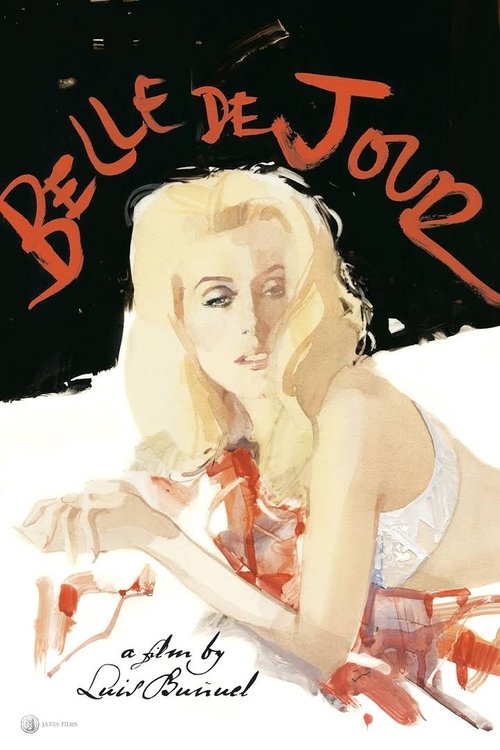
Belle de Jour
1967 · Luis Buñuel
For when you want something adult, ambiguous, and gorgeous to puzzle over — a film that trusts you to sit with unanswered questions. Definitely a challenge pick, best with someone to debate it with after.
What it's about
Séverine is a beautiful young Parisian housewife with a kind, devoted husband and a private life of masochistic fantasies she can't confess to him. When she hears about a discreet high-class brothel, she begins working there in the afternoons under the name Belle de Jour — keeping her two lives sealed off from each other, until one client refuses to stay on his side of the line.
The experience
Cool, elegant, and quietly destabilizing: the fantasies are filmed exactly like the reality, with no cue to tell you which is which, so the ground keeps shifting under your feet. It's provocative without a single explicit image — all suggestion, surface, and secrets.
Performances
Catherine Deneuve is extraordinary — glacial poise over hidden turmoil, an entire double life conveyed through composure and the tiny cracks in it. It's the role that fixed her international image.
The craft
Buñuel films fantasy and reality in the identical calm, immaculate style and never marks the border between them — the ambiguity is the design, not a puzzle to be solved. The bourgeois surfaces, including Deneuve's iconic Yves Saint Laurent wardrobe, are as meticulously composed as the mystery underneath.
Why it matters
Winner of the Golden Lion at Venice, it consolidated Deneuve's stardom and stands as the peak of Buñuel's late period — a permanent touchstone for films about desire, fantasy, and the double lives of respectable people.
Snapshot
A married Parisian woman of the haute bourgeoisie secretly works afternoon shifts at a high-class brothel, driven by masochistic fantasies she cannot articulate to her decent, devoted husband. Made during Buñuel's triumphant late French period, Belle de Jour is among the most rigorously ambiguous films in the art-cinema canon: its fantasy sequences are visually indistinguishable from its reality sequences, and Buñuel never resolves the question. The film won the Golden Lion at the 1967 Venice Film Festival, consolidated Catherine Deneuve's international stardom, and remains a touchstone for any serious discussion of cinema, desire, and the instability of the bourgeois subject.
Industry & production
The project originated with the Hakim brothers — Robert and Raymond Hakim, Egyptian-born Paris-based producers who had long worked at the intersection of commercial French cinema and prestige international co-production — who brought Buñuel the rights to Joseph Kessel's 1928 novel of the same name. The novel had circulated for decades as a moderately scandalous work of popular fiction; the Hakims saw in it the material for a prestige erotic art film. Buñuel, then in his late sixties and enjoying the most critically celebrated phase of his career, accepted, though characteristically he and co-writer Jean-Claude Carrière subjected the source to extensive reinvention. The film was a French-Italian co-production, produced under Paris Film Productions and Five Film. Its budget was modest by international co-production standards of the period; Buñuel's legendary shooting efficiency — minimal takes, meticulous preparation, schedules rarely exceeded — kept productions economical. The Hakim brothers provided the commercial infrastructure that gave Buñuel creative latitude he had not always enjoyed earlier in his career; the arrangement was mutually advantageous and the shooting proceeded without significant reported friction.
Technology
Belle de Jour was photographed in 35mm on Eastmancolor negative stock, the standard format for European prestige productions of the period. No unusual photographic or optical processes were employed — and that restraint is itself the point. The film's most consequential "technological" decision is a refusal: Buñuel and cinematographer Sacha Vierny declined to deploy any of the conventional optical or in-camera signals — soft focus, desaturation, dissolves, canted framing — that European art cinema of the era routinely used to flag fantasy sequences. The daylight fantasies are shot with precisely the same sobriety as the "real" scenes. This equality of visual treatment is the film's central formal proposition, and it required disciplined suppression of the toolkit.
Technique
Cinematography
Sacha Vierny, the Belgian cinematographer who had worked with Alain Resnais on Hiroshima Mon Amour (1959) and Last Year at Marienbad (1961), brought to Belle de Jour a cool, precise style ideally suited to Buñuel's purposes. Vierny favored clean, slightly formal compositions — the bourgeois apartment and the brothel interiors rendered with equal spatial legibility — and a color palette of muted elegance. The light reads as natural or institutionally neutral throughout; there is no expressionist chiaroscuro, no romantic warmth. This tonal impassivity is what makes the film's erotic and violent content so disturbing: nothing in the image asks for special feeling. The visual register of Séverine's flagellation fantasy in the opening carriage sequence is identical to the register of Pierre pouring his morning coffee.
Editing
The editing — by Louisette Hautecoeur — amplifies the ambiguity rather than resolving it. Transitions between fantasy and reality are made with cuts that carry no special punctuation: no dissolves, no audio bridges that signal a change of ontological register. Several sequences depend for their meaning entirely on the viewer's retrospective realization that a cut has moved between worlds. The pacing is unhurried but not slack; Buñuel's shooting efficiency meant the editing room received material that was already tightly pre-planned. The film's circular structure — opening and closing on the fantasy of the horse-drawn carriage — is consolidated in the cut.
Mise-en-scène / staging
Buñuel was a director of spare, theatrical staging who distrusted elaborate camera movement as an end in itself. He blocks scenes for clarity and psychological implication rather than visual rhetoric. The bourgeois domestic spaces — the Serizy apartment, the fashionable restaurant — are rendered with sociological precision: the furnishings establish class position without comment. The brothel interiors are also rendered soberly; there is no attempt to exoticize or degrade the space. The disproportion between the ordinariness of the décor and the extremity of what occurs within it produces Buñuel's characteristic effect of grotesque banality. The famous scene of the Japanese client's lacquered box — whose contents are never revealed to the viewer or to Séverine — is staged with absolute deadpan patience; the camera simply watches the other women look inside and react.
Sound
Buñuel had long been skeptical of the conventional use of non-diegetic orchestral scoring, which he regarded as emotional manipulation — an attitude he shared with several of his Surrealist contemporaries. Belle de Jour uses no composed score. The opening and closing sequences are marked by the sound of harness bells from the horse-drawn carriage, a diegetic detail that takes on structuring, almost leitmotific weight through its repetition. Otherwise the film relies on ambient sound and silence. The absence of a score forces the viewer to attend to the image and to construct their own emotional orientation toward scenes that the music would otherwise direct. The effect is of clinical observation.
Performance
Catherine Deneuve, twenty-three years old at the time of shooting, gives a performance of carefully managed opacity. Buñuel explicitly discouraged his actors from psychologizing their characters for the camera — from telegraphing interiority — and Deneuve internalized this injunction completely. Séverine's face registers surface states — composure, brief alarm, blank absorption — but withholds explanation. This inscrutability is not an absence of performance but its most demanding form: the viewer is forced to project, to guess, which replicates the epistemological situation of every other character in the film. Jean Sorel plays Pierre as a genuinely loving and decent man, a choice that deepens the film's unsettlement: Séverine's desires are not a legible response to marital neglect or cruelty. Michel Piccoli's Husson combines suavity with a low-grade predatory insinuation. Pierre Clémenti's Marcel introduces a different register — volatile, socially marginal, genuinely threatening — that the film uses to escalate toward its violent crisis. Geneviève Page as Madame Anaïs brings an unruffled professional authority that declines to moralize.
Narrative & dramatic mode
The film's narrative proposition is deceptively simple; its formal execution is radical. Buñuel and Carrière departed from Kessel's novel — which maintains a firmer line between Séverine's daydreams and her actual experience — to produce a text in which no sequence carries internal evidence of its ontological status. The viewer is given access to several sequences that retroactive evidence or internal logic marks as fantasy (the opening carriage, a mud-throwing scenario, a bullfighter's visit), but the marking is always retrospective and never certain. The final sequence — in which Pierre, confined to a wheelchair by Marcel's revenge attack, suddenly rises and resumes his former self; in which Husson visits, and smiles in a way that is unreadable; in which the carriage bells return — resists all confident interpretation. Buñuel refused throughout his life to adjudicate between readings: the ending might be Séverine's wish-fulfillment fantasy, or a second-order narrative frame might make the entire film a fantasy, or the final scene might simply be another discrete fantasy embedded in an otherwise realistic narrative. The film's dramatic mode is thus one of sustained epistemological irresolution — the viewer shares the position of Pierre, who knows, at the end, that something has been concealed from him, but not what.
Genre & cycle
Belle de Jour participates in the late-1960s cycle of European prestige erotic cinema that included works by Vadim, Malle, and others, but it engages that cycle with a characteristically Surrealist set of priorities that distinguish it sharply from simple titillation. The film draws on the literary tradition of the erotic novel — Kessel's source text, de Sade's thought in the background — while inflecting it through Buñuel's abiding interests in Catholic guilt, bourgeois hypocrisy, and the violence beneath respectable surfaces. It also belongs to the cycle of late Buñuel bourgeois satires that includes The Exterminating Angel (1962), The Diary of a Chambermaid (1964), The Discreet Charm of the Bourgeoisie (1972), and The Phantom of Liberty (1974): films that use the conventions of social drama to expose the instability at the core of bourgeois self-presentation.
Authorship & method
Luis Buñuel (1900–1983) was formed by Surrealism in late-1920s Paris, where he and Salvador Dalí made Un Chien Andalou (1929) and L'Age d'Or (1930) — foundational documents of avant-garde cinema. After a long Mexican period (1946–1964) during which he made commercially directed genre films alongside personal work (Los Olvidados, 1950; El, 1953; Viridiana, 1961), he entered his most celebrated phase with a series of French co-productions. His method was collaborative, economical, and anti-romantic about filmmaking: he prepared meticulously, shot quickly, and was uninterested in technical display for its own sake.
Jean-Claude Carrière, the French novelist and screenwriter, began his collaboration with Buñuel on The Diary of a Chambermaid (1964). Their working method, which Carrière has described in interviews and in his memoir The Secret Language of Film, involved extended conversations — often conducted at meals over extended periods — in which ideas, images, and narrative possibilities were explored at length before anything was committed to script form. Belle de Jour was their second collaboration; they would continue through The Milky Way (1969), The Discreet Charm of the Bourgeoisie (1972), The Phantom of Liberty (1974), and That Obscure Object of Desire (1977) — collectively the most sustained director-writer partnership in the French art cinema of the era.
Sacha Vierny's contribution has been discussed above. His prior work with Resnais on formally experimental, temporally ambiguous films made him an exceptionally appropriate collaborator for this project.
Movement / national cinema
Buñuel occupied a peculiar position in European cinema: Spanish by birth and formation, Surrealist by early affiliation, Mexican by decades of residence, and French by the circumstances of his late career. Belle de Jour is a French-Italian co-production made by a Spanish director with a French cast and crew, and it sits at an oblique angle to the Nouvelle Vague — which was reshaping French cinema in these years — without belonging to it. Buñuel was a generation older than Godard and Truffaut, his formal experiments preceded theirs and proceeded from entirely different premises (Surrealism rather than cinephilia), and his relationship to genre convention was satiric rather than affectionate. The French New Wave directors admired him — Truffaut cited him as an influence — but Belle de Jour is better understood as a product of the international art cinema circuit than of any national movement.
Era / period
1967 places Belle de Jour at the hinge between the high period of European art cinema (Bergman, Antonioni, Fellini, early Godard) and the social upheaval that would produce the radicalized cinema of post-1968 Europe. The film's cool treatment of erotic transgression was possible in this moment in a way it would not have been a decade earlier; it was also, by the standards of what was about to become possible, relatively restrained. The Golden Lion at Venice reflected the festival's appetite for exactly this kind of prestige transgression: formally sophisticated, star-driven, intellectually serious, and commercially viable.
Themes
The film's central preoccupation is the irreconcilability of bourgeois respectability and erotic life — a Buñuel constant. But where earlier work staged this as satiric comedy or anti-clerical polemic, Belle de Jour is more intimate and more genuinely curious about its protagonist. Séverine's masochism is presented neither as pathology to be explained nor as liberation to be celebrated; the film withholds both clinical and ideological frames. Her need to be paid — which the brothel satisfies and which her marriage cannot, regardless of what her husband would consent to — introduces a mercantile element into desire that the film declines to rationalize. The class dimension is persistent: the brothel operates in the same social stratum as the Serizy apartment; Séverine's clients are largely from her own world. The doubling of the husband (decent, impotent in the face of her real desires) and Marcel (violent, possessed, destroyed by his attachment) structures the film's erotic logic without resolving it. Throughout, the impossibility of knowing another person — of knowing even oneself — is the condition under which all the characters operate.
Reception, canon & influence
Belle de Jour won the Golden Lion at Venice in 1967 and was a significant commercial success in France and across European markets. Critical reception was strong, though some contemporary reviewers were uncertain whether the film's ambiguity represented depth or evasion — a debate that has not entirely ceased. The film's reputation has grown substantially over subsequent decades, sustained by feminist film theory's engagement with it (Laura Mulvey and others found in it unusually complex terrain for analyzing the gaze and female spectatorship) and by the emergence of Deneuve as a major cultural figure whose later career retroactively intensified interest in her early work.
A significant US theatrical revival, released by Miramax in 1995, brought the film to a new generation of American viewers and re-established it in critical discourse. The restoration received renewed attention and favorable reassessment in mainstream as well as specialized press.
Influences on the film run through Buñuel's own formation: the Surrealist imperative to take dream and desire as seriously as waking reality; the anti-bourgeois satire of his Mexican period; the literary tradition of the French erotic novel; and, obliquely, psychoanalytic thinking about sexuality and the unconscious that had permeated Surrealism from its origins. The specific debt to Kessel's novel is real but selective: Buñuel and Carrière retained the premise and the central character while radicalizing the formal ambiguity.
The film's forward influence is broad and difficult to delimit precisely, but several lines are clear. David Lynch has cited Buñuel as a central reference; the refusal to distinguish fantasy from reality, the suburban erotic uncanny, and the narrative circularity of Mulholland Drive (2001) are legible descendants of the strategy Belle de Jour pioneered. Pedro Almodóvar's engagement with female desire, bourgeois surfaces, and melodramatic extremity is inseparable from the Buñuel tradition. More broadly, any serious art film made after 1967 that treats female erotic fantasy as a narrative subject rather than a spectacle for male audiences is working, whether consciously or not, in terrain that Belle de Jour helped to define. The film also shaped the conventions of the erotic art film as a commercially viable category in Europe, demonstrating that formal rigor and star power were not incompatible with transgressive sexual content. Its influence on Buñuel's own subsequent work was direct: the methods of Belle de Jour — the deadpan co-presence of dream and reality, the bourgeois social milieu, the withholding of psychological explanation — were refined and varied across his remaining films through That Obscure Object of Desire in 1977.
A Deleuzian reading
A man pours his morning coffee.
The full Deleuzian reading of Belle de Jour →
Reception
A scandale and a smash in 1967 — it won the Golden Lion at Venice and became Buñuel's biggest commercial hit — then spent decades hard to see due to rights issues, until the 1995 Miramax re-release (championed by Martin Scorsese) re-canonised it for a new generation.
How Belle de Jour was received, from release to now →
Influences: the films it descends from and the films it influenced
- L'Age d'Or (1930) — Buñuel establishes here the formal principle Belle de Jour perfects: filming transgressive erotic fantasy and bourgeois behavior with identical sober visual grammar, refusing to assign different registers to 'normal' and 'deviant' content.
- Hiroshima Mon Amour (1959) — Sacha Vierny — whom Buñuel hired directly for Belle de Jour — developed here his practice of shooting memory-flashback sequences with identical stock, exposure, and lighting as present-tense scenes, the cinematographic basis for the equal visual register.
- Pickpocket (1959) — Bresson's method of directing actors to perform compulsive behavior as surface action without psychological interiority — precise physical gesture over legible emotion — is the formal precursor to Buñuel's anti-psychologizing direction of Deneuve as Séverine.
- L'Avventura (1960) — Antonioni's deadpan, formally precise staging of bourgeois erotic desire around an opaque female protagonist whose interiority is rendered through behavior rather than readable emotion provides the contemporary model Buñuel answers and radicalizes with Séverine.
- Last Year at Marienbad (1961) — Vierny's cinematography here — uniform lighting and lens treatment across sequences of irresolvably different ontological status — gives Buñuel the technical proof-of-concept that refusing optical distinctions between memory, fantasy, and reality produces durable ambiguity rather than mere confusion.
- The Exterminating Angel (1962) — Buñuel's own film fully develops the deadpan staging device — bourgeoisie trapped in compulsive ritual behavior filmed with the same formal sobriety as naturalistic scene-setting — that Belle de Jour imports directly into the domain of erotic fantasy.
- 8½ (1963) — Fellini's architecture of alternating between a protagonist's fantasy life and present reality provides the structural template; Buñuel's formal intervention is to strip away every marker Fellini uses to signal transitions — the dissolves, overexposure, and Nino Rota cues.
- Une Femme Mariée (1964) — Godard films a bourgeois married woman's erotic double life with clinical fragmented sequences and no romantic scoring, refusing psychological explanation of female desire — the immediate contemporary parallel that Buñuel then radicalizes by adding full ontological irresolution.
- Viridiana (1962) — Carries the surreal-fetish-within-realist-narrative method to its apex, embedding repression-driven daydreams in a polished classical surface without marking the seams.
- Diary of a Chambermaid (1964) — First full flower of the Carrière partnership launched here: a watchful woman's strategic sexuality and fetishized bourgeois desire presented with deadpan neutrality.
- The Criminal Life of Archibaldo de la Cruz (1955) — Perfects the calmly perverse bourgeois protagonist whose fantasy and reality interleave around fetish objects, the direct descendant of Archibaldo's music-box reveries.
- La Femme Infidèle (1969) — Chabrol inherits Buñuel's device of applying classical compositional formality — precise framing, elegant domestic interiors, restrained performance — to bourgeois transgression and murder, producing the grotesque banality effect: extreme content made uncanny by the sobriety of the container.
- The Discreet Charm of the Bourgeoisie (1972) — Buñuel and Carrière extend Belle de Jour's circular structure and epistemological irresolution to its logical limit — the entire film turns on whether the dinner-party sequences are real or dreamed, presented throughout with identical visual sobriety to prevent resolution.
- In the Realm of the Senses (1976) — Oshima films explicit sexual obsession with formal sobriety, no non-diegetic score, and clinical staging that refuses erotic titillation, inheriting Buñuel's method of defamiliarizing extreme content through equal visual register and scored silence rather than aestheticizing it.
- That Obscure Object of Desire (1977) — Buñuel radicalizes Belle de Jour's technique of making female desire epistemologically inaccessible by casting two physically different actresses in the single role of Conchita — managed opacity literalized as the formal instability of the desiring object itself.
- Eyes Wide Shut (1999) — Kubrick renders Harford's erotic-fantasy odyssey with the same evenly-lit, formally precise visual register as his domestic scenes and stages the orgy sequences with deadpan sobriety — equal visual treatment for reality and desire-projection producing the same grotesque banality effect Buñuel achieved in the brothel interiors.
- Under the Sand (2000) — Ozon directs Charlotte Rampling to perform the same managed opacity Buñuel achieved with Deneuve — desire and denial through surface behavior without psychological legibility — while organizing the narrative around the same epistemological irresolution: the viewer cannot determine whether the absent husband exists or is fantasy.
- Mulholland Drive (2001) — Lynch adopts Buñuel's specific formal combination of making fantasy sequences visually indistinguishable from reality sequences and using a circular structure to retroactively recontextualize the opening, producing the same retrospective epistemological crisis that Belle de Jour's carriage bookends create.
- 3 Women (1977) — Buñuel's technique of inserting fantasy sequences into the waking narrative without optical or editorial demarcation — so the viewer cannot determine which register is 'real' — is the literary-surrealism model for 3 Women's dream-logic, which refuses to mark the boundary between Pinky's waking perception and the nocturnal pool visions.
- Audition (2000) — Intercuts fantasy and reality with no markers separating them, the dream-logic editing Audition's climax weaponizes so the viewer cannot fix what 'actually' happened.
- Indochine (1992) — Constructs the cool, opaque, glamorous Deneuve screen icon that Indochine relies on as its star portraiture and organizing principle.
- Talk to Her (2002) — Spanish-surrealist braiding of fantasy and reality without marked transitions, the lineage behind the film-within-a-film standing in for what the plot dares not show.
- Tie Me Up! Tie Me Down! (1990) — Models the deadpan, classically framed staging of fantasies of submission within Spanish surrealism — the Buñuelian refusal of moral signposting around a woman's desire — that underwrites Almodóvar's tonal control.
- Persona (1966) — Bergman independently arrives at the same anti-psychologizing performance direction — actors performing psychological states through controlled surface behavior without legible emotional expression — that Buñuel deploys with Deneuve, producing in Ullmann and Andersson an equivalent managed opacity.
- Blow-Up (1966) — Buñuel uses identical visual grammar for fantasy and reality sequences, formally refusing to signal which is which, embedding epistemological ambiguity in the narration itself—the same structural logic by which Blow-Up refuses photographic confirmation of Thomas's murder, making uncertainty a property of the image rather than a solvable narrative puzzle.
- Juliet of the Spirits (1965) — Developed concurrently, both films use unannounced hard cuts to move a bourgeois wife into her own fantasy life with no transition marker, refusing to demarcate the boundary between social reality and interior imagination.
- The Handmaiden (2016) — Ancestor in surfacing bourgeois female fantasy and fetish as elegant, deadpan tableau — the lacquered eroticism Park adopts to interrogate the gaze.
- Un Chien Andalou (1929) — Late Buñuel masterpiece that interleaves fantasy and reality with the same refusal to flag dream from waking, descending directly from the short's seamless oneiric montage.
- L'Âge d'or (1930) — The amour fou and seamless interpenetration of fantasy and reality, shot with the same flat, lucid clarity that refuses to flag which images are dreamed.
- Él (1953) — Continues Él's technique of rendering fetishism and fantasy with an unemphatic, polite surface so that pathology erupts without any change in register.
Similar films
- That Obscure Object of Desire (1977) — influence & lineage · same viewing thread
- The Discreet Charm of the Bourgeoisie (1972) — influence & lineage · same viewing thread
- Last Year at Marienbad (1961) — influence & lineage
- Mulholland Drive (2001) — influence & lineage
- 8½ (1963) — influence & lineage
- The Exterminating Angel (1962) — influence & lineage · same viewing thread
- Diary of a Chambermaid (1964) — same viewing thread
- Tristana (1970) — same viewing thread
All the films related to Belle de Jour →
Watch it with: curated runs of related films
- Buñuel and the Bourgeoisie — A run of surrealist provocations where every dinner, prayer, and marriage bed hides an appetite polite society can't admit — watch them together for the way Buñuel (and Pasolini's Theorem) keep pulling the tablecloth out from under the well-heeled.