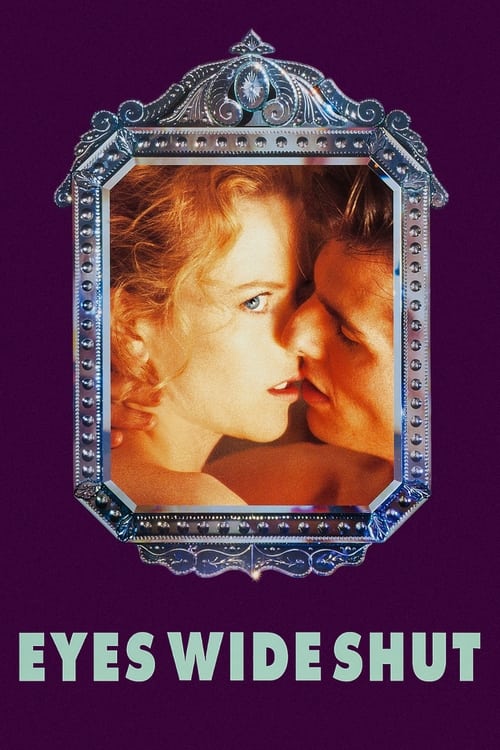
Eyes Wide Shut
1999 · Stanley Kubrick
For when you want a film to chew on for days — something adult, ambiguous, and immersive rather than fast or fun. A challenge more than a comfort, and oddly a Christmas movie, if your Christmas runs cold and strange.
What it's about
A comfortable Manhattan doctor's world tilts when his wife confesses a fantasy she once had about another man. Stung, he drifts out into the city over one long winter night, where every encounter hums with sexual possibility — until he talks his way into a masked gathering of a secret society and realizes he has wandered somewhere he was never meant to be. It's a film about a marriage, wearing the mask of a mystery.
The experience
Slow, hypnotic, and quietly unnerving — less a thriller than a waking dream, where ordinary rooms glow strangely and every conversation feels like it's happening slightly underwater. It builds a low hum of dread and desire that stays with you well after it ends.
Performances
Tom Cruise plays productively against type as a man whose confidence keeps failing him, and Nicole Kidman is riveting in a handful of scenes — her long, wine-loosened confession is the detonation the whole film proceeds from.
The craft
Stanley Kubrick's final film, finished days before his death, and every frame shows his obsessiveness: a dreamlike New York built on soundstages, rooms bathed in Christmas-light glow, unhurried camera moves, and a sparse piano motif that turns single repeated notes into menace. Watch it in the dark with the sound up — its spell is atmospheric and total.
Why it matters
Sold as an erotic thriller starring a real-life celebrity couple, it baffled audiences in 1999 and has since been rehabilitated as one of Kubrick's richest works — its masked-ball imagery now shorthand for hidden worlds of wealth and power.
Snapshot
Eyes Wide Shut is Stanley Kubrick's thirteenth and final feature, completed only days before his death on 7 March 1999 and released that July. Adapted from Arthur Schnitzler's 1926 novella Traumnovelle (Dream Story), it follows a Manhattan physician, Bill Harford (Tom Cruise), into a night-and-day odyssey of jealousy and erotic temptation after his wife, Alice (Nicole Kidman), confesses a fantasy about a naval officer. The film's notional plot — a doctor stumbling into a masked secret society — sits atop a far stranger object: a slow, hypnotic, almost somnambulant study of marriage, fantasy, and the gulf between desire and act. Marketed as an erotic thriller built around the real-life celebrity marriage of its two stars, it confounded audiences expecting either titillation or suspense, and its reputation has inverted over the decades from "disappointing swan song" to one of Kubrick's most quietly radical works. It is both a culmination of his formal obsessions — symmetry, the slow zoom, the tracking Steadicam, music deployed with surgical irony — and a peculiarly intimate film about the institution of monogamy.
Industry & production
The production is legendary chiefly for its duration. Principal photography reportedly began in November 1996 and continued for well over a year; the shoot is frequently cited as holding the Guinness record for the longest continuous film production, with figures around 400 days widely reported. Kubrick's method — endless takes, total control, an aversion to location work — was abetted by his refusal to leave England. Though set in New York, the film was made almost entirely at and around Pinewood Studios and on London streets dressed to evoke Greenwich Village; Kubrick had crews photograph Manhattan locations so that dimensions could be reproduced. The result is a "New York" that feels subtly off, dreamlike and stage-bound, an effect most critics now read as deliberate.
The casting of Tom Cruise and Nicole Kidman, then married, was central both to the financing and to the film's meaning, lending the marital tension an uncomfortable charge of the real. The long schedule famously strained the actors and contributed to scheduling difficulties for others. Several roles were recast: Harvey Keitel was originally cast as Ziegler but left and was replaced by director Sydney Pollack; Jennifer Jason Leigh shot scenes as Marion that were later reshot with Marie Richardson. Warner Bros. financed and distributed, continuing a relationship with Kubrick that stretched back to A Clockwork Orange.
The most notorious industry episode came posthumously. To secure an R rating in the United States rather than the commercially toxic NC-17, Warner Bros. digitally inserted cloaked figures into the orgy sequence to obscure explicit action. This altered version played U.S. theaters in 1999; the uncensored cut screened internationally and was eventually released uncut on home video in America. Whether Kubrick — a famous controller of his own work — would have sanctioned the alteration remains a matter of dispute, since he died before release; the record here is genuinely contested, and claims about his prior approval should be treated cautiously.
Technology
Kubrick shot on 35mm and, characteristically, exploited available and practical light to an unusual degree. The film is saturated with Christmas lights, lamps, and window glow as motivated in-frame sources, extending the low-light naturalism Kubrick had pursued since the candlelit interiors of Barry Lyndon (for which he used adapted Zeiss lenses developed for NASA). Here the technological signature is less a single exotic lens than the systematic use of color temperature — the warm tungsten and fairy-light interiors against cooler exteriors — to give the urban night a feverish, gilded unreality. Steadicam, a tool Kubrick helped popularize on The Shining, again underpins the film's gliding mobility. As with all late Kubrick, the technology serves a controlled, slightly artificial surface rather than documentary immediacy.
Technique
Cinematography
The cinematographer was Larry Smith, who had worked with Kubrick for years as a gaffer and chief lighting technician before being elevated to director of photography — a promotion typical of Kubrick's preference for trusted long-term collaborators over outside auteur-DPs. The visual scheme is built on Kubrick's signature one- and two-point perspective compositions, centered framings, and the slow, almost imperceptible zoom that draws the viewer toward a character without the kineticism of a dolly. Smith and Kubrick favor pools of warm practical light against shadow, with the recurring chromatic motif of Christmas-tree lights bathing nearly every interior in red, green, and gold. The Steadicam follows Bill through corridors, parties, and streets in long unbroken passages, producing a trance-like glide that matches the film's dream logic. The Somerton mansion sequence is staged with ritual frontality and cold, candlelit grandeur, a visual register apart from the domestic warmth elsewhere.
Editing
Editing was by Nigel Galt. The cutting is patient to the point of provocation: long takes are held, conversations play in extended exchanges, and the rhythm is deliberately becalmed rather than propulsive. This is anti-thriller editing — it withholds the acceleration the genre promises and instead lets scenes breathe, repeat, and circle, mirroring obsessive rumination. The pacing has been read both as a flaw (sluggish) and, increasingly, as the point: a tempo of reverie and compulsion rather than plot mechanics.
Mise-en-scène / staging
Production design (Les Tomkins and Roy Walker among the credited team) constructs an immaculate, slightly heightened upper-middle-class Manhattan: the Harfords' art-filled apartment, Ziegler's opulent townhouse, the cathedral-like Somerton. Kubrick stages the film around thresholds and repetitions — doorways, mirrors, the recurring Christmas iconography that ironizes the season of family and innocence against the narrative of erotic transgression. Marit Allen's costuming and the masks of the orgy sequence (drawing on Venetian Carnival traditions) supply the film's most indelible imagery. The blocking is formal and frontal, actors often addressing one another across symmetrical space, heightening the sense of performance and ritual within ordinary social interaction.
Sound
The film's most celebrated technical dimension is its use of music. Kubrick, who never used a conventional through-composed orchestral score for this film, built the soundtrack from pre-existing and specially composed pieces deployed with characteristic irony. The opening and recurring waltz is Dmitri Shostakovich's Waltz No. 2 from the Suite for Variety Orchestra (long popularly mislabeled a "Jazz Suite"), its lilting elegance underscoring bourgeois ritual. György Ligeti's Musica Ricercata II — a sparse, hammering single-note piano figure, performed by Dominic Harlan — punctuates the film with dread, continuing Kubrick's long association with Ligeti's music since 2001. Jocelyn Pook contributed original and adapted pieces, most famously the "Masked Ball" cue built on a reversed recording of Romanian Orthodox liturgy, which gives the Somerton ceremony its uncanny, profane-sacred atmosphere. Chris Isaak's "Baby Did a Bad Thing" scores a key erotic moment. The sound design otherwise favors quiet, footsteps, and the hush of empty rooms, amplifying unease.
Performance
Cruise plays Bill as a smooth professional progressively unmoored, his composure cracking into bafflement and fear; the performance trades on his star confidence precisely in order to puncture it. Kidman's Alice delivers the film's pivotal monologues — the marijuana-fueled confession and the closing exchange — with a raw, wavering candor that many critics single out as the film's emotional core. Pollack's Ziegler brings a worldly, faintly menacing authority to the late expository scene. The acting throughout is keyed to Kubrick's deliberate tempo: halting, repetitive line readings (characters echo each other's words) that some find stilted and others read as a precise rendering of social performance and dissociation.
Narrative & dramatic mode
The film operates in a dream mode rather than a thriller mode, faithful to its source's title, Dream Story. Its structure is a nocturnal odyssey — Bill drifts through a series of charged encounters (a grieving daughter, a prostitute, a costume-shop proprietor and his daughter, the masked ritual) that have the associative, escalating logic of a dream and the moral ambiguity of a parable. Causality is loosened; threats materialize and dissolve; the question of what "really" happened (was there a conspiracy, a murder, or only paranoid projection?) is left pointedly unresolved by Ziegler's possibly unreliable explanation. The dramatic engine is not external danger but the destabilization of a marriage by the mere admission of fantasy — the recognition that desire exceeds fidelity. It resolves not in revelation but in a return to the domestic and Alice's blunt closing word, which reframes the whole ordeal as a confrontation with the irreducible separateness within intimacy.
Genre & cycle
Nominally an erotic thriller — a cycle then commercially prominent (the Fatal Attraction/Basic Instinct lineage) — Eyes Wide Shut systematically frustrates the genre's conventions, withholding both eroticism-as-payoff and thriller-as-resolution. It belongs more truly to a tradition of oneiric, marriage-in-crisis cinema and to the literary mode of the Viennese fin-de-siècle (Schnitzler, Freud). It can also be situated within the small subgenre of secret-society and masked-ritual narratives, though Kubrick treats that material as psychological allegory rather than conspiracy plot. The mismatch between marketing genre and actual mode is itself part of the film's history and its initial cool reception.
Authorship & method
This is Kubrick's film to the bone: developed over decades (he had reportedly long been interested in Schnitzler's novella), controlled to the smallest detail, and bearing every hallmark of his late style — symmetrical framing, the slow zoom, ironic musical counterpoint, glacial pacing, and a coldly precise surface beneath which runs profound disquiet. The screenplay is credited to Kubrick and the novelist Frederic Raphael, whose subsequent memoir Eyes Wide Open offered a candid (and, to some, self-serving) account of a fraught collaboration in which Kubrick guarded the project's secrets and reshaped Raphael's drafts. Key collaborators reflect Kubrick's practice of cultivating loyal, in-house talent: cinematographer Larry Smith risen from the lighting department, editor Nigel Galt, and a music strategy curated by Kubrick himself with Jocelyn Pook's compositions and his beloved Ligeti and Shostakovich selections. The method — extraordinary numbers of takes, a year-plus shoot, total secrecy — is inseparable from the result's hermetic perfection. That Kubrick screened a finished cut for the studio and stars and then died days later lends the film an irreducible aura of testament.
Movement / national cinema
Kubrick stands somewhat apart from any national movement: an American expatriate director working in England with Hollywood (Warner Bros.) financing, in an idiosyncratic auteurist tradition entirely his own. The film is a transatlantic hybrid — an American story, drawn from Austrian literature, shot in Britain on recreated New York sets. Its deepest cultural lineage is Mitteleuropean: the Vienna of Schnitzler and Freud, with its preoccupations with sexuality, the unconscious, and the masks of bourgeois respectability. Within American cinema it belongs to the late-century auteur cinema of total control, a near-vanished mode of which Kubrick was the supreme exemplar.
Era / period
Released in 1999, the film arrived at the end of the celluloid century and at the close of a particular era of director-as-deity filmmaking. It reflects a 1990s milieu — affluent professional Manhattan, the erotic-thriller cycle, anxieties about marriage and sexuality — while remaining strangely timeless and abstracted, its Christmas-card New York floating free of specific topicality. Its posthumous release made it both a 1999 commercial event and an instant historical artifact: the last word from a master whose career spanned from the 1950s.
Themes
The film's central theme is the chasm between fantasy and fidelity — the disturbing recognition that the inner erotic life cannot be possessed or policed within marriage, and that a single confessed fantasy can detonate a settled relationship. Around this cluster: jealousy and the male ego; sexuality as commerce and power (nearly every erotic encounter is shadowed by money, class, or transaction); the masks people wear socially and sexually; dream and waking as porous states; and the seductions and dangers of secret power and wealth (the Somerton elite). The recurring Christmas imagery sets the iconography of family, innocence, and gift-giving in ironic counterpoint to transgression. Ultimately the film is about seeing and not-seeing — eyes wide shut — the willed blindness that sustains intimacy, and the dangerous, perhaps necessary, choice to keep certain knowledge at bay.
Reception, canon & influence
Initial reception in 1999 was sharply divided and, on balance, cool. Many reviewers and audiences, primed by erotic-thriller marketing and by fascination with the Cruise–Kidman pairing, found the film slow, chilly, sexually unrevealing, and anticlimactic; the digitally censored U.S. orgy scene became a notorious talking point and a symbol of studio interference. Yet there were prominent early defenders, and the film's stature has risen steadily in the decades since. Critical reappraisal now frequently ranks it among Kubrick's finest and most personal works, praising its dream architecture, formal control, and its mature, unsettling treatment of marriage — qualities that the thriller framing originally obscured. Its canonization has been aided by Kubrick's overall critical apotheosis and by the poignancy of its status as his final statement.
Influences on the film run backward to Schnitzler's Traumnovelle and the broader Viennese-Freudian culture of the unconscious; to Kubrick's own lifelong formal preoccupations; and to a Romantic-Gothic tradition of nocturnal quests and secret rites. Its legacy forward is felt less in direct imitation than in atmosphere and license: it helped legitimize the slow, dreamlike, ambiguous treatment of erotic and marital material in art cinema, and its imagery — the masked ball, the chant, the fairy-lit Manhattan night — has become deeply embedded in cinematic and popular iconography, endlessly referenced, parodied, and mythologized (including by conspiracy-minded readings of the elite ritual). As Kubrick's testament, it now functions as a fixed point in the canon: the enigmatic, much-debated coda to one of cinema's most scrutinized careers.
A Deleuzian reading
A woman stands before a bedroom mirror, undressing, and her husband comes up behind her and watches them both in the glass.
The full Deleuzian reading of Eyes Wide Shut →
Reception
Greeted in summer 1999 with shrugs and sniggers — marketed as an erotic thriller, received as a chilly puzzle — it's since been reappraised as Kubrick's misunderstood final masterpiece, now a fixture near the top of his ranked filmographies.
How Eyes Wide Shut was received, from release to now →
Influences: the films it descends from and the films it influenced
- La Ronde (1950) — The foundational Schnitzler adaptation, turning the author's Viennese carousel of deferred sexual encounters into a circling structure that Eyes Wide Shut's chain of almost-consummated temptations directly inherits.
- Vertigo (1958) — Established the obsessive nocturnal quest driven by erotic fixation, told through hypnotic slow tracking and a spectator-protagonist whose 'seeing' EWS hands to Bill Harford.
- Last Year at Marienbad (1961) — Pioneered frontal-symmetrical compositions and a gliding camera through baroque interiors to render an unresolvable dream-architecture, the formal grammar of EWS's mansion sequence.
- Persona (1966) — Set the template for masks, mirrored/merging faces, and the woman's intimate sexual confession delivered in unbearable held close-up — the model for Kidman's marijuana monologue.
- Belle de Jour (1967) — Staged a bourgeois wife's erotic fantasy life with deadpan ambiguity that refuses to mark where dream ends and reality begins, including the secret ritual-bordello Bill later stumbles into.
- 2001: A Space Odyssey (1968) — Kubrick's own precedent for Ligeti needle-drops and one-point-perspective framing deployed as instruments of dread rather than spectacle.
- A Clockwork Orange (1971) — Established the ironic counterpoint of classical music against staged sex and violence, plus the masking and stylization of bodies that returns at the orgy.
- Don't Look Now (1973) — Its candid married-couple love scene intercut with mundane dressing treated marital intimacy with frank, fragmented editing — the documentary-of-a-marriage register EWS builds on.
- Barry Lyndon (1975) — Source of the slow zoom-out and the practical/natural-light interior aesthetic that Larry Smith translated into EWS's lamp-lit, fairy-lit Manhattan rooms.
- The Shining (1980) — Perfected the Steadicam long take gliding through symmetrical interiors as an architecture of domestic dread, EWS's primary spatial device.
- That Obscure Object of Desire (1977) — Inherits the cyclical non-teleological structure of bourgeois erotic obsession — the protagonist's picaresque through projected desire ends exactly where it began — and the comedy of the bourgeois male's systemic inability to possess the woman he desires, staged with a flat, undramatized visual register that refuses emotional resolution.
- Le Plaisir (1952) — Kubrick's New Year's Eve party and Somerton ritual sequences deploy lateral tracking through rooms of social performance and ceremonial desire without cutting — the camera circling pleasure's surface without penetrating it — directly inheriting Le Plaisir's grammar of sustained social-space movement as instrument of erotic and temporal suspension.
- Mulholland Drive (2001) — Extends EWS's dream-mode narrative logic and unresolved ambiguity into nocturnal LA, where erotic obsession and ritual blur identity without ever resolving.
- Birth (2004) — Re-deploys Kidman in frozen slow-push close-ups against glacial pacing and cold classical scoring, a near-explicit continuation of Kubrick's late control.
- Enter the Void (2009) — Carries forward the neon-lit nocturnal dream-drift through a city of desire and ritual, dissolving the boundary between subjective vision and event.
- The Neon Demon (2016) — Builds masked ritual and erotic dread out of symmetrical neon practical-light tableaux scored with ironic synth counterpoint, EWS's orgy aesthetic refracted.
- The Killing of a Sacred Deer (2017) — Uses clinical frontal symmetry, anti-thriller pacing, Kidman, and dissonant classical needle-drops as mounting menace — Kubrick's late toolkit weaponized.
- Unbreakable (2000) — Kubrick's anamorphic 35mm framework with color symbolism coded through costuming and set dressing (blue-yellow-red vs. Unbreakable's green-purple), lateral staging of marital estrangement between protagonists sharing domestic space, and the decision to hold on one face rather than cut to the reacting listener, all arrive in Unbreakable as inherited formal choices.
- Only God Forgives (2013) — Larry Smith, who shot Kubrick's Eyes Wide Shut as director of photography, directly transmitted to Refn's Bangkok production the compositional method of sustained artificial light, symmetrical ceremonial staging, and masked ritual as formal event; the underworld initiation ceremony at Somerton is an identifiable structural and visual precursor to Chang's karaoke throne.
- TÁR (2022) — Field's direct formation as an actor under Kubrick — playing Nick Nightingale in this film — gave him firsthand exposure to Kubrick's method of deploying institutional ritual and architectural space to render professional identity as a performance sustained against mounting incoherence, the formal strategy that organizes TÁR's Berlin Philharmonic world.
- Luther: The Fallen Sun (2023) — Larry Smith's practical sodium-and-tungsten nocturnal photography here defines the warm-amber-against-dark palette he carries directly into Luther's lighting design.
- In the Bedroom (2001) — Field acted in it as Nick Nightingale and absorbed Kubrick's glacial controlled rhythm, durational long takes held past comfort, and categorical refusal of musical/sentimental emphasis.
- The Merchant of Venice (2004) — Jocelyn Pook's vocally-inflected, liturgical score ('Masked Ball') first reached cinema here; Radford engaged the same composer and her wordless-voice method to lend the comedy its elegiac, tragic undertow.
- Babygirl (2024) — Directs Kidman through a confessional monologue of illicit desire inside mirror-framed marital eros — the Kidman intertext Babygirl knowingly exploits in its own confessional staging.
- Under the Skin (2013) — Shares the slow alien drift through a nocturnal city and a dread sound-world whose Mica Levi score descends from the Ligeti/Penderecki tradition Kubrick favored.
- American Psycho (2000) — Kubrick's final film uses the same static-controlled anamorphic compositions and recurring mirror staging in luxury interiors — the space as psychological projection — to locate a male protagonist's identity crisis, maintaining formal precision as a register of vacancy while reality dissolves.
- Closer (2004) — Another Schnitzler-rooted anatomy of jealousy and erotic possession, where one partner's demand to hear the other's fantasies/confessions detonates the couple—the same possession-through-honesty engine.
- A.I. Artificial Intelligence (2001) — Kubrick's final film, whose austere, slow, ritualistic staging and cool nocturnal palette the A.I. team consciously emulated as homage to their absent collaborator.
Similar films
- Vertigo (1958) — influence & lineage · often watched together
- The Shining (1980) — influence & lineage · often watched together
- Barry Lyndon (1975) — influence & lineage · often watched together
- 2001: A Space Odyssey (1968) — influence & lineage · often watched together
- Mulholland Drive (2001) — influence & lineage · often watched together
- Birth (2004) — influence & lineage
- Last Year at Marienbad (1961) — influence & lineage
- Persona (1966) — influence & lineage · often watched together
All the films related to Eyes Wide Shut →
Watch it with: curated runs of related films
- Elegant Betrayals — Watch these back-to-back for couples and beautiful people whose polished surfaces — a London flat, a Riviera villa, a spies' dinner party — hide a betrayal, a surveillance, and a body, each turning intimacy into a crime scene.