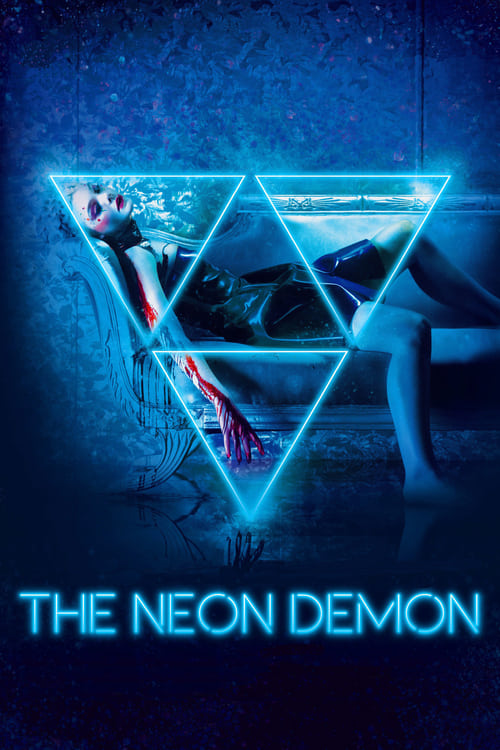
The Neon Demon
2016 · Nicolas Winding Refn
For a night when you want to be disturbed in style — challenge, not comfort. Reach for it when you're craving something gorgeous, icy, and transgressive that you'll argue about afterward.
What it's about
A sixteen-going-on-seventeen-year-old named Jesse arrives in Los Angeles with nothing but a disposable camera and a face photographers call dangerous. She rises fast through the city's modeling world, and the women around her — rivals, a makeup artist, the industry's gatekeepers — begin circling her youth with an appetite that turns from envy to something far more predatory. It's a horror film set in the fashion world, where beauty itself is the monster.
The experience
Slow, hypnotic, and increasingly menacing — long silences, strobing color, and a synth score that makes even a photo shoot feel like a ritual. It drifts like a dream for an hour, then tips into genuinely shocking territory. You leave feeling seduced and implicated at once.
Performances
Elle Fanning holds the center as Jesse, playing innocence curdling into self-awareness almost entirely through stillness and gaze, while Jena Malone brings unnerving warmth to the film's most disturbing role.
The craft
Refn shoots the film like a fashion editorial possessed — mirrored sets, saturated neon, tableaux held so long they become threatening — and Cliff Martinez's pulsing electronic score does half the storytelling. It absolutely demands a dark room, a big screen, and loud speakers; the images and sound are the point.
Why it matters
One of the most divisive Cannes premieres of its decade — booed and cheered in the same room — it cemented Refn's reputation as cinema's glossiest provocateur and became a touchstone for style-forward, fashion-world horror.
Snapshot
A seventeen-year-old girl named Jesse arrives in Los Angeles with a disposable camera and the kind of face that photographers describe as "dangerous." Within weeks she is ascending the city's modeling hierarchy; within months she is dead and partially consumed. Nicolas Winding Refn's sixth English-language feature is a horror film about beauty as predatory force—an art-house provocation that weaponizes the aesthetics of fashion photography, the occult cinema of Kenneth Anger, and the neon-soaked dream logic of Italian Giallo to interrogate what it means to be looked at, coveted, and eventually eaten. Premiered in competition at Cannes in May 2016, it divided audiences and critics with unusual ferocity: boos and applause in roughly equal measure, a reception that became part of the film's mythology.
Industry & Production
The Neon Demon was produced by Bold Films—the same shingle behind Drive (2011) and Only God Forgives (2013)—alongside Gaumont, the French company whose long pedigree in European art cinema gave the project its international distribution framework. Production was headquartered in Los Angeles, which functions in the film not merely as setting but as active antagonist: a city that grooms and consumes. The budget was modest by studio standards and the film received a limited theatrical release in the United States through Amazon Studios, marking one of the earlier high-profile acquisitions by a streaming platform of a Cannes competition title. Box-office figures were not a primary metric for the production, and the specific numbers that circulated at the time of release do not warrant repetition here without verification from reliable industry databases.
The screenplay went through multiple hands. Refn conceived the story and is credited alongside Mary Laws and Polly Stenham, both playwrights with backgrounds in literary drama rather than genre cinema—a choice consistent with Refn's practice of importing collaborators from adjacent disciplines. Laws had previously written for theater and television; Stenham was an emerging British playwright. The result is a script that functions less as conventional narrative than as a series of carefully staged provocations, with dialogue stripped to near-minimum to make room for image and sound.
Casting centered on Elle Fanning, then eighteen at the time of filming, whose particular quality of pale, open vulnerability Refn found essential: Jesse needed to be genuinely, almost embarrassingly beautiful rather than conventionally glamorous, a distinction the film insists upon. The supporting cast—Jena Malone as Ruby, Bella Heathcote and Abbey Lee Kershaw as Gigi and Sarah—drew on actresses with modeling experience or photogenic presence, grounding the fashion-world milieu in recognizable physical reality even as the film pushed toward the surreal.
Technology
The Neon Demon was shot on the ARRI Alexa, the digital camera that had by 2015–16 become the dominant tool of cinematographers working in the high-end art-film and prestige-television space. Cinematographer Natasha Braier used anamorphic lenses throughout—specifically to achieve the characteristic horizontal lens flares and the slightly compressed, painterly quality associated with anamorphic photography—and worked with the Alexa's native dynamic range to render the film's extreme color contrasts: the deep blacks of warehouse interiors against saturated magenta and electric blue.
Post-production color grading played a constitutive role in the film's visual identity. The primary colors of Refn and Braier's palette—the reds, the electric blues, the cadmium yellows—are pushed well past naturalism into a kind of Fauve expressionism, recalling the chromatic excess of Dario Argento's Suspiria (1977) while updating it for digital capture. The neon lighting is not merely decorative; it is the film's grammar, coding emotional states through color temperature rather than dialogue.
Sound design and music were mixed for theatrical presentation with attention to low-frequency response—the bass-heavy electronic score pressing on audiences at a subperceptual level, a technique borrowed from the broader post-Drive NWR aesthetic.
Technique
Cinematography
Natasha Braier, born in Argentina and trained at the National Film and Television School in London, had established herself with The Rover (David Michôd, 2014) before Refn brought her onto The Neon Demon—their first collaboration, and one that produces some of the most distinctive cinematographic work of the decade. Her approach is organized around two competing impulses: geometric rigidity and hypnotic stillness. Compositions are frequently symmetrical, the frame divided like a mandala or a ritual diagram, with Jesse positioned at the center of converging lines. The camera moves rarely but purposefully; when it does, the movement is slow enough to register as a change in pressure rather than mere staging.
Braier and Refn use darkness as positive space. Many scenes take place in near-total black, with characters lit by a single saturated source—a neon sign, a runway spotlight, a domestic lamp with a red gel—so that faces emerge from void rather than from an environment. This is formally allied to the Caravaggio tradition of tenebrism, but the cultural reference point is more immediately Anger's Inauguration of the Pleasure Dome (1954) and the American underground film's use of theatrical lighting as occult staging. The fashion-show sequence late in the film—Jesse absorbing the runway's triangular spotlight, becoming one with a geometric form she has also invoked in an earlier mirror fantasy—represents a sustained exercise in abstract visual poetry embedded within genre material.
Editing
Matthew Newman, Refn's editor since Only God Forgives, cuts The Neon Demon with aggressive asymmetry: long takes stretched until the viewer's attention begins to wander, then abrupt cuts to images that feel viscerally wrongly placed. This rhythm is not careless; it is calibrated to produce unease. The film's formal pacing refuses to give audiences the metabolic comfort of conventional continuity editing, instead building sequences out of stasis and sudden violence. The orgiastic finale involving necrophilia, cannibalism, and drowning is edited with the same cold deliberateness as the quieter scenes—the horror is not amplified by fast cutting but allowed to accumulate in slow, methodical takes.
Mise-en-scène / Staging
Refn stages most of the film's action in spaces that are simultaneously glamorous and sepulchral: a motel where the walls are the color of dried blood, photography studios that recall operating theaters, a mortuary that doubles as a site of erotic ceremony. The recurring motif of the triangle—drawn explicitly on Jesse's forehead in the opening shoot, projected as light in the runway scene, implicit in the geometric architecture of the sets—functions as a sigil that the film keeps invoking without fully decoding, consistent with Refn's interest in occult iconography as decorative system rather than legible narrative symbol.
Staging frequently places characters in front of mirrors, literal and figurative: Gigi and Sarah watch Jesse in reflective surfaces, Ruby paints Jesse's face from a photograph, the modeling world itself is framed as an industry of images replacing persons. The staging literalizes its themes with a directness that critics found either audacious or sophomoric, and the argument over which description is accurate has not been settled.
Sound
Cliff Martinez's score—synthesizer-based, textured with what sound like distant digital heartbeats and processed breath—is continuous enough across large sections of the film to function almost as sound design. Martinez and Refn had established their working method on Drive: atmospheric electronic music that displaces rather than supplements dialogue, scoring emotions that the characters cannot or will not name. For The Neon Demon, Martinez pushed further into abstraction, producing passages that owe debts to Angelo Badalamenti's work for David Lynch as well as to Giorgio Moroder's early electronic film scores. The music never attempts irony or period pastiche; it is treated as a direct channel to affect.
Sound design isolates and amplifies ambient sounds—the hum of fluorescent lights, the drip of liquid, the texture of fabric—with the care that Refn's films consistently apply to off-screen space. In the film's most disturbing sequence, sound carries more narrative information than the image, the specific sounds identifying what is happening before and after the camera chooses to show it.
Performance
Elle Fanning's performance is centrally difficult and, depending on one's reading of the film, either a flaw or a formal strategy. Jesse is written as luminous and largely inarticulate—a vessel for other people's projections as much as a consciousness—and Fanning plays her with a surface passivity that occasionally cracks into flashes of genuine menace and self-knowledge. The question of whether the character is naive or calculating is never resolved, which is clearly intentional: the film insists that beauty functions as a power regardless of the subject's interior life, and Fanning's performance gives this thesis a physical embodiment.
Jena Malone as Ruby brings specificity and grotesque warmth to a character whose desires are both the most visible and the most systematically misread by Jesse. Keanu Reeves, cast against type as the motel manager Hank, contributes a studied sleaziness that registers as a deliberate genre quotation—he is playing a type from a 1970s exploitation film, and the performance's theatricality is the point.
Narrative & Dramatic Mode
The Neon Demon operates in the register of the dream or the fable rather than the psychological-realist drama. Its plot is comprehensible but deliberately schematic—innocence arrives, corrupts the corrupt, and is consumed—and Refn is uninterested in the kind of character development that conventional dramatic narrative requires. The film's dramatic mode is closer to the ritual cinema of Anger or the surrealist fairy tales of Jean Cocteau than to the psychological horror of, say, Ari Aster. Events happen at the speed of imagery rather than the speed of causation; Jesse's transformation from ingénue to threat to victim is compressed and elliptical, and the film does not explain what is never in doubt.
Genre & Cycle
The Neon Demon belongs primarily to a strand of art-horror in which formal ambition and genre transgression are mutually reinforcing—a cycle visible in works from Argento and Mario Bava (Blood and Black Lace, 1964, which is both a fashion-world setting and a murder puzzle) through Gaspar Noé's Irréversible (2002) and Claire Denis's Trouble Every Day (2001), into the American "elevated horror" moment of the mid-2010s catalyzed by films like The Witch (Robert Eggers, 2015) and It Follows (David Robert Mitchell, 2014).
Within that cycle, The Neon Demon sits at the intersection of body-horror, cannibalism narrative, and fashion-world satire—a subgenre with limited precedent. The closest generic relatives are Jennifer's Body (Karyn Kusama, 2009), which uses similar predator/prey dynamics within a female peer group, and Robert Altman's Prêt-à-Porter (1994), though the satirical mode of the latter is entirely absent from Refn. The fashion-horror synthesis is unusual enough that the film functions partly as a genre-founding gesture rather than a contribution to an established tradition.
Authorship & Method
Nicolas Winding Refn is a Danish director who made his name with the Pusher trilogy (1996–2005) before transitioning to English-language productions with Bronson (2008) and Valhalla Rising (2009). The persona he has cultivated—dyslexic, instinctual, anti-intellectual in affect though deeply cinephilic in practice—is inseparable from his films' marketing. He has spoken in interviews about being unable to write and working from intuition rather than analysis, claims that should be treated as strategic self-presentation rather than methodology: the formal precision of his films with Braier and Martinez is not accidental.
Braier's contribution to The Neon Demon is substantial enough that the film's visual argument cannot be separated from her compositional intelligence. Similarly, Martinez's score is not illustrative but constitutive—the film would be incoherent without the emotional architecture the music provides. Mary Laws and Polly Stenham's screenwriting contribution is harder to assess from public record; Refn has tended to dominate the authorial narrative around his productions, and the specific contributions of his co-writers to the final screenplay remain underexplored in published accounts.
Movement / National Cinema
The Neon Demon is an American-set, British-American-French financed film directed by a Dane—a configuration that places it outside any coherent national cinema tradition. Refn belongs to a category of auteurs whose careers were enabled by European public funding structures (his early work was supported by Danish institutions) before migrating to international co-production. His visual sensibility is shaped by Italian Giallo and American genre cinema as much as by Danish or Scandinavian filmmaking traditions.
The film's engagement with Los Angeles connects it to a long tradition of European directors treating the city as a site of mythological significance: Michelangelo Antonioni in Zabriskie Point (1970), Wim Wenders in Paris, Texas (1984), David Lynch's sustained career-long meditation on Hollywood's shadow. Refn's Los Angeles is continuous with Lynch's—a beautiful surface concealing systematic predation—but where Lynch finds grief and nostalgia in the corruption, Refn finds something colder and more abstract.
Era / Period
The film arrives at a specific cultural moment: the mid-2010s consolidation of social-media image culture, in which beauty had become simultaneously more democratic (anyone with a phone) and more ruthlessly competitive, the Instagram aesthetic of aspirational self-presentation running beneath every fashion industry assumption. The Neon Demon does not reference social media directly—Refn strips the contemporary setting to near-mythological abstraction—but its diagnosis of beauty as a zero-sum resource consumed rather than shared is legible as a meditation on 2016's image economy. It also arrives during the period of the American art-horror renaissance: A24's distribution of The Witch (released February 2016) had demonstrated that formally ambitious, genre-adjacent horror could find an audience, and The Neon Demon's release later that year participated in that opening, however controversially.
Themes
The film's central argument is that beauty—particularly female beauty in its most socially valued, youth-coded form—functions as a material substance that can be taken, metabolized, and destroyed. Jesse possesses it innately; Gigi and Sarah have manufactured approximations through surgical intervention; Ruby is positioned as a mediating figure whose necrophilic desires literalize the vampiric logic the fashion world applies metaphorically. The cannibalism of the finale is the film's thesis made flesh: the industry does not merely evaluate or exploit young women, it eats them.
Running through this is an inquiry into the male gaze as a force that produces rather than merely reflects beauty—the film's photographers and casting directors do not discover Jesse but create her—and into what happens when women internalize that gaze and direct it toward each other. The film is ambivalent about whether this internalization is false consciousness or a form of power; it refuses to produce a feminist reading that would make audiences comfortable, ending instead on an image of vomiting and drowning that declines to assign meaning.
Narcissism as both pathology and survival strategy, Los Angeles as the American mythological space where self-invention meets self-destruction, the triangle as geometrical emblem of aspiration and exclusion: these are the film's recurring symbolic objects, deployed with the consistency of ritual rather than the development of argument.
Reception, Canon & Influence
Backward influences. Refn has cited Dario Argento's Suspiria (1977) as a formal touchstone—the primary-color expressionism, the institution populated by women, horror as aesthetic spectacle—and the debt is visible throughout. Mario Bava's Blood and Black Lace (1964) provides the fashion-world setting for murder. Kenneth Anger's Inauguration of the Pleasure Dome (1954) and Lucifer Rising (1972) supply the occult-ceremonial imagery and the treatment of glamour as dark ritual. Maya Deren's Meshes of the Afternoon (1943) haunts the film's dream-logic construction. David Lynch's Mulholland Drive (2001) is the most proximate antecedent: Los Angeles as labyrinth, the entertainment industry as devouring machine, the female protagonist's dissolution into the city's logic. Michael Powell's Peeping Tom (1960)—which poses the male camera as instrument of predation—informs the film's sustained engagement with the apparatus of looking.
Critical reception. The Cannes screening generated what reviews consistently described as one of the more dramatic mixed receptions in the festival's recent history. Defenders in the critical press—Robbie Collin at the Telegraph among them—argued for the film's formal rigor and its willingness to follow its internal logic to its most uncomfortable conclusions. Detractors, including many feminist critics, argued that whatever critique the film attempted of the male gaze was compromised by its own complicity in aestheticizing female suffering and staging misogynist violence as art-house spectacle. The debate remained unresolved, which is arguably the condition the film was designed to produce. It has not entered the canonical consensus of essential 2010s cinema but maintains a vigorous cult existence, particularly among viewers interested in transgressive art-horror and the intersection of fashion and film.
Forward influence. The Neon Demon's direct influence on subsequent cinema is difficult to trace with precision, as its visual language overlaps with broader trends in neon-noir aesthetic and its specific formal strategies have not produced obvious imitations. Its most legible legacy is as a data point in the art-horror consolidation of 2015–2016 that helped establish a market for formally ambitious horror, and as an object in ongoing critical debates about whether provocation and critique can coexist in genre filmmaking, or whether the former inevitably consumes the latter—a question the film poses about beauty and declines to answer about itself.
A Deleuzian reading
Start with the first image the film shows you.
The full Deleuzian reading of The Neon Demon →
Reception
Booed (and cheered) at its Cannes 2016 premiere and a box-office flop, it split critics right down the middle — but a decade on it's a full-blown cult object, a fixture of the Letterboxd generation's neon-aesthetic canon.
How The Neon Demon was received, from release to now →
Influences: the films it descends from and the films it influenced
- Suspiria (1977) — Establishes the saturated primary-color gel lighting and the all-female institution where horror is staged as pure aesthetic spectacle rather than narrative threat — Refn's explicit formal touchstone.
- Blood and Black Lace (1964) — Originates the fashion-house-as-murder-site giallo, equating mannequin-perfect beauty and couture display with stalking and violent death.
- Inauguration of the Pleasure Dome (1954) — Ritual-ceremonial superimposition montage treating cosmetics and glamour as occult invocation, the direct source for the film's triangle/occult-rite staging.
- Meshes of the Afternoon (1943) — Dream-logic editing and recursive mirror imagery in which a single woman doubles, multiplies, and dissolves — the anti-continuity grammar Refn borrows.
- Peeping Tom (1960) — Frames the camera apparatus itself as a predatory instrument, fusing the act of looking with the act of killing — the basis of the film's gaze-as-predation argument.
- Mulholland Drive (2001) — Renders Los Angeles as a devouring labyrinth and the entertainment industry as a machine that dissolves a young woman's identity — the most proximate antecedent for the fable's structure.
- Persona (1966) — Mirror staging and facial superimposition that merge and absorb one woman's identity into another — the compositional model for the rivalry/consumption motif.
- The Red Shoes (1948) — Technicolor melodrama in which artistic beauty literally consumes the woman who embodies it, fusing rapturous color design with the destruction of its muse.
- The Holy Mountain (1973) — Symmetrical, frontal occult tableaux that stage esoteric symbols — triangles, alchemical geometry — as the film's organizing visual logic rather than decoration.
- Valerie and Her Week of Wonders (1970) — Surreal fable of a girl whose blossoming beauty draws vampiric predators, supplying the dream-fable structure and the equation of innocence with prey.
- Only God Forgives (2013) — Larry Smith's tenebrist lighting and glacial symmetrical tableaux, with Martinez's drone score, perfect the slow-ceremony staging Neon Demon inherits.
- Eyes Wide Shut (1999) — Builds masked ritual and erotic dread out of symmetrical neon practical-light tableaux scored with ironic synth counterpoint, EWS's orgy aesthetic refracted.
- Mandy (2018) — Fauve color-grading that drowns whole frames in monochrome red and a synth score driving a near-wordless fable — extending the same color-as-emotion grammar.
- Knife+Heart (2018) — Giallo revival pairing an M83 synthesizer score with an eroticized fashion/film-industry world, reviving Bava-Argento color-horror in the same register.
- Suspiria (2018) — Elevated-horror reworking of the all-female institution as occult coven, extending the art-horror-consolidation craft of staging women's beauty and labor as ritual sacrifice.
- The Ugly Stepsister (2025) — Supplies the strain of beauty-as-predation rendered in saturated, symmetrical painterly tableaux and mirror-framed gazes that stage the female body as a consumable industrial object.
- Drive (2011) — Same Refn–Cliff Martinez collaboration: neon-soaked anamorphic compositions scored by pulsing synthesizer and ambient-amplified silences in place of dialogue.
- Beyond the Black Rainbow (2010) — Analog-synthesizer score and anamorphic retro art-horror that aestheticizes a sterile institution through color and texture over plot — a parallel formal project.
- Black Swan (2010) — Performance-world body horror built on doppelganger mirror staging and the dissolution of a passively luminous heroine into her rival/ideal.
- Climax (2018) — Synth-driven, strobe-lit descent of a beautiful performing collective into bodily horror — sibling in the mid-2010s art-horror mode of sensory assault over narrative.
- Santa Sangre (1989) — Pairs symmetry-and-procession staging with saturated primary-color lighting and a melodrama of bodily transgression, extending the same Argento-via-Jodorowsky aesthetic of beauty fused to the grotesque.
- A Girl Walks Home Alone at Night (2014) — High-contrast, synth-scored style-as-substance where image and soundtrack deliberately outrun narrative — the very quality critics flagged in Amirpour.
- Last Night in Soho (2021) — Neon-saturated color expressionism deployed as an argument about a beauty industry devouring a young woman — kin to Soho in both palette and the exploitation-of-women theme.
- MaXXXine (2024) — Shares the sodium-vapor-and-neon photographed portrait of Los Angeles beauty industries as predatory spectacle, a parallel neo-giallo formalism about women consumed by looking.
Similar films
- Only God Forgives (2013) — influence & lineage
- Drive (2011) — influence & lineage
- Climax (2018) — influence & lineage
- Black Swan (2010) — influence & lineage
- Blood and Black Lace (1964) — influence & lineage
- Suspiria (1977) — influence & lineage
- Helter Skelter (2012) — shared sensibility
- Teenage Sex and Death at Camp Miasma (2026) — shared sensibility
All the films related to The Neon Demon →