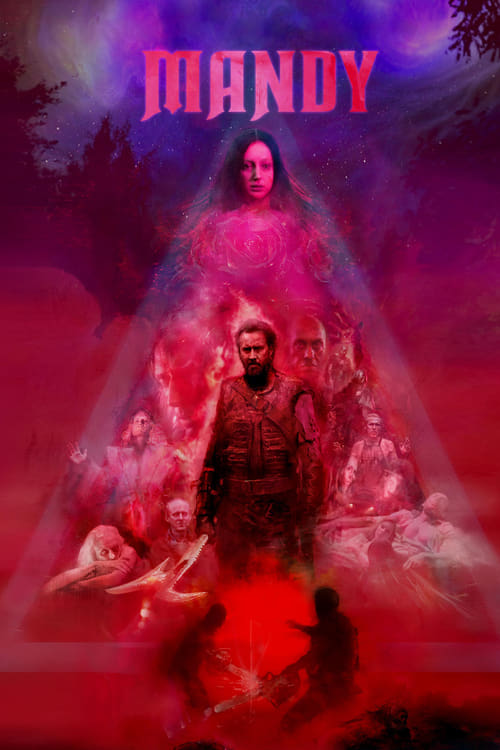
Mandy
2018 · Panos Cosmatos
For a late night when you want to be flattened — a midnight movie for when comfort viewing feels beside the point and you're craving something loud, strange, and cathartic. Absolutely not a casual watch.
What it's about
The Shadow Mountains, 1983. Red, a quiet logger, and Mandy, an artist, live a hushed, tender life in the pines — until a wandering religious cult led by a failed folk musician, and the demonic bikers they summon, tear that life apart. What follows is Red's descent into a hallucinatory campaign of revenge, forged weapon in hand, through a landscape that looks like a heavy-metal album cover come to life.
The experience
Two films in one: a slow, dread-soaked first half that moves like a fever dream, then an unhinged second half of neon-drenched carnage, chainsaw duels, and pitch-black comedy. It's overwhelming by design — druggy, deafening, and strangely mournful underneath all the blood.
Performances
Nicolas Cage delivers one of his defining late-career turns, holding volcanic grief and full-tilt mania in the same body — including a single-take breakdown scene that's already legendary. Linus Roache is skin-crawling as the vain cult leader, and Andrea Riseborough gives Mandy an otherworldly stillness that haunts the whole film.
The craft
Panos Cosmatos drenches every frame in reds and purples, with long dissolves, animated interludes, and one of Jóhann Jóhannsson's final scores — a doom-laden synth-and-guitar wall that demands good speakers. The pacing is deliberately narcotic before it explodes. This is maximalist sensory filmmaking; watch it loud and in the dark.
Why it matters
An instant cult classic that recentered Cage as a serious force, gave Jóhannsson's score a devoted afterlife, and became a touchstone for the psychedelic, style-first wing of modern genre cinema.
Horror · Art-horror · Splatter & gore · Exploitation & grindhouse. A narcotic, color-drenched slow burn that erupts into chainsaw-duel revenge carnage: mournful, deafening, a midnight trance.
Snapshot
Mandy is the second feature by Panos Cosmatos, an American-Canadian production that fuses a revenge narrative of extreme simplicity with a maximalist audiovisual style drawn from heavy-metal album art, 1980s fantasy illustration, and psychedelic horror. Set in the "Shadow Mountains" in 1983, it follows Red Miller (Nicolas Cage), a logger whose partner, the artist Mandy Bloom (Andrea Riseborough), is abducted and murdered by a wandering religious cult, the Children of the New Dawn, led by the failed folk musician Jeremiah Sand (Linus Roache). The film cleaves cleanly into two movements: a slow, dread-soaked first half of domestic idyll and its violation, and a second half of hallucinatory, near-wordless vengeance in which Red forges a weapon and hunts both the cult and a gang of demonic bikers summoned to protect them. Premiering in the Midnight section at the 2018 Sundance Film Festival and released later that year, it became one of the defining cult films of its decade and a touchstone for the era's revival of stylized, analog-nostalgic genre cinema. It also carries elegiac weight as one of the final completed scores by the Icelandic composer Jóhann Jóhannsson, who died in February 2018.
Industry & production
Mandy is a product of the specialty-genre financing ecosystem that matured in the 2010s. It was produced in association with SpectreVision, the genre-focused company co-founded by actor Elijah Wood, alongside XYZ Films and the Belgian outfit Umedia; principal photography took place in Belgium, with the "Shadow Mountains" assembled from Belgian locations and controlled interiors. This arrangement is characteristic of the period's boutique horror model: modest budgets, international co-production for tax and infrastructure advantages, and a reliance on festival premiere plus genre-savvy distribution rather than a wide studio release. RLJE Films handled the U.S. release, pairing a limited theatrical run with a simultaneous or near-simultaneous video-on-demand window — a distribution pattern that suited the film's cult appeal and let it find an audience beyond major markets.
The casting of Nicolas Cage was central to the project's identity. By 2018 Cage had spent years in a prolific run of low-budget genre work, and Mandy arrived as the film that reframed that phase as an asset rather than a liability, giving his expressionistic register a formal container worthy of it. The production leaned on a small ensemble — Riseborough, Roache, and a cluster of character actors including Bill Duke in a brief but memorable role as the man who arms Red — keeping the scale intimate even as the imagery grew operatic. I do not have reliable budget or box-office figures to cite, and will not invent them; the film is best understood as a modestly budgeted independent that overperformed relative to expectations on the strength of reviews and word of mouth.
Technology
Mandy was shot digitally and is, in a real sense, a film built in the grade. Its signature look — deep blacks bleeding into saturated reds and magentas, skies the color of a bruise — depends on aggressive color manipulation that combines lighting on set with extensive post-production timing. The film makes heavy use of optical-style effects: long dissolves in which one face melts into another, superimpositions that layer figures over landscape, lens flares and diffusion, and passages where the image seems to smear or double as if the emulsion itself were hallucinating. Where an earlier generation would have achieved such effects photochemically or in-camera, Mandy reconstructs that analog vocabulary through digital compositing, so the picture reads as a memory of 1980s film texture rather than a literal reproduction of it. A brief hand-drawn animated interlude further breaks the film's material register, nodding to the fantasy and metal illustration that saturate its design. I don't have a verified record of the exact camera package and will not specify one; what is certain is that the film's aesthetic identity lives at the intersection of on-set lighting design and a highly authored digital pipeline.
Technique
Cinematography
The cinematography, by Benjamin Loeb, is the film's most immediately recognizable feature. Loeb builds images around a small number of dominant hues — a red-and-blue duotone recurs so often it functions as the film's emotional weather — and favors slow, deliberate camera movement, symmetrical or centered framing, and compositions that hold long enough to become oppressive. Light sources are frequently colored and directional, carving faces out of darkness; the frame often isolates a single figure against void-black negative space. This is a cinematography of atmosphere over legibility: spatial geography is deliberately vague, and the mountains, the cabin, and the cult's compound feel less like real places than like states of mind rendered in gel-lit color.
Editing
Brett W. Bachman's editing enforces the film's bifurcated structure and its patience. The first half moves at a near-somnambulant pace, holding on stillness, faces, and reading light so that the eventual violence lands as a rupture. The cutting is willing to let dissolves run long, blurring the boundary between scenes and between characters — a formal choice that ties directly to the film's interest in identity, drugs, and dissolution. In the second half the tempo tightens toward set-piece confrontation, but even the action retains a ritualistic, tableau-like rhythm rather than conventional continuity acceleration. The editing's willingness to withhold and to linger is what makes the film's excesses feel composed rather than merely loud.
Mise-en-scène / staging
Every element of the film's design pulls from a coherent set of sources: fantasy paperback covers, doom and black-metal album art, occult iconography, and the airbrushed dream-space of early-1980s genre illustration. Mandy is introduced as a reader and illustrator of exactly this material, which makes the film's visual world an externalization of her imagination — a clever bit of self-justification for its style. Props carry enormous weight: a forged battle-axe, a crossbow, a horn that summons the biker demons, the psychotropic drugs the cult and the bikers consume. The staging is often frontal and symmetrical, arranging characters like figures on an album gatefold, and the production design keeps the palette and the period signifiers absolutely consistent, so the film never breaks the spell of its invented 1983.
Sound
Sound is inseparable from the film's power. Jóhann Jóhannsson's score abandons his earlier neoclassical restraint for a dense, distorted, drone-heavy soundworld — sludgy guitars, low synth tones, and orchestral swells that curdle into noise — that sits somewhere between film scoring and doom metal. The music does not underline the action so much as generate the film's altered-consciousness state, and its heaviness gives the slow first half its sense of gathering doom. The sound design pairs this with tactile, exaggerated effects — the roar of the forge, the whine of chainsaws, the crunch of violence — and long stretches nearly free of dialogue. The result is a film that often communicates through texture and volume rather than speech.
Performance
The acting operates in two keys. Riseborough plays Mandy with a watchful, interior stillness, and Roache gives Jeremiah Sand a wounded narcissism — a mediocre man convinced of his own divinity, curdling into rage when Mandy laughs at him — that grounds the film's metaphysics in petty male grievance. But the performance the film is built to unleash is Cage's. He begins muted and shifts, after Mandy's death, into a register of raw, howling grief — a much-discussed scene of him drinking and screaming in a bathroom marks the pivot — before settling into a grimly funny, almost catatonic determination. Cage's willingness to go fully operatic, matched to a director who frames rather than restrains him, is the film's central act of collaboration.
Narrative & dramatic mode
The story is archetypal to the point of myth: love, its destruction, and revenge. Mandy strips the revenge plot to its bones and then inflates its execution to cosmic scale, so that a simple line of action becomes a descent through escalating rings of a hell. The dramatic mode is closer to fairy tale, heavy-metal epic, or ritual than to psychological realism — characters are figures, the villain is a demon of ego, and Red's quest has the shape of a legend rather than a crime story. The near-total absence of dialogue in the second half pushes the film toward the operatic and the primal, asking to be experienced as an emotional and sensory ordeal rather than followed as a plot.
Genre & cycle
Mandy sits at the confluence of several genres — revenge thriller, supernatural horror, dark fantasy, and the "acid Western" tradition of hallucinatory, mythic violence. Within its moment it belongs to the 2010s wave of stylized, atmosphere-first independent horror associated with distributors and producers like A24, SpectreVision, and their peers, films that treated genre as a vehicle for authorial vision and formal experiment. It also participates in a broader nostalgia cycle that mined 1980s texture — synth scores, VHS grain, period settings — though Mandy uses that nostalgia less as fan service than as a fully absorbed aesthetic language. Its embrace of extreme, cathartic violence and metal iconography aligns it with a lineage of exploitation and midnight-movie cinema even as its patience and painterliness pull it toward art film.
Authorship & method
Mandy is an intensely authored film, and Cosmatos's method is one of total aesthetic control in service of a dreamlike interior world. His first feature, Beyond the Black Rainbow (2010), established the signatures — analog-1980s atmosphere, glacial pacing, saturated color, a fascination with altered states — that Mandy amplifies and warms with genuine emotion. The screenplay is credited to Cosmatos and Aaron Stewart-Ahn, who shaped the mythic, sparse narrative and the cult's theology of male entitlement. There is a biographical resonance worth noting without overstating: Cosmatos is the son of director George P. Cosmatos, whose credits include muscular 1980s genre pictures, and Mandy's reclamation of that decade's pulp energy reads in part as a dialogue with that inheritance.
The key collaborators are essential to any account of the film. Benjamin Loeb's cinematography supplies the color-drenched image; Brett W. Bachman's editing supplies the rhythm of dread; and Jóhann Jóhannsson's score supplies the film's altered consciousness. Jóhannsson's contribution is especially poignant: Mandy stands as one of his last completed works before his death in February 2018, and its heavy, mournful sound is a striking departure from the spare compositions that made his name. The film is thus a genuine meeting of strong artists, with Cosmatos as the orchestrating sensibility.
Movement / national cinema
Mandy resists tidy national classification. Cosmatos is American-Canadian, the financing and production drew on U.S. genre companies and Belgian infrastructure, and the film was largely shot in Belgium — a transnational arrangement typical of contemporary independent genre cinema. Rather than a national school, it belongs to a stylistic movement: the psychedelic, analog-obsessed strain of 21st-century genre filmmaking that treats color, sound, and texture as primary and narrative as scaffolding. Its closest kin are less geographic than temperamental — filmmakers and producers committed to genre as a space for uncompromised visual authorship.
Era / period
The film is doubly period-marked. It is set in 1983 and steeped in the iconography of that year — the paperback fantasy, the metal, the cults, the synthesizers — and it is also a distinctly late-2010s object in its relationship to that past, filtering the decade through nostalgia and reconstruction rather than documentary fidelity. Its 1983 is a mythologized one, a dreamscape assembled from cultural memory. As an artifact of its own moment, Mandy captures the convergence of the boutique-horror boom, the VOD-plus-limited-theatrical distribution model, and the reappraisal of Nicolas Cage — three currents of late-2010s film culture meeting in a single work.
Themes
At its core the film is about grief and the way loss can hollow a person into a pure instrument of vengeance; Red's transformation is less a triumph than a self-immolation. It is also pointedly about male ego and the violence it licenses — Jeremiah Sand is a portrait of thwarted narcissism, a would-be prophet who cannot bear a woman's laughter and destroys what he cannot possess, and the film frames the cult and the biker demons as extensions of that entitlement. Running beneath these is a fascination with altered consciousness and the porousness of identity: drugs, dissolves, and doubling recur constantly, so that reality itself feels unstable. Love, art, and imagination — embodied in Mandy — stand as the fragile counterweight the film mourns.
Reception, canon & influence
Critical reception was strong and, in the case of Cage's performance and Jóhannsson's score, frequently rapturous; reviewers singled out the film's formal audacity and its fusion of art-house patience with exploitation excess, and it was widely embraced as an instant cult object rather than a mainstream success. It quickly became a repertory and midnight-screening staple and a reference point in discussions of both the Nicolas Cage renaissance and the decade's stylized-horror wave.
Looking backward, the film's influences are worn openly: the fantasy illustration of artists like Frank Frazetta, the visual and sonic language of doom, black, and heavy metal, the acid-Western tradition of mythic hallucinatory violence, 1980s VHS horror and exploitation cinema, and Cosmatos's own Beyond the Black Rainbow. Looking forward, Mandy helped consolidate a template for maximalist, color-and-sound-driven genre filmmaking and further legitimized Cage's expressionistic late style as a subject of serious critical interest — it is now routinely cited when critics discuss both. Precise long-term influence is difficult to quantify and I will not overstate specific lineages, but the film's status as a canonical cult work of its decade, and as a poignant late testament to Jóhann Jóhannsson, is secure.
A Deleuzian reading
A woman reads in bed.
The full Deleuzian reading of Mandy →
Reception
It arrived at Sundance's midnight section in 2018 already a cult object — the rare film that skipped the 'rediscovery' phase and went straight to canonization. It's since been enshrined as the moment the 'Cage-aissance' became official, the pivot point critics cite before Color Out of Space and Pig.
How Mandy was received, from release to now →
How to watch Mandy: what to notice on a first viewing
- Watch the red and blue take over whole scenes. Benjamin Loeb floods the frame from colored directional sources that no lamp in the room could explain. The duotone comes back so often it stops describing objects and starts setting the weather. Color is carrying the mood the way another film would carry it with dialogue. The man is even named Red.
- Notice how long a centered shot holds before it cuts. Cosmatos frames frontally and symmetrically, puts one figure dead center against black, and stays there well past the point of usefulness. Bodies are arranged like panels on an album gatefold. You stop gathering information and start looking. Each shot is built as a plate rather than a link in a chain.
- Look at the cover art on the book Mandy reads. She reads airbrushed fantasy paperbacks and draws in the same idiom. Doom and black metal sleeves, Frazetta barbarians, occult symbols. The design of the whole film comes out of that shelf. The film tells you where its look comes from by putting it in a character's hands in the first reel.
- Listen for the score becoming a low, distorted drone. Johann Johannsson drops the spare neoclassical writing he was known for and delivers sludge guitar, heavy synth and orchestral swells that curdle into noise. It was among the last work he completed. The music does not follow the events. It generates the altered state you watch them in.
- Watch Riseborough's face hold still while she listens. Riseborough plays Mandy watchful and interior, giving almost nothing away while men talk at her. Roache plays Jeremiah Sand as a mediocre man who needs to be adored immediately. The film sets a face that holds against a face that demands. That contrast decides everything that follows.
The whole guide to watching Mandy, with the keys for a rewatch →
Influences: the films it descends from and the films it influenced
- Beyond the Black Rainbow (2010) — Cosmatos's own debut established the template Mandy amplifies: analog-1980s texture, glacial dissolve-driven pacing, and a monochromatic gel-saturated color field bathing single rooms in one dominant hue.
- El Topo (1970) — Founds the acid-Western grammar Mandy inherits — a mythic, near-wordless revenge quest structured as episodic ritual stations rather than plot, with violence staged as hallucinatory allegory.
- The Holy Mountain (1973) — Its centered, frontal, symmetrical tableaux composed like painted panels are the direct precedent for Mandy's album-gatefold framing and its treatment of the shot as a static illustrated icon.
- Suspiria (1977) — Argento's Technicolor-imitation gel lighting — flooding faces and walls with saturated primary red and blue from unmotivated colored sources — is the horror-lineage root of Mandy's duotone red/blue palette.
- Heavy Metal (1981) — Transposes fantasy-illustration and metal-album cover art (the Frazetta/Corben school) into moving image, the same pulp-fantasy visual reference bank Mandy raids for its Cheddar Goblin/barbarian iconography.
- Conan the Barbarian (1982) — Its Frazetta-derived musculature and a revenge myth scored as solemn liturgy model Mandy's grief-fueled barbarian arc and the elevation of pulp vengeance to operatic ritual.
- Legend (1985) — An almost plotless fantasy built as a series of heavily gel-lit, smoke-filled dreamscape tableaux, prefiguring Mandy's preference for atmosphere-as-narrative and colored-light interiors over exposition.
- The Beyond (1981) — Fulci's dream-logic Italian horror — near-incoherent plotting subordinated to gel-drenched surreal set-pieces and lingering gore — is the exploitation-side ancestor of Mandy's art-house-meets-splatter patience.
- Enter the Void (2009) — Its extended psychedelic light-passages and long dissolving transitions that render altered consciousness as pure color-and-motion abstraction feed Mandy's drug-trip sequences and dissolve-based editing.
- Rambo: First Blood Part II (1985) — Panos's father's muscular 1980s revenge picture is the literal inheritance Mandy reclaims — its lone-avenger pulp energy and 80s-genre iconography reworked as a dialogue with that paternal filmography.
- Only God Forgives (2013) — Shares the near-wordless, slow-burn revenge structure lit in unmotivated red-and-blue neon gels, with violence staged as symmetrical, trance-like operatic ritual — the closest contemporary formal cousin.
- The Neon Demon (2016) — Extends maximalist gel-color image-making into rigidly symmetrical, mirror-heavy compositions synced to a heavy synth score, treating frames as designed art objects like Mandy's gatefold staging.
- Color Out of Space (2019) — The most direct heir: casts late-style operatic Nicolas Cage inside a cosmic-horror farm suffused with magenta/violet unmotivated gel light, explicitly picking up Mandy's Cage-plus-alien-color formula.
- Possessor (2020) — Renders altered consciousness through analog-feeling saturated color fields and abstract dissolve-melts, continuing Mandy's use of gel-lit imagery and slow-morphing edits to visualize a dissolving mind.
- Prisoners of the Ghostland (2021) — Builds a mythic, hyper-stylized revenge world around Cage's expressionistic late-period performance, extending the post-Mandy license for operatic Cage and neon-saturated genre maximalism.
- Climax (2018) — A parallel 2018 experiment in bifurcated structure — a calm first half collapsing into a red-lit hell — where colored light and relentless score, not dialogue, carry the descent into altered-state violence.
- Knife+Heart (2018) — Revives giallo gel-lighting and a synth-drenched (M83) score in a stylized revenge-horror, sharing Mandy's project of channeling 70s/80s Euro-horror color through a nostalgic analog sensibility.
- Mandy's
- Dream Scenario (2023) — Shares cinematographer Benjamin Loeb, whose control pivots between naturalist flatness and saturated dream-uncanny imagery.
- TRON: Legacy (2010) — Full inheritor of the outrun mood Legacy mainstreamed: saturated neon-and-black frames and a synth score (Jóhannsson) deployed as immersive audiovisual atmosphere over plot.
- The Lords of Salem (2013) — It brings together a metal-musician sensibility, saturated single-colour washes and an occult-cult plot told in dreamlike tableaux, the same crossover of music and art-horror that Lords began.
Similar films
- Climax (2018) — influence & lineage · often watched together
- Possessor (2020) — influence & lineage
- The Texas Chain Saw Massacre (1974) — same viewing thread
- The Thing (1982) — same viewing thread
- House of 1000 Corpses (2003) — same viewing thread
- Suspiria (1977) — influence & lineage · often watched together
- Videodrome (1983) — often watched together
- Annihilation (2018) — often watched together
All the films related to Mandy →
Watch it with: curated runs of related films
- Into the Heart of Darkness — A run of grueling journeys into hostile country — jungle, ice, desert, occupied forest — where the ordeal strips men down to something primal, hallucinatory, and often unrecoverable.
- The Grindhouse and Its Heirs — A run from the 70s–80s drive-in and 42nd Street originals (Texas Chain Saw, Maniac, Basket Case, Chopping Mall, Near Dark) to the filmmakers who grew up on them and rebuilt their grime, roadside dread and gleeful excess (Rodriguez, Zombie, Ti West, Cosmatos, Mollner, Leone). Watched near each other, the lineage plays…