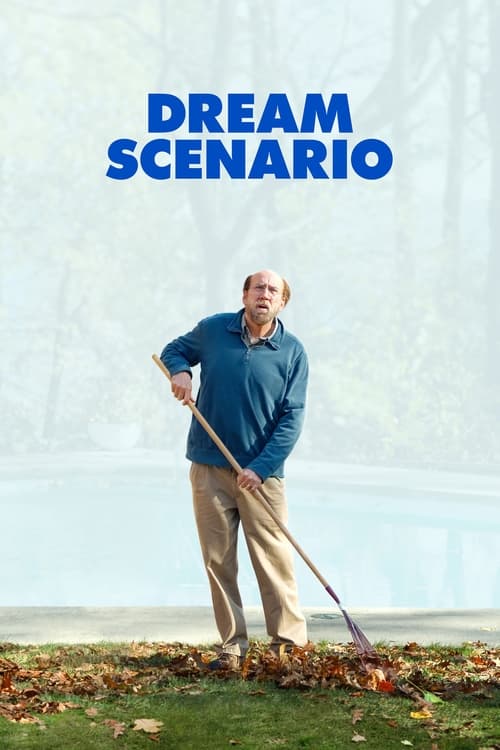
Dream Scenario
2023 · Kristoffer Borgli
When you want a smart, strange comedy with teeth — something to chew on for days about fame, mobs, and being seen. Ideal for viewers who like their laughs with an undertow of unease.
What it's about
Paul Matthews is a balding, tenured biology professor whose defining trait is that nobody remembers him — until millions of strangers start seeing him in their dreams, where he mostly just stands around watching. Overnight he's a phenomenon: interviewed, courted by brand agencies, finally seen. Then the dreams turn dark, and the same crowd that adored him wants him gone.
The experience
Squirmy, funny, and increasingly sad — it plays like a comedy of embarrassment that keeps deepening into something more melancholy about wanting to matter. You laugh, cringe, and end up aching for the guy a little.
Performances
Nicolas Cage gives one of his best late-career performances by doing the opposite of a Nic Cage performance — playing Paul as deflated, petty, and achingly ordinary, a man whose vanity and vulnerability are the same thing.
The craft
Borgli slides between waking life and dream with no warning, so every scene carries a flicker of 'is this real?' — the dream sequences are staged with eerie, mundane precision rather than special-effects spectacle. The writing walks a tightrope between satire and sympathy and rarely wobbles.
Why it matters
The Norwegian director's English-language debut landed him on the map as a sharp satirist of the attention economy, and it gave Cage's critical renaissance one of its defining roles.
Snapshot
Dream Scenario is a high-concept social satire built on a single absurdist premise: Paul Matthews, a balding, tenured evolutionary-biology professor of conspicuous mediocrity, begins appearing — unbidden and largely passive — in the dreams of millions of strangers. The film tracks his accidental ascent to a strange species of viral celebrity and his equally swift descent into pariah status once the collective dreams curdle into nightmares. Written and directed by the Norwegian filmmaker Kristoffer Borgli in his first English-language feature, and anchored by Nicolas Cage in a deliberately deflated, anti-charismatic register, the film operates as a fable about the contemporary attention economy: the longing to be seen, the ungovernable mechanics of virality, and the speed with which public sentiment can invert. Produced under Ari Aster's Square Peg banner and released by A24, it premiered at the Toronto International Film Festival in September 2023 before a North American theatrical release that autumn. It sits at the intersection of Charlie Kaufman–style metaphysical comedy and a sharply of-the-moment satire of internet fame and cancellation.
Industry & production
Dream Scenario belongs squarely to the A24 model of mid-budget, auteur-forward genre-adjacent cinema. The film was produced by Ari Aster and Lars Knudsen through Square Peg, the company Aster co-founded, with A24 distributing — a pairing that gave a relatively untested (in the Anglophone market) director the backing of one of the most recognizable boutique brands in contemporary American film. Aster's involvement is significant in lineage terms: he had championed Borgli on the strength of the Norwegian-language Sick of Myself (2022), and Dream Scenario extends Aster's pattern of producing distinctive directorial voices adjacent to his own sensibility.
The casting of Nicolas Cage is the production's central wager. Cage's late-career persona — forged through both genuine art-house work and a meme-ified reputation for excess — is here turned inside out: he plays a man whose defining trait is the absence of remarkability, which the film weaponizes as both joke and pathos. The supporting ensemble is built for deadpan precision rather than star wattage: Julianne Nicholson as Paul's wife Janet, Michael Cera as a glib brand strategist, with Tim Meadows and Dylan Baker among the academic and corporate figures. Exact budget and box-office figures are not something I can responsibly cite here; the broad record indicates a modestly scaled production whose theatrical performance was unexceptional relative to its critical profile, but I won't put numbers to that.
Technology
The film is technologically unflashy by design, and its most interesting "technology" is thematic rather than apparatus-based: it dramatizes the infrastructure of virality and, in its second half, a satirical near-future of "dream advertising," in which a marketing consultancy proposes inserting branded content (and Paul himself) into people's sleep. This is a fictional conceit, not a depiction of real technology, but it functions as the film's sharpest extrapolation of attention-economy logic — the colonization of the last unmonetized space, the unconscious.
On the production side, the film was shot digitally (consistent with contemporary mid-budget practice), which suits its naturalistic, slightly clinical daytime palette. The dream sequences require the film's most pointed technical decisions, distinguishing oneiric space from waking reality without resorting to heavy digital spectacle; the approach favors uncanny staging and lighting over conspicuous visual effects. Where the precise pipeline of effects work is concerned, the public record is thin, and I won't invent specifics.
Technique
Cinematography
Cinematography is by Benjamin Loeb, whose résumé carries a meaningful Cage connection: Loeb shot Panos Cosmatos's Mandy (2018), an extravagantly stylized horror-fantasy that represents almost the polar opposite of Paul Matthews's drab world. The contrast is instructive. Where Mandy was saturated, hallucinatory, and maximalist, Loeb's work in Dream Scenario is comparatively restrained and observational in the waking scenes — flat suburban and campus interiors, an unglamorous domestic realism that makes Paul's ordinariness legible as image. The dream sequences are then set apart through subtle shifts in composition and lighting: a slightly heightened, off-kilter quality that signals the unreal without tipping into overt fantasy iconography. The visual grammar enforces the film's central irony — that the most extraordinary thing about Paul happens only when others are asleep.
Editing
The editing governs the film's tonal modulation, which is among its trickiest achievements: it must oscillate between comic deadpan, genuine unease, and finally something close to melancholy. The cutting structure leans on the accumulation and variation of dream vignettes — each a small set piece in which Paul appears, often doing nothing — so that rhythm and repetition become the joke and, later, the dread. The turn from benign ubiquity to nightmarish menace is handled as a structural pivot rather than a single scene, and the film's pacing tracks the curve of a viral phenomenon: slow ignition, rapid escalation, abrupt collapse. The specific editor credit and the granular cutting choices are matters I'd rather not over-attribute without certainty; the film's overall construction, however, clearly privileges escalating premise-logic over conventional plot mechanics.
Mise-en-scène / staging
Borgli's staging is the film's signature. The waking world is rendered with a precise, slightly airless naturalism — the beige textures of academic and suburban life, the awkward geometry of dinner parties, faculty corridors, and corporate offices. Within this, the dream sequences are staged for uncanniness through understatement: Paul typically stands at the edge of frame, passive, watching events unfold, which is precisely what makes him unsettling. The comedy of impotence — a man who cannot even be a proper figure in someone else's subconscious — is built into the blocking. As the dreams sour, the same compositional logic is inverted: Paul's passivity becomes threat, the watcher becomes the menace, and the staging exploits horror-film vocabulary while keeping the camera's clinical distance.
Sound
The score is by Owen Pallett, the Canadian composer and violinist whose credits include orchestral collaboration on the music for Spike Jonze's Her (2013) and extensive work in art-pop. Pallett's contribution helps calibrate the film's slippery tone, lending the dream material an unstable, dreamlike coloration while avoiding the cues that would over-determine the comedy or the horror. Sound design more broadly carries weight in differentiating dream-space from waking-space and in engineering the film's moments of unease; the precise design credits and choices are not something I can detail reliably here, so I'll note only that the audio strategy reinforces the visual one — restraint in the real world, controlled wrongness in the dreams.
Performance
Cage's performance is the film's keystone and its critical talking point. He plays Paul against type and against his own legend: hunched, defeated, querulous, grasping — a man whose pettiness and vanity are rendered with unflattering honesty, and whose late-arriving self-pity the film refuses to fully redeem. The achievement is one of subtraction; Cage suppresses the volcanic register associated with his name to inhabit a small, aggrieved ordinariness, which makes the rare flickers of need and humiliation land harder. Around him, the ensemble plays in a register of social comedy — Cera's brand consultant as a study in frictionless opportunism, Nicholson grounding the domestic stakes — that keeps the satire human-scaled rather than purely conceptual.
Narrative & dramatic mode
The film's dramatic mode is the satirical fable: a single irrational premise, introduced without explanation and never mechanistically justified, used as a lens on social behavior. Crucially, the film withholds any "rules" for the phenomenon — there is no science, no origin, no cure presented as plausible — which marks it as parable rather than science fiction. The narrative arc follows a rise-and-fall structure mapped onto the lifecycle of a viral moment: Paul's bewildered delight at being recognized, his clumsy attempts to monetize and direct his fame, the inversion into collective revulsion when his dream-appearances become violent, and the social ostracism that follows. The dramatic engine is character irony — Paul wants, above all, recognition for his (largely imaginary) intellectual contributions, and the universe grants him recognition for nothing at all, then punishes him for it. The ending pushes into a more openly surreal, melancholic key that reframes the whole as a meditation on connection and isolation.
Genre & cycle
Generically, Dream Scenario is a hybrid: a comedy and contemporary social satire with a fantasy premise and a pronounced drift toward horror in its back half. It participates in a recognizable recent cycle of A24-adjacent films that use genre frameworks to anatomize modern anxieties — fame, image, the self under digital observation — and it belongs to a longer tradition of "high-concept metaphysical comedy" in which an impossible conceit externalizes an interior condition. The film also explicitly invokes the dream-stalker archetype of the slasher tradition; Paul's transformation into a figure who menaces people in their sleep deliberately summons Freddy Krueger and A Nightmare on Elm Street (1984), with the film itself gesturing at that comparison. This places it within both the satire cycle and a knowing dialogue with horror iconography.
Authorship & method
The dossier's center of gravity is Kristoffer Borgli as writer-director. Borgli emerged from Norwegian filmmaking with a sensibility tuned to vanity, self-image, and the pathologies of attention; his preceding feature, Sick of Myself (2022), concerns a woman who deliberately disfigures herself to harvest sympathy and notoriety — a near-mirror of Dream Scenario's diagnosis of the craving to be seen. The continuity is thematic and tonal: a deadpan, faintly cruel comic register; protagonists whose neediness the film observes without flattering; satire aimed at the social mechanisms that reward and then destroy the attention-seeker. Dream Scenario represents Borgli's transition to English-language, American-set, star-driven filmmaking while retaining that authorial signature.
The key collaborators reinforce the method. Cinematographer Benjamin Loeb supplies a visual control that can pivot from suburban flatness to dream-uncanny. Composer Owen Pallett provides a destabilizing musical voice. Producer Ari Aster functions as both enabler and aesthetic kin, his Square Peg banner being the vehicle through which Borgli's voice reached an American audience. And Nicolas Cage, as discussed, is less a hired star than a thematic instrument — his casting is an argument about fame, persona, and the public's appetite to elevate and discard.
Movement / national cinema
The film is a transnational object: a Norwegian auteur's American debut, financed and distributed through the American independent-prestige ecosystem. Borgli's roots connect Dream Scenario to a Nordic strain of mordant, deadpan satire — a comic tradition more comfortable than mainstream American comedy with discomfort, social cruelty, and unredeemed protagonists. At the same time, the film is fully legible within contemporary American independent cinema as practiced by A24, which has cultivated precisely this kind of cross-pollination, importing distinctive international voices into English-language production. The result is a hybrid national identity: Scandinavian in sensibility, American in subject and setting.
Era / period
Dream Scenario is emphatically a product and portrait of the early 2020s. Its concerns — instantaneous virality, the collapse of the boundary between private life and public image, "cancellation" as a social mechanism, the monetization of attention down to its most intimate registers — are specific to the social-media-saturated moment of its making. The dream-advertising subplot reads as a satirical extrapolation of the period's anxieties about surveillance and the commercialization of every remaining unmonetized space. As a period document, the film captures the precise emotional texture of the attention economy at the moment when "going viral" had become both aspiration and existential hazard.
Themes
The film's thematic spine is the human hunger for recognition and the catastrophe of receiving it on the wrong terms. Paul wants to be seen as significant; instead he is seen literally, ubiquitously, and meaninglessly — fame without achievement, presence without agency. From this flow the film's other concerns: the arbitrariness and velocity of public sentiment, which can convert adoration into revulsion overnight; the cruelty of cancel culture and mob dynamics, dramatized as a force that punishes a man for events outside his control; mediocrity and male vanity, embodied in Paul's petty resentments and unearned sense of intellectual injury; and the colonization of inner life by commerce and image. Underneath the satire runs a more tender theme — isolation and the desire for genuine connection — which the film's surreal coda foregrounds, suggesting that the fantasy of being universally seen is, finally, a displaced wish to be truly known by even one person.
Reception, canon & influence
Critically, Dream Scenario was received as one of the more inventive American releases of its year, with particular and near-unanimous praise directed at Cage's against-type performance and at Borgli's confidence in sustaining a difficult tonal balance; reservations, where they appeared, tended to concern the back half's pivot and whether the conceit fully resolves. (I'm characterizing the broad shape of the response rather than quoting specific reviews or aggregator scores, which I can't verify precisely here.)
In terms of influences on the film (backward), the most direct lineage is Charlie Kaufman — Being John Malkovich (1999) and Eternal Sunshine of the Spotless Mind (2004) — for its template of metaphysical premise as emotional allegory. The dream-menace turn explicitly draws on A Nightmare on Elm Street (1984) and the Freddy Krueger archetype. Borgli's own Sick of Myself (2022) is the proximate authorial precursor. One can also situate it within a broader tradition of deadpan European social satire and of American satires of fame and media.
For influence forward (legacy), the film is recent enough that its long-term standing is unsettled, and I won't overstate it. Its most secure legacy claims are as a landmark in the reappraisal of Cage's late career — a definitive example of his persona being used self-reflexively — and as the film that established Kristoffer Borgli as a notable English-language voice, raising expectations for his subsequent work. It also stands as one of the defining cinematic satires of the virality-and-cancellation moment, a reference point likely to be cited as that cultural condition is historicized. Claims beyond these would be premature.
A Deleuzian reading
Picture the shape the dreams keep taking.
The full Deleuzian reading of Dream Scenario →
Reception
Premiered at TIFF 2023 to strong reviews and instant 'best Cage in years' chatter, earning him a Golden Globe nomination; it's since settled in as a keystone of the Cage-aissance alongside Pig, the one people point to when arguing he's still a great actor.
How Dream Scenario was received, from release to now →
Influences: the films it descends from and the films it influenced
- Being John Malkovich (1999) — The Kaufman template of presenting an impossible mechanism with flat bureaucratic literalism so the metaphysical conceit functions as emotional allegory rather than spectacle.
- Eternal Sunshine of the Spotless Mind (2004) — Anchors a high-concept premise to a passive, sad-sack ordinary man, using the conceit as a vehicle for unflattering self-examination rather than wonder.
- A Nightmare on Elm Street (1984) — Supplies the engine of the horror pivot — a malevolent presence invading the shared space of dreams, converting sleep itself into the site of inescapable dread.
- The Truman Show (1998) — The involuntary everyman elevated into mass spectacle, framed in bright clinical suburban flatness that curdles into unease — a direct model for the protagonist's relation to fame.
- Sick of Myself (2022) — The proximate authorial precursor: deadpan, faintly cruel observation of a protagonist's craving to be seen, satirizing the social machinery that rewards then destroys the attention-seeker.
- Adaptation (2002) — Establishes the self-reflexive deployment of Cage's persona as the film's actual subject, embedding commentary on identity directly into the casting choice.
- Being There (1979) — A blank, passive protagonist accidentally vaulted to fame, played in a deadpan register where everyone around him projects meaning onto his vacancy.
- Force Majeure (2014) — The clinical-naturalist framing of male social humiliation, holding wide static compositions on a man's collapse of status until it becomes excruciating comedy.
- Groundhog Day (1993) — Metaphysical-comedy architecture in which an unexplained supernatural rule reshapes an ordinary man's social standing through an escalating-vignette rhythm.
- Synecdoche, New York (2008) — The metaphysical-fable-as-life-allegory, an outsized conceit used to anatomize ego, neediness, and mortality from inside an unremarkable man.
- I'm Thinking of Ending Things (2020) — Extends the Kaufman dream-logic lineage forward, using shifting unreality to externalize a character's interior dread within an everyday frame.
- The Drama (2026) — Pairs a high-concept premise with a movie star under A24, using Loeb's clinical lensing to literalize a fear-of-being-perceived conceit until satire tips into sadness.
- Beau Is Afraid (2023) — Shares producer Aster's Square Peg house style — escalating-anxiety vignette structure and deadpan dread surrounding a passive, humiliated everyman.
- The Lobster (2015) — Deadpan ensemble performance and affectless, symmetrical clinical staging that render absurd social rules as bone-dry satire.
- Pig (2021) — The parallel late-career reappraisal of Cage through radical restraint, casting his volatile persona deliberately against expectation.
- Mandy (2018) — Shares cinematographer Benjamin Loeb, whose control pivots between naturalist flatness and saturated dream-uncanny imagery.
- Sorry to Bother You (2018) — Satire of the attention-and-virality economy that escalates from naturalist comedy into surreal body-horror, paralleling the viral-curve pacing and tonal rupture.
Similar films
- The Truman Show (1998) — influence & lineage · same viewing thread
- Being John Malkovich (1999) — influence & lineage · often watched together
- Mandy (2018) — influence & lineage
- Groundhog Day (1993) — influence & lineage
- Eternal Sunshine of the Spotless Mind (2004) — influence & lineage · same viewing thread
- Waking Life (2001) — same viewing thread
- Synecdoche, New York (2008) — influence & lineage · often watched together
- Resurrection (2025) — often watched together
All the films related to Dream Scenario →
Watch it with: curated runs of related films
- Waking Up Inside the Illusion — Watch these in a run when you want the same jolt over and over — an ordinary man realizing the calm reality around him was built, dreamed, or erased, and clawing his way toward waking up.