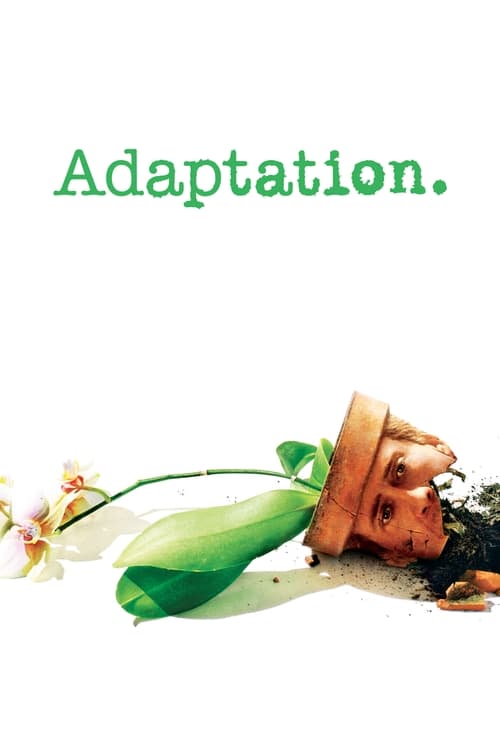
Adaptation.
2002 · Spike Jonze
For when you want something genuinely clever to chew on — a film for a sharp, curious evening, especially if you've ever tried to create anything and choked. Playful enough to be a joy, twisty enough to demand your attention.
What it's about
Screenwriter Charlie Kaufman — sweating, self-loathing, hopelessly blocked — has been hired to adapt Susan Orlean's book about a Florida orchid poacher, and he can't do it. So the movie becomes the story of him failing to write it, braided with Orlean's own reporting on the strange, toothless obsessive John Laroche, while Charlie's cheerfully hacky twin brother Donald cracks the Hollywood formula Charlie despises.
The experience
Dizzying and very funny, with an undertow of real ache — it keeps folding in on itself in ways that shouldn't work and do, then swerves somewhere you don't expect. You come out half laughing, half wanting to make something.
Performances
Nicolas Cage plays both twins and makes them instantly, physically distinct — one of his great performances, all flop sweat and self-torture opposite easy confidence. Meryl Streep gives Orlean surprising longing and mischief, and Chris Cooper is magnetic as Laroche, a swamp-rat visionary you can't stop watching.
The craft
Charlie Kaufman's screenplay is the star — a script about its own writing that somehow keeps emotional stakes alive inside all the mirrors — and Spike Jonze directs it with a light, grounded touch, putting Cage seamlessly on screen with himself. It's a writers' movie that never feels like homework.
Why it matters
It became the defining metafiction of its Hollywood moment, cemented Kaufman as American film's great anatomist of creative anxiety, and deepened the Jonze–Kaufman partnership into legend.
Essays & theory: a reading of Adaptation. →
Reception & legacy: how Adaptation. was received, argued over, and remembered →
Snapshot
Adaptation. is a film about the impossibility of making itself. Commissioned to adapt Susan Orlean's discursive non-fiction book The Orchid Thief, screenwriter Charlie Kaufman responded to his own creative paralysis by writing the paralysis into the screenplay: the film's protagonist is "Charlie Kaufman" (Nicolas Cage), a sweating, self-loathing screenwriter unable to adapt The Orchid Thief, saddled with a fictional twin brother, Donald (also Cage), who blithely cracks the Hollywood code Charlie despises. The result is a recursive, essayistic comedy that braids three timelines — Orlean's reporting in Florida, the orchid hunter John Laroche's obsessions, and Charlie's writing-room despair in Los Angeles — before detonating its own art-cinema scruples in a third act of guns, drugs, and alligators. Directed by Spike Jonze in his second feature, written by Kaufman (credited, in the film's central joke, alongside the invented "Donald Kaufman"), and adapted from Orlean's book, it stands as one of the defining metafictional films of the early 2000s and a landmark of the screenwriter-as-author moment in American cinema.
Industry & production
Adaptation. emerged directly from the creative team and circumstances of Being John Malkovich (1999). After that film's success established Kaufman as Hollywood's most singular new screenwriting voice and Jonze as a feature director of note, Kaufman was hired — reportedly before Malkovich — to adapt Orlean's 1998 book. The widely circulated account, which the film itself dramatizes and Kaufman has affirmed in interviews, is that he found the book genuinely unadaptable: a meditative, plotless work of literary journalism about orchids, obsession, and Florida resistant to conventional dramatization. His solution — writing his own struggle into the script — became the film.
The production reunited the Malkovich nucleus: Jonze directing, Kaufman writing, and producer Edward Saxon among the production team, with the project ultimately set up through Jonathan Demme's orbit (Demme and Saxon's Clinica Estetico) and distributed by Columbia Pictures. It was a relatively modest mid-budget production by studio standards, its appeal resting on the prestige of its talent and the gamble of its premise rather than on spectacle. The casting of Nicolas Cage — then better known for action vehicles — in the dual role of the Kaufman twins was central to its industrial identity, pairing a movie star with deliberately unglamorous, interior material. Meryl Streep as Orlean and Chris Cooper as Laroche anchored the prestige side of the ledger. The film premiered in late 2002 and was positioned as an awards contender, a calculated bet that a self-devouring metafiction could function as serious studio cinema.
Technology
Adaptation. was produced on 35mm film using largely conventional photochemical technology; its ambitions are conceptual and structural rather than technological. Its one genuinely demanding technical problem is the dual-role performance: Cage plays both Charlie and Donald, frequently sharing the frame. The film achieves this through the established repertoire of split-screen compositing, motion-control or locked-off camera setups, body doubles shot over the shoulder, and careful eyeline matching, integrated so that the twins can converse, touch, and occupy the same space convincingly. The work is deliberately invisible — the technology serves the conceit that two distinct people exist rather than calling attention to the trick. Beyond this, the film's effects are practical and modest: the orchids, the Florida swamps, and the climactic violence are staged in-camera. The period's broader digital tools are present only in service of the twinning and standard finishing, never as display.
Technique
Cinematography
Lance Acord, Jonze's regular collaborator (and a veteran of his music-video and commercial work), shot the film. The visual strategy is one of registered tonal difference across the braided timelines without ever becoming showy. Charlie's Los Angeles world — writing rooms, his bedroom, restaurants, soundstages — is rendered in a clammy, naturalistic key that keeps the camera close to Cage's perspiring discomfort, often handheld or loosely observational, emphasizing claustrophobia and the body. The Orlean and Laroche material, particularly the Florida swamps and nurseries, opens into a more lyrical register, with the orchids and wetlands shot to register the beauty Charlie cannot find words for. Acord's lighting favors available-light realism over gloss, in keeping with the film's anti-Hollywood self-image — a look that makes the eventual genre eruption of the third act feel like a tonal betrayal the film is committing knowingly.
Editing
Eric Zumbrunnen (another Malkovich and music-video collaborator) edited, and the cut is the film's primary architectural instrument. Adaptation. runs at least four time streams in parallel — Charlie writing in the present, the orchid story being written, Orlean's earlier reporting, and recurrent flashes reaching back across evolutionary and personal time (the famous montage sweeping from the origins of life forward, and Charlie's own childhood and prenatal imaginings). The editing must keep these legible while dramatizing Charlie's mind looping back on itself; voiceover and image are frequently set in ironic counterpoint, the cut illustrating, undercutting, or literalizing his narration. The structural joke is that the film's form gradually "improves" in conventional terms as Donald's screenwriting logic takes over — the third act accelerates into cross-cut chase-and-peril rhythm, the editing itself enacting the surrender to formula.
Mise-en-scène / staging
The staging insists on the unglamorous texture of the creative life: cluttered desks, the soundstage of Being John Malkovich recreated as a setting (with that film's cast and crew appearing as themselves), the banal interiors of L.A. domesticity. Against this, Florida's nurseries and swamps furnish an almost overripe natural abundance. The central staging problem — putting both twins in the frame — is handled so that the brothers' physical proximity carries the film's emotional argument about the divided self. Streep's Orlean is staged across a register from polished New York literary composure to swamp-bound dishevelment, the mise-en-scène charting her descent from observer to participant.
Sound
Carter Burwell composed the score, a restrained, melancholic accompaniment that lends Charlie's flailing a current of genuine pathos and gives the orchid material its note of yearning. Burwell's music resists comedy-scoring cliché, treating the absurd premise with emotional seriousness — a tonal choice essential to keeping the film from collapsing into mere cleverness. The sound design otherwise foregrounds Charlie's interiority: voiceover is the film's dominant sonic device, an almost continuous stream of self-commentary that the images alternately confirm and mock. The shift in the final act brings the conventional sonic furniture of the thriller — and the contrast is the point.
Performance
The performances are the film's load-bearing achievement. Cage's dual turn distinguishes the twins almost entirely through posture, vocal pitch, and the physical management of anxiety: Charlie hunched, sweating, apologizing; Donald open, upright, guileless. That he makes two men out of one body without prosthetic disguise is the performance's quiet feat, and the role earned him wide critical praise and an Academy Award nomination. Chris Cooper's John Laroche — gap-toothed, voluble, evangelically passionate about whatever currently obsesses him — won the Academy Award for Best Supporting Actor and is the film's most fully embodied creation, a man whose serial obsessions give the film its thematic spine. Meryl Streep, nominated, traces Orlean's arc from controlled detachment to unmoored longing with calibrated wit. Brian Cox appears as the real screenwriting guru Robert McKee, delivering the seminar scene that functions as the film's ironic thesis.
Narrative & dramatic mode
Adaptation. is the canonical case of recursive metafiction in mainstream cinema: a film whose subject is its own writing, in which the author appears as a character struggling to write the film we are watching. Its dramatic mode is essayistic and self-reflexive, organized less by plot than by the friction between Charlie's modernist scruples (no plot, no arc, no false epiphanies, "a movie about flowers") and the commercial screenplay's demands as voiced by Donald and McKee. The genius and the controversy of the structure lie in its final movement: Charlie, capitulating, lets the film become the very thing he despised — a third act of stalking, sex, drugs, captivity, a car chase, a swamp shootout, and a death-by-alligator, complete with the conventional lessons learned. The film thus stages its own corruption as both joke and genuine question: is the "satisfying" ending a sellout, a parody of sellouts, or a sincere argument that formula contains real feeling? The McKee scene supplies the hinge — its advice ("wow them in the end") is followed literally, leaving the viewer unable to fully separate sincerity from irony. This is the film's permanent productive ambiguity.
Genre & cycle
The film sits athwart several genres by design: it is a comedy, a writer's-block drama, a literary adaptation, and — in its final stretch — a crime thriller it half-mocks and half-inhabits. It belongs to the cycle of late-1990s/early-2000s American metafictional and "puzzle" or "mind-game" films, and most specifically to the Kaufman cycle itself — Being John Malkovich, Human Nature, Confessions of a Dangerous Mind, Eternal Sunshine of the Spotless Mind, and later Synecdoche, New York — in which authorship, consciousness, and the porous boundary between self and fiction are the recurring subjects. As an adaptation that thematizes adaptation, it also belongs to a small reflexive lineage of films about filmmaking and writing, from Fellini's 8½ onward, while pushing that tradition into literal recursion.
Authorship & method
Authorship is, uniquely here, the film's text rather than merely its context. The screenplay is credited to "Charlie and Donald Kaufman" — Donald being a fiction, a device that turns the writing credit itself into a joke and a thesis about the divided creative self. (The phantom credit famously went on to receive an Academy Award nomination, the only nomination for a nonexistent person.) Kaufman's method — converting the failure to adapt into the substance of the adaptation — is the film's foundational gesture, and it makes him as much the film's subject as its author.
Spike Jonze's direction is the essential counterweight. Coming from music videos and Being John Malkovich, Jonze grounds Kaufman's conceptual vertigo in unfussy, emotionally legible realism; he refuses to let the cleverness float free, insisting on the sweat and sadness that make the metafiction land as feeling rather than stunt. The key collaborators carry forward from Malkovich: cinematographer Lance Acord, editor Eric Zumbrunnen, and composer Carter Burwell, a continuity of craft that gives the two Jonze–Kaufman films a shared sensibility — deadpan surrealism rendered in a sincere emotional key. Susan Orlean and John Laroche, real people who consented to be turned into characters (including in the invented, lurid third act), are a further authorial wrinkle: the film fictionalizes its own sources and makes that fictionalizing visible.
Movement / national cinema
The film is a product of American independent-minded studio cinema at the turn of the millennium — work made within the studio system (Columbia) but carrying the authorial signature and formal risk associated with the indie sensibility of the 1990s. It belongs to no formal movement, but it is emblematic of a particular American moment: the brief window in which mid-budget, writer-driven, formally adventurous films could be financed and marketed as prestige product. Its kinship is with the milieu of Jonze, Michel Gondry, David O. Russell, and the broader "smart film" tendency in American cinema rather than with any national-cinema movement abroad.
Era / period
Adaptation. is deeply of its early-2000s moment — the high point of the screenwriter-auteur and the "mind-game film," when reflexivity, nonlinear structure, and metafictional play were entering the mainstream (alongside Memento, Magnolia, Being John Malkovich, and Eternal Sunshine soon after). It captures a specific industry anxiety about formula and the McKee-style commodification of screenwriting craft, and it speaks to a turn-of-the-century self-consciousness about authorship and authenticity. Its release in 2002 places it at the crest of this cycle, before the puzzle-film sensibility diffused into franchise and television storytelling.
Themes
The film's governing theme is adaptation in its triple sense: literary adaptation, biological adaptation (Darwin and the orchids supply the running metaphor, with Laroche's mutating obsessions as the human case study), and the self's adaptation to a world that demands compromise. Obsession and passion run throughout — Laroche's serial fixations, Orlean's hunger for a passion she lacks, Charlie's tortured devotion to artistic integrity — posed against the question of whether passion can be willed or only suffered. Self-loathing, sexual frustration, and the paralysis of self-consciousness drive Charlie's arc, set against Donald's unreflective ease as two answers to the problem of living. Underneath sits a sincere inquiry, voiced finally through Donald, into love and self-acceptance — "you are what you love, not what loves you" — which the film offers as either its earned epiphany or its knowing parody of one. Authenticity versus formula, originality versus theft, and the loneliness of the creative act complete the cluster.
Reception, canon & influence
Adaptation. was received as a major critical success and an awards-season standout. Chris Cooper won the Academy Award for Best Supporting Actor; Nicolas Cage, Meryl Streep, and the screenplay were also nominated, the writing nomination memorably extending to the fictional Donald Kaufman. Critics widely praised its audacity, wit, and the way it converted a creative dead end into a genuine work of art, though some debated whether its third-act capitulation was a brilliant gambit or a hedge — a debate that remains the central critical question about the film and a sign of its richness rather than a flaw.
The influences on the film are explicit and unusually traceable: Susan Orlean's The Orchid Thief is the literal source; Robert McKee's Story and screenwriting-seminar culture furnish the antagonist worldview; the reflexive tradition of films about their own making (Fellini's 8½ is the standard touchstone) supplies the formal lineage; and Darwinian evolutionary thinking provides the structuring metaphor. Charles Darwin appears as a figure within the film's montage of deep time.
Its legacy forward is substantial. Adaptation. became the reference point for cinematic metafiction and the screenwriter-as-subject, frequently taught in screenwriting and film-theory courses precisely because it dramatizes the rules it breaks. It consolidated Kaufman's authorship and pointed toward Eternal Sunshine of the Spotless Mind (2004) and his directorial work Synecdoche, New York (2008), with its even more totalizing recursion. More broadly, it helped license a strain of self-aware, structurally playful storytelling that has since become common across prestige film and television. As a demonstration that the deepest possible obstacle — the inability to write the thing — can be transmuted into the thing itself, it remains without close equal.
Lines of influence
- 8½ (1963) — The foundational template of the film-about-its-own-impossibility, where the artist's creative block becomes the narrative engine and his fantasies erupt directly into the realist frame.
- Being John Malkovich (1999) — Supplies the exact craft team carried forward — Lance Acord's available-light realism, Eric Zumbrunnen's editing, Carter Burwell's score — and the house method of grounding a high-concept conceit in deadpan, emotionally sincere naturalism.
- Persona (1966) — Treats the divided/doubled self as a formal cinematic problem, merging two identities in the frame as a precedent for staging Charlie and Donald as a single split psyche.
- Dead Ringers (1988) — Motion-control split-screen and matched eyelines let one actor play twin brothers sharing a shot — the direct technical precedent for Cage's Charlie/Donald twinning.
- Annie Hall (1977) — Fourth-wall-breaking voiceover and a neurotic creator who narrates and annotates his own creative/romantic failures as the film's structuring device.
- Stardust Memories (1980) — Transplants the 8½ reflexive mode to an American comic register — an artist besieged by audiences and critics demanding he deliver the expected product.
- Sullivan's Travels (1941) — Dramatizes the artist's anguished choice between serious art and crowd-pleasing formula — the exact thematic engine of Adaptation's third-act 'surrender to formula.'
- Barton Fink (1991) — The agonized screenwriter paralyzed before the blank page in a hostile Hollywood, scored by Carter Burwell — writer's-block rendered as dread.
- The Purple Rose of Cairo (1985) — Establishes the permeable membrane between a fiction and its makers/subjects, with characters crossing into one another's reality.
- F for Fake (1973) — Essayistic blurring of documentary truth and fabrication that openly confesses its own manipulations — precedent for fictionalizing real subjects (Orlean, Laroche) on screen and flagging the act.
- Eternal Sunshine of the Spotless Mind (2004) — Kaufman's next screenplay extends the recursive-interiority structure, externalizing a mind's own processes as the literal architecture of the film.
- Synecdoche, New York (2008) — Pushes Adaptation's recursion to a totalizing extreme — a creator building a life-size replica of his own life inside the work he can't finish.
- Stranger than Fiction (2006) — Literalizes the author-subject collapse by having a character hear the authorial voiceover narrating his life and rebel against its plot.
- American Splendor (2003) — Same-era metafiction that places the real subject beside the actor portraying him in-frame, making the fictionalizing of a real person visibly part of the text.
- Fight Club (1999) — Builds a mind-game film on voiceover-interiority and a split/twinned self — narrator versus alter ego — as its structural spine.
- Anomalisa (2015) — Continues Kaufman's anatomy of the blocked, self-absorbed creator, literalizing sameness and doubling through identical voices and faces.
- Twinless (2025) — Nicolas Cage's composited dual turn as the Kaufman twins fuses the dual-role technology to a tonally slippery dramedy, the same comedy-grief braid Twinless inherits.