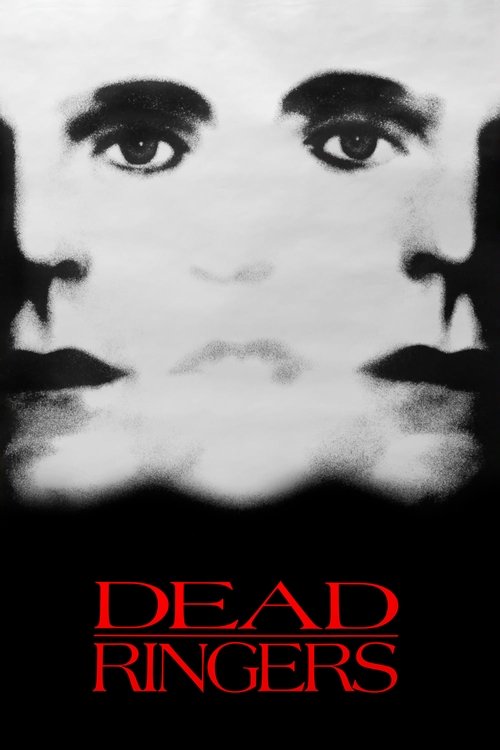
Dead Ringers
1988 · David Cronenberg
For when you want something serious and unsettling to chew on for days — a film about intimacy and dependency that hurts more than it shocks. Choose it when you're up for a challenge and in no need of a happy ending.
What it's about
Elliot and Beverly Mantle are identical twin gynecologists — brilliant, celebrated, and so completely fused that they share an apartment, a practice, and, without the women ever knowing, lovers. Confident Elliot seduces; shy Beverly inherits. The system works until Beverly genuinely falls in love with a patient, an actress, and the balance that has held the brothers together their whole lives begins to come apart.
The experience
Cold, elegant, and quietly devastating — less a horror film than a slow-motion tragedy that tightens like a hand around your throat. It's clinical on the surface and heartbreaking underneath, and the dread builds with terrible patience.
Performances
Jeremy Irons plays both twins, and it's one of the great dual performances ever put on film — you always know which brother you're watching from posture and eyes alone, even as the two begin to blur. Geneviève Bujold matches him with warmth and bruised intelligence as the woman caught between them.
The craft
The twinning effects are so seamless you stop thinking about them within minutes, which is exactly the point — the camera glides through icy, immaculate interiors punctuated by shocking crimson surgical gowns, and Howard Shore's mournful score gives the whole thing the gravity of opera. It's one of the most controlled, beautiful films ever made about coming apart.
Why it matters
It marked Cronenberg's turn from visceral shocks to psychological horror and proved he was a major dramatic filmmaker; the dual performance became the standard every actor playing twins gets measured against.
Snapshot
Dead Ringers is David Cronenberg's chamber tragedy of twin gynecologists who share a practice, an apartment, a temperament split in two, and—fatally—a woman. Jeremy Irons plays both Elliot and Beverly Mantle, brilliant Toronto fertility specialists so fused in identity that they pass patients and lovers between themselves without disclosure. When the meeker Beverly falls in love with the actress Claire Niveau (Geneviève Bujold) and the symbiotic balance of the brothers collapses, the film descends from cool clinical satire into a slow, narcotic dissolution. Made directly after the commercial success of The Fly (1986), it marked a decisive turn in Cronenberg's career: the visceral, prosthetic "body horror" of his earlier work was largely internalized, replaced by a horror of psychology, dependency, and the unbearable separateness of two people who cannot tell where one ends and the other begins. It is widely regarded as one of Cronenberg's finest achievements and a high-water mark of restrained, intellectualized horror.
Industry & production
The project originated in a true story and a novel. In 1975, identical-twin gynecologists Stewart and Cyril Marcus were found dead in their New York apartment, a case that drew lurid press attention and inspired Bari Wood and Jack Geasland's 1977 novel Twins. Cronenberg and co-writer Norman Snider adapted that material, though the film departs substantially from both the case and the book, inventing its own emotional architecture.
The development was notoriously protracted and difficult: the subject matter—twin gynecologists, drug addiction, surgical instruments for operating on "mutant" women—made financing hard to secure, and the production passed through false starts before coming together as a Canadian-rooted film with Cronenberg and Marc Boyman producing. The picture's title changed for a prosaic industry reason: the planned title Twins was unavailable because Ivan Reitman's Arnold Schwarzenegger–Danny DeVito comedy of the same name was in release in 1988, so Cronenberg's film became Dead Ringers. Coming off The Fly, then his biggest hit, Cronenberg had unusual leverage to make so uncommercial and austere a film. Beyond its strong critical reception, the precise commercial performance is not something I can state with confidence, so I won't assign figures; it is generally understood to have been a modest theatrical earner buoyed by acclaim rather than a wide hit.
Technology
The film's signature technical problem was putting one actor opposite himself, in motion, convincingly, for sustained two-shots of intimate conversation. Twin effects in cinema had traditionally relied on locked-off cameras and static split-screens, which freeze the frame and limit staging. Dead Ringers is notable for using computerized motion-control cinematography to create a moving split-screen: a camera whose movement could be precisely repeated, allowing two performances by Irons to be composited within a shot where the camera pans, tracks, or reframes. The result lets the brothers occupy the same space dynamically rather than being pinned to either side of an invisible vertical seam. Where the two had to touch, pass objects, or sit in close physical contact, a body double stood in for the "other" twin during one pass, with Irons matching eyelines and rhythm across takes. The technique is celebrated precisely because it is largely invisible—the viewer accepts two Ironses as a single ensemble. (The film predates the digital compositing that would make such work routine a decade later; here it is achieved photochemically and mechanically.)
Technique
Cinematography
Dead Ringers was the first of cinematographer Peter Suschitzky's many collaborations with Cronenberg, a partnership that would run through Naked Lunch, Crash, eXistenZ, A History of Violence, and beyond. Suschitzky—who had earlier shot The Empire Strikes Back—brings a cool, controlled, almost antiseptic elegance. The camera is patient and composed, favoring measured movement over agitation, which makes the brothers' eventual unraveling read against a surface of clinical order. The most-discussed visual decision is chromatic: the surgical gowns are a deep cardinal red rather than conventional medical green or blue. Cronenberg has explained the choice as deliberately ceremonial, evoking the robes of Catholic cardinals and turning the operating theater into a site of ritual and priesthood—surgery as sacrament. The effect is to estrange the medical from the safe and the routine.
Editing
Ronald Sanders, Cronenberg's longtime editor, cuts the film with a controlled, unhurried rhythm appropriate to its descent. Much of the picture's difficulty is invisible editorial labor: matching Irons's two performances within scenes so that the twins' exchanges feel like genuine ensemble acting. The pacing tightens psychologically rather than through action—the cutting lets long, quiet beats of codependency and decay accumulate, mirroring the brothers' slide into addiction and disintegration.
Mise-en-scène / staging
Production designer Carol Spier, another core Cronenberg collaborator, built a world of muted modernist surfaces—the clinic, the brothers' shared apartment—that grow colder and more disordered as the men decline. The film's most infamous objects are the bespoke gynecological instruments Beverly commissions, grotesque sculptural tools "for operating on mutant women," forged from his delusion that his patients' bodies are deformed. These instruments crystallize the film's themes in a single visual conceit: the medical instrument as torture device, the doctor's authority curdled into derangement. Staging exploits the twin conceit constantly—mirrorings, pairings, and compositions that double or split the frame so that even single-occupant shots feel haunted by the absent brother.
Sound
Howard Shore's score is among the film's defining elements: a melancholy, string-led orchestral theme of mournful grandeur that lends the brothers' fall a tragic, almost elegiac weight rather than horror-movie menace. The music humanizes what could be merely clinical or grotesque, treating the twins' bond as a doomed romance. The film's sound design otherwise leans toward quiet and clinical precision, so that the score's swells carry the emotional surges.
Performance
The film rests almost entirely on Jeremy Irons, whose dual performance is the engine of its credibility. Irons differentiates Elliot—confident, predatory, socially dominant—and Beverly—diffident, sensitive, the one who feels—through posture, vocal pitch, and bearing rather than makeup or obvious tics, so that audiences track which twin is onscreen by behavior alone. The achievement is doubled because the two often share scenes, requiring Irons to act against himself and against a stand-in while sustaining two distinct interior lives. Geneviève Bujold gives Claire a worldly, bruised intelligence; the character, an actress with a rare trifurcate uterus, becomes both the object of Beverly's love and the wedge that destroys the brothers' equilibrium. Irons's work here is frequently cited as the performance that consolidated his international standing as a leading dramatic actor.
Narrative & dramatic mode
The film is structured as a tragedy of individuation: two beings who function as one are forced toward separation, and neither can survive the cut. Its dramatic mode shifts deliberately across the running time—beginning in a register of cool, mordant satire (the brothers' callous sexual deceptions, the glossy success of their practice) before sliding into psychological horror and finally a hushed, narcotic dirge. Cronenberg withholds conventional suspense mechanics; the dread is ontological rather than situational. The drug addiction that consumes both men is rendered not as a thriller plot but as a symptom of a deeper collapse—the impossibility of being two when you have only ever been one.
Genre & cycle
Nominally a thriller and horror film, Dead Ringers belongs more precisely to a lineage of doppelgänger and double narratives that runs through Gothic literature and psychological cinema. Within Cronenberg's own filmography it sits at a hinge point in the "body horror" cycle he had defined through Shivers, Rabid, The Brood, Videodrome, and The Fly. Here the horror migrates inward: there is no contagion, no transformation prosthetic, no exploding body—only minds and a shared self coming apart. It can be read as the film in which Cronenberg's body horror becomes psychological horror, anticipating the more cerebral, literary direction of Naked Lunch and the films that followed.
Authorship & method
Dead Ringers is a signature Cronenberg work assembled by what would become his repertory company of craftspeople. He co-wrote the screenplay with Norman Snider, drawing on the Wood–Geasland novel but reshaping it toward his own obsessions; he also produced, with Marc Boyman. The film inaugurated his career-long collaboration with cinematographer Peter Suschitzky and consolidated his ongoing partnerships with composer Howard Shore, editor Ronald Sanders, and production designer Carol Spier—a creative unit that gives Cronenberg's work of this period its consistent tone of intelligent, controlled unease. Cronenberg's method is evident in the film's refusal of sensationalism: the most extreme material (addiction, the mutilating instruments, the brothers' deaths) is handled with clinical calm, trusting concept and performance over spectacle. The director has spoken of the film as being, beneath its premise, about the body and mortality—about how human beings are trapped in flesh that ultimately separates and fails them.
Movement / national cinema
The film is a landmark of English-Canadian cinema and of Cronenberg's particular Toronto-based body of work, which built a distinctive national-auteur identity outside the dominant Hollywood mode while remaining in productive dialogue with it. Cronenberg is the central figure of a Canadian horror and "body" tradition, and Dead Ringers, shot in and around Toronto, exemplifies the cool, intellectual, institutionally-set aesthetic associated with his films. It belongs to no organized movement so much as to the singular cinema Cronenberg himself constitutes.
Era / period
Made in the late 1980s, the film is inevitably read against the anxieties of its moment: a decade marked by intensifying cultural fear of the body, contagion, and bodily fluids during the early AIDS era—concerns that thread through much of Cronenberg's work, though here they are sublimated rather than literalized. It also reflects an end-of-the-eighties skepticism toward professional success and clinical authority, presenting two men at the apex of medical prestige whose mastery of women's bodies masks a profound psychological incapacity. The film's atmosphere of polished surfaces concealing rot is very much of its period.
Themes
The film's central subject is the dissolution of identity through symbiosis: the terror and tragedy of a self that was never singular. Doubling and mirroring saturate every level—the twins, the split screen, the paired compositions. Around this cluster the film's other preoccupations: the fear of the female body and its interiors, dramatized through gynecology and the fantasy of "mutant" anatomy; codependency and the violence of separation; addiction as both metaphor and mechanism of collapse; and the gendered dynamics of medical power, with women rendered as patients, conquests, and objects of dread. Underneath runs Cronenberg's persistent theme of the body as destiny—flesh as the thing that joins us, betrays us, and finally divides us. The instruments "for operating on mutant women" externalize the men's pathology: a refusal to accept that other bodies, and finally their own, are separate and real.
Reception, canon & influence
Dead Ringers was received as a major critical success and is frequently named among Cronenberg's best films, often cited alongside Videodrome and The Fly as central to his canon. Jeremy Irons's dual performance drew particular acclaim and was honored by several critics' bodies, including recognition from the New York Film Critics Circle, while the film featured prominently in Canada's Genie Awards. It became a touchstone in a much-discussed Academy Awards "snub" narrative, its absence from the Oscar field treated by many critics as evidence of the institution's discomfort with difficult, intelligent horror; I'll refrain from cataloging specific award tallies beyond what is firmly established.
Looking backward, the film draws on a deep doppelgänger tradition in Western literature and on the psychological double-cinema for which Hitchcock and European art film provide obvious touchstones; its proximate sources are documented—the real Marcus twins case and the Wood–Geasland novel—while broader resonances with the literary double are best understood as inheritance rather than direct citation. Looking forward, Dead Ringers helped legitimize a mode of cerebral, restrained psychological horror and stands as a key text for later filmmakers exploring identity, doubling, and bodily dread. Its most direct legacy is the 2023 streaming series of the same name, created by Alice Birch and starring Rachel Weisz, which reimagines the Mantle twins as women and updates the material's gender politics—an adaptation that testifies to the original's continuing cultural resonance. Within Cronenberg's own arc, the film is pivotal: it proved he could sustain horror's emotional intensity through psychology and performance alone, opening the path to the literary, interiorized cinema of Naked Lunch, Crash, and after.
A Deleuzian reading
Watch the camera move.
The full Deleuzian reading of Dead Ringers →
Reception
Critically admired in 1988 but famously stiffed by the Oscars — Jeremy Irons' dual performance wasn't even nominated. Today it routinely tops rankings of Cronenberg's filmography and is held up as one of the great screen performances, period.
How Dead Ringers was received, from release to now →
Influences: the films it descends from and the films it influenced
- Persona (1966) — Bergman's composite shots fusing two women's faces into one and his mirror-blocking of merging identities supply the formal grammar for Cronenberg's doubling-and-mirroring staging and the Mantles' dissolution of separate selves.
- Vertigo (1958) — Hitchcock's psychological double — one body standing in for another obsessively recreated identity — handled with controlled, elegiac dread rather than shock, is the art-cinema model Cronenberg cites for restrained doppelgänger horror.
- Sisters (1973) — De Palma builds a conjoined-twin premise around a single actress, split-screen, and gynecological/psychiatric horror scored by Herrmann — the exact fusion of medical-instrument dread, twinning optics, and dual performance Cronenberg refines.
- The Dark Mirror (1946) — Olivia de Havilland plays good and evil twins via optical-printing split-screen, differentiating them through posture and voice alone — the dual-role-via-composite playbook Jeremy Irons inherits.
- The Parent Trap (1961) — Pioneers traveling-matte and split-screen so one performer can move and interact convincingly against herself, the in-camera twinning technique Dead Ringers modernizes.
- Star Wars (1977) — The Dykstraflex motion-control rig made repeatable moving-camera passes possible; Dead Ringers adapts that motion-control technology so its split-screen twins can share a single moving frame rather than a locked-off shot.
- The Fly (1986) — Immediately precedes Dead Ringers in proving Cronenberg could sustain horror as tragedy through performance and Howard Shore's elegiac scoring, with the Sanders/Spier repertory unit carried forward.
- Morgiana (1972) — Refines the single-actor-as-two-siblings performance craft, using seamless technical doubling to explore one identity splitting into rival selves.
- The Brood (1979) — Takes the clinic-as-stage to its endpoint — fabricated gynecological instruments presented as legitimate medical objects in cool, even operating-theater light — with Shore's chamber strings sustaining the same psychological, non-cued dissonance.
- Naked Lunch (1991) — The interiorized, literary cinema Dead Ringers opened the path to, made by the same consolidated unit — Suschitzky, Shore, editor Sanders, designer Spier — extending its psychology-over-spectacle approach.
- Crash (1996) — Extends the clinical elegance and affectless tone toward eroticized body trauma, retaining the Suschitzky/Shore/Sanders/Spier company and the trusting-concept-over-gore restraint.
- Adaptation (2002) — Nicolas Cage plays twin brothers via motion-control passes and body doubles, directly refining Dead Ringers' seamless single-actor twinning into a full two-hander conversation.
- The Social Network (2010) — Armie Hammer becomes the identical Winklevoss twins through motion-control photography plus digital face replacement — the contemporary endpoint of the moving-camera split-screen twinning Dead Ringers advanced.
- Black Swan (2010) — Stages individuation as somatic body-horror through mirror and double imagery and a performer's physical disintegration, inheriting Cronenberg's tragedy-of-individuation framing.
- Enemy (2013) — Jake Gyllenhaal plays his own double in a cerebral, restrained doppelgänger study that ends on a body-horror reveal — the lineage of intelligent identity-dread Dead Ringers legitimized.
- Us (2019) — Builds doppelgänger horror on dual lead performances differentiated by posture and voice, the same actor-as-two craft challenge Irons set the bar for.
- Dead Ringers (2023) — A direct gender-flipped reimagining with Rachel Weisz performing the twin gynecologists via the now-digital twinning techniques, explicitly updating the original's instruments, doubling, and body politics.
- Twinless (2025) — Pioneers the motion-control compositing that lets a single actor share the frame as identical twins, treating the technical doubling as a vehicle for dread about where one self ends and the other begins.
- The Prestige (2006) — Cronenberg solved the formal problem of staging one actor as psychologically mirrored identical twins — through split-screen compositing, body doubles, and choreographed blocking — confronting precisely the camera-physics problem Nolan faces with Bale's hidden twin; the horror of doubled identity as mutual self-annihilation is the conceptual template.
- Moon (2009) — Pioneers motion-control split-screen compositing that lets one actor convincingly share the frame as two selves — the exact technical lineage for Rockwell's dual-role staging.
- Sinners (2025) — Cronenberg and Jeremy Irons develop a systematic vocabulary for physically differentiating identical twins — postural asymmetry, vocal register shift, gaze quality — enabling one actor to inhabit two distinct bodies through micro-performance; Jordan's dual construction of Smoke and Stack inherits this performance architecture.
- Videodrome (1983) — Shares the Howard Shore score, the body-as-destiny thesis, and Cronenberg's method of treating bodily transformation with clinical calm over spectacle.
- The Skin I Live In (2011) — Centers a surgeon whose instruments reshape flesh, shot with cold clinical elegance and a body-as-destiny logic, privileging controlled tone over surgical gore exactly as Cronenberg does.
- Alien: Covenant (2017) — The single-actor dual-role doppelganger achieved through performance and blocking rather than spectacle — the lineage Fassbender's David/Walter confrontation extends.
- A History of Violence (2005) — Cronenberg's defining study of doubled identity and a single actor splitting into two selves, the psychological doubling that resurfaces as Tom Stall / Joey Cusack.
Similar films
- Persona (1966) — influence & lineage · same viewing thread
- The Fly (1986) — influence & lineage
- Videodrome (1983) — influence & lineage
- Crash (1996) — influence & lineage
- The Skin I Live In (2011) — influence & lineage
- Twinless (2025) — influence & lineage
- Cries and Whispers (1972) — same viewing thread
- Possessor (2020) — shared sensibility
All the films related to Dead Ringers →
Watch it with: curated runs of related films
- The Fractured Self — A run of art films where identity, memory, and sanity refuse to stay solid — watch them near each other and the faces, silences, and doublings start to rhyme.