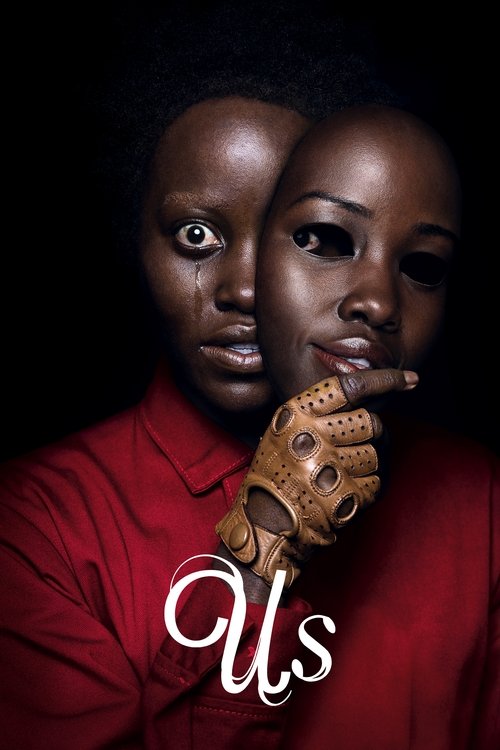
Us
2019 · Jordan Peele
The face of the "elevated horror" era and the rare director whose name alone markets a film; Nope divided audiences between "masterpiece about spectacle" and "muddled," which is exactly the argument his fans enjoy having. Every delay of his fourth film generates news cycles.
When you're craving a real scare that also gives your brain something to chew on for days — best watched with other people so you can debrief immediately after. Challenge over comfort, but wildly entertaining challenge.
What it's about
The Wilson family — easygoing dad, watchful mom, two kids — head to their Santa Cruz beach house for a summer vacation. Adelaide, the mother, can't shake her unease about being back near the boardwalk where something happened to her as a child. Then, after dark, a family appears at the end of their driveway, holding hands and holding scissors — and they look exactly like the Wilsons.
The experience
Starts as a sunlit family comedy, snaps into white-knuckle home-invasion terror, and then keeps widening into something stranger and more unsettling than a scare machine. It's genuinely frightening and genuinely funny, and it leaves you arguing about what it all means on the drive home.
Performances
Lupita Nyong'o plays both Adelaide and her double, and the dual performance is astonishing — two complete physical beings, two voices, one of them among the most unnerving creations in modern horror. Winston Duke supplies warm, dad-joke ballast, and Elisabeth Moss makes a sharp impression as a brittle family friend.
The craft
Jordan Peele directs with total confidence — mirror imagery threaded through every frame, precise slow-burn staging, and a score by Michael Abels that turns chanted voices and a remixed hip-hop track into pure menace. The night photography and sound design reward a dark room and good speakers.
Why it matters
It proved Peele's debut was no fluke, broke opening-weekend records for original horror, and put its scissor-wielding doubles — the Tethered — straight into the pop-culture bloodstream.
Snapshot
Jordan Peele's second feature is a home invasion horror film that doubles as a national allegory, following the Wilson family's vacation shattered by the arrival of their silent, scissors-wielding doppelgängers. Where Get Out (2017) trained its genre machinery on the specific pathologies of American racism, Us aims at something more diffuse and more disturbing: the shadow America casts on itself, the underclass tethered to the prosperous by invisible chains. The film's central image — hundreds of white rabbits in fluorescent-lit tunnels beneath the United States — lodged itself immediately in the cultural imagination, and its closing reveal, which retroactively reframes everything the audience has witnessed, provoked the kind of interpretive ferment that sustains films long after their theatrical runs.
Industry & production
Us was produced under Peele's Monkeypaw Productions banner in partnership with Universal Pictures, which had distributed Get Out and recognized what Peele represented commercially: a filmmaker who could deliver prestige-level discourse alongside genuine box-office returns. The film was produced on a modest budget of approximately twenty million dollars and returned well over two hundred and fifty million dollars worldwide, cementing Peele's status as a bankable auteur in a genre — horror — where such authorial standing is rare. Universal's confidence was evident in the relatively unencumbered creative latitude Peele received; unlike many horror productions shaped by committee anxieties, Us bears the mark of a single, coherent vision from script to final cut.
Peele developed the screenplay over several years following Get Out, resisting pressure to simply replicate that film's formula. He has described wanting to interrogate a specifically American psychology: the willful ignorance of those who thrive alongside those who are left behind. The Hands Across America campaign of 1986 — in which millions of Americans formed a human chain across the continent to raise money for domestic hunger and homelessness, ultimately raising far less than projected — supplied the film's organizing symbol and its critical irony. The gesture of solidarity became in Peele's imagination an emblem of inadequacy: the surface people joining hands while those tethered below them were never seen, let alone helped.
Technology
Us was shot on the ARRI Alexa in an anamorphic format, yielding the 2.39:1 aspect ratio that cinematographer Mike Gioulakis and Peele used to fill frames with significant lateral negative space, emphasizing isolation and the possibility of something lurking just beyond the edge of attention. Gioulakis, who had previously shot M. Night Shyamalan's Split (2016) before joining Peele's project, brought a command of paranoid wide framing suited to a film preoccupied with what goes unseen. The anamorphic choice contributes to the uncanny register of daylight sequences: the Santa Cruz beach boardwalk is rendered in warm, golden light that refuses to feel safe. Post-production made deliberate use of color grading to differentiate the surface world's ochre warmth from the cold, desaturated blue-green of the underground tunnels, coding the two realms as inverse expressions of the same America.
Technique
Cinematography
Gioulakis and Peele construct an economy of mirror imagery that operates below the threshold of direct statement. Symmetrical compositions recur throughout, often with the Wilsons placed at the center of a frame that suggests a reflection waiting to assert itself. The film's opening sequence — young Adelaide (Madison Curry) wandering alone along the foggy Santa Cruz waterfront, entering the beachside funhouse — establishes a visual grammar of doubling: the fog erases depth, the funhouse mirrors multiply, and the camera holds on the child's face rather than cutting away at the crucial moment of encounter. This withholding is the film's central cinematographic strategy: the camera knows more than we do and refuses to be innocent about it.
The beach sequences maintain a quality of anxious pastoral, sunlight used not as reassurance but as exposure. Gioulakis favors medium and long shots in these exteriors, granting the environment a surveillance quality. Once the Tethered arrive, the film moves into tighter, more claustrophobic framings inside the vacation home, and then into the radical darkness of the underground, where sources of illumination — fluorescent tubes, fire, flashlight beams — become diegetically motivated and expressively unstable.
Editing
Nicholas Monsour's editing achieves its most ambitious work in the ballet sequence late in the film, which cross-cuts between Adelaide's climactic underground fight with Red and the childhood memory of Adelaide's ballet recital, now reread through the film's twist as Red's recital — the moment when the Tethered girl first learned to mirror and then surpass the surface child. The cutting creates a layered temporal experience, each plane of time illuminating the other, as choreographic grace and mortal struggle are revealed to be aspects of the same performance. Elsewhere Monsour calibrates the film's tonal shifts between family comedy and dread with considerable skill; the pacing of the first act deliberately lulls, front-loading Winston Duke's comedic presence to make the pivot into horror visceral rather than merely mechanical.
Mise-en-scène / staging
Peele's staging consistently exploits the threshold spaces of the horror genre — windows, doorways, the gap between inside and outside — while adding his own iconographic contribution: the Tethered's red jumpsuits, a single white glove, and gold scissors. The scissors are the film's most resonant prop, simultaneously domestic and surgical, cutting both ways. The Tethered's choreographic movement — synchronized, deliberate, eerily unhurried — was developed through rehearsal, with the cast of doppelgänger performers working to create movement vocabularies distinct from their surface counterparts. Production designer Ruth De Jong built the underground facilities with a quality of institutional decay, an America-shaped bureaucracy that has rotted from the inside.
Sound
Michael Abels, who composed Get Out, returned to create what is arguably the most discussed score of his career. His approach is syncretic: choral writing, classical orchestration, and electronic manipulation are braided together in ways that deny the score any single cultural address. The signature choral piece, used to accompany the Tethered's formation of their own chain across the land, functions as a hymn in an unknown religion — communal, fervent, and wholly alien. Abels' treatment of Luniz's 1995 hip-hop track "I Got 5 on It" is equally striking: the song is introduced in its original form during a cheerful car ride, then reappears as a slowed, orchestral arrangement during the confrontation, the familiar melody made menacing by tempo and instrumentation. The use of existing popular music as a site of horror distortion connects Us to a broader genre tradition, but the specific selection — a song about collective contribution and shared cost, its title a statement of equal stakes — is precisely calibrated to Peele's thematic concerns.
Performance
Lupita Nyong'o's dual performance as Adelaide and her Tethered counterpart Red is one of the more remarkable physical and vocal achievements in recent American cinema. For Red's voice, Nyong'o researched spasmodic dysphonia, a neurological condition affecting vocal cord control, and constructed a delivery that sounds like speech relearned from first principles: raspy, halting, effortful, and finally terrifying. The performance's intelligence lies in its consistency — Red speaks this way not as affectation but as someone for whom language is a conquered territory. Winston Duke provides essential counterweight as Gabe Wilson, whose comedic self-deprecation grounds the film in recognizable family dynamics and makes its pivot into violence genuinely distressing. Shahadi Wright Joseph and Evan Alex, as the Wilson children and their Tethered selves, deliver performances that required them to embody stylized, often physically extreme states without tipping into camp.
Narrative & dramatic mode
Us operates through a structure of nested revelations, the most consequential of which is deferred to its final minutes: the Adelaide we have followed throughout is herself a Tethered, the underground girl who strangled and replaced the surface child at the film's opening and who has lived in the surface world, slowly, imperfectly, learning to pass. The film's allegory thus performs its argument at the level of narrative: the line between the oppressed and the privileged is not ontological but contingent, and the prosperity of the surface world has been built, in some measure, on the theft of another's life. This reframing is both the film's structural coup and, for some critics, its limitation — the revelation risks domesticating the Tethered's collective grievance into a single protagonist's personal tragedy.
Genre & cycle
Us belongs to the wave of American horror that critics and marketers began calling "elevated horror" or "prestige horror" in the latter 2010s, a cycle that includes Robert Eggers's The Witch (2015), David Robert Mitchell's It Follows (2014), Ari Aster's Hereditary (2018) and Midsommar (2019), and Peele's own Get Out. The cycle's defining characteristic is genre filmmaking in which the horrific mechanism is overdetermined by social and psychological allegory, creating films legible as both entertainment and cultural criticism. Us is additionally situated within a longer tradition of American horror organized around doubles and bodily substitution — Don Siegel's Invasion of the Body Snatchers (1956) and Philip Kaufman's 1978 remake are obvious ancestors — as well as the home invasion subgenre typified by Michael Haneke's Funny Games (1997/2007) and Bryan Bertino's The Strangers (2008).
Authorship & method
Peele writes, directs, and produces under Monkeypaw, maintaining authorial control across the production chain. His method involves extensive research and a willingness to use horror's genre conventions as vehicles for ideas that might resist other modes. Peele has publicly cited Rod Serling and The Twilight Zone as formative influences; the episode "Mirror Image" (1960), in which a woman at a bus depot encounters her own doppelgänger and descends into paranoia, is a direct if unacknowledged structural template. His collaborators across both his first two features — Abels (composer), Gioulakis (director of photography on this film), and Monsour (editor) — were given unusual degrees of interpretive latitude, Peele functioning as a director who frames a conceptual problem and trusts his collaborators to contribute solutions.
Movement / national cinema
Us belongs to a resurgence of Black horror in American cinema, a genre tradition with roots in the Blaxploitation films of the 1970s and scattered subsequent efforts, now revitalized by Peele's commercial and critical success. The film and its predecessor have been credited with opening space for a generation of Black horror filmmakers and expanding genre conventions to accommodate Black protagonists whose Blackness is not incidental to the narrative's meaning. Peele himself has been cautious about reducing his films to racial allegory, noting that the Wilsons are Black but the Tethered problem is structurally American; Us is less a film about race specifically than about class, shadow, and the costs of American prosperity distributed so unevenly as to constitute a different civilization beneath the visible one.
Era / period
The film is a product of the period immediately following the 2016 American election, when questions about national division, invisible populations, and the stability of shared identity had an unusual political urgency. Its 2019 release placed it in conversation with a broader cultural moment preoccupied with what America occludes about itself. The Hands Across America motif is deliberately historical and deliberately ironic — the 1986 event belongs to a moment of naive optimism about collective gesture, and Peele's redeployment of it asks what has changed since.
Themes
The film's governing metaphor — a tethered double, resourceless and invisible, mimicking everything the surface person does without any of the rewards — addresses the condition of those whom prosperity systematically excludes while requiring their labor or simply their absence from view. The Tethered are not merely oppressed; they are structurally necessary to the surface world's self-image, the shadow that proves the light is real. Peele builds this allegory through the logic of the uncanny, the Freudian Unheimlich, in which the source of horror is not the alien but the familiar turned wrong — the family, the house, the self. Generational trauma is addressed through Adelaide's repressed knowledge of her own origins, a suppressed history that returns, as suppressed histories do, with annihilating force.
Reception, canon & influence
Us received strong critical approval upon release, with particular praise directed at Nyong'o's performance and Peele's formal control. The discourse around the film has been notably divided between admiration for its ambition and skepticism about whether its allegorical architecture is finally coherent — several critics argued that the revelation of Adelaide's origins complicates rather than resolves the Tethered's collective claim. Nyong'o's absence from the Academy Award nominations for Best Actress was widely and vocally criticized, and remains a frequently cited example of industry bias against performances in the horror genre. The film's canonical status was established quickly: within the genre it is routinely grouped with the defining horror films of its decade.
The film's backward influences run through Hitchcock's doubling obsession (Strangers on a Train, Vertigo), Kubrick's institutional corridors and uncanny children (The Shining), Siegel's Cold War body-snatching anxiety, and the Serling tradition of the twist that reframes rather than merely resolves. Michael Jackson's Thriller (1983) — another work about doubles, performance, and the seductive danger beneath glamorous surfaces — informs the film's aesthetic at a deep structural level, and the Tethered's red jumpsuits carry visual echoes of that video's zombie choreography.
Looking forward, Us has contributed to a consolidation of "social horror" as a recognized and commercially viable category within American genre film. It has influenced subsequent horror films in their willingness to sustain thematic ambiguity, to resist explanatory closure, and to trust audiences with an allegorical register that cannot be fully evacuated of its political meaning. Peele's subsequent film Nope (2022) extended his concerns with spectacle, visibility, and the violence of being seen — a continuation, rather than a departure, from the formal and thematic project Us advances.
A Deleuzian reading
Hold on the funhouse.
The full Deleuzian reading of Us →
Reception
Landed in 2019 with a record-breaking opening and instant 'is it better than Get Out?' chatter; the hot takes have cooled into a fairly settled view of it as Peele's messier, more ambitious swing — and for a vocal contingent, secretly his best.
How Us was received, from release to now →
Influences: the films it descends from and the films it influenced
- Strangers on a Train (1951) — Hitchcock structures the double as completion-by-opposition — each man holds what the other wants, their crimes completing each other — establishing the grammar of the mirror-self as necessary antagonist that Peele literalizes in Red's underground inversion of Adelaide's entire life trajectory.
- Vertigo (1958) — Hitchcock's doppelganger revelation — that one woman has been physically remade into another, retroactively reframing every prior scene — provides the structural template for Peele's climactic inversion, in which the disclosure of which figure is the 'original' rewrites the film's entire moral geometry.
- Don't Look Now (1973) — Roeg's temporal cross-cutting — intercutting future events into present action so that meaning assembles only retrospectively — is the formal model for Peele's Adelaide beach flashback, whose full significance is withheld and returned, transformed, by the climactic reveal.
- Invasion of the Body Snatchers (1978) — Kaufman visualizes body-substitution paranoia through physically identical doubles emerging from underground, and closes with the protagonist's complicit signal; Peele inverts this mechanics precisely — locating authenticity below ground rather than above, and making the compromised figure the film's nominal hero.
- The Shining (1980) — Kubrick's symmetrical corridor compositions — the frame as mirror that doubles rather than simply records — and his staging of identical twins as uncanny spatial intrusion are direct visual precedents for Gioulakis's symmetrical-doubling framings and the Tethered's choreographic mirroring of every Wilson gesture.
- Funny Games (1997) — Haneke stages home-invasion antagonists as mirror-doubles of the bourgeois family — same clothes, same leisure register — and deploys the threshold (the door crossed uninvited) as the structural hinge between safety and catastrophe, a formal device Peele inherits and charges with racial and class meaning.
- Black Swan (2010) — Aronofsky uses a single performer's split physicality — Portman embodying both the repressed and released self through contrasting movement vocabularies — as the film's central horror mechanism, establishing the template Nyong'o extends through her research into spasmodic dysphonia to differentiate Adelaide's and Red's bodily grammars.
- Get Out (2017) — Peele's own prior film establishes the Monkeypaw elevated-horror method — Abels composing, single-location isolation, racial body-horror mechanics, social allegory delivered through genre form — that Us directly inherits and extends toward a class-shadow register where the oppressed cannot be simply distinguished from the oppressor.
- Dead Ringers (1988) — Builds doppelgänger horror on dual lead performances differentiated by posture and voice, the same actor-as-two craft challenge Irons set the bar for.
- To Sleep with Anger (1990) — Builds a Black family home invaded by an uncanny doppelgänger-intruder whose folkloric menace exposes the household's fault lines, and scores dread with vernacular Black-American musical texture — a genre-forward heir to Harry's trickster-in-the-parlor threat.
- Split (2017) — Gioulakis again, now serving a doubled lead performance and a subterranean lair — the Beast's withheld-in-shadow reveal and posture-coded second self are Split's basement grammar scaled up.
- Enemy (2013) — Peele converts the doppelgänger into a performance problem — Nyong'o's two calibrated registers of voice, posture, and tempo sharing the frame — the commercial genre descendant of Gyllenhaal's tempo-differentiated dual role.
- Candyman (2021) — DaCosta inherits Us's class-shadow allegory through its housing-project/gentrification geography and constructs Candyman explicitly as a doppelganger assembled from the accumulated trauma of racialized urban displacement — the monster not as outside threat but as the inevitable return of what the surface world has buried.
- Nope (2022) — Peele's direct follow-up inherits Us's anamorphic-widescreen grammar and its politics of visibility — the violence of being seen, of being spectacle — displacing the threshold from the home's exterior onto the sky and literalizing the predatory gaze that in Us operates through the Tethered's mirroring stare.
- Men (2022) — Garland casts a single actor in all male roles, deploying the same multiplication-of-one-body logic and dual-role physicality that Nyong'o's performance in Us established as a viable horror grammar; the uncanny is generated entirely from the shock of repeated identical faces appearing in new relational contexts.
- They Cloned Tyrone (2023) — Named influence: doubles and a hidden underground infrastructure deployed as metaphor for a deliberately engineered underclass — the literal-clones-below-the-streets device Tyrone inherits.
- The Double (2013) — Ayoade deploys differential lighting to distinguish the meek original from his confident usurper and grounds the horror in a class logic of replacement from below — the same structural grammar Us uses at a societal scale, with the Tethered's underground existence literalizing the underclass's invisible labor sustaining surface life.
- Under the Skin (2013) — Glazer uses differential color grading to partition the alien's interior void from the world she passes through, and stages threshold crossings — van doors, liquid floors, water surfaces — as the film's structural pivots, a formal vocabulary Us shares in its underground/surface color-coding and its obsessive return to the beach as threshold space.
- Hereditary (2018) — Aster's A24 prestige-horror peer uses Colin Stetson's unconventional choral score as affective engine and sustains a principled refusal of explanatory closure as genre stance, consolidating alongside Us the commercial-critical category of 'elevated horror' in which allegorical residue is treated as a feature rather than a flaw.
- Midsommar (2019) — Aster deploys diegetic folk music as both narrative ritual and non-diegetic affective instrument — blurring the boundary Us also exploits with its distorted 'I Got 5 on It' — and stages communal choreography in full daylight as horror's vehicle, a formal parallel to the Tethered's synchronized performance as both threat and spectacle.
- It Follows (2015) — Descendant employing Gioulakis as cinematographer, carrying forward his anamorphic deep-focus 'threat-in-the-frame' camera language and the doppelgänger-pursuer-who-walks motif.
- Leviticus (2026) — The doppelganger as the returned repressed made flesh — a literal double that hunts the self — deployed as sustained allegory in the same key as Leviticus's rule-bound double.
- It Chapter Two (2019) — Same-year prestige studio horror built on a hall-of-mirrors funhouse trigger and the return of a repressed childhood trauma, a craft sibling in elevated-horror set-piece design.
- Don't Worry Darling (2022) — Extends the same intrusion-driven editing and doppelgänger/mirror motif within elevated genre, using scored percussive stingers and delayed exposition to reframe an ordinary reality as engineered duplication.
- Barbarian (2022) — Extends the buried-horror staging into a literal subterranean society living beneath American infrastructure, encoding class violence in the space directly below inhabited ground.
- The End of Oak Street (2026) — Gioulakis's other studio-scale showcase for the same toolkit: 35mm anamorphic, mirror-symmetrical staging, and the driveway shot that holds four silhouettes in unlit deep focus for an unbroken beat rather than cutting in to identify them.
Similar films
- Get Out (2017) — influence & lineage
- Nope (2022) — influence & lineage
- Hereditary (2018) — influence & lineage
- The Shining (1980) — influence & lineage
- Bring Her Back (2025) — same viewing thread
- Leviticus (2026) — same viewing thread
- It (2017) — same viewing thread
- Talk to Me (2023) — same viewing thread
Watch it with: curated runs of related films
- Whatever's Wearing That Face — A run of horror-thrillers where the real terror is that you can't trust what a person appears to be — a double, a shapeshifter, a smiling stranger, the one you desire.