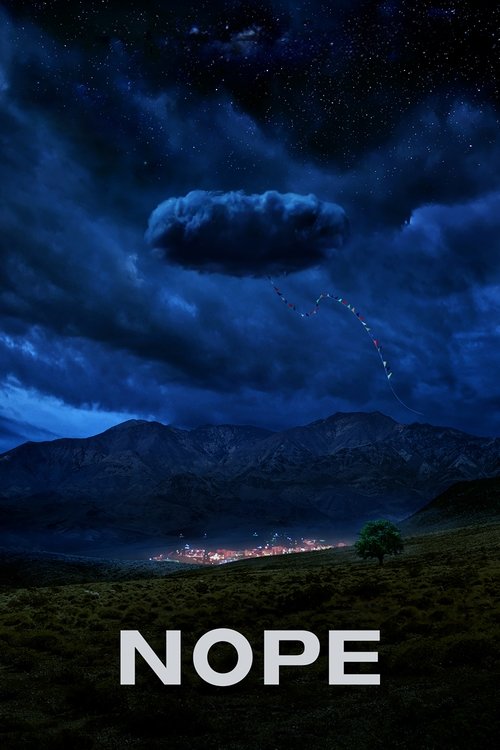
Nope
2022 · Jordan Peele
The face of the "elevated horror" era and the rare director whose name alone markets a film; Nope divided audiences between "masterpiece about spectacle" and "muddled," which is exactly the argument his fans enjoy having. Every delay of his fourth film generates news cycles.
For when you want a big, strange summer blockbuster with an actual brain — a real scare that leaves you something to argue about afterward. More thrilling than punishing, but it lingers.
What it's about
Two siblings run a struggling horse ranch in a dry stretch of inland California, training animals for Hollywood shoots the way their family has for generations. After their father dies in a freak accident, they start noticing something wrong in the sky above their property — something vast that doesn't behave like weather or aircraft. Instead of running, they decide to get it on camera, and the film becomes a standoff between people who work with animals for a living and a predator nobody understands.
The experience
It plays like a slow-building daylight nightmare — long stretches of wide-open quiet where you scan the frame and the clouds like the characters do, punctured by sequences of real terror. It's also funnier than you'd expect, and it keeps turning over an uneasy idea about our need to look at terrible things.
Performances
Daniel Kaluuya plays OJ almost entirely through stillness and side-glances — a man who says nothing and watches everything — while Keke Palmer's Emerald is his live-wire opposite, all charisma and hustle; the film runs on the friction and loyalty between them.
The craft
Jordan Peele shot this on large-format 65mm film, and it shows: enormous skies, night scenes with real depth, a sense of scale most horror never attempts. The sound design does half the terrifying work — what you hear coming from above is worse than anything shown. This one genuinely earns the biggest screen and best speakers you can find.
Why it matters
It confirmed Peele as a director working at blockbuster scale on his own terms, and it kicked off a wave of conversation about spectacle itself — why we can't look away from disasters, and who pays the price for the footage.
Snapshot
A sci-fi Western horror film set on a horse ranch in the Agua Dulce highlands north of Los Angeles, Nope follows siblings OJ and Emerald Haywood as they discover that something vast and predatory inhabits the sky above their property. Formally ambitious to the point of provocation, the film interweaves a creature narrative with a meditation on spectacle, exploitation, and the history of Black labor in the Hollywood image machine. It is the third feature written and directed by Jordan Peele, and his most technically expansive work — shot on large-format 65mm film with a scale and compositional gravity that marks a deliberate break from the intimate suburban dread of his debut. Where Get Out and Us worked through psychological enclosure, Nope opens the frame to the horizon and implicates the sky itself.
Industry & Production
Produced by Jordan Peele through his company Monkeypaw Productions and distributed by Universal Pictures, Nope was budgeted in the range reported by trade coverage at approximately $68 million — a significant step up from Us and the largest production Peele had yet undertaken. Principal photography took place primarily in Agua Dulce, California and surrounding areas in the Antelope Valley, a semi-arid terrain whose spare grandeur had served Westerns and science fiction films for decades. The alien entity required extensive post-production visual effects work handled by a collaboration of effects houses; early creative decisions locked the creature's final form — a vast, billowing, asymmetric organism — relatively late in production, placing unusual demands on the compositing pipeline.
The shoot encountered practical obstacles particular to its ambitions: photographing a nighttime sky in large-format film with minimal artificial light pushed the capabilities of available camera systems. The production's solution became one of its distinguishing technical achievements. Monkeypaw's working relationship with Universal, established through the commercial and critical success of Get Out (2017) and Us (2019), gave Peele a degree of creative autonomy unusual for a mid-budget original property. The film carries no franchise infrastructure and no pre-existing intellectual property to ease marketing, a bet on original genre filmmaking that became rarer across the 2020s studio landscape.
Technology
Nope is among the few theatrically released films of its era to commit fully to large-format photochemical capture. Cinematographer Hoyte van Hoytema shot primarily on IMAX 65mm cameras alongside Panavision System 65 equipment — a format choice with both aesthetic and conceptual stakes. The IMAX 65mm frame, roughly ten times the area of a standard 35mm frame, yields an image with a texture and depth that resists digital interpolation and carries the landscape's expanse in a way no spherical lens on a smaller negative could fully replicate. For a film whose argument concerns what can and cannot be seen, and what the act of seeing costs, the format is itself an argument.
The nighttime sequences presented a specific technical challenge. Film emulsion has a fixed sensitivity ceiling; filming a dark sky in 65mm and recovering detail in the creature's nocturnal movements required van Hoytema to test multiple film stocks and to design lighting rigs capable of illuminating the cloud layer without destroying the naturalism of the night. Some sequences were reportedly shot during magic hour and color-timed to deeper darkness in post — a technique with precedent in films like Apocalypse Now, where Gordon Willis employed similar strategies. The film also made expressive use of the IMAX aspect ratio not merely as a canvas for spectacle but as an instrument of visual disorientation, allowing the creature to exist at the periphery or beyond the frame's upper edge.
Technique
Cinematography
Van Hoytema's work on Nope is the film's most formally distinctive contribution. Coming off Tenet (2020) and before Oppenheimer (2023), van Hoytema brought a large-format sensibility shaped by long collaboration with Christopher Nolan, but here in a more expansive, unhurried register. The California landscape — scrubby ridges, dust-hazed distances, sky taking up fully half or more of the compositions — recalls the Fordian West without quotation. Shots of the horizon with distant mountains recall the deep-focus plains photography of James Wong Howe or Russell Harlan, the air itself thick with implication. Van Hoytema consistently places the creature at the vanishing point or above the upper edge of frame, a refusal to deliver the visual payoff that the genre contract usually demands.
Editing
Nicholas Monsour edited the film, extending the collaboration with Peele that began with Us. The film's structure is non-linear in significant ways: the opening Gordy's Home flashback — a fictional 1998 chimpanzee-related on-set disaster — is intercut through the contemporary narrative without fully disclosing its connection to the main story until the third act. This fragmented temporality places the viewer in the position of inference and assembly that the film thematically assigns to spectatorship itself. The editing rhythm in the climactic sequences stretches duration in ways that discomfort conventional horror pacing; the expected cut-away is withheld, holding the audience in the gaze it has been warned to escape.
Mise-en-scène / Staging
Peele's staging choices throughout consistently organize space around questions of visibility and exposure. The Haywood ranch — Haywood's Hollywood Horses, a family business supplying trained horses to the film industry — is designed as a horseshoe of partial enclosures with open sky overhead, a geography that is both refuge and trap. The Jupiter's Claim theme park across the road functions as a theatrical space in which the relation between performance and consumption is literalized. The Gordy's Home set design, rendered in the rounded corners and primary-color palette of early-1990s American television, is staged with a carefully off-register quality — the sitcom domesticity just slightly wrong, an uncanny valley of genre. Peele positions Steven Yeun's character Ricky Park beneath a table as witness but not participant in the Gordy incident, a staging choice that encodes his character's psychology for the rest of the film.
Sound
Michael Abels composed the score, continuing his collaboration with Peele across all three features. Abels's approach to Nope leans harder on tonal and textural scoring than the more melodically propulsive work in Get Out; much of the alien's presence is scored through low-frequency mass — sub-bass registers that the theatrical IMAX format was calibrated to reproduce physically. Sound designer Johnnie Burn contributed to the creature's sonic vocabulary, constructing a library of sounds for the entity that resists familiar alien-movie convention: no electronic warble, no mechanical hum, but something more organic and ambiguous. The decision to make the alien largely silent — or to register its presence through wind displacement and the panic of animals — keeps the creature in the register of weather rather than technology.
Performance
Daniel Kaluuya's performance as OJ Haywood is built primarily from withholding — a character whose interiority is communicated through posture, silence, and a quality of attention directed at horses, landscape, and threat that registers as a kind of professional calm in the face of extinction. It is anti-theatrical in a film whose dominant argument is about the pathology of performance. Keke Palmer as Emerald is the film's engine and its extroversion, a character whose hustle and presentation-consciousness place her in the film's thematic web without reducing her to a foil. Steven Yeun's Ricky Park, the most enigmatic figure in the film, plays trauma transformed into showmanship; Yeun locates in Ricky not villainy but a kind of terrible optimism. Michael Wincott as cinematographer Antlers Holst, a reclusive figure drawn back to dangerous image-making, functions as a genre conscience, the film's acknowledgment of its own obsession with the impossible shot.
Narrative & Dramatic Mode
Nope withholds its full narrative architecture from conventional disclosure throughout much of its runtime, distributing revelations across multiple story strands without providing a connective tissue until the structural design becomes apparent. The Gordy's Home subplot, initially appearing as a disconnected prologue and interspersed flashback, ultimately functions as a structural rhyme with the alien encounter: in both cases, something has been domesticated for spectacle and cannot be contained; in both cases, a witness survives by refusing to meet the creature's gaze. This parallel is thematic rather than plot-mechanical, which frustrated some viewers expecting genre architecture to resolve.
The film's central conceit — that the alien entity kills those who look at it directly — inverts the logic of conventional horror spectatorship and creates a dramatic problem in which the desired image is lethal. The Haywoods' plan to capture footage of the entity for financial and evidentiary purposes echoes the film's own project, and implicates the audience in the same circuit of dangerous looking. This self-reflexivity is characteristic of Peele's narrative method.
Genre & Cycle
Nope is generically composite in ways that exceed easy categorization. It is a creature feature in the tradition descending from Them! (1954) and Jaws (1975); a UFO encounter film in the line of Close Encounters of the Third Kind (1977); a rural siege film with echoes of Signs (2002); and a Western, not merely in setting but in structure — the lone-family-against-landscape schema, the showdown rhythm, the frontier mythology converted to alien contact. The alien itself, as a vast, open-sky predator visible in daylight, is a deliberate departure from the convention of nocturnal, enclosed alien horror established by Alien (1979) and its descendants.
The film belongs to what critics have termed the "elevated horror" or "prestige horror" cycle, a commercial and critical formation that includes Hereditary (2018), Midsommar (2019), The Witch (2015), and It Follows (2014) — films that use the genre's license for extremity in the service of thematic and formal ambitions legible to art-house audiences while retaining the basic machinery of dread. Nope is the most expensive and formally classical film in this cycle, leaning on Hollywood craftsmanship rather than the low-budget austerity that distinguished most of its company.
Authorship & Method
Jordan Peele is the sole credited writer and director, and the film's thematic coherence across narrative, form, and production design reflects a singularity of authorial vision more demanding of control than any single department could supply. His background in sketch comedy and performance — he was a co-creator and performer on Key & Peele — informs a rhythm in his films in which dread and absurdity cohabit without canceling each other. Nope is the most explicit meditation on cinema itself that he has produced, and the decision to shoot on film with a DP identified with the most formally ambitious commercial cinema of the 2010s-2020s (van Hoytema's career includes Interstellar, Dunkirk, and Ad Astra) signals a deliberate alignment with a lineage of technically rigorous American genre filmmaking.
Michael Abels's three-film collaboration with Peele establishes him as the closest equivalent to a house composer Peele has; Abels's ability to score ideas as much as emotions — to find musical form for an argument, not merely a feeling — suits Peele's method. Nicholas Monsour's editing work on both Us and Nope suggests a developing formal language around temporal disruption and withheld resolution.
Movement / National Cinema
Nope is an American studio film that draws on and complicates the Western, the alien invasion film, and the summer blockbuster as specifically American popular forms. More particularly, it belongs to a wave of Black-directed genre cinema that emerged with commercial and critical force in the 2010s and 2020s — a formation including Get Out, Candyman (2021), and work by directors including Ryan Coogler, Nia DaCosta, and Mati Diop — in which genre machinery is used to give formal shape to histories of racial exploitation and violence. Peele is the most commercially prominent figure in this formation, and Nope is his most ambitious attempt to anchor a genre argument in the specific history of Black labor and Black image-making in Hollywood.
The Muybridge connection — the film opens with a reference to the 1878 horse gallop photographs through which Eadweard Muybridge demonstrated the mechanics of equine motion, and implies that the unidentified Black jockey in those photographs may have been an ancestor of the Haywood family — grounds the film's meditation in documented history. The horse gallop sequence is widely cited as among the earliest instances of motion-picture photography; Peele's insertion of a Black figure as its unacknowledged subject makes visible what the archive has occluded.
Era / Period
Nope was released in summer 2022, during a theatrical recovery period following pandemic-related closures and a prolonged industry reckoning over streaming versus theatrical exhibition. Universal's decision to commit a $68 million original property to an IMAX-scaled theatrical release — without franchise scaffolding, pre-existing IP, or sequel infrastructure — was itself a position on the future of theatrical cinema. The film's formal insistence on large-format photography legible only in the conditions of a large screen carries an implicit argument about the specificity of theatrical experience that is continuous with its thematic material about spectatorship and looking.
Themes
The organizing principle of Nope is the ethics and economics of the spectacle. The alien entity, whose behavior resembles an ambush predator that uses the spectacle of its own display to draw prey toward it, is a figure for entertainment itself — for the entertainment industry, for celebrity culture, for the spectatorial contract that turns bodies (and, the film argues specifically, Black bodies) into consumable images. The Gordy's Home subplot makes the argument legible by showing a different context for the same dynamic: a wild animal domesticated and displayed for television audiences, then destroying the humans who mistook its performance for docility.
The Haywood family's history as Hollywood horse trainers places their labor in a position structurally identical to the horses they train — essential to the image, invisible in the credit sequence, owned by no share of the spectacle they produce. Emerald's recitation of her ancestor's contribution to the Muybridge photographs — contribution that went unattributed — converts film history into a personal grievance and a structural argument simultaneously.
The film is also about the compulsion to document, and the specific folly of wanting to possess an image of something that kills the seeing. Antlers Holst's final scene — choosing to keep the impossible shot rather than survive — is the film's most concentrated statement on the pathology of the image-maker and, by implication, on cinema itself.
Reception, Canon & Influence
Nope opened to strong reviews and was one of the more discussed American films of 2022 — critics consistently praised its formal ambition and thematic density, while noting that the film's refusal of conventional genre resolution left some audiences outside its architecture. The discourse around the film's meaning was unusually productive, with significant critical attention given to the Muybridge connection, the gaze mechanics, and the Gordy subplot's relation to the main narrative; few genre films of its budget released in its era generated the same volume of serious analytical writing in the weeks following release.
Hoyte van Hoytema received an Academy Award nomination for Best Cinematography at the 95th Academy Awards — the film's only major awards nomination, widely considered underrecognized given the breadth of its technical achievement. The score, editing, and production design did not receive equivalent recognition.
The film's backward influences are legible throughout its construction: the Spielberg debt is most obvious in the creature-reveal restraint derived from Jaws and the collaborative, equipment-dependent alien encounter from Close Encounters; the Western landscape compositions draw from the Ford tradition and from the wide-screen California photography of Conrad Hall and James Wong Howe; the post-Jaws blockbuster structure is simultaneously invoked and subjected to critique. Akira Kurosawa's deployment of weather and environment as expression of psychological state has been cited in critical reception as an analog for van Hoytema and Peele's use of the California sky.
As of this writing, Nope's influence on subsequent filmmaking is still consolidating. Its most durable formal contribution may be its demonstration that the "elevated horror" cycle could operate at genuine Hollywood scale without sacrificing the formal or intellectual density of the smaller films that defined the movement. Its thematic contribution — the alignment of spectator mechanics with racial exploitation, grounded in specific film-historical material — offers a methodology for genre filmmaking as historiography that subsequent directors working in adjacent territory will likely extend.
A Deleuzian reading
A cloud that doesn't move.
The full Deleuzian reading of Nope →
Reception
Opened big in summer 2022 but split audiences — plenty walked out asking 'what was that about?' and called it lesser Peele. Four years on it's the one cinephiles increasingly call his best, a spectacle-about-spectacle that keeps climbing in esteem.
How Nope was received, from release to now →
Influences: the films it descends from and the films it influenced
- Jaws (1975) — Spielberg's enforced absence of the shark across the first two acts — substituting water surface, victim POV, and Williams's cues for the creature itself — is the direct formal model for Peele and van Hoytema's strategy of withholding the full creature form as the film's primary compositional engine.
- Close Encounters of the Third Kind (1977) — Spielberg stages the Crescendo Summit encounter as a technologically mediated event requiring specialized apparatus — lights, sound equipment, airstrip — to facilitate contact; Nope inherits this grammar for OJ and Em's equipment-dependent approach to luring and documenting the creature.
- Duel (1971) — Spielberg's inexplicable industrial threat encountered in open American highway landscape — the truck's driver permanently withheld, its motivation never rationalized — establishes the grammar of the unknowable entity in American terrain that Nope's creature, initially misread as an aircraft, structurally echoes.
- The Searchers (1956) — Ford's deep-focus widescreen compositions embed racial violence and cultural dispossession within Western landscape iconography; Nope inherits this grammar to encode Black ownership and labor within the same horizon-and-sky mise-en-scène, making the ranch geography itself the argument.
- 2001: A Space Odyssey (1968) — Kubrick's large-format 70mm presentation of alien encounter as fundamentally aesthetic rather than narrative — the alien as something to be photographed and experienced, not explained — establishes the formal precedent for Nope's refusal to rationalize its creature within conventional genre terms.
- The Birds (1963) — Hitchcock's sustained aerial creature attacks across Northern California landscape, with permanently withheld motivation, establish the creature-from-above horror grammar — attacks arriving from the sky as the organizing principle of dread — that Nope directly transposes to the Inland Empire.
- Peeping Tom (1960) — Powell's film explicitly aligns the cinematic apparatus with predatory violence, making the act of looking the film's subject rather than merely its vehicle; Nope's alignment of spectatorial attention with the creature's kill mechanism is the most direct extension of this thesis in American genre cinema.
- Ran (1985) — Kurosawa's use of clouds, fog, and natural light as expressive correlates of psychological and social states — weather deployed as argument rather than atmosphere — is the most frequently cited formal analog for van Hoytema and Peele's treatment of the California sky as an active dramatic participant.
- Interstellar (2014) — Hoyte van Hoytema's first large-scale deployment of IMAX 65mm for American agricultural landscape — dust-storm sequences and cornfield horizon lines held at ground level against open sky — develops the specific photographic grammar of scale and texture he brought directly to Nope five films later.
- Hereditary (2018) — Aster's demonstration that horror could sustain art-cinema formal density — shot scale, performance withholding, dread constructed through composition rather than shock — while maintaining genre structure established the elevated horror aesthetic within which Nope then operated at full Hollywood blockbuster scale.
- Us (2019) — Nicholas Monsour's editing and Michael Abels's score, in their first Peele collaboration, establish the formal language of temporal disruption, structural parallelism, and idea-scoring — the score as argument rather than mood — that Nope then extends and formalizes.
- Disclosure Day (2026) — Hoyte van Hoytema's long-lens daytime sky-watching, shot as in-camera IMAX spectacle, weaponizes the upward gaze — the wonder-against-fear lineage pushed into the seed's long-lens, in-camera ethos.
- Hope (2026) — Withholds its creature behind a misread silhouette and then discloses it at full size in open daylight over agricultural landscape, scored again by Abels; the reveal-as-recategorisation (it was never the thing they named) is Hope's perspective reversal in miniature.
- Get Out (2017) — Peele and Daniel Kaluuya establish the anti-theatrical performance mode — horror expressed through controlled physiological suppression rather than outward display — that Kaluuya carries directly into OJ, making withheld interiority the signature register of Peele's protagonists across both films.
- A Quiet Place (2018) — Krasinski builds his entire horror grammar around a single sensory rule — sound triggers the creature — deriving geography, staging, and performance from that one constraint; Nope reverses the polarity exactly, making visual attention the trigger, applying the same single-rule creature-grammar to a different sensory domain.
- Annihilation (2018) — Garland, Salisbury, and Barrow construct the alien entity's acoustic presence from biological and environmental sources rather than conventional sci-fi synthesis — the creature as organism, not machine — a parallel approach to Nope's sound team building the creature's audio signature from organic material.
- Arrival (2016) — Villeneuve and editor Joe Walker embed pre-event sequences within the present-tense narrative to structurally withhold temporal orientation; this is the closest formal analog to Nicholas Monsour's management of Nope's non-linear prologue and the strategic delay of the Gordy flashbacks' meaning.
- They Cloned Tyrone (2023) — Extends the same craft-forward Black-authored genre spectacle, using a digitally-shot image finished for a filmic, period-textured grain rather than clean gloss — kin to Ken Seng's graded-to-film halation look.
- Twisters (2024) — Sibling in the sky-as-threat spectacle film that is self-consciously about spectacle-vs-substance — IMAX/large-format anamorphic photography aimed upward, marrying practical staging to digital for a menace that descends from open air.
- Smile 2 (2024) — Spectacle-industry horror that stages an approaching aerial threat in long-lens wide compositions and makes the machinery of entertainment the site of terror, sharing the negative-space-and-push-in grammar of dread.
Similar films
- Annihilation (2018) — influence & lineage · often watched together
- Get Out (2017) — influence & lineage
- Us (2019) — influence & lineage
- Disclosure Day (2026) — influence & lineage
- A Quiet Place (2018) — influence & lineage
- Zootopia 2 (2025) — same viewing thread
- Leviticus (2026) — often watched together
- Hunt for the Wilderpeople (2016) — shared sensibility
All the films related to Nope →
Watch it with: curated runs of related films
- Genre as Trojan Horse — Watch these together when you want the pleasures of a genre picture — a buddy-cop case, a heist crew, a monster in the sky — that turns out to be secretly arguing about who America polices, prices, and erases.