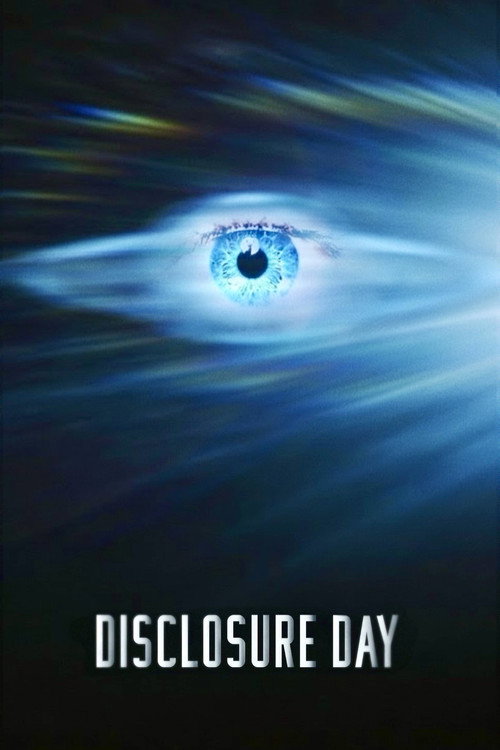
Disclosure Day
2026 · Steven Spielberg
For the night you want a big, gripping ride that still gives you goosebumps of the good kind — popcorn tension with a sense of wonder chaser. Comfort food for anyone who grew up on UFO stories, with enough conspiracy edge to keep you leaning forward.
What it's about
A cybersecurity expert stumbles onto proof that a corporation is hiding the truth about extraterrestrial life, and blowing the whistle puts him on the run. He joins forces with a meteorologist who's been recording phenomena she can't explain, and together they race to expose what's really out there before they're silenced.
The experience
A paranoia machine with wonder inside it — chase-movie momentum and creeping foreboding that keeps opening out into awe. Tense, propulsive, and built to leave you scanning the sky afterward.
The craft
Spielberg returning to first-contact territory means blockbuster craft at full wattage: the fusion of conspiracy-thriller paranoia with the awe-and-dread rhythm he practically invented. Expect setpieces and sound design that demand the biggest screen and loudest speakers you can find.
Why it matters
This is Spielberg circling back to the UFO-encounter terrain he defined half a century ago, and the movie conversation around it is exactly that: the master of first-contact cinema revisiting his own legacy in a more suspicious age.
Snapshot
Disclosure Day is a science-fiction thriller directed by Steven Spielberg, returning the filmmaker to the UFO-encounter terrain he helped define nearly half a century earlier with Close Encounters of the Third Kind (1977) and E.T. the Extra-Terrestrial (1982). The premise — a cybersecurity expert turned whistleblower flees a corporation after uncovering a concealed truth about extraterrestrial life, and is joined by a meteorologist whose unexplained observations corroborate his claims — fuses the paranoia of the conspiracy thriller with the awe-and-dread structure of first-contact cinema. A word of caution on the record: as a recently released or just-releasing 2026 title, much of Disclosure Day's production and reception history is not yet stabilized in the scholarly or trade literature, and several details circulating publicly are reported rather than confirmed. This dossier distinguishes what is securely known from what is, at the time of writing, provisional, and reconstructs Spielberg's likely method from his long and unusually consistent body of work rather than from settled documentation of this particular film.
Industry & production
The film arrives as a major studio event picture under the Amblin–Universal axis that has anchored most of Spielberg's late-career work. Spielberg's UFO project was widely reported in the trade press as an original, non-franchise science-fiction film with a substantial budget and a wide theatrical release — a category that has become increasingly rare and increasingly tied to a small handful of brand-name directors. In that sense the picture functions as both a creative return and a market argument: Spielberg remains one of the few filmmakers whose name alone can justify a tentpole-scale original concept in an era dominated by intellectual property.
The screenplay is reported to be the work of David Koepp, Spielberg's collaborator on Jurassic Park (1993), The Lost World (1997), War of the Worlds (2005), and Indiana Jones and the Kingdom of the Crystal Skull (2008). If accurate — and this is the most consistently reported production fact — the pairing is significant: Koepp is among the most reliable architects of high-concept suspense in contemporary studio cinema, and his prior alien-invasion collaboration with Spielberg, War of the Worlds, is the most obvious structural ancestor of this film. Other below-the-line and casting specifics that have circulated should be treated as provisional until confirmed by the finished credits.
Technology
Spielberg has, across his career, occupied an unusual position toward production technology: an enthusiastic adopter who nonetheless privileges photographed, in-camera spectacle over fully synthetic imagery. A contemporary Spielberg science-fiction film can be expected to integrate large-format or anamorphic capture with digital effects, but with the director's characteristic insistence that visual effects serve a photographed reality rather than replace it. His historical preference — visible in War of the Worlds, Minority Report (2002), and Ready Player One (2018) — is to ground the fantastic in tactile, weather-bearing, location-rooted environments, deploying CGI for the otherwise-impossible while keeping actors, light, and atmosphere physically present.
The meteorological dimension of the premise invites exactly the kind of large-scale atmospheric effects — anomalous skies, electromagnetic disturbance, light phenomena — that Spielberg and his effects collaborators have long excelled at staging as events of weather rather than of machinery. Where the specific pipeline and vendors are concerned, the documented record for this film is presently thin; what can be said with confidence is that Spielberg's house style subordinates technological display to dramatic legibility.
Technique
Cinematography
Spielberg's cinematographer since Schindler's List (1993) has been Janusz Kamiński, and continuity of that partnership is the reasonable expectation for any new Spielberg feature, though it should be confirmed against the final credits. Kamiński's signature — hard, high-key backlight blooming through atmosphere, strong source motivation, and a willingness to let highlights flare — is in fact the visual grammar of the Spielberg "encounter": light as the medium of the numinous. The UFO and first-contact mode depends almost entirely on how light behaves at the threshold of the unknown, and the Kamiński–Spielberg collaboration has refined that vocabulary across decades. Expect, characteristically, long lenses isolating faces in reaction, wide compositions that dwarf the human figure against sky or landscape, and the famous Spielberg device of the slow push toward an upturned, awe-struck face.
Editing
Spielberg's editorial language is built on clarity of geometry and the controlled release of information — the audience is taught, shot by shot, exactly where to look and what is at stake. His longtime editor Michael Kahn shaped that style for decades; more recent films have credited Sarah Broshar, frequently alongside Kahn. The thriller architecture of Disclosure Day — a fugitive plot, a corporate pursuer, and a convergence of two investigators — demands cross-cut suspense and accelerating rhythm, balanced against the slower, held passages that Spielberg reserves for wonder. The hallmark is contrast: tight, propulsive cutting in pursuit, then a deliberate easing into stillness at the moment of contact.
Mise-en-scène / staging
Few directors stage spatial relationships with Spielberg's precision. His blocking favors continuous, choreographed movement of actors and camera within a deep, legible frame, often resolving complex action in a single fluid take rather than a flurry of coverage. The "ordinary world invaded by the extraordinary" is his foundational tableau — domestic interiors, workplaces, and roadways into which the inexplicable intrudes. The pairing of a cybersecurity professional (a world of screens, interiors, surveillance) with a meteorologist (a world of sky, instruments, exposure to the elements) offers a built-in dialectic between enclosure and openness that Spielberg's staging instincts are unusually well suited to exploit.
Sound
Sound design is central to the Spielberg encounter — the rumble, the tonal hum, the sudden silence before revelation. From the five-note motif of Close Encounters to the unforgiving mechanical shriek of the tripods in War of the Worlds, Spielberg treats the sonic signature of the alien as a primary dramatic instrument. A first-contact thriller turns substantially on what the unknown sounds like, and on the calibrated withholding and release of sound as a suspense mechanism.
Performance
Spielberg's direction of actors favors emotional transparency and reactive presence: the human face registering the incomprehensible is, in his cinema, the true special effect. The whistleblower archetype calls for a performance of mounting isolation and conviction; the meteorologist, for skepticism converted to belief. Spielberg's strength has always been the ordinary person enlarged by extraordinary circumstance, and the film's two-hander structure foregrounds exactly that. Casting specifics reported in the trade press should be verified against the finished film before being treated as fact.
Narrative & dramatic mode
The film operates in two interlocking modes Spielberg has worked in repeatedly but rarely fused so directly: the conspiracy/pursuit thriller and the first-contact wonder film. The whistleblower-on-the-run plot belongs to the lineage of the paranoid thriller — the individual who knows too much, hunted by an institution with the resources to erase him. Grafted onto this is the discovery narrative, in which evidence of the non-human accumulates toward a revelation. The dramatic engine is the convergence of two perspectives — one from the world of data and concealment, one from the world of observed natural phenomena — into a shared, dangerous certainty. This twin-protagonist structure allows Spielberg to dramatize "disclosure" itself as the film's subject: the movement of hidden truth into the open.
Genre & cycle
Disclosure Day sits at the intersection of several cycles. It belongs to the post-2017 wave of renewed cultural interest in UFO phenomena, government acknowledgment, and the language of "disclosure" that has saturated popular discourse — a context the title foregrounds. Within film history it joins the modern first-contact tradition (Spielberg's own Close Encounters; later Contact, 1997; Arrival, 2016) and the corporate-conspiracy thriller tradition (the 1970s paranoia cinema of The Parallax View and Three Days of the Condor, updated for the surveillance-and-data age). The whistleblower-versus-corporation frame also locates it within a contemporary cycle anxious about private power, information control, and the question of who is permitted to know. That Spielberg, the architect of the benevolent-encounter film, returns to this terrain in a moment of institutional distrust is itself a notable generic torsion.
Authorship & method
Disclosure Day is, above all, an auteur object: its primary meaning derives from Spielberg's authorship and from the way it converses with his own filmography. No director has done more to shape the popular grammar of the cinematic alien encounter, and a late-career return to that subject reads inevitably as self-commentary — the optimism of Close Encounters and E.T. set against the darker, more skeptical register of War of the Worlds and of the present cultural moment.
The key collaborators, to the extent the record supports naming them, form the long-standing Spielberg unit. David Koepp is the reported screenwriter, reuniting the War of the Worlds partnership. Janusz Kamiński is the expected cinematographer and the author of the director's modern visual signature. Editing is likely to fall to Sarah Broshar and/or Michael Kahn, the inheritors of Spielberg's cutting style. The score is the most genuinely uncertain creative slot: Spielberg's lifelong musical collaboration with John Williams — the most consequential director-composer partnership in film history, and the source of the Close Encounters tonal "language" — has in recent years been complicated by Williams's age and intermittent statements about retirement, so the identity of this film's composer should not be assumed. Each of these attributions should be checked against the finished credits; what is not in doubt is that the controlling sensibility is Spielberg's.
Movement / national cinema
The film is a work of American studio cinema in the fullest sense — the Hollywood tentpole tradition that Spielberg, more than any single figure, helped to define from the mid-1970s onward. It is not affiliated with any oppositional movement; rather, it represents the mainstream classical-spectacular mode at its most refined, the very center of gravity against which other movements have positioned themselves. Its national character is bound up with a specifically American mythology of the sky, of government secrecy, and of the citizen-witness — the UFO as a recurring figure in the country's postwar imagination.
Era / period
As a 2026 release, Disclosure Day belongs to a late-theatrical moment in which the original, non-franchise blockbuster has become a scarce and director-dependent proposition. It also belongs squarely to the "disclosure era" of UFO discourse — the period following heightened official attention to unexplained aerial phenomena, in which the vocabulary of the subject migrated from the fringe toward the institutional. The film's currency lies in metabolizing that shift: where Spielberg's 1970s encounter films imagined contact as private revelation, the 2020s frame contact as a matter of suppressed information and contested authority.
Themes
The film's governing theme is disclosure itself — the passage of concealed truth into public knowledge, and the price exacted from those who force it open. Around this cluster several characteristic Spielberg concerns. Trust in institutions: the corporation-as-pursuer dramatizes the displacement of older fears of government secrecy onto privatized power. The ordinary witness: both protagonists are competent professionals rather than chosen heroes, and the film locates its stakes in the credibility of ordinary observation. Knowledge as danger: to know is to be hunted, a thriller convention here fused with the metaphysical stakes of contact. And, persistently across Spielberg's career, wonder against fear — the question of whether the unknown is a threat to be survived or a horizon to be reached. The premise's insistence on "life beyond our understanding" signals that the older Spielbergian openness to the numinous remains in tension with the film's harder conspiratorial frame.
Reception, canon & influence
Backward (influences on the film). The most direct ancestors are Spielberg's own: Close Encounters of the Third Kind, for the grammar of sky-borne wonder and the obsessed witness; E.T., for the intimacy of contact; and War of the Worlds, for the fusion of alien threat with ground-level human pursuit and for the Koepp collaboration. Beyond his filmography, the picture draws on the 1970s American paranoia thriller and on the broader culture of UFO disclosure that has reshaped the subject in the 2020s. Its dual-investigator, evidence-accumulating structure also converses with the modern intelligent first-contact film exemplified by Contact and Arrival.
Critical reception. At the time of writing, a stabilized critical record for Disclosure Day is not yet available, and any specific quotations, scores, or box-office figures would be premature to assert. The honest position is that reception remains to be established; readers should consult the contemporary critical press for evaluation rather than rely on this dossier for verdicts the record does not yet support.
Forward (legacy / what it shaped). For the same reason, the film's influence cannot yet be assessed. Its likely significance, should it land as intended, will be twofold: as a late-career statement in which the originator of the modern encounter film revisits the subject under altered cultural conditions, and as a test case for the viability of the original science-fiction tentpole in a franchise-saturated market. Whether Disclosure Day enters the Spielberg canon alongside his earlier encounter films, or is read as a minor coda to them, is a judgment that only the fuller record — and time — will settle.
A Deleuzian reading
Start with the face.
The full Deleuzian reading of Disclosure Day →
Reception
Critics greeted it as Spielberg firing on all cylinders — 'his best in years' — but opening-day audiences handed it a lukewarm B CinemaScore and word-of-mouth cooled fast; a month in, it's already a critics-versus-crowds film.
How Disclosure Day was received, from release to now →
Influences: the films it descends from and the films it influenced
- Close Encounters of the Third Kind (1977) — Originates the backlit-beam sky grammar and the obsessed-everyman witness, and codifies the alien-sonic-signature via Williams's five-note tonal 'language' that Disclosure Day's contact scenes inherit wholesale.
- E.T. the Extra-Terrestrial (1982) — Supplies the intimacy-of-contact register — low child-eye-level staging and hazy backlight bloom — set against shadowy institutional pursuers, the same wonder-against-fear axis the seed organizes itself around.
- War of the Worlds (2005) — The direct method ancestor: the Koepp script and Kamiński camera fuse alien threat with ground-level human flight, including long-take car-interior staging the reactive everyman is trapped inside.
- Jaws (1975) — Establishes the withheld-creature suspense economy and the dolly-zoom slow-push-in onto the everyman's dawning-dread face that the seed lists as a core cinematographic device.
- The Parallax View (1974) — Gordon Willis's deep, legible widescreen compositions dwarf the lone investigator within institutional architecture, the staging vocabulary the seed borrows for its conspiracy-thriller distrust.
- All the President's Men (1976) — Models the long-lens, evidence-accumulating investigative procedural driven by a paired two-investigator team — the formal source of the seed's twin-protagonist whistleblower structure.
- Three Days of the Condor (1975) — Defines the whistleblower-on-the-run template: an insider hunted by his own intelligence agency after stumbling onto a buried truth, the exact chase logic the seed adopts.
- The Conversation (1974) — Builds paranoia from an audio signature treated as forensic evidence, the sound-design-as-revelation method behind the seed's alien-sonic-signature reading.
- Contact (1997) — Pioneers the intelligent first-contact film assembled from accumulating signal-evidence, with a scientist-versus-institution dual structure the seed converses with directly.
- Duel (1971) — Spielberg's foundational pursuit grammar — a lone reactive everyman hunted by an unseen, implacable force across open terrain, cross-cut to escalating dread — underwrites the seed's on-the-run sequences.
- Super 8 (2011) — An explicit homage that reverse-engineers the anamorphic backlight/lens-flare bloom and small-town in-camera spectacle, with children witnessing a covered-up contact the institution denies.
- Midnight Special (2016) — Makes the Close Encounters lineage overt: a family flees government pursuers protecting a wondrous child, the reveal restrained — the seed's wonder-against-fear and whistleblower-on-the-run fused.
- Nope (2022) — Hoyte van Hoytema's long-lens daytime sky-watching, shot as in-camera IMAX spectacle, weaponizes the upward gaze — the wonder-against-fear lineage pushed into the seed's long-lens, in-camera ethos.
- The Vast of Night (2019) — Organizes a period disclosure-era contact entirely around a radio sonic signature, extending the alien-sound-as-evidence craft on a deliberately small footprint.
- Minority Report (2002) — Kamiński's bleach-bypass blows highlights into the same backlight bloom, and its hero is a whistleblower-on-the-run fleeing his own agency — the seed's conspiracy spine inside a Spielberg/Kamiński frame.
- Arrival (2016) — Extends the same craft: an acoustic/linguistic alien signature decoded against military-institutional distrust, with slow push-ins holding on awe rather than spectacle.
- Signs (2002) — Plays first contact entirely as reactive-everyman domestic suspense, withholding the alien and using patient slow push-ins — the chamber-scale inverse of the seed's tentpole.
- District 9 (2009) — Fuses corporate/institutional conspiracy with a whistleblower-on-the-run protagonist via mockumentary disclosure, a ground-level institutional-distrust variant of the same first-contact material.
Similar films
- Arrival (2016) — influence & lineage · often watched together
- Minority Report (2002) — influence & lineage · often watched together
- Close Encounters of the Third Kind (1977) — influence & lineage
- War of the Worlds (2005) — influence & lineage
- Contact (1997) — influence & lineage
- E.T. the Extra-Terrestrial (1982) — influence & lineage
- Nope (2022) — influence & lineage
- Dune: Part Two (2024) — often watched together