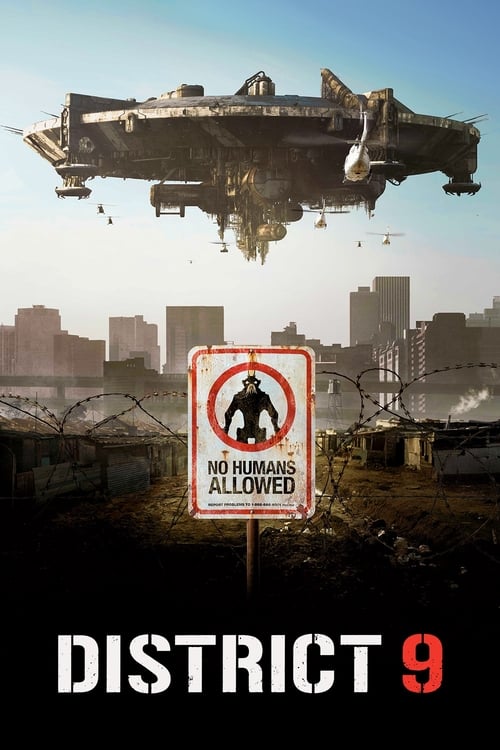
District 9
2009 · Neill Blomkamp
When you want sci-fi that hits hard and means something — an action ride that leaves you arguing about borders, bureaucracy, and who counts as human. Intense and sometimes gruesome, so bring a strong stomach.
What it's about
Twenty-eight years after a massive alien ship stalled over Johannesburg, its stranded insectoid passengers live penned in a militarized slum called District 9, despised by the humans around them and administered by a corporation that cares only about their weapons technology. Wikus, a cheerfully clueless company bureaucrat, is put in charge of evicting them — until an accident during the operation exposes him to a strange fluid, and his own body begins turning him into exactly what he's been rounding up.
The experience
Starts as a deadpan mockumentary, then tightens into visceral body horror and full-throttle action — funny, gross, thrilling, and genuinely upsetting, often in the same scene. The political anger never gets in the way of the momentum; it fuels it.
Performances
Sharlto Copley, in his first major screen role and largely improvising, is astonishing as Wikus — a smug petty official who earns your sympathy inch by agonizing inch. It's one of the great transformation performances in modern genre film.
The craft
Blomkamp fuses documentary handheld grit with photoreal creature effects so seamless the aliens simply seem to live in the frame, all on a fraction of a blockbuster budget. Shot in real Johannesburg periphery locations, it looks and sounds tactile and grimy in a way studio sci-fi rarely does — and the weapons effects reward good speakers.
Why it matters
A surprise Best Picture nominee that proved socially charged, effects-driven sci-fi could come from outside Hollywood on a modest budget, launching Blomkamp and Copley and reshaping expectations for what genre allegory could do at multiplex scale.
Snapshot
A South African science fiction film that recasts apartheid-era forced removal as alien internment, District 9 arrived as one of the rare genre films of its decade to be simultaneously a popcorn spectacle and a rigorous political allegory. Shot on a modest budget of approximately $30 million against the deteriorating post-industrial periphery of Johannesburg, it introduced director Neill Blomkamp to international audiences and demonstrated that socially urgent science fiction could thrive outside the Hollywood studio system's center of gravity. The film is formally audacious — beginning as a mockumentary, then dissolving that frame under mounting body-horror pressure — and its central conceit, the bureaucratic "resettlement" of a stateless alien population, carries the specific weight of South African history while reaching far enough beyond it to feel universal.
Industry & production
District 9 traces a production arc nearly as strange as its narrative. Blomkamp's 2005 short film Alive in Joburg — made in Cape Town, mixing stock documentary footage of South African social conditions with digital alien imagery — attracted the attention of Peter Jackson, who had been seeking a director for a planned live-action Halo adaptation. When that project collapsed in pre-production amid studio disputes between Fox and Universal in 2006, Jackson redirected his confidence in Blomkamp and offered to produce an expanded feature based on Alive in Joburg. The resulting film, financed through Jackson's WingNut Films and TriStar Pictures with Sony handling distribution in some markets, was budgeted at roughly $30 million — modest by the standards of effects-intensive genre filmmaking. Shooting took place principally in and around Johannesburg, most notably in the Chiawelo township in Soweto and in derelict industrial zones that served as the physical world of District 9 itself. The production's use of real locations inhabited by real communities created a documentary texture that no soundstage could have approximated, and also generated some controversy around the representation of Nigerian characters in the film. The film grossed approximately $210 million worldwide, an extraordinary return on investment that confirmed the commercial viability of low-budget socially inflected science fiction.
Technology
Visual effects were handled by WETA Digital, the Wellington-based facility whose work on the Lord of the Rings trilogy had established it as a world-class house. The "prawns" — the film's alien beings — are entirely CG creations, yet the integration of digital creatures into handheld, naturalistic photography was accomplished with a cohesion that had rarely been achieved at that price point. The relatively small budget required WETA to develop efficient rendering and compositing pipelines to embed convincing alien bodies into fly-on-the-wall footage; the aliens had to read as physically present on cracked asphalt and under harsh South African light rather than floating in composited space. The alien technology — weapons, spacecraft, and Christopher's accumulated materials — was designed with a functional aesthetic markedly different from the sleek iconography of most Hollywood science fiction, presenting artifacts that looked salvaged, arcane, and biological. This design philosophy reinforced the film's anti-triumphalist view of technology: advanced instruments of power controlled not by their makers but by corporate interests. The MNU exoskeleton that appears in the climax is a predecessor of the mechanized-suit imagery that would pervade action cinema in the following decade.
Technique
Cinematography
Trent Opaloch served as director of photography. The film opens in a register of strict documentary verisimilitude — handheld cameras, crash-zoom, surveillance and news-footage aesthetics — before gradually migrating toward a more kinetic, constructed visual language as the plot's allegorical machinery engages. Opaloch works in harsh, bleached daylight through much of the first half, with the overexposed platinum sky of the highveld lending the township sequences an ethnographic rawness. As Wikus's transformation progresses, the lighting grows more expressionistic and the framing more conventionally cinematic without entirely abandoning the tactile shakiness established at the outset. This formal drift mirrors Wikus's own disintegrating subject position: the documentary frame that once positioned him as an unremarkable functionary can no longer contain what he is becoming.
Editing
Julian Clarke edited the film. The editing architecture moves from the associative, interview-interspersed rhythms of observational documentary in the opening act — cutting between MNU archival material, news segments, witness accounts, and present-tense observational footage — to punishing action editing in the film's second half. Clarke's achievement is in managing the seams between these registers without losing the audience. The pace accelerates around the midpoint and does not relent, but the transition feels organic rather than jarring because it tracks the subjective experience of a character losing control of his own story.
Mise-en-scène / staging
Blomkamp makes ruthless use of the material reality of Johannesburg's outer zones. The sprawl of the District 9 camp — its improvised shelters, corrugated metal, garbage accumulations, the cat-food that the prawns inexplicably crave — functions as a citation of actual South African informal settlements, and the film does not glamorize or aestheticize poverty. The alien dwelling spaces are rendered as extensions of the township's precarity rather than as alien wonders, which is precisely the point. The MNU offices and processing centers, by contrast, are rendered in the flat, fluorescent aesthetic of mid-level bureaucracy: cubicles, clipboards, lanyards. The mise-en-scène consistently refuses the spectacular in spaces associated with human institutional power, reserving the visually arresting material for the alien and the abject.
Sound
Clinton Shorter composed the score. The music draws on African sonic vocabularies — low brass, massed percussion, what appear to be elements from South African popular and ceremonial traditions — without deploying them exoticistically. The score supports the film's tonal balancing act between documentary flatness and genre propulsion, often arriving late in scenes, allowing the ambient world to carry its own acoustic weight first. The sound design gives considerable attention to the alien language, developed as a series of clicks and vocalizations that register as expressive and specific rather than merely alien gibberish, and to the distinctive reports of the alien weapons technology, which have a wet, biological quality distant from conventional firearm sound design.
Performance
Sharlto Copley plays Wikus van de Merwe in what was effectively his feature acting debut — he had collaborated with Blomkamp on short projects and commercials but had not appeared as a lead in a theatrical release. The performance is a sustained piece of comic-to-tragic modulation: Wikus begins as an almost satirically banal company man, comfortably mediocre, and Copley plays the early material with a cringing likability that makes his enthusiastic complicity in the evictions all the more damning. As the transformation accelerates, Copley shifts into registers of panic, self-pity, and finally something like genuine grief and solidarity. The performance only works because the first act establishes Wikus as a type — the ordinary man who does extraordinary harm through cheerful bureaucratic compliance — before forcing the audience to watch that type crack open.
Narrative & dramatic mode
The film is structured as an interrupted documentary, beginning with the conceit that we are watching post-event archival material — interviews, institutional footage, news reconstructions — before the narrative pulls away from that framing and becomes a conventional third-person thriller. This formal structure mirrors Franz Kafka in its basic situation (a man ensnared by a bureaucratic apparatus he served, stripped of his standing and his body) and echoes David Cronenberg's body-horror inflection of identity crisis. Wikus's transformation is physically repulsive and dramatically clarifying: forced by circumstance into empathy with those he has oppressed, he becomes legible as a moral subject only in extremis. The film does not offer the transformation as redemption in any comfortable sense — the ending withholds reunion and resolution, leaving Wikus in an ambiguous state of becoming.
Genre & cycle
District 9 belongs to a cycle of socially allegorical science fiction that intensified in the mid-2000s, including Alfonso Cuarón's Children of Men (2006) and — further back — the tradition of apartheid-era speculative fiction in South African letters. It explicitly recodes first-contact and alien-internment tropes through the grammar of refugee displacement and racialized population management. The film also participates in the found-footage / mockumentary cycle that had been gathering momentum since The Blair Witch Project (1999) and Cloverfield (2008), though it uses the documentary frame more strategically than either, as an ideological container to be ruptured rather than a sustained aesthetic commitment. It shares the body-horror subgenre with Cronenberg's The Fly (1986) — the involuntary metamorphosis that estranges the protagonist from his own humanness — and the action-thriller genre with the late-period Johannesburg as urban dystopia.
Authorship & method
Neill Blomkamp co-wrote the screenplay with Terri Tatchell, adapting and expanding the social and narrative premises of Alive in Joburg into feature-length form. Blomkamp's method is one of location saturation: he works with environments that carry political and historical memory and allows that memory to saturate the genre machinery. His training in visual effects and commercial direction is evident in his command of the integration of digital imagery into practical space, and in a tendency to lead with visual concept — the alien shantytown, the bureaucratic eviction notice, the alien exosuit — and build dramatic logic outward from the image. Peter Jackson's producing hand is largely invisible in the finished film; Jackson functioned primarily as enabler rather than shaper, providing the institutional support and WETA access that made the film possible without imposing the narrative scale of his own work.
Movement / national cinema
District 9 is an anomalous object in the landscape of South African cinema: internationally financed and globally distributed, yet anchored with unusual specificity to South African geography, history, and social texture. It arrived during a period of intensified global attention to post-apartheid South Africa and contributes to a set of post-apartheid cultural negotiations around how to represent racial geography and state violence. The film's allegorical displacement — aliens for black South Africans displaced by apartheid's forced removals, most pointedly recalling the destruction of District Six in Cape Town — was received with considerable ambivalence within South Africa, where some critics argued that the displacement of race onto extraterrestrial otherness diffused rather than confronted the historical record, while others read the allegory as pointed and effective. The critical debate around the film's Nigerian characters — depicted through criminal and predatory stereotypes — represents a genuine unresolved tension in its postcolonial politics.
Era / period
The film is a product of the late 2000s moment in which digital effects had become affordable enough to permit genre filmmaking at the margins of the studio system, and in which the documentary aesthetic had been so thoroughly absorbed by popular culture — through reality television, YouTube, and a decade of post-Blair Witch found footage — that it could function as a generic frame legible to mass audiences. It also belongs to the post-9/11 cycle of genre films preoccupied with detention, displacement, and the administrative violence of state and corporate institutions, a thematic cluster visible across the science fiction and thriller output of the decade.
Themes
The film's allegorical architecture is organized around the experience of forced displacement and the bureaucratic apparatus that administers it. The "resettlement" of the prawns from District 9 to District 10 explicitly echoes the forced removal of black South Africans under the Group Areas Act, and the film is specific about the language of that process: the paperwork, the consent forms, the cheerful corporate branding of population management. Corporate exploitation of alien bodies and technology extends the allegory toward extractive capitalism. Wikus's transformation functions as a narrative mechanism for obligatory empathy — the oppressor compelled to occupy the position of the oppressed — and the film is clear-eyed about the limitations of that mechanism, showing Wikus's solidarity as coerced, impure, and incomplete rather than earned. Xenophobia as a social pathology is treated not as the aberration of individual bigots but as systemic, institutionalized, and banal. The film's persistent interest in bodily abjection — the alien food, the alien biology, Wikus's hybrid flesh — connects political exclusion to the category of the disgusting, to a politics of the body that determines whose embodiment is tolerable.
Reception, canon & influence
District 9 was received with strong critical enthusiasm on its release, praised for the ambition of its allegorical project and the formal ingenuity of its documentary-to-thriller transition. It received four Academy Award nominations — Best Picture, Best Adapted Screenplay, Best Film Editing, and Best Visual Effects — a remarkable recognition for a debut feature at its budget level, and the Best Picture nomination, in the expanded field introduced that year, registered as a validation of socially engaged genre filmmaking. Commercially, the film's performance vindicated the low-budget prestige science fiction model.
Backward influences are legible in the film's formal DNA: Alive in Joburg is the direct source; Children of Men offers a model for realist-inflected political sci-fi; Cronenberg's The Fly shapes the body-horror register; cinéma vérité and observational documentary traditions underwrite the film's opening aesthetic; and South African literature and the historiography of apartheid forced removals provide the allegorical frame.
Forward influence is harder to measure precisely. Blomkamp's subsequent features — Elysium (2013) and Chappie (2015) — extended his interest in South African geography and social allegory into diminishing commercial and critical returns, suggesting that the first film's coherence was partly a product of its specific context and scale. More broadly, District 9 is one of the films that established the commercial credibility of the low-budget socially allegorical blockbuster that would proliferate in the following decade, a form in which Jordan Peele's work represents the most critically acclaimed development. The film's mockumentary-to-genre sliding form has influenced a range of genre hybrids, and its alien design aesthetic — organic, functional, unglamorous — perceptibly shifted the visual vocabulary of science fiction creature design. A sequel has been discussed intermittently since 2009; as of this writing, none has been produced.
A Deleuzian reading
He's grinning at the camera.
The full Deleuzian reading of District 9 →
Reception
A $30M sleeper that stormed the 2009 summer and rode all the way to a Best Picture nomination — rare air for sci-fi. Now it's remembered as Blomkamp's lightning-in-a-bottle moment, the film each of his follow-ups gets measured against and hasn't matched.
How District 9 was received, from release to now →
Influences: the films it descends from and the films it influenced
- Alive in Joburg (2005) — District 9 directly expands this short's core formal devices: the interview-format mockumentary intercutting with fictional narrative, VFX compositing of aliens into handheld documentary footage shot in actual Johannesburg townships, and the alien-as-forced-removal allegory are transplanted wholesale into feature form.
- The Fly (1986) — Blomkamp inherits Cronenberg's body-horror grammar of involuntary interspecies transformation charted through escalating practical makeup and effects work, using the protagonist's physical deterioration as the dramaturgical engine for simultaneous psychological dissolution and audience empathy transfer.
- Children of Men (2006) — Emmanuel Lubezki's vérité deep-focus handheld cinematography—which integrates VFX-heavy action sequences into documentary-grammar long takes without clean compositional framing—provides the direct cinematographic template for Blomkamp's approach to shooting township action sequences without a heroic clean frame.
- Man Bites Dog (1992) — Established the mockumentary device in which the documentary camera crew becomes morally complicit in the violence it observes; District 9's MNU film teams shadowing evictions and Wikus's coerced participation in alien extermination directly inherit this grammar of complicit witnessing that implicates the observational form itself.
- The Battle of Algiers (1966) — Pioneered documentary formal grammar—non-professional actors, location shooting at actual sites of colonial violence, faux-newsreel texture—to stage a narrative about forced population control and institutional dehumanization, establishing the template for using pseudo-documentary form to make political allegory about state displacement feel like historical record.
- Alien Nation (1988) — Established the genre convention of extraterrestrial arrival as racialized immigrant allegory with bureaucratic processing and slum-segregation of alien arrivals; District 9 radicalizes this premise by replacing the buddy-cop delivery mechanism with documentary form and historically specific South African apartheid geography.
- RoboCop (1987) — Demonstrated how satirical genre filmmaking can deploy the documentary language of corporate communications—institutional memos, bureaucratic signage, corporate PR rhetoric—as the primary vehicle for political critique; MNU's eviction notices, administrative paperwork, and bureaucratic euphemism in District 9 apply this device directly.
- Cloverfield (2008) — Demonstrated mainstream audience appetite for sustained handheld found-footage documentary grammar within a monster-genre framework, validating the formal gamble District 9 would extend; but Cloverfield's single-register found-footage commitment makes the comparison reveal District 9's more ambitious formal register shift from documentary interview mode to cinematic third-person.
- Aliens (1986) — Blomkamp translates Cameron's corporate-indifference-as-plot-driver into an apartheid allegory, using the same monstrous-sympathetic inversion (the bug becomes the victim of bureaucratic violence) and the identical institutional-failure structure — the company that sends Wikus in is the same species of antagonist as Weyland-Yutani — while replacing Cameron's clarity-first editing with found-footage disorientation.
- The Host (2006) — Fuses documentary-register photography and satiric institutional mise-en-scène to a creature premise, making bureaucratic indifference the real antagonist exactly as The Host makes the quarantine state its true monster.
- Minority Report (2002) — Extends the design-fiction method: a meticulously prototyped near-future built from consultant research and faux-functional technology, plus the surveillance-and-control state apparatus as the SF subject.
- Starship Troopers (1997) — Builds its whole structure on the mock-broadcast insert — faux-documentary news segments, corporate PSAs, and interview cutaways frame the action exactly as the Federal Network does.
- Monsters (2010) — Extends District 9's location-saturation alien-presence method to Central American border terrain, using non-professional actors and actual locations to ground alien co-existence in geopolitical specificity; the anti-spectacular alien design—unglamorous, ecologically integrated, present in the landscape rather than arriving to destroy it—directly extends the visual grammar Blomkamp established.
- Chronicle (2012) — Applies District 9's specific structural device—a documentary frame that ruptures into cinematic action grammar—to the superhero origin story, including the transition from diegetic handheld camera-as-character to free-floating cinematography at the climactic action sequence, extending the interrupted documentary frame as a formal unit.
- Attack the Block (2011) — Grounds alien-invasion genre spectacle in a specific underclass milieu—South London council estate—as political grammar rather than backdrop, applying District 9's principle that non-spectacular location carries ideological content; also inherits the comic-register ensemble performance that modulates into genuine dramatic stakes as the film develops.
- Elysium (2013) — Direct authorial continuation of the location-saturation method—Iztapalapa, Mexico City as the functional equivalent of Soweto—with WETA Digital exosuit and robot work extending the organic-functional creature aesthetic; the weaker formal coherence retroactively reveals how much District 9's structure depended on the discipline imposed by its short-film origin.
- Get Out (2017) — The most critically developed extension of District 9's coerced-empathy mechanism: both films engineer genre situations that force a predominantly white audience into prolonged identification with a protagonist being systematically othered and physically violated by institutional power, using genre conventions to make that empathy structural rather than voluntary.
- Chappie (2015) — Returns to Johannesburg with the same slum-location aesthetic, deploying Die Antwoord's zef-rap sonic world as the South African cultural vocabulary equivalent to District 9's township ambience and kwaito; but the comic-to-tragic performance modulation is never coherently calibrated, revealing by contrast how precisely District 9 timed Wikus's tonal arc.
- Hope (2026) — Proved a non-Hollywood mid-budget vendor could integrate photoreal creatures into handheld documentary-grade daylight plates, and framed first contact as a bureaucratic mistranslation in which the paperwork, not the alien, is the violence.
- Tsotsi (2005) — The South African township film that demonstrated to international distributors that Soweto's built environment could carry full dramatic and symbolic weight without scenic augmentation; Blomkamp's staging method of using actual slum locations as environments that generate political meaning through their material presence shares this commitment to location as content.
- Disclosure Day (2026) — Fuses corporate/institutional conspiracy with a whistleblower-on-the-run protagonist via mockumentary disclosure, a ground-level institutional-distrust variant of the same first-contact material.
- Godzilla Minus One (2023) — Blomkamp achieved Hollywood-scale VFX on a $30M budget by keeping effects development tightly integrated within a small in-house team rather than farming to vendors — the production methodology that directly parallels Yamazaki's micro-VFX approach — while embedding the spectacle within a civilian-protagonist-against-institutional-abandonment narrative structure.
- Bacurau (2019) — Sibling in Global-South genre hybridity: grafting sci-fi surveillance-drone iconography onto a concrete politics of dispossession and militarized outsiders.
Similar films
- Elysium (2013) — influence & lineage
- Chappie (2015) — influence & lineage
- RoboCop (1987) — influence & lineage
- Disclosure Day (2026) — influence & lineage
- Colony (2026) — shared sensibility
- Annihilation (2018) — shared sensibility
- Starship Troopers (1997) — shared sensibility
- War of the Worlds (2005) — shared sensibility