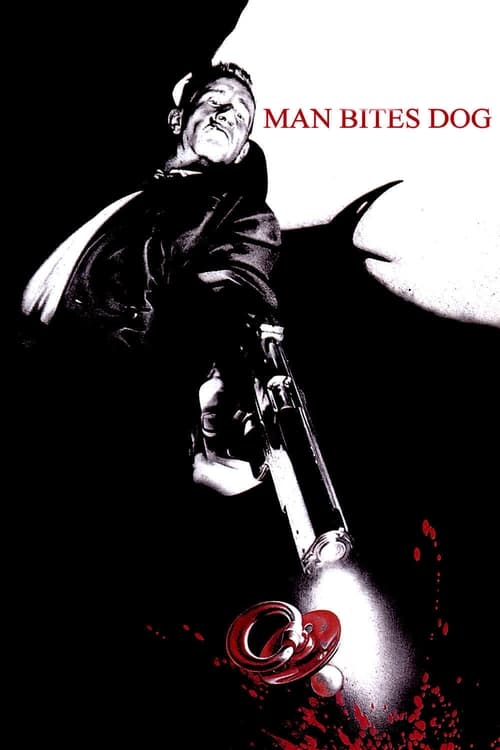
Man Bites Dog
1992 · Rémy Belvaux
For when you want transgressive, provocative cinema with teeth — the kind of cult film you show someone to watch their jaw drop. Strictly for strong stomachs; the discomfort is the point.
What it's about
A small documentary crew follows Ben, a charming, endlessly opinionated serial killer, as he goes about his work — chatting to camera about music, architecture, and technique between murders. The longer they film, the more the crew slides from observers into accomplices. It's a pitch-black Belgian comedy about our appetite for filmed violence, aimed squarely at the people holding the camera — and the people watching.
The experience
Shocking and genuinely funny in a way that makes you feel complicit for laughing — which is precisely the trap it's setting. Fast, scrappy, and increasingly nasty as the joke curdles; it's designed to leave you queasy about your own spectatorship.
Performances
Benoît Poelvoorde is astonishing as Ben — motor-mouthed, vain, weirdly likable — a charm offensive so complete it becomes the film's most damning accusation.
The craft
Made by three film-school graduates on grainy black-and-white 16mm, playing themselves as the crew, it weaponizes the documentary look decades before found-footage became a genre staple. The handheld rawness makes every scene feel captured rather than staged, which is exactly what makes it so uncomfortable.
Why it matters
A scandal at Cannes and an enduring cult landmark, it anticipated the ethics debates around true-crime entertainment and reality TV by decades, and remains a touchstone for every film about a camera crew getting too close to its subject.
Snapshot
Man Bites Dog (French: C'est arrivé près de chez vous, literally "It Happened in Your Neighbourhood") is a Belgian black-comedy mockumentary in which a film crew follows a glib, garrulous serial killer named Ben as he goes about his murders, and is gradually drawn from observation into complicity and participation. Shot in grainy black-and-white 16mm by a trio of recent film-school graduates, it remains one of the sharpest and most disturbing satires ever made on the ethics of documentary spectatorship and the appetite for mediated violence. Its premise — the camera that records atrocity and is implicated by the recording — was provocative in 1992 and has only become more legible in the decades of reality television, true-crime entertainment, and viral footage that followed. The film is at once a formal stunt, a vicious comedy, and a moral argument, and its lasting reputation rests on how completely those three registers are fused.
Industry & production
The film originated as a student project. Its three principal makers — Rémy Belvaux, André Bonzel, and Benoît Poelvoorde — met through the Belgian film milieu around INSAS (the Institut National Supérieur des Arts du Spectacle in Brussels), and the production carries the marks of its scrappy, self-financed origins. It was made on a famously minuscule budget, with the filmmakers reportedly exhausting their resources during the shoot and stretching production over an extended period as money was raised piecemeal; precise figures vary across accounts, so the exact budget is best treated as approximate. The decision to shoot in black-and-white 16mm was as much economic as aesthetic — cheap stock, available light, a small crew doubling as the film's diegetic crew.
What transformed the project from a curiosity into a phenomenon was its reception at the 1992 Cannes Film Festival, where it screened in the International Critics' Week (Semaine de la Critique) sidebar and won multiple prizes there, including recognition from the international critics and a youth prize; it subsequently took the André Cavens Award from the Belgian Film Critics Association. That festival validation secured distribution well beyond what a no-budget Belgian student film could otherwise expect. In the United States it was picked up for theatrical release and ran into the ratings system: the MPAA assigned it an NC-17, and the film circulated in both cut and uncut forms, its commercial reach in the U.S. limited by the rating and by its content. It later became a catalog title in the Criterion Collection on home video, which cemented its standing as a canonical art-house provocation rather than a mere shock object.
Technology
The technological choices are inseparable from the film's argument. It was photographed on 16mm black-and-white film with portable, largely handheld equipment and synchronized location sound — the toolkit of observational documentary and television news rather than of fiction features. This is the point: the film impersonates the technology of nonfiction. The visible apparatus — the boom microphone that occasionally dips into frame, the crew members who appear when the "documentary" turns its camera on itself, the reliance on available and practical lighting — is the realism the film both exploits and interrogates. There are no opticals or effects spectacle; the violence is staged for a camera that is meant to read as a real, present recording device. The grain, the contrast, and the imperfections of the format do the work of authentication, persuading the viewer that what is seen has the evidentiary weight of footage.
Technique
Cinematography
André Bonzel's camerawork is the film's central formal instrument. It adopts the grammar of direct cinema — handheld framing, reframing on the fly to catch action, the camera trailing Ben or planted while he addresses it directly — so that the image always asserts itself as something captured rather than composed. The black-and-white photography lends a documentary austerity and a newsreel coldness, draining the violence of any genre gloss. Crucially, the camera is a character: its position implies a crew, its movements imply decisions, and its continued recording during atrocity implies consent. The cinematography's "amateurism" is precisely calibrated — rough enough to read as nonfiction, controlled enough to land each beat of comedy and horror.
Editing
The cutting sustains the fiction of an assembled documentary — interviews, "field" sequences, and to-camera monologues stitched into the shape of a profile piece. The film's most celebrated structural joke is built in the editing and casting of the crew itself: the sound recordists keep being killed and replaced, a running gag that, beneath its grim humor, marks the mounting cost of the crew's proximity to Ben. The pacing modulates between Ben's relaxed, discursive monologues and abrupt eruptions of violence, the editing withholding the cushioning that conventional fiction would supply. As the crew's complicity deepens, the rhythm tightens and the comic distance collapses.
Mise-en-scène / staging
The staging is documentary-naturalistic: real apartments, streets, bars, and a quarry or waterside for body disposal; non-actors and the filmmakers' own associates filling out the world. The most discussed staging concerns Ben's family — his mother and grandparents are played by Benoît Poelvoorde's actual relatives, lending the domestic scenes an uncanny authenticity. Ben is staged as a man entirely at ease in ordinary settings, which is the horror of it: the dinner tables, the housing-estate conversations, the casual demonstrations of technique all unfold in unremarkable spaces that the violence then contaminates.
Sound
Sound is foregrounded both diegetically and thematically. The synchronized location audio reinforces the nonfiction texture, and the boom operator's literal presence — and repeated death — turns sound recording into a recurring motif and morbid punchline. Music is used sparingly and largely from within the world of the film; the most memorable musical material is associated with Ben himself, including a recurring waltz-like piano motif and his recitations, which characterize him as a would-be aesthete and sentimentalist. (Detailed credits for the score are not widely documented in English-language sources; the precise authorship of the musical material is one area where the public record is thin, and it should not be overstated.)
Performance
Benoît Poelvoorde's performance as Ben is the film's engine and its most consequential legacy. He plays the killer as a voluble raconteur — charming, opinionated, pedantic about his methods, full of pet theories about architecture, music, low-income housing, and the proper ballast for sinking bodies. The performance is genuinely funny, which is exactly what makes it indicting: the viewer's laughter becomes evidence of the same fascination that keeps the crew filming. Poelvoorde sustains an extraordinary register of relaxed menace and comic self-regard, and the role launched a major career in Belgian and French cinema. The supporting performances — including the filmmakers themselves as the crew — are pitched to documentary naturalism rather than theatricality.
Narrative & dramatic mode
The film's mode is the faux documentary, or mockumentary, deployed for horror and satire rather than affectionate parody. Its dramatic engine is not plot in the conventional sense but the steadily eroding boundary between observer and participant. The crew begins as ostensibly neutral chroniclers; by degrees they accept Ben's hospitality, his money, his logistical help, and finally join in his crimes — a moral slide rendered as procedural inevitability. The most notorious sequence, a home-invasion assault, is the point of no return at which the documentary alibi collapses entirely and the camera's neutrality is exposed as a lie. The arc is tragic and self-consuming: complicity is contagious, and the film proposes that nobody holding the camera — and by extension nobody watching — is exempt.
Genre & cycle
Man Bites Dog sits at the intersection of black comedy, crime film, and horror, executed through the documentary-hoax form. It belongs to an early-1990s moment of intense interest in the serial killer as a cultural figure and in the faux-documentary as a vehicle for critique. It can be located within a lineage of mock-documentaries that turn the form's truth-claim against the audience, and within a serial-killer cycle that includes the bleak of clinical realism in Henry: Portrait of a Serial Killer (1986). Where many films of the cycle invite identification with the killer through style, Man Bites Dog makes that identification its explicit subject, anticipating the self-reflexive media satires that proliferated mid-decade.
Authorship & method
Although the grounding credit here lists Rémy Belvaux as director, the established record is that Man Bites Dog was a genuinely collective authorship by three collaborators who shared writing and directing duties: Rémy Belvaux, André Bonzel, and Benoît Poelvoorde. Belvaux is generally treated as the principal directorial and structuring intelligence and a co-writer; Bonzel served as cinematographer and co-author; Poelvoorde co-wrote and gave the central performance as Ben. The film grew out of their shared film-school formation and was developed and produced largely outside the established industry, with the trio also taking on the on-screen roles of the documentary crew — a method that literalizes the film's theme by making the real filmmakers the fictional accomplices. This fusion of maker and subject is the method's signature: the satire of complicity is enacted, not merely depicted. The collaboration did not produce a comparable second act for the group together, and Belvaux died in 2006; the film stands as the defining work of all three careers, and especially as the springboard for Poelvoorde's subsequent stardom.
Movement / national cinema
The film is a product of French-language Belgian (Walloon) cinema and of its Brussels film-school culture. Belgian cinema of this period is often characterized by a taut realism on one hand — the milieu that would shortly produce the Dardenne brothers' international breakthroughs — and by a strain of deadpan absurdism and dark surrealism with deep roots in Belgian culture on the other. Man Bites Dog draws on both: the unsentimental, observational realism of its surface and a mordant, transgressive humor beneath it. It is frequently cited as one of the key Belgian films of the 1990s and as evidence of a small national cinema producing outsized, formally daring work on minimal means.
Era / period
Made and released in the early 1990s, the film is a pre-internet artifact that nonetheless reads as eerily prophetic. It arrived as observational "reality" formats were emerging on television and as the serial killer was consolidating as a pop-cultural fixation. Its core anxiety — that the act of recording confers neither innocence nor distance, and that audiences are morally entangled in what they consume — would become a defining concern of the subsequent media decades. Watched today, against a backdrop of reality television, true-crime as mass entertainment, and the casual circulation of real violence online, the film's argument has lost none of its force; if anything its period specificity has given way to a disquieting universality.
Themes
The governing theme is complicity — the moral status of the witness. The film argues that to record is to participate, that the neutral observer is a convenient fiction, and that the spectator's fascination (registered as laughter and continued attention) is itself implicating. Secondary themes include the spectacle and commodification of violence; the seductiveness of the charismatic monster, whose wit and cultural pretension function as camouflage; and the banality of evil staged within wholly ordinary settings — apartments, family dinners, conversations about housing and money. The crew's escalating involvement dramatizes how institutional or professional alibis ("we're just documenting") dissolve under proximity and incentive. Beneath the comedy runs a bleak thesis about how easily ordinary people are recruited into atrocity once they have agreed to keep watching.
Reception, canon & influence
Critically, the film was a succès de scandale: lauded at Cannes for its audacity and intelligence while dividing viewers over the morality of its extreme content — a division the film itself anticipates and arguably engineers, since discomfort is the intended response. Its NC-17 rating in the U.S. both limited and amplified its notoriety, and its later canonization through art-house repertory and a Criterion home-video release confirmed its standing as a landmark provocation rather than a passing shock.
Looking backward, the film's influences include the observational grammar of direct cinema and cinéma vérité, the mockumentary's manipulation of the documentary truth-claim, and the clinical serial-killer realism exemplified by Henry: Portrait of a Serial Killer; one can also situate it within a longer tradition — reaching back to Peeping Tom (1960) — of films that implicate the viewer in the act of looking at violence.
Looking forward, Man Bites Dog is routinely invoked as a touchstone for media-violence satire and for the found-footage and faux-documentary horror that expanded later in the decade and beyond. It is frequently mentioned alongside the mid-1990s wave of films interrogating violence-as-spectacle and audience complicity. Direct, documented lines of causal influence on specific later films should be asserted cautiously — much of the connection is one of shared concern and critical comparison rather than acknowledged debt — but the film's status as an early, uncompromising statement of the "the camera is complicit" thesis is secure, and it remains a fixture in discussions of mockumentary, transgressive cinema, and the ethics of spectatorship.
A Deleuzian reading
Ben wades into the water at a quarry and explains, with the dry helpfulness of a man sharing a hobby, exactly how much ballast it takes to sink a body — adjusted for build, for children, for the season.
The full Deleuzian reading of Man Bites Dog →
Reception
It arrived at Cannes 1992 as a scandal — walkouts, an NC-17, bans in some countries — but three decades on it's a Criterion-canonised classic, routinely cited as the mockumentary that got to the media-violence question before Natural Born Killers did.
How Man Bites Dog was received, from release to now →
Influences: the films it descends from and the films it influenced
- Peeping Tom (1960) — Establishes the camera-as-weapon conceit in which the act of filming is itself the act of killing, forcing the audience into the killer's optical point of view and indicting the pleasure of looking.
- Titicut Follies (1967) — Models the narration-free observational direct-cinema grammar — long handheld takes, no music, no authorial commentary — whose 'neutral' camera Man Bites Dog weaponizes by attaching it to a murderer.
- David Holzman's Diary (1967) — Pioneers the fully scripted mockumentary that adopts cinéma-vérité's first-person truth-claim and then betrays it, with the filmmaker-character collapsing the line between observer and subject.
- The Battle of Algiers (1966) — Supplies the newsreel-realist staging of violence using grainy reportage textures and nonprofessional casting so that fiction is mistaken for recovered documentary footage.
- Punishment Park (1971) — Plants a fictional documentary crew inside escalating real-feeling violence, its vérité handheld camera becoming a passive accomplice that records atrocity without intervening.
- Cannibal Holocaust (1980) — Originates the recovered-footage conceit in which a film crew's own camera implicates them as perpetrators, making documentary apparatus the engine of the horror.
- Henry: Portrait of a Serial Killer (1986) — Provides the flat, clinical, deglamorized realism of serial murder — banal affect, naturalist lighting, casual brutality — that Man Bites Dog adopts and then turns into deadpan comedy.
- This Is Spinal Tap (1984) — Codifies the comic mockumentary method of an on-screen documentary crew interacting with improvising subjects, the deadpan interview-plus-vérité structure Man Bites Dog inherits.
- The Vanishing (1988) — The mock-documentary following of a serial killer with a neutral crew gaze extends Sluizer's collaborative-witnessing strategy to its logical conclusion: the camera crew within the fiction becomes explicitly complicit through sustained observation, literalizing the ethical problem Sluizer's documentary remove poses implicitly.
- Camera Buff (1979) — Makes a documentary crew's escalating complicity with the subject it films the moral engine of the piece, weaponizing Amator's insight that pointing a camera is never a neutral act.
- Funny Games (1997) — Extends the 'the audience is complicit' argument by having killers address the camera and manipulate the viewer's expectations, making the spectator's desire for violence the explicit subject.
- The Last Broadcast (1998) — Builds faux-documentary horror from a crew's recovered tapes, exploiting the same documentary truth-claim to make staged death read as authentic record.
- The Blair Witch Project (1999) — Mainstreams the found-footage horror form in which the characters' own handheld camera survives them, descending directly from the crew-as-witness apparatus Man Bites Dog satirized.
- Series 7: The Contenders (2001) — Transposes the complicit-camera satire into a reality-TV mockumentary, framing murder as broadcast entertainment with editing and narration that implicate the viewing audience.
- The Last Horror Movie (2003) — Has a serial killer hijack the documentary form to film and narrate his own murders while directly accusing the viewer of choosing to keep watching.
- Behind the Mask: The Rise of Leslie Vernon (2006) — Embeds a documentary crew with a killer who performs for their camera, literalizing the observer-becomes-participant turn as the crew's neutrality finally collapses into complicity.
- District 9 (2009) — Established the mockumentary device in which the documentary camera crew becomes morally complicit in the violence it observes; District 9's MNU film teams shadowing evictions and Wikus's coerced participation in alien extermination directly inherit this grammar of complicit witnessing that implicates the observational form itself.
- I Saw the Devil (2010) — Established surveillance-as-complicity as a narrative-formal device — the film crew's continued recording of murders implicates them and the audience in the violence they observe without preventing, the structural precursor to I Saw the Devil's GPS-tracking conceit where witnessing without intervening becomes indistinguishable from participation.
- What We Do in the Shadows (2014) — Originates the black-comic 'documentary etiquette' gag — a polite camera crew embedded with a serial killer — that the film reworks as journalists solemnly filming vampires who feed on people.
- One Cut of the Dead (2017) — Absorbs the documentary film crew into the on-screen carnage, making the camera operator a character — the conceit One Cut's opening deploys and then explains.
- Nirvanna the Band the Show the Movie (2026) — Implicates the filming crew itself in the action, dissolving the line between documentarian and participant that Johnson foregrounds by making the show-within-the-show the plot.
- [REC] (2007) — Builds its horror from a TV reporter-plus-cameraman crew whose professional dyad and on-camera address organize every shot, the exact Ángela/Pablo working relationship [REC] adopts.
- Natural Born Killers (1994) — Shares the mid-90s thesis that media frames and feeds the appetite for violence-as-spectacle, foregrounding the camera's role in manufacturing the celebrity-killer.
- Benny's Video (1992) — Interrogates the same year how video recording desensitizes and implicates the watcher, using the replayed image of killing as evidence of spectatorial complicity.
- To Die For (1995) — The other early-90s mockumentary that makes the documentary apparatus complicit in the killing — the crew's presence is what the subject performs for, the same causal loop by which Suzanne's murder exists to generate footage.
Similar films
- Funny Games (1997) — influence & lineage
- Henry: Portrait of a Serial Killer (1986) — influence & lineage
- Natural Born Killers (1994) — influence & lineage
- Peeping Tom (1960) — influence & lineage
- The Battle of Algiers (1966) — influence & lineage · often watched together
- La Haine (1995) — often watched together
- Memories of Murder (2003) — often watched together
- The Celebration (1998) — often watched together
All the films related to Man Bites Dog →